COMPARISION OF RESULTS WITH BASE SIMULATION AND IMPROVED SHELL ELEMENT PROPERTIES
COMPARISION OF RESULTS WITH BASE SIMULATION AND IMPROVED SHELL ELEMENT PROPERTIES
AIM:
- The aim is to run the simulation on crash beam model by entering the prescribe simulation parameters.
- Change the elemental properties as mentioned below and compare the results with the base simulation and to check the errors as mentioned
- Studying the output of both the simulation by plotting Rigid wall forces and Energies like internal energy, Hourglass energy, Contact energy and Total energy.
Inputs
Run time – 55ms.
Animation steps – 25 – 60.
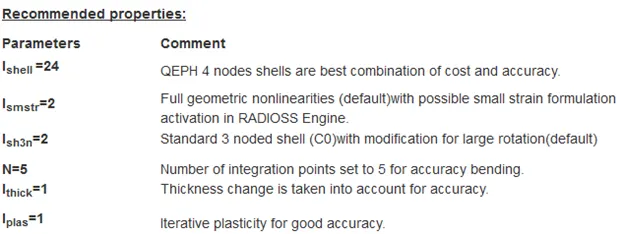
Fig: Elemental properties.
PROCEDURE:
1. Import the given solver deck file to the radioss user profile and edit the Cards to change the run time to 55ms and change ANIM DT – Tf to 2.2 considering step as 25.
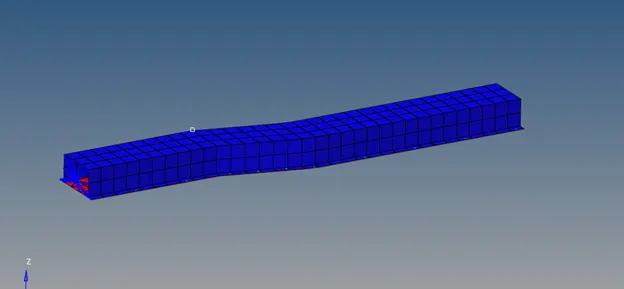
Fig: Imported Model.
2. Export the file and save. Go to Analysis –Radioss_ select the saved starter file and enter the number of threads to 4 and hit radios to run the simulation.
3. Once completed check the engine file output for energy errors and mass errors.
4. Change the hypermesh to hypergraph 2D and select the T01 file in order to plot the graph.
5. Select the Global variables – select the required parameters to plot – Mag – Apply.
6. Split the window and minimize the graph, select the same file and but select Rigid wall forces. And plot the required parametrs.
7. If required Plot the Von mises stress as by splitting and cascading to hyperview.
8. Save the file as report template.
9. Repeat the above procedures for improved shell element properties but before the simulation Change the variables from the property card according to the recommended property.
RESULT:
The given model has been simulated with 2 different elemental properties and results are as follows.
1. The Energies like Internal, Hourglass, Contact and Total energy.
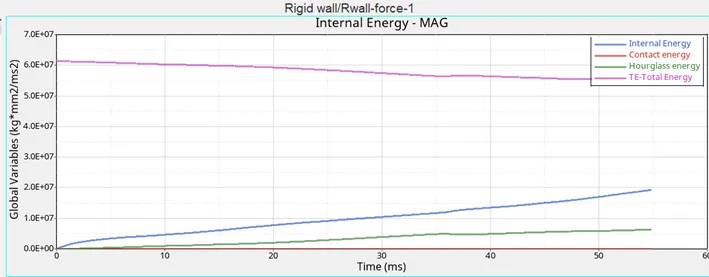
Fig: Results of Default elemental properties.
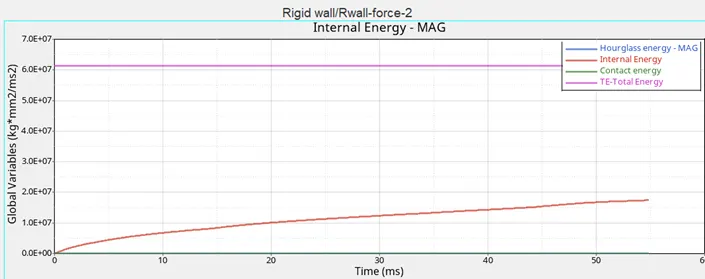
Fig: Results of Improved elemental properties.
By comparing the above graphs the major differences are with the Hourglass energy and Total energy. In both the cases the contact energy was fo
Hourglass energy
- As the deformation starts increasing the hourglass energy increases gradually because the Default elemental property I;e 0- DEF SHELL has a single integration point and the hourglass is managed with perturbation method by slightly changing the material properties thus it makes to increase the hourglass energy.
- Where as in improved elemental property I;e QEPH-4 the hourglass energy is zero because the property of the element has improved 4 noded under integration points and it has physical hourglass stabilization property it thus it avoids the hourglass completely in this case.
Total energy
- The total energy for the default element property varies. At the initial stage when the load is applied, energy will be at its maximum and decreses as the material starts to deform this is due to the energy error in the simulation where the error was found to be varying from 0 to -10.3% .
- The total energy was found to be constant throughout the simulation for the improved elemental property simulation because the energy errors were negligible and close to 0 (found to be 0 to -0.1%) due to the accuracy of this property it’s always preferred in explicit analysis.
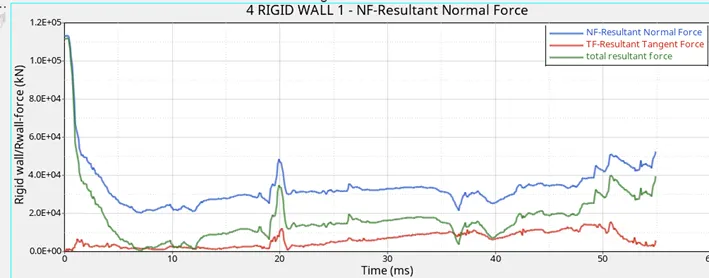
Fig: Results of Default elemental properties.
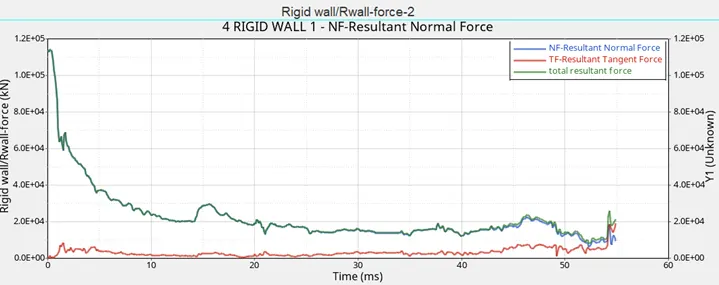
Fig: Results of Improved elemental properties.
Resultant Normal and Tangent force
- For the default elemental properties the resultant force starts decreasing as deformation increases, at 20ms the deformation reaches the center of the beam where the beam is bent so that the internal energy and single integration point the force hikes a bit and reduces accordingly. Because of friction and deformation the tangential force increases a bit.
- The behavior of the beam remains same as of default for the improved elemental properties but might be small variations in the magnitudes which are more accurate than the default elements.
Total resultant force.
- The major differences are with the total resultant force where the total force is lesser than the normal force.
- Where as in the improved elemental properties the total resultant force is equal to the resultant normal force.
Comparison of stress and displacement values
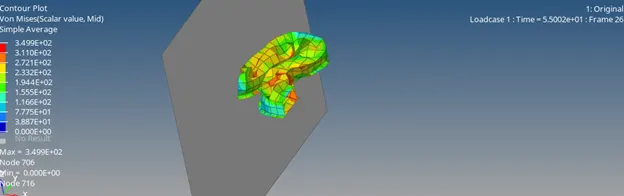
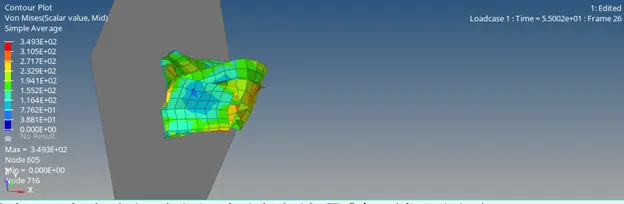
Fig: Von mises Stress (left Default , Right Improved)
The stress values were found to be 3.499e02 for default and 3.493e02 for improved elements.
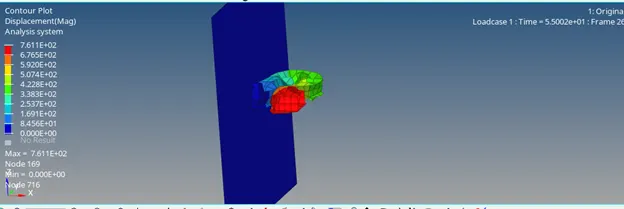
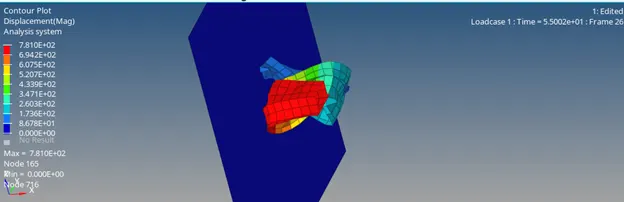
Fig: Displacement (left Default , Right Improved)
The Deformation were found to be 7.611e02 mm for default and 7.810e02mm for improved elements.
Thus it concludes that the improved elemental properties is suitable for the explicit analysis since it gives accurate results.