Advanced Sheet Metal Design Using NX Cad Challenge_5_Odd Shaped Enclosure
MODELLING OF SHEET METAL ODD SHAPED ENCLOSURE
AIM : To design a sheet metal odd shaped enclosure using NX Cad software with suitable commands to achieve the final product as per the inputs.
INTRODUCTION :
Sheet Metal is a type of material that is flattened into thin sheets. Sheet metal is made by taking a large cast in and rolling it into a long ribbon of the thickness it wants. This flat metal is rolled into a coil and sent directly or cut the metal into sheets before being sent to a machine shop.
The sheets are made from metals such as aluminum, brass, copper, steel, tin, nickel, and titanium. The sheet’s thickness depends on the material needed for a project. Thicknesses can vary from 0.15 -6.00 mm significantly; extremely thin sheets are considered foil or leaf, and pieces thicker than 6 mm (0.25 in) are considered plate steel or “structural steel.”
Punching :
- Punch forming is a process of cutting holes or other openings into sheet metal. It is commonly used in the fabrication of custom precision sheet metal parts.
- The process can be performed using a variety of different tools, including hand punches, power presses, and computer numerical control (CNC) punching machines.
-
To create holes and indents in a piece of metal modern sheet metal punching is carried out by using state of the art equipments. The sheet metal being punched is sandwiched between the metal punches and dies.
-
The punch moves downward into the die. This process causes the sheet metal beneath the punch to be sheared from the surrounding material.
-
Small hole size in sheet metal requires smaller size punching tool which may leads to break during the operation. It is recommended that the diameter of the hole should be equal or more than the thickness of the sheet metal.
Die :
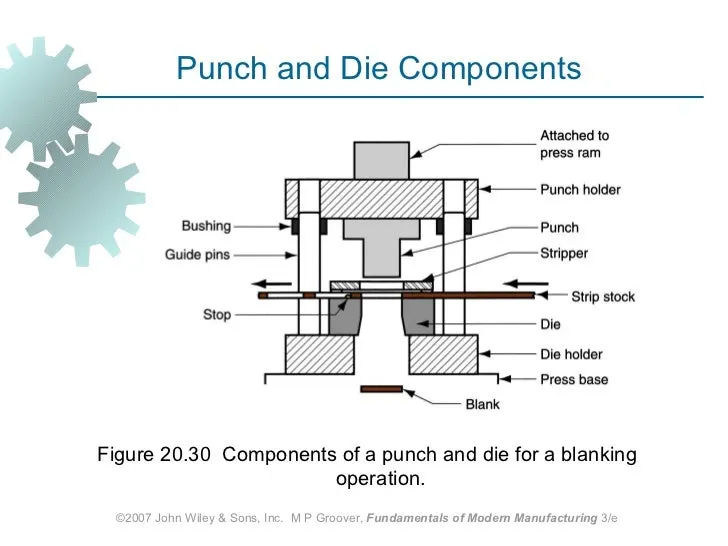
- Sheet metal dies are widely used in the cold forming process. The die stamping presses are used to transform the sheet metal into different sizes and shapes.
- The different types of dies used in sheet metal operations are as follows: 1 #1 Simple Die: If only one operation is performed in One Stroke and at One Stage is called Simple Die. 2 #2 Compound Die: 3 #3 Progressive Die: 4 #4 Transfer Die: 5 #5 Combination
-
The most common application of sheet metal stamping dies, is in the automotive industry. Any automotive component made from sheet metal is generally made in a metal stamping die. Perhaps the second largest application is in house hold consumer goods, such as dish-washers and clothes washing machines.
-
The die stamping presses are used to transform the sheet metal into different sizes and shapes. Pieces of flat sheet metal, which is also referred to as the blanks, are fed into the sheet metal stamping press wherein there is a set of tool and die surface which helps give it the desired shape and form.
-
A die is a specialized tool used in manufacturing industries to cut or shape the material mostly using a Press. Like molds, dies are generally customized to the item they are used to create. Products made with dies range from simple paper clips to complex pieces used in advanced technology.
Cutting :
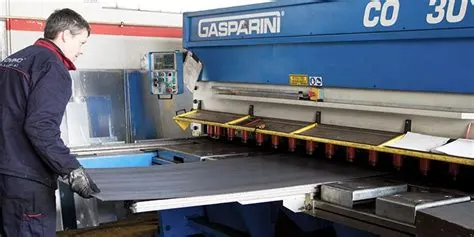
Sheet steel is cut by a shearing method that was used a lot before being replaced by faster and precise methods. A punch press is used to punch and die sets to cut the metal. It is effective for cutting simple parts which is then cut with a laser or a water jet.
It operates at hundreds of strokes per minute; a punch press makes suitable parts quickly. Punching is used to make holes or other cutouts in parts. The creation of a complex flat pattern with size-limited stamped features is done through laser cutting and combining punch.
Bending :
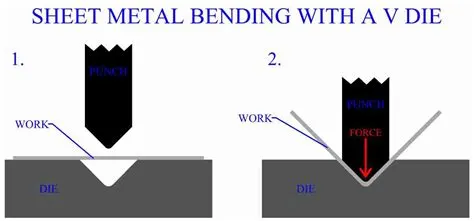
Some metals can be bent along a straight axis using a variety of presses. Bends shape can be varied from gentle curves to vertical axis of steel used to sharpen the corners at an angle above, below, or right at 90 degrees. Press brakes are used to create these sharp bends. Open or closed single-axis curves can be produced by the rolling and forming method in a bending operation.
Hemming :
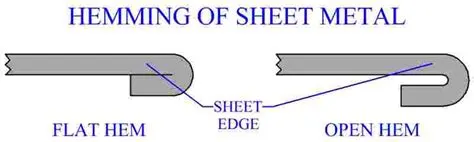
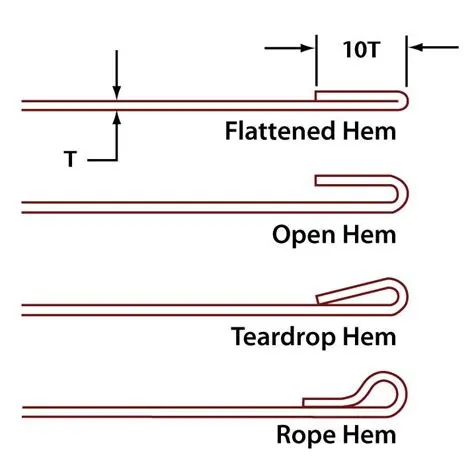
It is the rolling edge of a metal shape that provides a smoother, stronger edge that is open, leaving an air space with a bend or closing the folded metal that is pressed tightly against itself.
Barrel hem is the curling that produces a rounded edge to a piece of metal. It is used to eliminate the sharp edges or serve an operational function in the case of a door hinge that holds the pin around the hinge rotates.
Bend Radius :
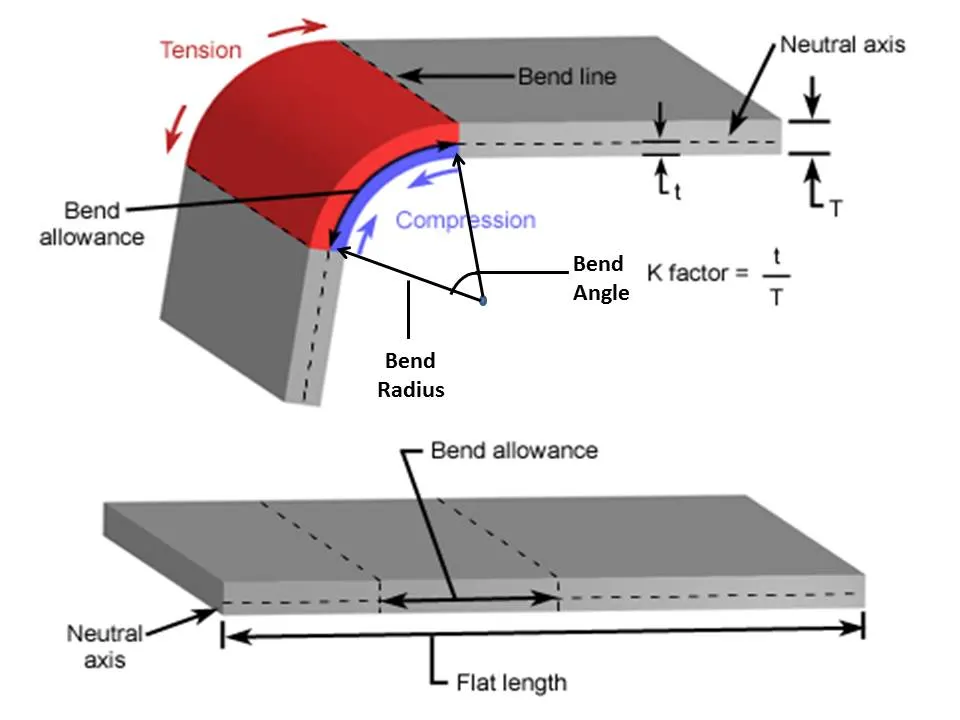
It is the inner radius of the sheet metal after bending .
K Factor :
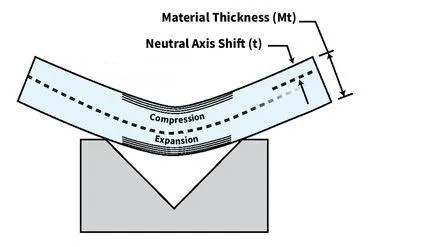
The K-factor is the ratio of the neutral axis to the material thickness. When a piece of metal is being formed, the inner portion of the bend compresses while the outer portion expands . The neutral axis is the area of transition between compression and expansion, where no change in the material occurs—except that it moves from its original location at 50 percent of the material thickness toward the inside surface of the bend. The neutral axis does not change its length but instead relocates; this causes elongation to occur during bending. How far the neutral axis shifts depends on a given material’s physical properties, its thickness, inside bend radius, and the method of forming.
Design methodology IN Flowcharts
Select the XY Plane to draw the Sketch

The tab is created with Reference Sketch
Advanced flanges on the edges of bends create in the previous step
Bending operation is done on side of the tab behind the cut-out
on the tab created as a sketch to perform normal cut-out operation
Unbend the Sheetmetal by using unbend command
Added the holes were ever required by using the Hole command
Sketch is created on the Surface of tab to perform dimple operation
Studio Spline option is selected to create a spline curve
Rebend the Sheetmetal By using Rebend command
Beads also created with reference to holes where placed at required points Dimple operation with reference to Spline curve
Rotated Spline curve to 45 degree
final product was achieved as per the inputs
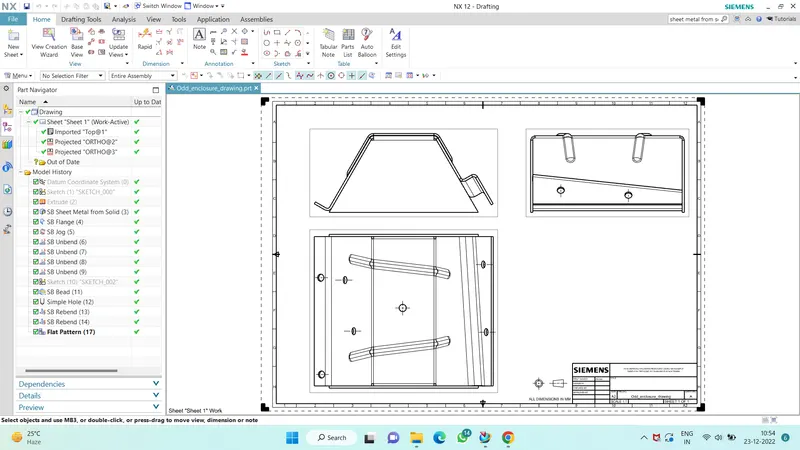
Final Touch up was given in Drafting Sheet with a suitable Scale
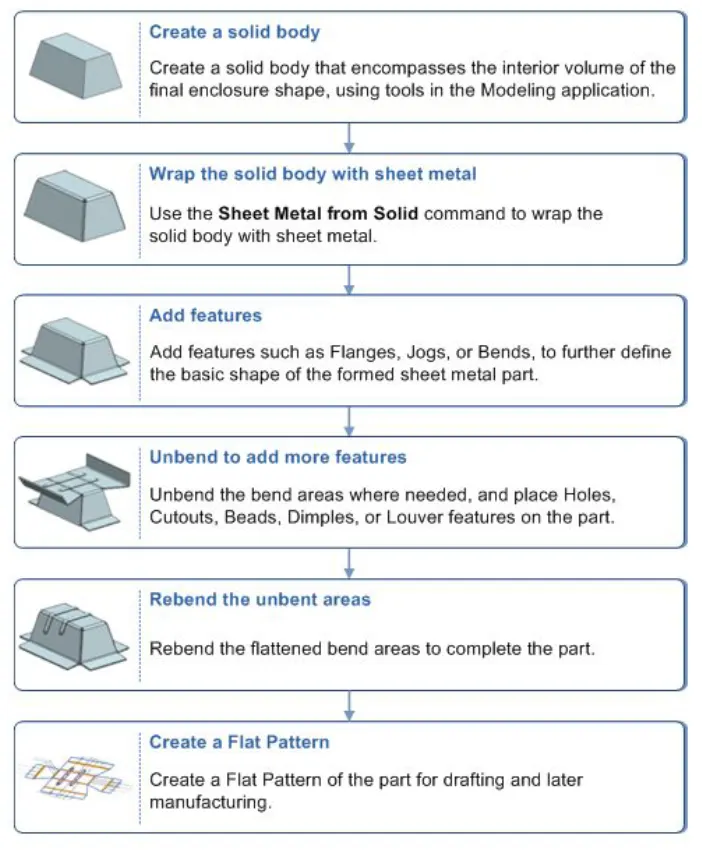
Workflow Chart :
Commands are used in design :
- Sketch : It’s a basic command to draw 2d models.
- Tab : A command to add parameters of a Sketch
- Bend : It’s an operation to bend the tab at a particular position with reference
- Flange : It’s an operation to extend of a sheet metal with to one of the edge of an tab
- UNBEND : It’s a command used to flatten the created 3d model taking one face as a stationary face.
- HOLE : It’s a command used to create a different type of holes like tapping and normal drilling, on the Surface of an Sheet metal.
- DIMPLE : It is a projection command of a particular shape with reference to a sketch with a certain depth.
- BEAD : It is also the type of projection to deform the shape at a certain point with reference to sketch and also give strength to the material.
- HEM : Hem is used for bend the edges.
- Normal Cutout : For cutting the sheet metal it is used.
- REBEND : This command is used to re-bend the already flattened sheet metal.
- Mirror Body : This command help to mirror same part with the of plane for complete the part.
- Unite : This command is used for joining operation of two parts.
- Solid Punch : This command is used for punch the sheet metal part.
- Pattern Feature : It is used for create the pattern of curves.
- Jog : It is used for create flanges.
Different Views of Part after complete the design with the help of given PDF :
All Views :
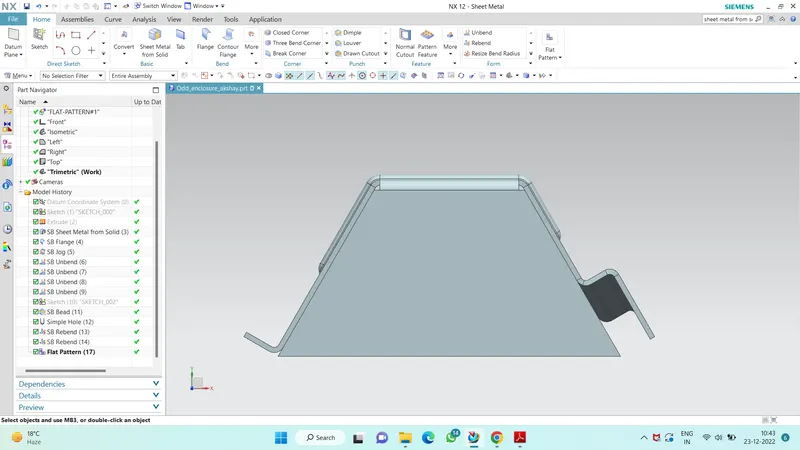
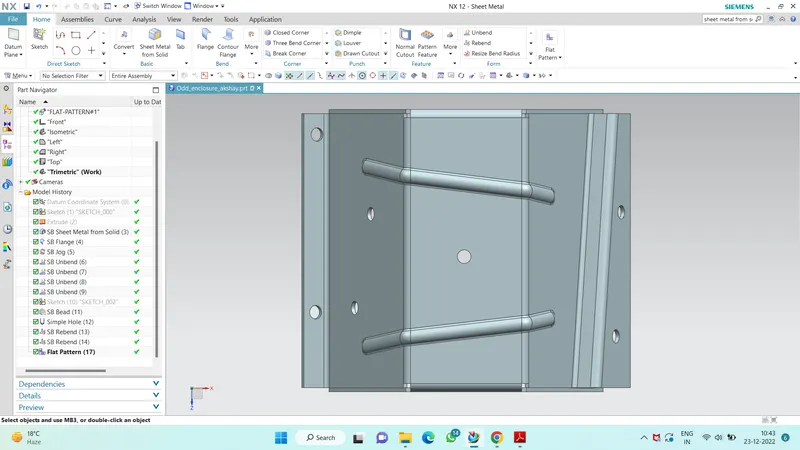
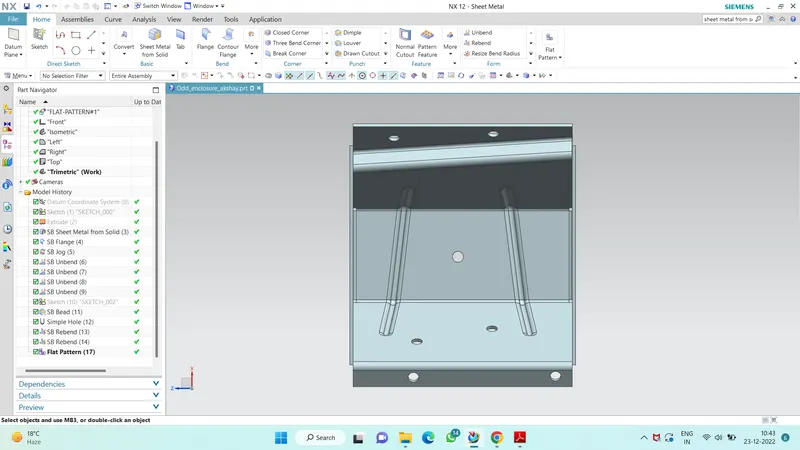
Isometric View :
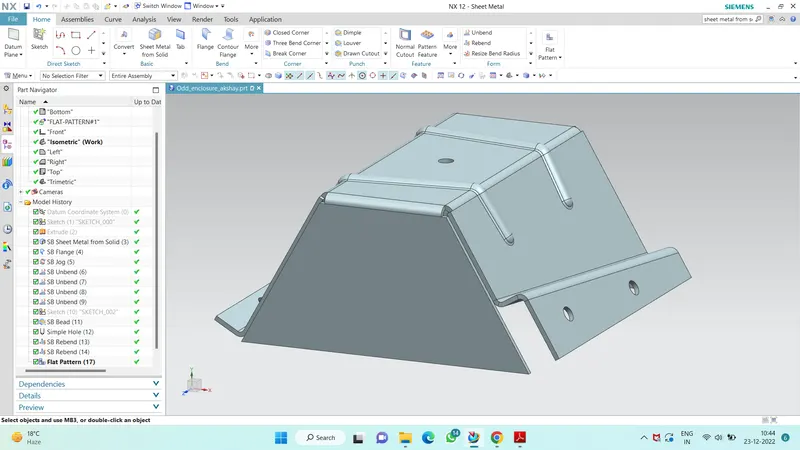
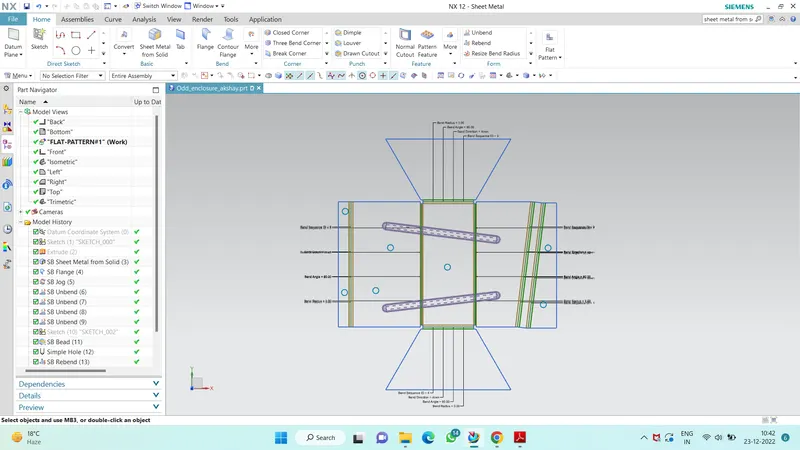
Flat Pattern :
Drwing Sheet :
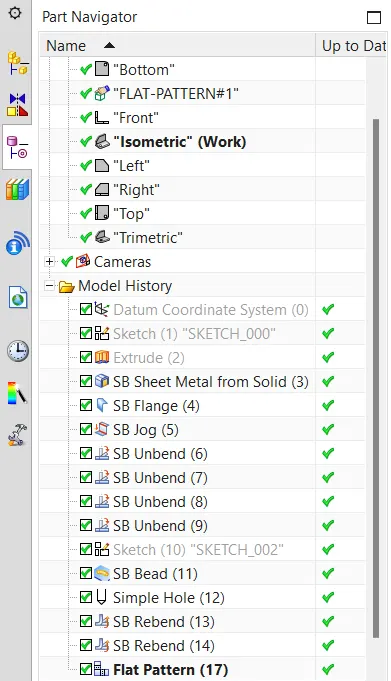
Part Navigator :
CONCLUSION :
Finally the modelling of the sheet metal odd shaped enclosure using NX CAD has successfully completed and though this project I can able to know the various GUI of NX and different comments and tool use in various sheet metal modelling.