The Future of CFD: GPU Solvers, AI Surrogates and LES, With the Numbers
Where computational fluid dynamics is heading after 2026: GPU-native solvers, wall-modelled LES, AI surrogates and agents, exascale machines and the long shot of quantum CFD. With two worked calculations you can rerun (will your mesh fit on a GPU, and what a tenfold Reynolds number does to LES cost), November 2026 facts and the skills that will matter.
The future of computational fluid dynamics (CFD) is faster, bigger and more automated, but not magic. Over the next few years, solvers move from CPU clusters to GPUs, wall-modelled large-eddy simulation (LES) starts to replace steady RANS where accuracy matters, AI surrogates take over quick design sweeps, and scripts and agents handle the repetitive set-up. The engineer's job shifts from running cases to judging them. This guide works through each shift with numbers you can check, as of November 2026.
In short
- GPUs are the new default for big meshes. In Ansys's July 2026 benchmark, four RTX PRO 6000 GPUs, priced about the same as a 516-core CPU cluster, ran a 50-million-cell car model about 4.6× faster.
- Memory sets the limit. Ansys plans GPU runs at about 1.2 GB per million cells (single precision, steady SIMPLE), so a 250-million-cell car needs about 300 GB: two 192 GB B200 GPUs.
- LES gets cheaper only with wall models. Going from a 1:10 wind-tunnel model to a full car (10× the Reynolds number) multiplies the cost of wall-resolved LES by about 525, and of wall-modelled LES by about 14 (Yang and Griffin, 2021).
- Supercomputers keep growing about 24× a decade. The fastest TOP500 system went from 93 PF (November 2016) to 2,198 PF (LineShine, November 2026). CFD-like sparse maths still runs at only about 1% of those headline speeds.
- AI learns from the solver; it does not replace it. Ansys says SimAI typically needs 30 to 100 simulation results to train a usable model.
Learn the skills that last: Skill-Lync's Master's in CFD covers meshing, turbulence modelling and solver set-up in Ansys Fluent and OpenFOAM. Compare every option on the CFD courses page, or talk to a Skill-Lync counsellor.
What is the future of CFD?
CFD is moving in six directions at once: solvers rewritten for GPUs, scale-resolving turbulence models (LES) used in everyday design, AI surrogate models trained on solver results, automated and agent-driven workflows, more computing power through exascale machines and the cloud, and a long-range research bet on quantum computing. The first four are already in commercial software in 2026.
None of these removes the core of CFD: the conservation laws of mass, momentum and energy, discretised on a mesh and solved iteratively. If you want to see what happens inside that loop, our guide on how CFD works numerically walks through it with worked examples. This article is about what is changing around it.
| Shift | Status in Nov 2026 | What it changes for you |
|---|---|---|
| GPU-native solvers | Shipping in Fluent and STAR-CCM+ | Hours become minutes on large meshes |
| Wall-modelled LES | High-end design and research | Better accuracy where RANS struggles |
| AI surrogates | Commercial (e.g. Ansys SimAI) | Seconds per design inside a trained range |
| Automation and agents | Scripting standard; agents early | Less clicking, more checking |
| Exascale and cloud | Five exascale systems on TOP500 | Bigger meshes for those who can access them |
| Quantum CFD | Research only | Nothing yet for working engineers |
Why are CFD solvers moving to GPUs?
CFD solvers spend most of their time moving data, not doing arithmetic, and GPUs move data much faster. Every sweep of a sparse CFD matrix fetches each cell's neighbours from memory. A data-centre GPU such as NVIDIA's B200 reads its memory at 8 TB/s, so in vendor benchmarks large meshes solve several times faster than on similarly priced CPUs.
The supercomputer rankings show the same thing. The TOP500 list ranks machines by HPL, a dense linear-algebra test that keeps processors busy with arithmetic. Its companion, HPCG, runs a sparse conjugate-gradient solver, which is much closer to what a CFD pressure solver does. On the November 2026 lists, every leading machine reaches only about 1% of its HPL speed on HPCG.
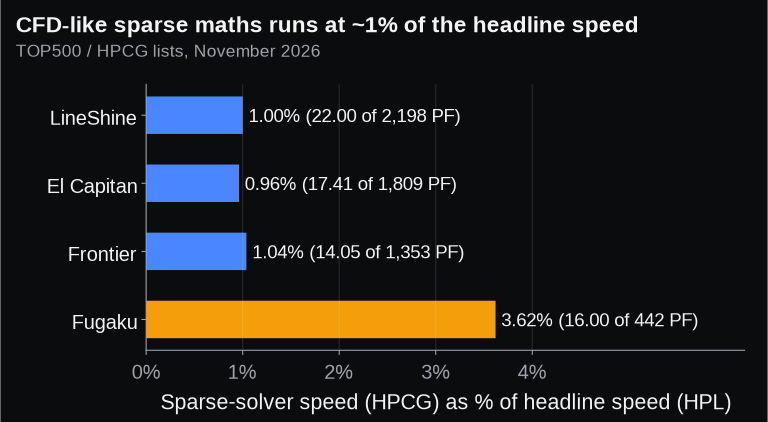
The lesson for CFD is that memory bandwidth sets the pace, not peak FLOPs. That is why the vendors' GPU work in 2026 is about getting more physics onto the GPU:
- Ansys Fluent 2026 R1 added volume-of-fluid (VOF) with energy and sliding meshes to its GPU solver, plus a hybrid-precision mode that, Ansys says, reduces memory while maintaining accuracy.
- Simcenter STAR-CCM+ 2602 (released 24 February 2026) made its VOF and mixture multiphase solvers GPU-native, improved multi-GPU scaling, and added AMD GPU support on Windows. Siemens says its CPU and GPU versions share one solver, so well-converged cases give the same results.
- Benchmarks are vendor-run, so read them carefully. In Ansys's July 2026 test, four RTX PRO 6000 Blackwell GPUs, roughly the same system cost as a 516-core CPU baseline, ran the 50-million-cell DrivAer car about 4.6× faster. Four B200s, about 30% more expensive, reached about 7.5×.
Worked example 1: will your mesh fit on a GPU?
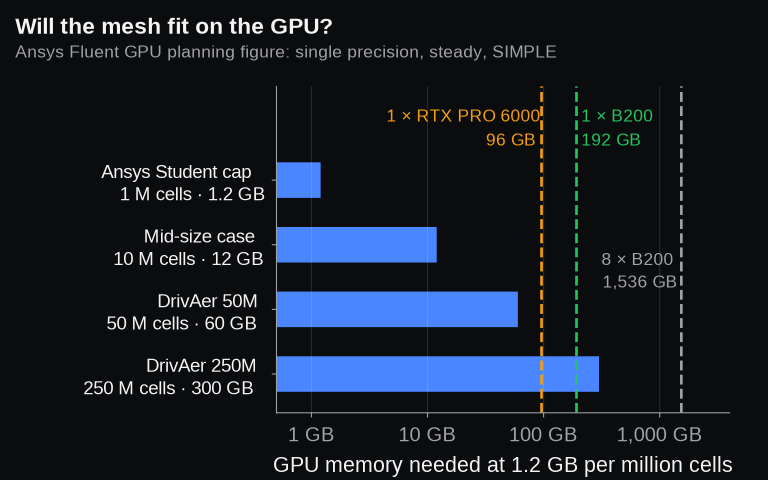
On a GPU, the whole case has to fit in GPU memory. Ansys's Fluent GPU buying guide plans on about 1.2 GB of GPU memory per million cells for a single-precision, steady SIMPLE case, and warns that double precision and the coupled solver need significantly more.
- 1 million cells (the cap on the free Ansys Student licence for fluids): 1.2 GB. Any modern GPU holds it.
- 50 million cells (Ansys's DrivAer_50M car): 60 GB, which uses 62.5% of one 96 GB RTX PRO 6000.
- 250 million cells (DrivAer_250M): 300 GB. That needs at least two 192 GB B200s, or four RTX PRO 6000s.
- Eight B200s (one DGX B200, 1,536 GB) top out near 1,280 million cells at this rate, before any double-precision overhead.
A practical point for students: the habits that make a case efficient on a CPU, such as a clean mesh with sensible y+ and good mesh quality, matter even more on a GPU, where a bloated mesh can stop the case fitting at all.
Will LES replace RANS in industry?
Not everywhere. LES earns its cost where steady RANS models are weakest, such as separated flows, wakes and flow noise, and wall-modelled LES is the version cheap enough to reach design work. LES that resolves the wall layer stays too expensive for whole vehicles at real Reynolds numbers, so RANS remains the workhorse for quick iterations.
The reason is how cost grows with the Reynolds number, . Yang and Griffin (Physics of Fluids, 2021) revisited the classic estimates for a turbulent boundary layer and found the total cost, grid points times time steps, scales roughly as:
DNS (direct numerical simulation) resolves every eddy. Wall-resolved LES resolves the large eddies everywhere, including the tiny ones near the wall. Wall-modelled LES resolves the large eddies away from the wall and replaces the thin near-wall layer with a model. That last step is what removes most of the cost.
Worked example 2: from a wind-tunnel model to a full car
Take a car 4.5 m long at 30 m/s in air ( at 20 °C) and a 1:10 model at the same speed:
A tenfold step in Reynolds number multiplies the cost by for DNS, for wall-resolved LES and for wall-modelled LES.
Now compare that with hardware growth. The fastest machine on the TOP500 went from 93.0 PF (Sunway TaihuLight, November 2016) to 2,198.4 PF (LineShine, November 2026), about 23.6× in ten years, or a doubling every 2.2 years. At that pace, absorbing a 14× cost increase takes about 8 years of hardware progress. Absorbing 525× takes about 20 years.
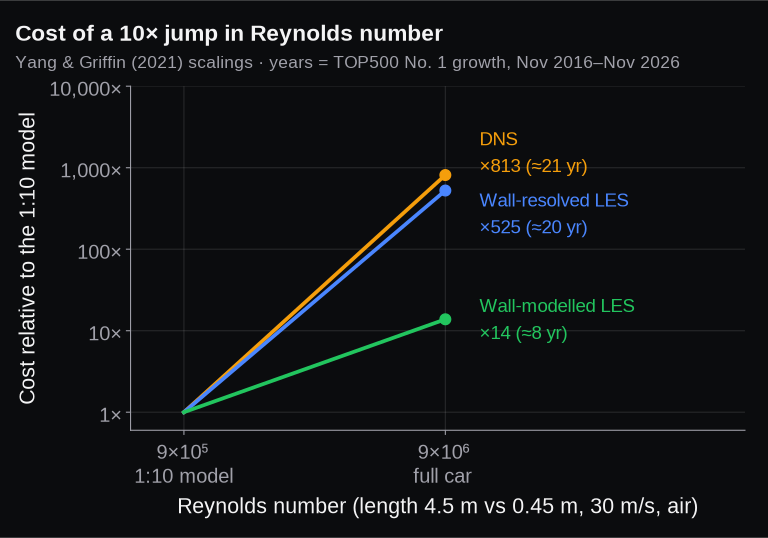
Two cautions. These scalings are for a flat-plate boundary layer, so a real car, with separation and a wake, will differ in detail. And the comparison is relative: each method has its own constant in front, so the chart says how fast each bill grows, not which bill is smaller today. The direction is clear, though. Wall models are the reason LES is becoming a design tool rather than a research luxury.
Will AI replace CFD solvers?
No. AI surrogate models learn from solver results and then predict new designs in seconds, but only inside the range they were trained on. The solver produces the training data, checks the AI's answers and handles anything new. AI is making CFD faster to use, not making the physics optional.
The commercial tools say this themselves. Ansys states that SimAI typically needs 30 to 100 simulation results to train a model with sufficient accuracy. Each prediction comes with a confidence level that flags when a design is too far from the training data, and the fix is to retrain with new solver runs. The 2026 R1 release extended training to datasets larger than 15 TB. Siemens's STAR-CCM+ 2602 release likewise headlines "instant predictions with AI" alongside its GPU solvers.
Two practical consequences:
- Clean, converged data becomes valuable. A surrogate trained on under-converged runs learns the errors. Mesh studies, residual checks and validation against tests become more important, not less.
- The engineer decides when to trust it. Our deep-dive on AI surrogate models vs CFD and FEA solvers works through a validation example and a checklist for exactly that call.
Can AI agents run CFD simulations?
Partly. Large-language-model agents can now write OpenFOAM case files, launch runs and read logs, and commercial solvers can already be driven entirely from Python (Ansys's PyFluent, for example). They still make physics mistakes a trained engineer would catch, such as wrong boundary conditions or unconverged results reported as final. Treat them as a fast junior that needs review.
We tested what agents get right and wrong in Can an AI agent run your CFD?. The near-term change is less glamorous and more useful: pre-processing, parametric sweeps and report generation are increasingly scripted end to end, which is why Python has become a core CFD skill (see Skill-Lync's automation for FEA and CFD pre-processing programme).
What does exascale computing mean for CFD?
Exascale machines perform more than 1018 operations per second on the HPL test. Five systems on the November 2026 TOP500 reach it: LineShine (2.198 EF), El Capitan (1.809 EF), Frontier (1.353 EF), Aurora (1.012 EF) and JUPITER Booster (1.000 EF, Europe's first). They let researchers run the wall-resolved LES and DNS that calibrate tomorrow's wall models and turbulence models.
For most working engineers, the compute that matters is a GPU server in the company data centre or rented cloud hardware. You pay per hour and size the machine to the case, which is exactly where the memory sizing from worked example 1 comes in. In India, the National Supercomputing Mission is building shared academic capacity. One example is the PARAM Rudra system at the S.N. Bose National Centre in Kolkata, dedicated in September 2024 at 838 TFLOPS. That is about 0.04% of LineShine, a reminder that access, not just hardware, shapes who can run the biggest cases.
Is quantum computing the future of CFD?
Not on any timescale you should plan a career around. Quantum algorithms for fluid flow are an active research field, but reviews from 2023 and 2026 name the same obstacles: non-linear, dissipative flow equations fit quantum mechanics poorly, and loading data in and reading results out is costly. Whether quantum CFD beats classical CFD in practice remains open.
The appeal is real. Succi, Itani, Sreenivasan and Steijl (2023) estimate that about 80 qubits could in principle represent the complexity of a full aircraft at , a problem needing around floating-point operations classically. But they call non-linearity and dissipation the two "elephants in the room". A 2026 review by Rathore and colleagues adds that compact encodings bring bottlenecks in state preparation, readout and non-linear terms, and that no single encoding suits every problem. Worth following if you are heading into research; not something to learn instead of turbulence modelling.
What will not change in CFD?
The fundamentals stay. Results still depend on the mesh, the boundary conditions, the turbulence model and the convergence criteria, and they still need validating against experiments or trusted data. Faster hardware and AI make it easier to produce a wrong answer quickly, so the ability to judge a result becomes the most valuable CFD skill.
Here is the honest list of limits behind the headlines:
- GPU solvers do not cover every model yet. Each release adds physics, so check your vendor's supported-feature list before you buy hardware or promise a speed-up.
- Vendor speed-ups are vendor benchmarks. They are real but chosen; your case, mesh and licence will give a different number. Ansys itself notes that small cases such as its 24-million-cell combustor scale less well than the 250-million-cell car.
- LES needs more than a bigger computer. It needs good inflow turbulence, time-step discipline (see the Courant number calculator) and statistics averaged over many flow-through times.
- Surrogates extrapolate badly. Outside their training range, they produce confident nonsense unless someone checks.
Is CFD a good career for the future?
Yes, for engineers who combine physics judgement with modern tools. CFD is used across automotive and EV, aerospace, energy, HVAC and electronics cooling (see our guide to applications of CFD), and GPU and AI tools reward engineers who can verify and interpret results. Skill-Lync placement data puts the median starting CFD offer at 3.5 LPA (n = 240).
That figure comes from Skill-Lync's own records: based on 3,711 Skill-Lync placement records up to 7 November 2026 (data snapshot of 15 November 2026). Learners placed in CFD roles had a median offer of 3.5 LPA, with the middle half between 2.81 and 4.5 LPA (n = 240). The companies that hired most often in this sample include Mechartes, Cyient, Analyzer CAE, Expleo Engineering, Alten and Cummins. This is a self-selected sample of early-career offers, mostly from 2021 to 2023, so treat it as a starting point; we update it as new placements come in. For fresher and experienced pay side by side, see the CFD engineer salary guide and the CFD engineer salary page.
Which CFD skills will matter most in 2027?
| Skill | Why it matters more now |
|---|---|
| Meshing and mesh studies | GPU memory and LES cost both scale with cell count |
| Turbulence modelling (RANS to LES) | Knowing when RANS is enough is the key judgement |
| Verification and validation | Surrogates and agents multiply the cost of a wrong baseline |
| Python scripting | Parametric sweeps and AI training data are scripted |
| Open-source solvers (OpenFOAM) | No licence cost for large cloud or GPU runs |
| Basic machine learning | To build, test and question surrogate models |
To build these step by step, start with Introduction to CFD using MATLAB and OpenFOAM, then move to Advanced CFD using Ansys Fluent. Revise the theory in the free CFD interactive book, and practise with our 50 CFD interview questions. Want help choosing? Talk to a Skill-Lync counsellor.
Frequently asked questions
Will AI replace CFD engineers?
No. AI surrogates and agents speed up repetitive work, but they learn from solver results and fail outside their training range. Someone still has to set up valid cases, check convergence and mesh independence, and decide whether a prediction can be trusted. Those judgement skills become more valuable as AI tools produce answers faster.
Can Ansys Fluent run on a GPU?
Yes. Fluent has a native GPU solver that, as of 2026 R1, supports steady and transient runs, segregated and coupled solvers, VOF with energy and sliding meshes, and NVIDIA and AMD GPUs. Ansys plans memory at about 1.2 GB per million cells in single precision. Not every model is supported, so check the current feature list first.
What is the difference between LES and RANS?
RANS averages out all turbulence and models its effect, so it is cheap and usually run steady. LES resolves the large turbulent eddies in time and models only the small ones, so it captures separation, wakes and noise better but costs far more. Wall-modelled LES also models the thin near-wall layer to cut that cost.
Is CFD still in demand in India?
Yes. CFD engineers work in automotive and EV, aerospace, HVAC, energy and engineering-services firms. In Skill-Lync's placement records (snapshot 15 November 2026, n = 240), frequent CFD hirers included Mechartes, Cyient, Expleo Engineering, Alten and Cummins, with a median starting offer of 3.5 LPA in this early-career sample.
Should I learn OpenFOAM or Ansys Fluent first?
Learn the method with either, then add the other. Fluent has a guided interface, a free student version capped at 1 million fluid cells, and wide use in industry. OpenFOAM is free, open-source and scriptable, and it shows you what the solver actually does, which helps with cloud and automation work. Knowing both widens your options.
Sources and further reading
- TOP500, Highlights, November 2026 (68th list: HPL and HPCG results) and November 2016 list, accessed 23 Nov 2026.
- Yang, X.I.A. and Griffin, K.P., Grid-point and time-step requirements for DNS and LES, Physics of Fluids 33, 015108 (2021).
- Ansys, Which NVIDIA Blackwell GPU delivers the best Fluent ROI? (22 Jul 2026).
- Ansys Innovation Space, Fluent GPU solver hardware buying guide, accessed 23 Nov 2026.
- Ansys, What's new across Ansys Fluids in 2026 R1.
- Ansys, Ansys SimAI product page and FAQ, accessed 23 Nov 2026.
- Siemens, What's new in Simcenter STAR-CCM+ 2602 (24 Feb 2026).
- Ansys, Ansys Student (problem-size limits), accessed 23 Nov 2026.
- PIB, PARAM Rudra supercomputer at S.N. Bose National Centre (27 Sep 2024).
- Succi, Itani, Sreenivasan and Steijl, Quantum computing for fluids: where do we stand? (arXiv, July 2023), and a 2026 review of flow encodings for quantum CFD.
- Engineering ToolBox, Air: dynamic and kinematic viscosity (15.06 × 10⁻⁶ m²/s at 20 °C).
- Skill-Lync placement records, snapshot of 15 Nov 2026; public list at recent placements.