Tata Sierra.ev Bharat NCAP Result: 30.62/32 Adult, 45/49 Child, 5 Stars
The electric Sierra.ev has its own Bharat NCAP rating, separate from the petrol and diesel Sierra: 5 stars, 30.62/32 adult and 45/49 child. Here are the official scores, where the 2,412 kg EV lost points against the ICE car, and what the extra mass means for crash engineers.

The Tata Sierra.ev, the electric version of the Sierra SUV, has a 5-star Bharat NCAP rating for both adult and child occupant protection. Its official scores are 30.62 out of 32 (adult) and 45 out of 49 (child). This is a separate rating from a separate crash test, not the petrol and diesel Sierra's March 2026 result carried over. The Bharat NCAP portal lists it as applying from November 2026, and car media reported it on 18 November.
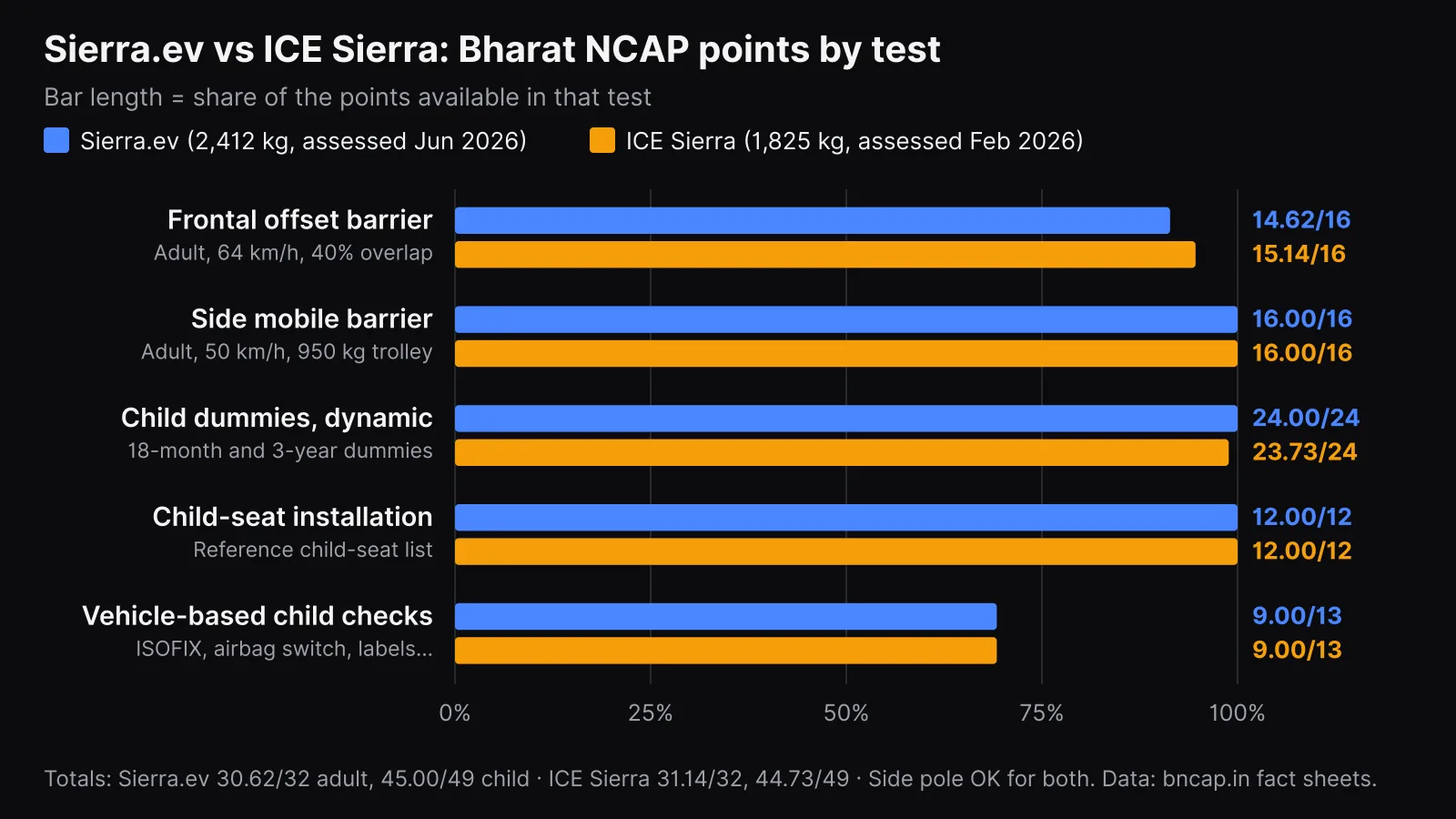
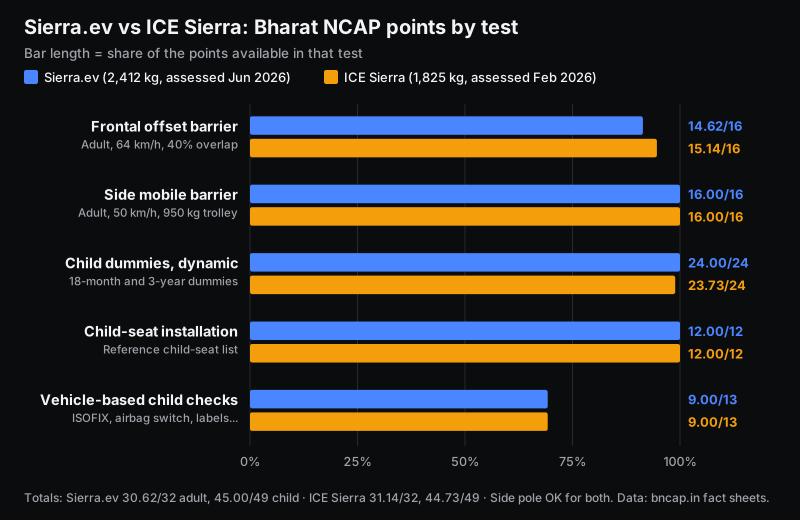
- Adult 30.62/32: 14.62/16 frontal offset (64 km/h), 16/16 side barrier (50 km/h), side pole passed (Bharat NCAP fact sheet).
- Child 45/49: 24/24 dynamic, 12/12 child-seat installation, 9/13 vehicle-based checks.
- Test car: EMP AWD A 75 ACFC, 2,412 kg crash-test weight, assessed June 2026: 587 kg heavier than the tested ICE Sierra.
What did Bharat NCAP give the Sierra.ev?
Bharat NCAP gave the Sierra.ev 5 stars in both categories. All 1.38 adult points it dropped came in the frontal offset crash. Its only child losses were 4 points in the vehicle-based checks, which score fitted features rather than dummy readings.
The fact sheet colour-codes each dummy body region. In the frontal test, everything above the knee is green (good) for both front dummies. Their lower legs are yellow (adequate) and the driver's feet orange (marginal). Side and pole tests are green throughout. No per-region points are published, so our reading is that the lost frontal points sit below the knee.
The safety-equipment list is the same as the ICE car's, with front, side chest, side pelvis and curtain airbags, ISOFIX on the second-row outboard seats, and no knee airbag or integrated child seat.
How is the Sierra.ev rating different from the ICE Sierra's?
They are separate ratings from separate crash tests. The ICE Sierra was assessed in February 2026 and rated from March 2026. Its November Revision 03 added petrol and diesel variants only. The Sierra.ev has its own model page and fact sheet from a June 2026 test.
| From the official fact sheets | Sierra.ev | ICE Sierra |
|---|---|---|
| Variant tested | EMP AWD A 75 ACFC | Accomplished+ / Adventure+ diesel MT |
| Assessed / rating from | Jun 2026 / Nov 2026 | Feb 2026 / Mar 2026 |
| Crash-test weight | 2,412 kg | 1,825 kg |
| Frontal regions below green | Both dummies' lower legs (adequate); driver's feet (marginal) | Driver's chest and lower legs, one passenger lower leg (adequate) |
| Adult /32; child /49 | 30.62; 45.00 | 31.14; 44.73 |
The EV's driver chest is rated better than the ICE car's, but its legs and feet do worse. The ICE car's lost child points came in the 18-month dummy's frontal test (7.73/8).
Why does this matter for engineers?
The Sierra.ev's crash-test weight is 32% higher than the ICE Sierra's. In the frontal test the car hits a fixed deformable barrier, so its front structure has to absorb the car's own kinetic energy. Our calculation from the official masses, at 64 km/h (17.78 m/s):
The ICE Sierra brings about 288 kJ, so the EV's crush zone must handle roughly 93 kJ more while keeping the underfloor battery pack intact. In AIS-197, the driver's foot and ankle rating depends on how far the pedals move rearward: full points under 100 mm, zero at 200 mm. A marginal foot rating therefore points to the footwell and pedal area as the place where the extra energy showed.
In the side test, mass helps. A 950 kg trolley hits the parked car at 50 km/h. In an idealised plastic collision, the EV picks up about 14.1 km/h against 17.1 km/h for the ICE car (our calculation).
AIS-197 also adds EV-specific checks. After the frontal and side tests, the high-voltage system must meet the post-crash electrical safety rules of AIS-098 and AIS-099, with up to 1 point deducted per test if it fails. The fact sheet does not itemise modifiers. Getting all this right is work for crash CAE engineers (LS-DYNA, Radioss), battery-enclosure designers and homologation teams.
What happens next?
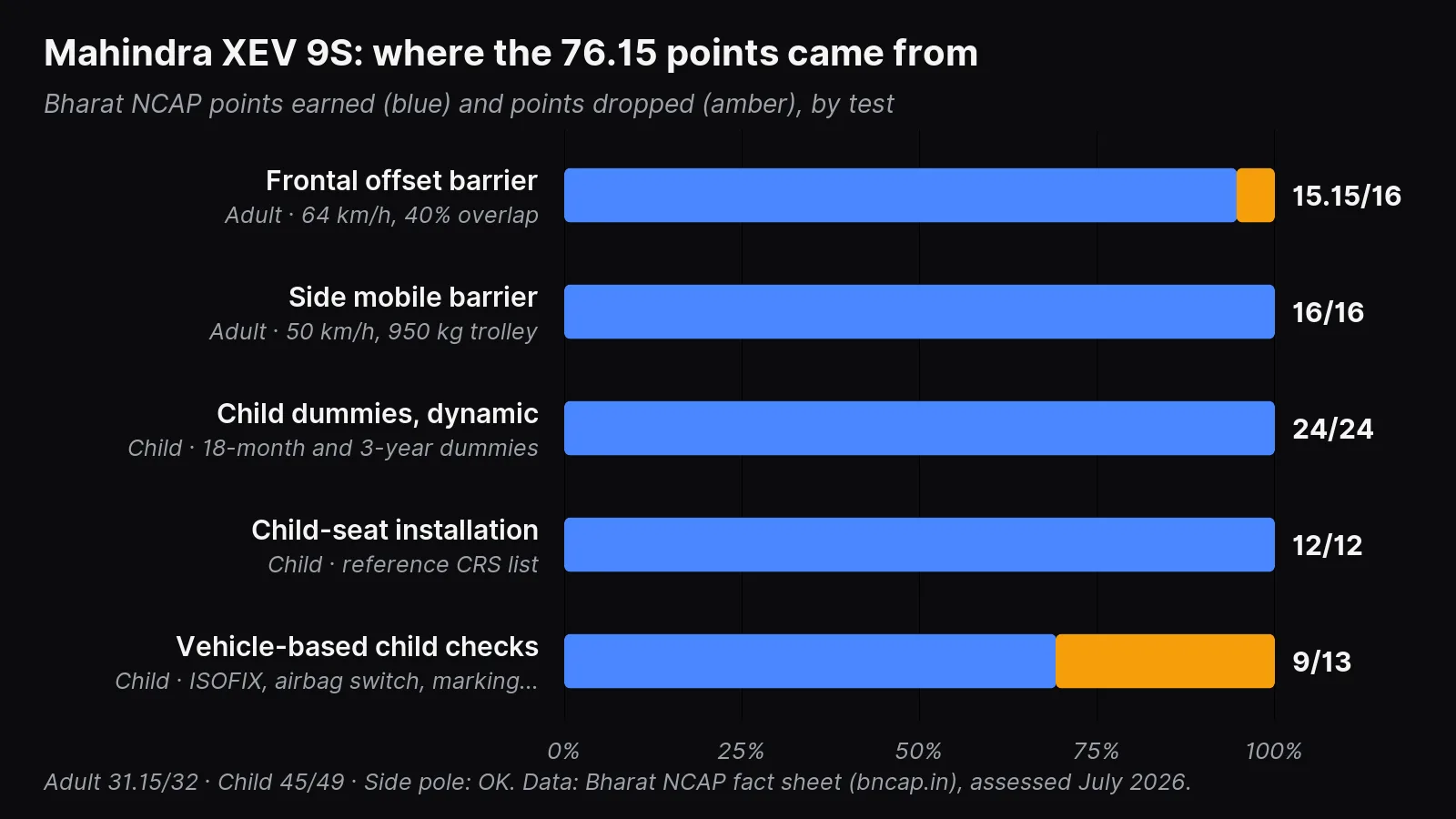
The annexure covers 14 rear-wheel-drive variants (PURE, PURE S, ADV and EMP trims, 63 and 75 versions) and 2 all-wheel-drive EMP A 75 variants. Unusually, the fact sheet also says the rating applies to vehicles built from VIN MAT879029TAF90381 onward. Read literally, earlier-built cars are outside it. Our 2026 Bharat NCAP tracker explains star thresholds and variant extensions, and the same batch rated the Mahindra XEV 9S.
Frequently asked questions
What is the Tata Sierra.ev Bharat NCAP rating?
5 stars for adult occupant protection (30.62/32) and 5 stars for child occupant protection (45/49). It was assessed in June 2026, and the rating applies from November 2026.
Is the Sierra.ev rating the same as the petrol and diesel Sierra's?
No. The ICE Sierra has its own rating (31.14/32 adult, 44.73/49 child) from a February 2026 test. The Sierra.ev was tested separately and scored 0.52 adult points lower and 0.27 child points higher.
Where did the Sierra.ev lose points?
It lost 1.38 points in the frontal offset test, where the fact sheet marks the lower legs adequate and the driver's feet marginal. It also lost 4 of 13 points in the vehicle-based child checks.
Learn the engineering behind crash ratings
Skill-Lync's crashworthiness analysis course with HyperMesh and Radioss teaches the crash simulation behind results like this. The EV design and development programme covers battery packs and vehicle integration. Not sure which fits you? Talk to a Skill-Lync counsellor.
Sources and further reading
- Bharat NCAP, Tata Sierra.ev rating page and fact sheet (read 21 Nov 2026)
- Bharat NCAP, Tata Sierra rating page and fact sheet, Revision 03 (read 21 Nov 2026)
- Bharat NCAP, vehicle safety ratings list (read 21 Nov 2026)
- Bharat NCAP, AIS-197 (September 2023 version): test speeds, pedal-displacement limits, EV post-crash checks