What Is Body in White (BIW)? Parts, Materials, Joining and Why It Matters
Body in white is a car's welded, unpainted sheet-metal shell. What it includes, where it is built, its crush zones and safety cage, why press-hardened steel goes in the cage (with a worked example), how it is joined, why it decides crash ratings, and what BIW engineers earn in Skill-Lync's placement data.
In short
- Body in white (BIW) is a car's bare sheet-metal body after its panels have been welded and bonded together in the body shop. It is not yet painted, and has no engine, glass, wiring, seats or trim.
- It is joined mostly by resistance spot welding: one SAE paper puts a car body at 4,500 to 6,500 spot welds.
- Its safety cage is where press-hardened boron steel goes. After hot stamping it reaches 950-1,200 MPa yield and about 1,300-1,650 MPa tensile strength, against roughly 450-750 MPa before forming (AHSS Insights).
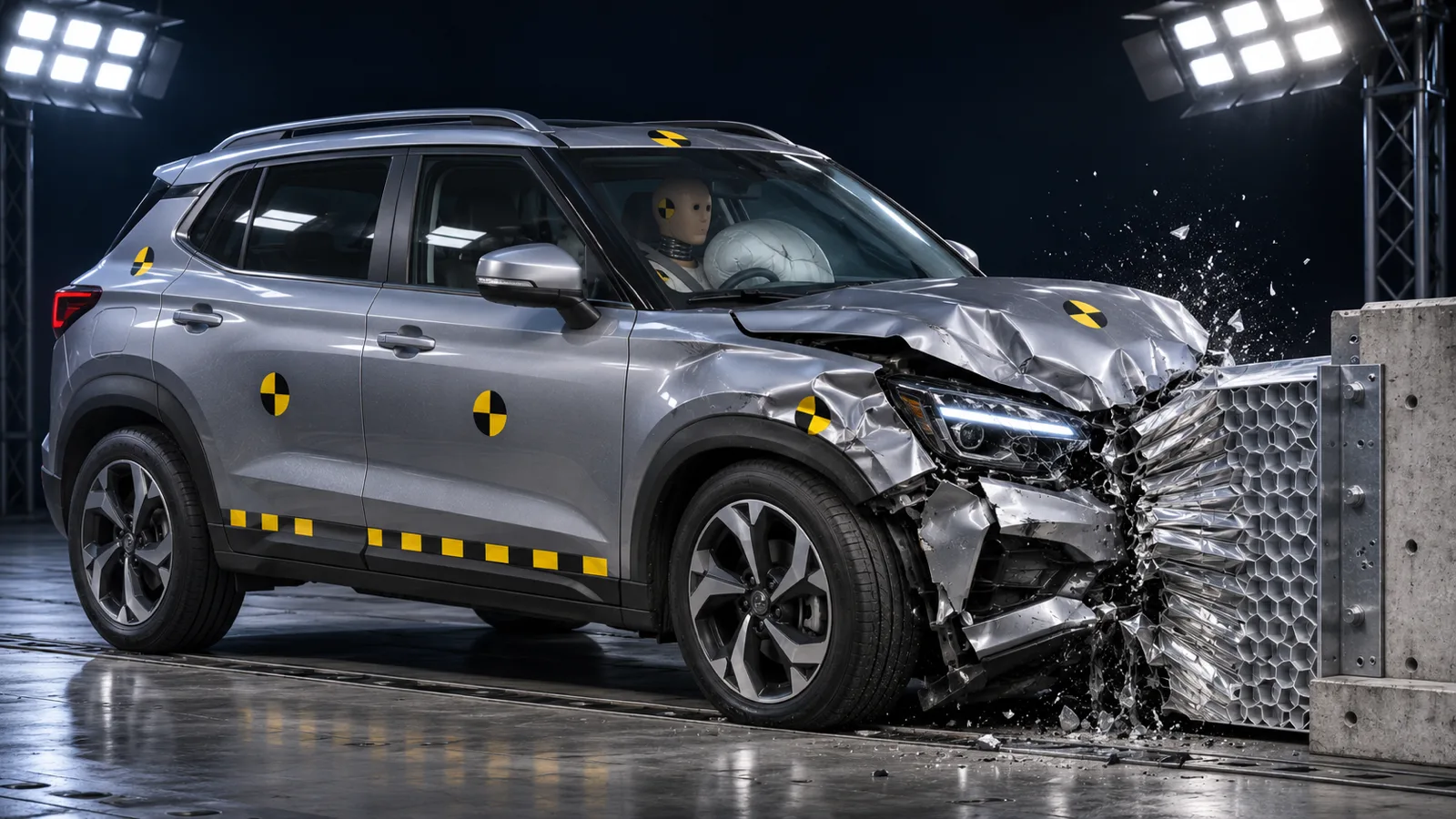
- The BIW is what crash tests grade. Bharat NCAP started on 1 October 2023 under AIS-197. In Global NCAP's 8 November 2024 test of the new Maruti Suzuki Dzire, the structure was rated "stable".
- In Skill-Lync's placement records, the design domain, which includes BIW, has a median starting offer of ₹3.5 lakh a year (n = 1,463, snapshot 15 Nov 2026).
Body in white (BIW) is the stage of car manufacturing at which the body's sheet-metal panels have been joined into one structure, before painting and before the engine, chassis parts and trim go in. It is the car's load-carrying shell. It decides how the car protects its occupants in a crash, how stiff and quiet it feels, and a large part of its weight and cost.
This guide explains what the term covers and where it sits in a car plant. It names the parts of a BIW and what each one does, and shows what BIWs are made of and how they are joined. A worked example shows why carmakers don't build the whole body from the strongest steel available. It ends with what BIW engineers do in India and how to start learning the work.
What does body in white mean?
Body in white means the car body in its bare joined state: stamped steel or aluminium panels welded, riveted or bonded into one shell, before paint. It excludes the powertrain, suspension and other chassis sub-assemblies, and all trim such as glass, door handles, seats, upholstery and electronics. In most plants it includes the hung closures: doors, bonnet and boot lid.
Plants and suppliers draw the boundary slightly differently, so check what a drawing or quote means by "BIW". Some count the closures separately ("BIW without closures" or "body structure"). Others include them, because they are fitted in the body shop before the body goes to paint.
Nobody has a well-documented answer for why it is called "white". The explanations usually given are that coachbuilt bodies were unpainted ("white") wood or metal before finishing, that bodies were once primed in a light colour, or that bodies were painted white before the final colour. Wikipedia lists all three and flags each as uncited. For an engineer, the useful meaning is simply "joined but unpainted".
The term applies to monocoque (unibody) cars, where the body itself carries the loads. In a body-on-frame vehicle, such as many pickups and some large SUVs, a separate ladder frame carries the loads and the body is bolted on top.
Where does the BIW fit in a car plant?
The BIW is built in the body shop, the second of four main stages. The press shop stamps coil and blanks into panels, and the body shop joins them into the BIW. The paint shop then cleans, e-coats, primes and paints it, and trim, chassis and final assembly turns the painted body into a car.
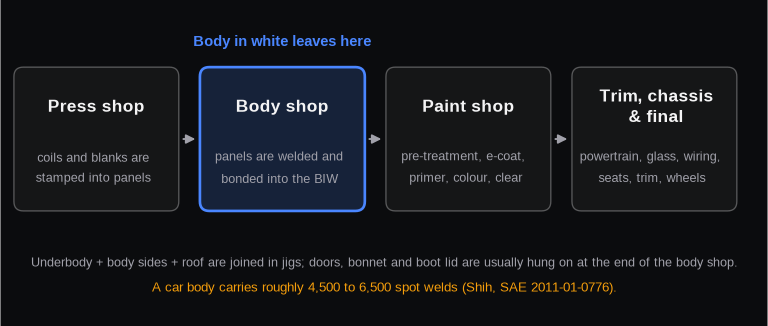
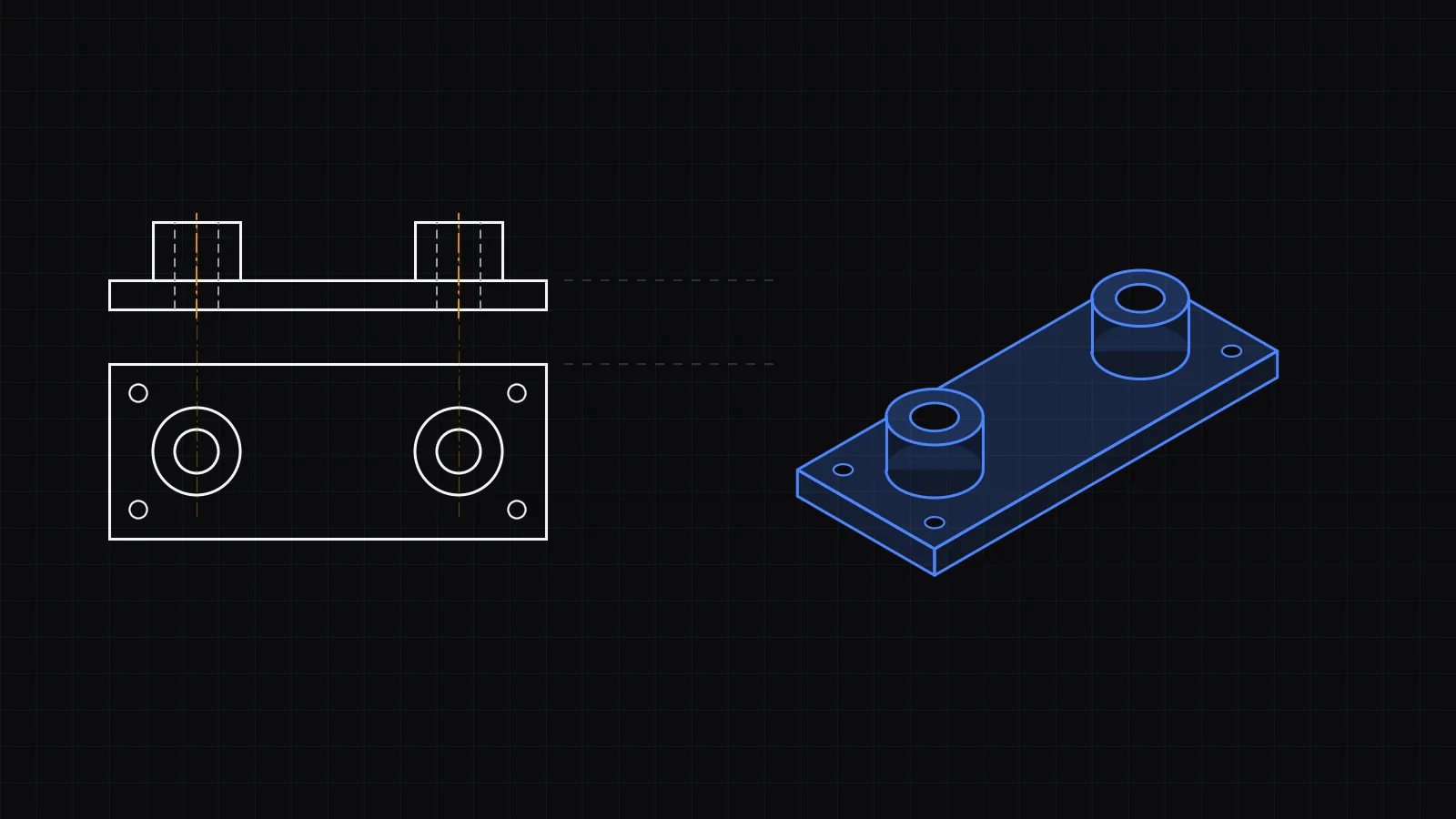
Inside the body shop, sub-assemblies are built first: the underbody (floor, front and rear rails, dash panel), the two body sides (pillars, sills and roof rails), and the roof. A main framing station then clamps them in a fixture and welds them into one shell. The fixture locates the parts precisely, so that the shell comes out within tolerance and the doors, glass and trim will fit later. Designing those fixtures is a specialist job of its own, covered in our BIW tooling basics. Closures are hung on at the end, and the finished shell is checked for dimensions and weld quality before paint.
What parts make up a body in white?
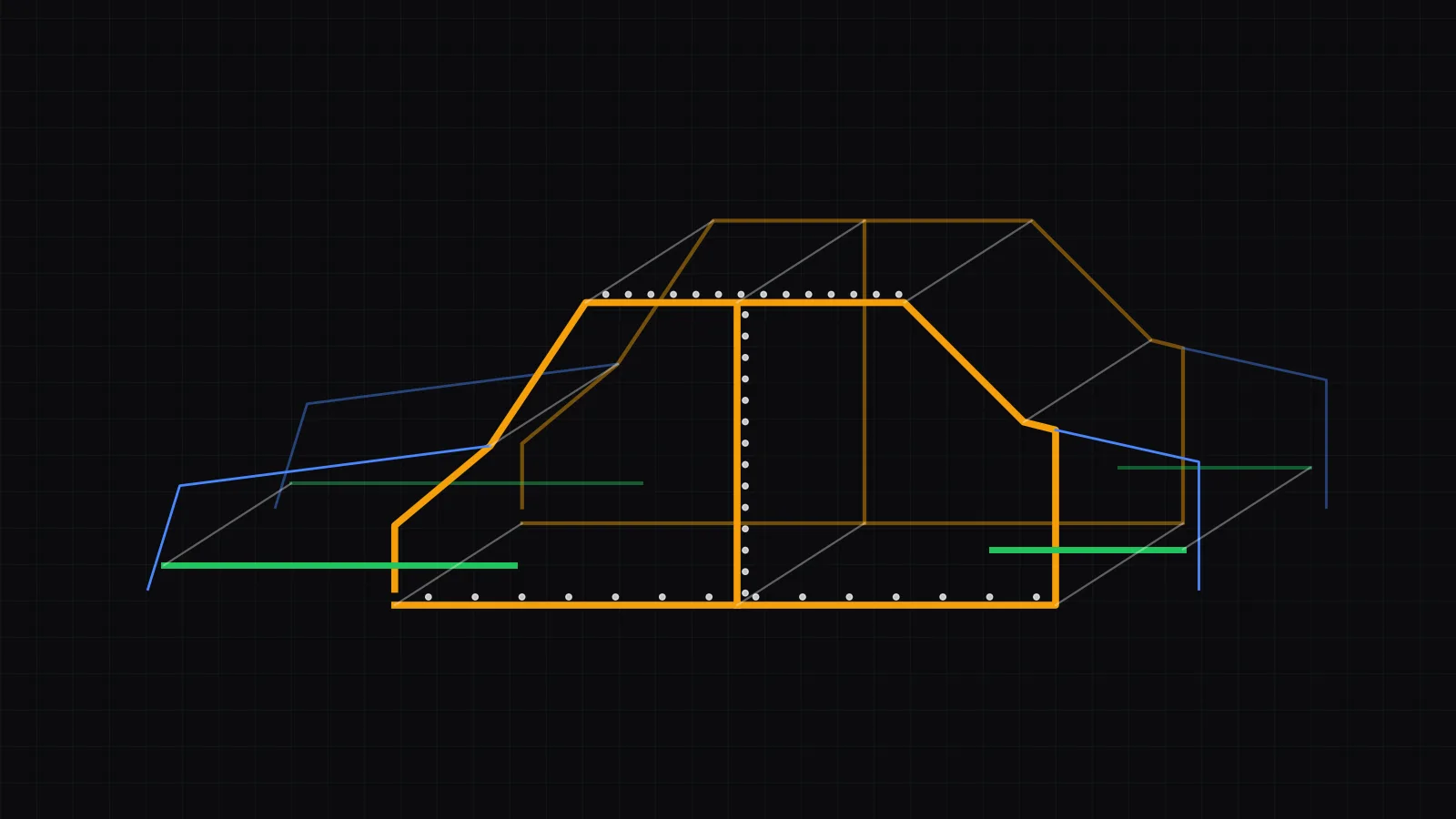
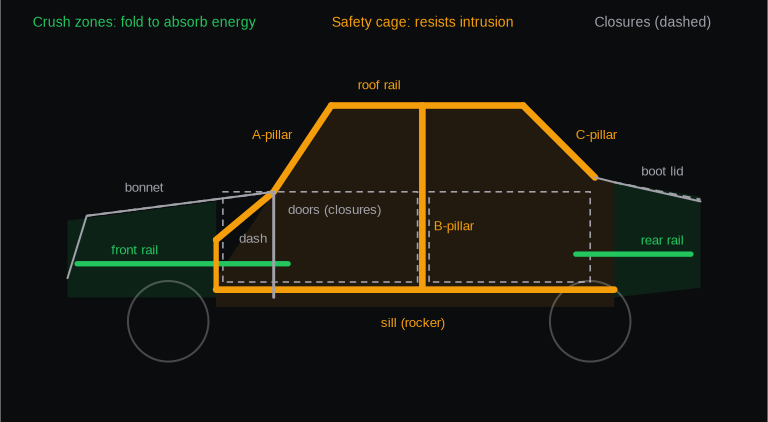
A BIW has four groups of parts: the underbody (floor, front and rear rails, dash panel), the body sides (A, B and C pillars, sills and roof rails), the roof panel with its cross members, and the closures (doors, bonnet, boot lid and fenders). Structurally, they form two crush zones and a rigid safety cage.
| Member | Where | Main job |
|---|---|---|
| Front rails (longitudinals) | Engine bay | Fold progressively in a frontal crash to absorb energy; carry the front suspension and powertrain loads |
| Dash panel | Between engine bay and cabin | Separates the cabin; must not push into the footwell |
| A-pillar and hinge pillar | Front of the cabin | Carry crash loads up to the roof and down to the sill; hold the front doors |
| B-pillar | Between the doors | Main defence in a side impact; holds the rear door and the seat belt anchor |
| Sill (rocker) | Below the doors | Ties front to rear; resists side and pole impacts |
| Roof rails and bows | Top of the cabin | Resist roof crush in a rollover; stiffen the cabin |
| Floor and cross members | Cabin floor | Carry seats and loads; spread side-impact loads across the car |
| Rear rails | Boot area | Absorb rear-impact energy; carry the rear suspension |
| Closures | Doors, bonnet, boot lid | Access and sealing; side-impact beams in the doors |
The two zones need opposite behaviour. Crush zones should fold in a controlled way, so they use steels that can stretch a lot before breaking. The safety cage should barely deform, so it uses the strongest steels, which is why press-hardened parts are found mainly where intrusion resistance is needed (AHSS Insights).
What is a BIW made of?
Most car BIWs are mixed-grade steel. Mild steel goes in panels with complex shapes. High-strength and advanced high-strength steels (AHSS) go in most structural members, and press-hardened boron steel in the safety cage. Aluminium appears in closures or whole bodies on premium cars, and some cars add composites or magnesium in places.
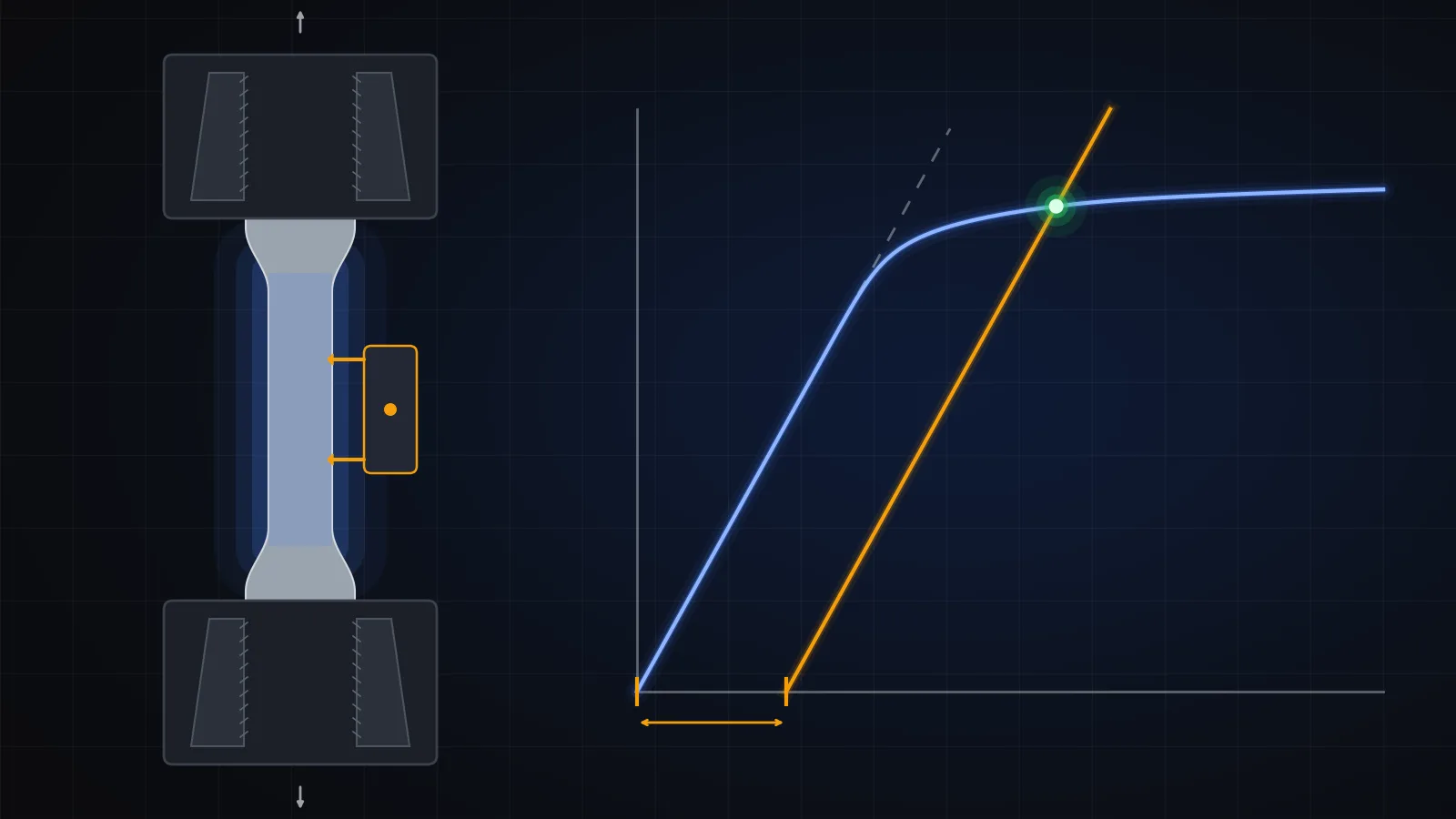
Press-hardened steel (PHS), usually the boron steel 22MnB5, shows why grade choice matters. As delivered, it has 300-600 MPa yield and 450-750 MPa tensile strength, soft enough to form. It is heated to make it austenitic, pressed and quenched in a cooled die. That gives at least 950 MPa yield (typically 950-1,200 MPa) and about 1,300-1,650 MPa tensile strength, but only about 3.5-6% elongation (AHSS Insights). That makes it ideal for a B-pillar or roof rail that must not bend, and wrong for a front rail that must fold.
Worked example: why not build the whole body from the strongest steel?
Take a flat panel or simple member of fixed width and span, 1.2 mm thick in mild steel, loaded in bending. For a rectangular section of thickness , mass, bending strength and bending stiffness scale as:
Swap the material and keep one property equal. For equal strength the thickness ratio is ; for equal stiffness it is . We used a 200 MPa yield for mild steel and for a 6xxx aluminium sheet (round illustrative values), the 950 MPa minimum for press-hardened 22MnB5, Young's moduli of 200 GPa for steel and 68 GPa for aluminium, and densities of 7,850 and 2,700 kg/m³. A short Python script did the arithmetic:
| Swap from 1.2 mm mild steel | New gauge | Mass | Bending stiffness |
|---|---|---|---|
| PHS, equal strength | 0.55 mm | 0.46 (-54%) | 0.10 |
| Aluminium, equal strength | 1.20 mm | 0.34 (-66%) | 0.34 |
| Aluminium, equal stiffness | 1.72 mm | 0.49 (-51%) | 1.00 |
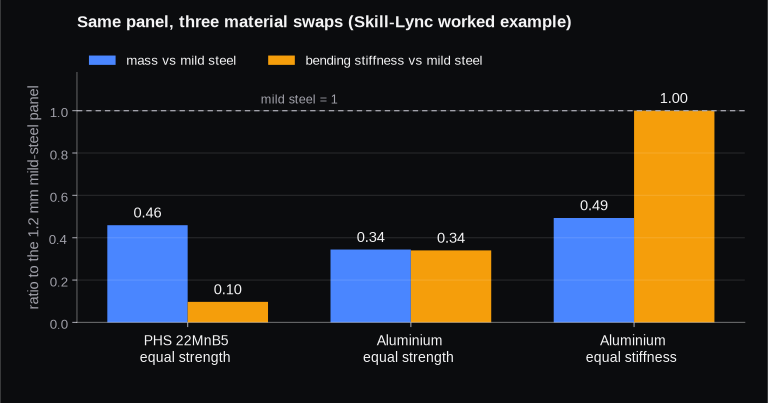
The thinner PHS panel is just as strong but keeps only about a tenth of its bending stiffness. All steels share roughly the same Young's modulus, so strength doesn't buy stiffness. Two lessons follow. First, high-strength steel saves mass where a part is sized by strength, as in crash members of the safety cage. Second, where a part is sized by stiffness or dent resistance, such as floors and outer panels, the saving has to come from deeper sections, beads and better load paths, or from a lighter material like aluminium. Even aluminium, thickened to equal stiffness, saves about half the mass, not two-thirds.
The model is deliberately simple. Real gauges have practical minimums (a 0.55 mm structural part would not survive forming, welding or corrosion), and crash design works in the plastic range, not at first yield. CAE does the real sizing. The scaling still explains the pattern you see in every modern BIW: hot-stamped steel in the cage, ductile steels in the crush zones, and aluminium in closures first.
How are BIW panels joined?
Most of a steel BIW is joined by resistance spot welding: two electrodes squeeze the sheets and pass a large current to fuse a small nugget. One SAE paper (Shih, 2011) puts a typical car body at 4,500 to 6,500 spot welds. Other methods fill gaps: laser welding, MIG/MAG arc welding, structural adhesives, self-piercing rivets, clinching, friction stir welding and laser brazing.
| Method | Where it is typically used | Why |
|---|---|---|
| Resistance spot welding | Almost every steel flange | Fast, cheap, robot-friendly; needs access from both sides |
| Laser welding and brazing | Roof-to-side joints, door inners | Continuous seam, narrow flanges, clean appearance |
| MIG/MAG arc welding | Thick brackets, places a spot gun can't reach | Fills gaps and joins thicker sections |
| Structural adhesive | Along flanges with spot welds (weld-bonding), hems | Raises stiffness and fatigue life, seals the joint |
| Self-piercing rivets, clinching | Aluminium and mixed steel-aluminium joints | Aluminium and steel can't be fusion-welded together |
Joining is a design decision, not a shop-floor detail. Each weld needs a flange wide enough for the electrode, gun access in the fixture, and a sequence that limits distortion.
Why is BIW important?
The BIW decides four things a buyer feels and a regulator measures: crash safety, weight (and so fuel use or EV range), stiffness (which drives handling and noise), and cost. It is also the largest single structure the carmaker designs and tools in-house, so changes to it are slow and expensive.
- Crash safety. In a crash test, the dummy readings depend on airbags and belts, but the starting point is a cabin that keeps its shape. The Union Road Transport Minister launched Bharat NCAP on 22 August 2023. It started on 1 October 2023 under AIS-197, for M1 cars under 3.5 tonnes (PIB). Reports of the AIS-197 protocol give test speeds of 64 km/h frontal offset, 50 km/h side and 29 km/h pole impact. When Global NCAP tested the new Maruti Suzuki Dzire (published 8 November 2024), it rated "the structure and footwell area" as stable and able to take further loading. That is a BIW verdict. Current star ratings are in our Bharat NCAP ratings tracker.
- Weight. A lighter body needs less energy to accelerate. That matters doubly in an EV, where the body also has to protect a heavy battery pack.
- Stiffness and NVH. A stiff body lets the suspension do its job and keeps squeaks, rattles and vibration down (NVH: noise, vibration and harshness). As the worked example shows, stiffness comes from geometry and joints more than from steel grade.
- Cost and manufacturing. Every member needs a press die, fixtures and weld guns. A design that is easy to stamp, locate and weld costs less to build for years.
What does a BIW engineer do, and who hires them in India?
BIW engineers design the body's sheet-metal parts and joints in CAD (mostly CATIA V5 or Siemens NX) to sheet-metal design rules, GD&T and crash and stiffness targets. Related roles include BIW fixture and tooling design, body-shop process engineering, and CAE for crash and NVH. Employers in India include carmakers and engineering service firms.
Skill-Lync's placement records group BIW jobs under the broader design domain, along with plastics, sheet metal, seating and lighting design. They are based on 3,711 Skill-Lync placement records up to 7 November 2026 (data snapshot of 15 November 2026). This is a starting point, and we'll update it as new placements come in.
| Design domain (Skill-Lync, snapshot 15 Nov 2026) | n | Median | 25th-75th percentile |
|---|---|---|---|
| All design-domain placements | 1,463 | ₹3.5 LPA | ₹3.0-4.4 LPA |
| Design Engineer role | 1,053 | ₹3.4 LPA | ₹3.0-4.2 LPA |
| Graduate Engineer Trainee role | 236 | ₹3.8 LPA | ₹3.0-4.6 LPA |
The companies that hired the most Skill-Lync design learners in this snapshot were:
- Cyient: 212 placements, median ₹3.3 LPA.
- Tata Technologies: 98, median ₹4.6 LPA.
- Hyundai Motor: 48, median ₹5.0 LPA.
- Expleo Engineering: 44.
- Tata Elxsi: 38.
- Segula Technologies: 37.
- Tech Mahindra and Hinduja Tech: 33 each.
Read these figures with their limits. They come from Skill-Lync learners who reported a placement, not the whole job market. They are mostly starting offers, and most records are from 2021-2023; recent years are thin (2025: n = 20, 2026: n = 24). They are not BIW-only. For role-by-role detail, see jobs in the BIW domain and skills a BIW engineer needs.
How do you start learning BIW design?
Start with sheet-metal part design in CATIA V5 or NX: flanges, draft, beads, holes and joining features. Then learn how a vehicle is split into zones and how BIW parts are benchmarked and sectioned, and add GD&T and fixture basics. Build one closure, such as a bonnet with its inner panel, end to end.
Skill-Lync teaches this in several courses:
- Automotive BIW Design and Development Part 1 using NX CAD: 25 recorded lessons, about 8.5 hours of video. They run from vehicle architecture and BIW materials to hood modelling and section modulus. The first 3 lessons (39 minutes) are free on Grow by Skill-Lync.
- Automotive BIW Fixture Design using CATIA V5: 41 lessons on fixtures, clamping, welding processes and unit design.
- The 24-week PG Program on Automotive BIW Design and Development.
Course facts are from Skill-Lync's course records as of 16 Nov 2026. Preparing for interviews? Our BIW fixture design interview questions cover the common ones. Not sure which route fits you? Talk to a Skill-Lync counsellor.
Frequently asked questions
Is body in white the same as the chassis?
No. In a modern monocoque car the body in white is the load-carrying structure itself, and "chassis" usually means the running gear bolted to it: suspension, steering, brakes and subframes. In a body-on-frame vehicle the chassis includes a separate ladder frame, and the body bolted on top is not the main load path.
Does body in white include the doors?
Usually yes. In most plants the doors, bonnet and boot lid, together called closures, are hung on at the end of the body shop and go through paint with the body, so they are part of the BIW. Some suppliers and cost studies count the closures separately as "BIW without closures", so check which definition a document uses.
Why is it called body in white?
There is no well-documented origin. Common explanations are that coachbuilt bodies were unpainted before finishing, that early bodies were primed in a light colour, or that bodies were painted white before the final colour. Today the term simply means a body that has been fully joined but not yet painted or fitted with anything.
What software do BIW design engineers use?
CATIA V5 and Siemens NX are the two CAD tools Skill-Lync's BIW courses use for part, assembly and fixture design. Engineers also use CAE tools for crash, stiffness and durability checks, and PLM systems to manage releases. Learn one CAD tool deeply, with its sheet-metal and generative shape workbenches, before adding a second.
How is an EV body in white different?
An EV body has to carry and protect a heavy battery pack under the floor, so the floor, sills and cross members are designed around it. Without an engine, the front crush zone has different packaging and load paths. The principles are the same: a stiff, intrusion-resistant cabin and crush zones that absorb energy.
What is a BIW fixture?
A BIW fixture is a jig in the body shop that locates sheet-metal parts with pins and rests and holds them with clamps, so they can be welded in the right position. Good fixture design keeps the assembled body within tolerance, limits weld distortion, and leaves access for weld guns and robots.
Sources and further reading
- K. Shih, Welding Automobile Body Without Expulsion, SAE Technical Paper 2011-01-0776 (4,500-6,500 spot welds per body). Accessed 16 Nov 2026.
- AHSS Insights (WorldAutoSteel), Press hardened steels: 22MnB5 properties before and after hot stamping. Accessed 16 Nov 2026.
- Press Information Bureau, Shri Nitin Gadkari launches Bharat NCAP, 22 Aug 2023. Accessed 16 Nov 2026.
- Autocar Professional, Bharat NCAP crash safety regime for new cars kicks off in India, 1 Oct 2023 (AIS-197 test speeds). Accessed 16 Nov 2026.
- Global NCAP, New Dzire from Maruti Suzuki achieves five star rating, 8 Nov 2024. Accessed 16 Nov 2026.
- Wikipedia, Body in white (definition, joining methods, origin of the term) and Young's modulus (steel 200 GPa, aluminium 68 GPa). Accessed 16 Nov 2026.
- Skill-Lync placement records (research/placement-stats.json, snapshot 15 Nov 2026, 3,711 records) and course records, 16 Nov 2026. The worked example was computed by the script in this post's run folder.