Bharat NCAP Ratings 2026: Every Result and How Cars Earn 5 Stars
Every Bharat NCAP rating published in 2026, with official adult and child scores, including the November XUV 3XO CNG update. Then the protocol: the three crash tests, how dummy readings become points and stars, and what crash-CAE engineers change to get a car to 5 stars.

In short
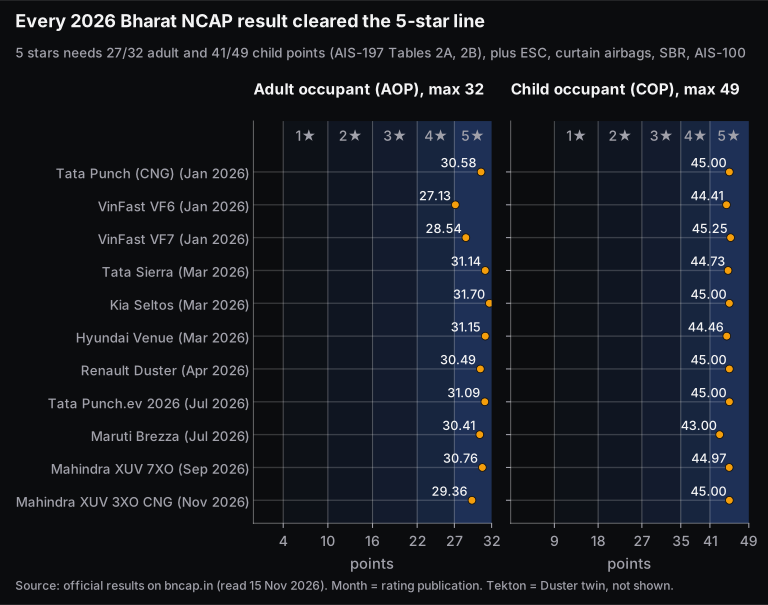
- Up to 15 November 2026, Bharat NCAP has published 11 new car ratings in 2026 (10 crash-tested models and one corporate twin) plus a CNG extension for the Mahindra XUV 3XO. All of them earned 5 stars for both adult and child occupant protection.
- The highest adult score of the year is the Kia Seltos at 31.70/32. The lowest is the VinFast VF6 at 27.13/32, only 0.13 points above the 27-point line for 5 stars.
- The newest result is the XUV 3XO CNG (November 2026): a fresh frontal test scored 13.91/16, but the rating stays at 29.36/32 and 45/49.
- Several cars in recent "November" headlines were not tested this month. The Nexon.ev and Thar Roxx ratings date from 2024. The Brezza was rated in July 2026 and the Sierra in March 2026; in November the Sierra's rating was only extended to new variants.
- To earn 5 stars a car needs at least 27 of 32 adult points and 41 of 49 child points. It also needs ESC, side head protection that passes a 29 km/h pole test, seat belt reminders and pedestrian protection to AIS-100.
Every car Bharat NCAP has rated in 2026 so far got 5 stars for adult occupant protection (AOP) and 5 stars for child occupant protection (COP). That covers 11 ratings published between January and September 2026, plus a November 2026 update that brought the Mahindra XUV 3XO's CNG variants under its existing 5-star rating. Every score below comes from the official Bharat NCAP portal, bncap.in, which we read on 15 November 2026.
After the tracker, this guide explains how the protocol turns crash-test dummy readings into stars. It covers the three crash tests, the points maths and the extra conditions for 5 stars. It ends with what crash-CAE (computer-aided engineering) engineers in India actually change in a car to get it over the line.
Bharat NCAP ratings 2026: every result so far
Bharat NCAP lists each rating with a "month onwards" date, which is the month the rating was published. The month of assessment (when the car was tested and scored) is usually a month or two earlier. Both are shown below. "Frontal" is the 64 km/h offset test and "Side" is the 50 km/h barrier test, each scored out of 16. Their sum is the AOP score out of 32.
| Car (variants tested) | Assessed | Published | Frontal /16 | Side /16 | AOP /32 | COP /49 | Stars (adult / child) |
|---|---|---|---|---|---|---|---|
| Tata Punch (Pure+ CNG AMT, Accomplished CNG MT) | Dec 2025 | Jan 2026 | 14.71 | 15.87 | 30.58 | 45.00 | 5 / 5 |
| VinFast VF6 (Earth, Wind, Sky) | Nov 2025 | Jan 2026 | 11.13 | 16.00 | 27.13 | 44.41 | 5 / 5 |
| VinFast VF7 (Wind, Sky) | Nov 2025 | Jan 2026 | 12.54 | 16.00 | 28.54 | 45.25 | 5 / 5 |
| Tata Sierra (Accomplished+, Adventure+ diesel MT) | Feb 2026 | Mar 2026 | 15.14 | 16.00 | 31.14 | 44.73 | 5 / 5 |
| Kia Seltos (HTE(O), GTX diesel AT) | Feb 2026 | Mar 2026 | 15.70 | 16.00 | 31.70 | 45.00 | 5 / 5 |
| Hyundai Venue (HX2 diesel MT, HX10 diesel AT) | Feb 2026 | Mar 2026 | 15.15 | 16.00 | 31.15 | 44.46 | 5 / 5 |
| Renault Duster (Evolution 1.3 MT, Techno 1.3 DCT, Iconic 1.3 MT) | Mar 2026 | Apr 2026 | 14.49 | 16.00 | 30.49 | 45.00 | 5 / 5 |
| Tata Punch.ev 2026 (Adventure 40, Empowered+ S 40) | May 2026 | Jul 2026 | 15.28 | 15.80 | 31.09 | 45.00 | 5 / 5 |
| Nissan Tekton (rated as the Duster's corporate twin, not separately tested) | Jun 2026 | Jul 2026 | 14.49 | 16.00 | 30.49 | 45.00 | 5 / 5 |
| Maruti Brezza (ZXi+ 1.5 6AT; select variants only) | Jun 2026 | Jul 2026 | 14.41 | 16.00 | 30.41 | 43.00 | 5 / 5 |
| Mahindra XUV 7XO (AX7 diesel AT 2WD, AX7L diesel AT 4WD) | Jul 2026 | Sep 2026 | 14.76 | 16.00 | 30.76 | 44.97 | 5 / 5 |
| Mahindra XUV 3XO CNG (extension; frontal test on AX5 CNG) | Nov 2026 | Nov 2026 | 13.36* | 16.00 | 29.36 | 45.00 | 5 / 5 |
*The XUV 3XO CNG scored 13.91/16 in its own frontal test. The rating keeps the lower 13.36 from the original October 2024 test. The Punch.ev's frontal and side scores add to 31.08, while its published total is 31.09. That gap is rounding: the protocol keeps each body-region score to three decimal places, and the portal shows only two.
Star counts come from the thresholds in AIS-197, the standard Bharat NCAP runs on: 27 or more adult points and 41 or more child points mean 5 stars, provided the safety-equipment conditions below are met. The official pages show stars as graphics, and the scores above sit inside the 5-star bands.
What actually changed in November 2026?
Only one result is new this month, and it is an extension of an older rating:
- Mahindra XUV 3XO CNG. The official fact sheet (Revision 02, November 2026) extends the XUV 3XO's 5-star rating to six CNG variants: MX1, MX2, MX EDGE, REVX EDGE(O), AX5 and REVX A. Bharat NCAP ran a new frontal offset test on an AX5 CNG with a crash-test weight of 1,726 kg, against 1,737 kg for the 2024 test car. The side barrier and pole results were carried over because the structure and safety systems are unchanged. The same revision raised the child score from 43 to 45 for vehicles built from VIN MA1NS2NVPS2B98575 onwards, after the vehicle-assessment score went from 7 to 9 of 13 "on meeting the marking requirements". Autocar India reported the result on 6 November 2026.
- Tata Sierra. Revision 03 (November 2026) adds a long list of new Sierra variants, assessed in September 2026, to the rating first published in March 2026. There was no new crash test and the scores (31.14 and 44.73) are unchanged.
Some other cars are being described online as "new" results, but their official dates say otherwise:
- Tata Nexon.ev: 29.86/32 and 44.95/49, rated from May 2024. Bharat NCAP extended it to the 45 kWh variants in March 2025 and added more variants in August 2025. There is no 2026 retest on the portal.
- Mahindra Thar Roxx: 31.09/32 and 45/49, assessed in October 2024 and rated from November 2024.
- Maruti Brezza (2026 facelift): assessed in June 2026 and rated from July 2026. Autocar India reported the result on 23 July 2026.
Any results announced after 15 November will appear on the official list first. Treat a crash-test headline without a bncap.in page as reported, not confirmed.
What the 2026 numbers tell you
All the ratings are 5 stars, so the more useful question is where these cars still lost points.
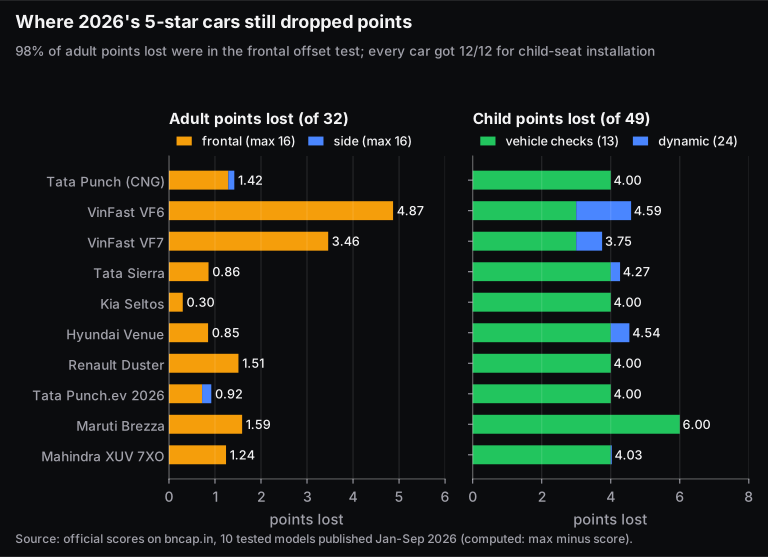
- The frontal offset test decides the adult score. Eight of the 10 tested models scored a full 16/16 in the side barrier test. Across all 10, the frontal test accounts for 98% of the adult points lost: an average of 1.67 points against 0.03 in the side test.
- Every car scored 12/12 for child-seat installation. Child points were lost mainly in the vehicle-based checks (out of 13): on average 4 points, against 0.32 in the dynamic child-dummy tests. None of the fact sheets we checked (Sierra, Brezza, XUV 7XO, XUV 3XO) lists an integrated child seat, and that item alone is worth 2 points.
- Small details move the child score. The Brezza scored 7 of 13 on vehicle checks, two fewer than most cars. Its page lists no passenger airbag cut-off switch, and airbag warning marking and disabling is worth up to 4 points. The XUV 3XO gained exactly 2 points, and went from 43 to 45, when it met the marking requirement.
How does Bharat NCAP test a car?
Bharat NCAP is a voluntary programme run by the Ministry of Road Transport and Highways (MoRTH). Union minister Nitin Gadkari launched it on 22 August 2023 and testing began on 1 October 2023. It covers type-approved M1 (passenger) vehicles under 3.5 tonnes gross weight. The base variant of a model is tested, and the Central Institute of Road Transport (CIRT) anchors the programme. A manufacturer may also sponsor an extra test of a better-equipped variant. That result is published alongside the base rating, as with the Maruti Baleno, which has separate 2-airbag and 6-airbag ratings.
The rules are in AIS-197 (September 2023 version). The standard specifies three full-vehicle crash tests:
| Test | Speed | Set-up | Dummies | Scores |
|---|---|---|---|---|
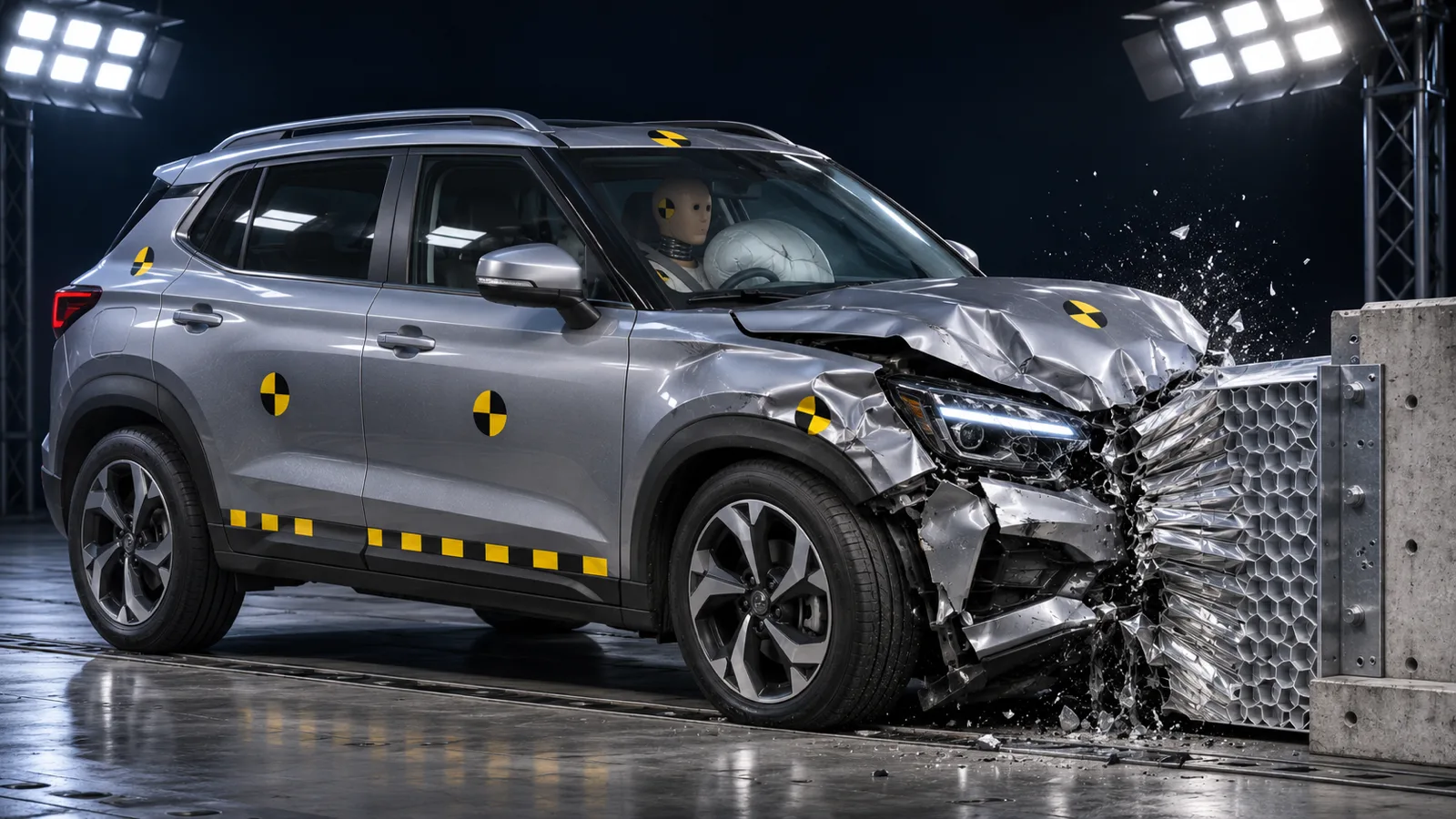
| Offset deformable barrier (ODB) frontal | 64 km/h ± 1 | 40% of the car's width, on the driver side, hits a deformable barrier (to UNECE R94) fixed to a concrete block | Two Hybrid III 50th-percentile adults in front; Q1.5 and Q3 child dummies in rear child seats | 16 adult points + 16 child points |
| Mobile deformable barrier (MDB) side | 50 km/h ± 1 | A 950 kg trolley with an aluminium-honeycomb deformable face strikes the stationary car at the driver's seating position | ES-2 side-impact adult at the driver seat; Q1.5 and Q3 in the rear | 16 adult points + 8 child points |
| Side pole | 29 km/h ± 0.5 | The car slides sideways at 90° into a rigid 254 mm pole aligned with the driver's head | ES-2 at the driver seat | Pass ("OK") or fail on head criteria |
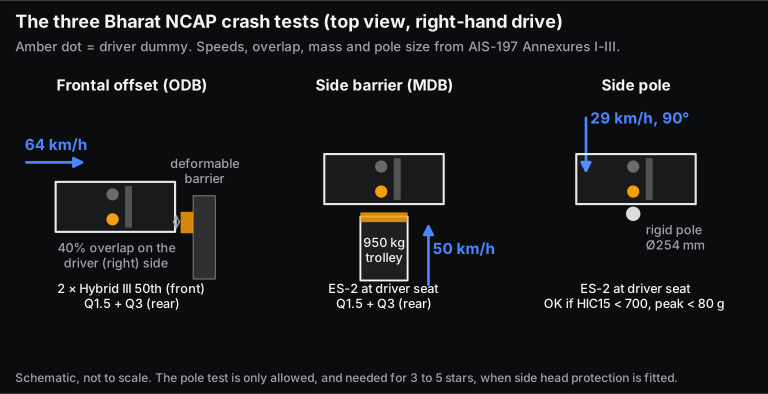
To see how hard each test is, compare the kinetic energy (½mv²) involved. The Tata Sierra's crash-test weight is 1,825 kg, and at 64 km/h (17.78 m/s) it carries about 288 kJ into the barrier. Because of the 40% overlap, most of that energy goes through one side of the front structure. The side trolley brings 950 kg at 50 km/h, about 92 kJ. That is less energy, but there is only a door, a pillar and a few centimetres of padding between the barrier and the occupant. In the pole test the same Sierra carries about 59 kJ, all of it concentrated on a 254 mm-wide post. These are our calculations from the official masses and speeds.
Two details matter for Indian cars. First, the frontal overlap is always on the steering-wheel side, which is the right-hand side of an Indian car. Second, the testing agency chooses whether to run the side tests on the driver or the passenger side, using the same criteria either way. A car that reinforces only one side therefore gains nothing.
How is a Bharat NCAP star rating calculated?
Adult occupant protection: 32 points
Each dummy reading is converted to points on a sliding scale. Every body region has a higher-performance limit, at or below which it earns the full 4 points, and a lower-performance limit, at or beyond which it earns zero. In between, the points are linearly interpolated. For the frontal test, the regions are head and neck, chest, knee-femur-pelvis, and leg and foot. For each region the worse of the driver and front passenger counts, and the four regions add up to 16. The side test scores head, chest, abdomen and pelvis on the ES-2 dummy, also to 16.
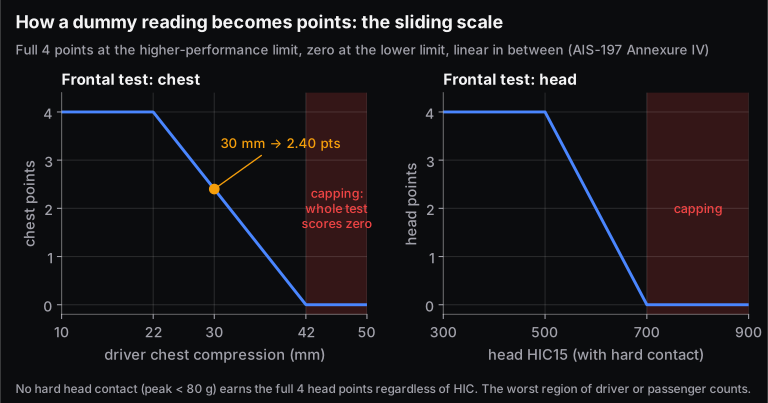
A worked example: a driver chest compression of 30 mm sits between the 22 mm and 42 mm limits, so the chest earns 4 × (42 − 30) / (42 − 22) = 2.40 points. Some limits from AIS-197, Annexure IV:
| Region (test) | Full 4 points at | Zero points at |
|---|---|---|
| Head (frontal, if there is hard contact) | HIC15 500; 72 g for 3 ms | HIC15 700; 88 g for 3 ms (also the capping limit) |
| Chest (frontal) | 22 mm compression; viscous criterion 0.5 m/s | 42 mm; 1.0 m/s (capping) |
| Knee, femur, pelvis (frontal) | Femur 3.8 kN; knee slider 6 mm | Femur 9.07 kN at 0 ms; knee slider 15 mm |
| Lower leg (frontal) | Tibia index 0.4; tibia compression 2 kN | Tibia index 1.3; 8 kN |
| Foot and ankle (frontal, driver) | Pedal moves 100 mm rearward | 200 mm |
| Chest (side, worst rib) | 22 mm; viscous criterion 0.32 m/s | 42 mm; 1.0 m/s |
| Abdomen (side) | 1.0 kN total force | 2.5 kN |
| Pelvis (side) | 3.0 kN pubic symphysis force | 6.0 kN |
If the head has no hard contact (peak acceleration below 80 g and no other evidence of a strike), it gets the full 4 points regardless of HIC. Inspectors then apply modifiers that only subtract points:
- Head: −1 for unstable contact with the airbag, for example if the head slides off its edge or bottoms out.
- Airbags: −1 for any airbag that deploys incorrectly.
- Steering column: up to −1 if the column moves too far. The penalty starts at 90% of the limits (100 mm rearward, 80 mm upward, 100 mm lateral) and reaches −1 at 110%.
- A-pillar: up to −2 if it moves rearward. There is no penalty up to 100 mm and the full −2 at 200 mm.
- Passenger compartment: −1 if structural integrity is lost, for example a door latch failure or the dashboard rail separating from the A-pillar.
Two general rules can also cut stars. If a critical body region is rated red (zero points), the adult rating is limited to 1 star, whatever the total. If the frontal and side scores differ by more than 35%, the adult rating drops by one star. That second penalty does not apply if both tests score above 8.2 and the total is above 22. For EVs and hybrids, a post-crash compliance check follows the tests, with a penalty of up to 1 point.
Child occupant protection: 49 points
- Dynamic tests, 24 points. The Q1.5 and Q3 dummies ride in the rear seat in the maker's recommended child seats. Each can earn 8 points in the frontal test and 4 in the side test. Ejection and head contact with the vehicle are switches, meaning that failing them removes points regardless of the readings.
- Child seat installation, 12 points. A list of common child seats is fitted in each seating position (10 points), plus the maker's recommended seats (2 points).
- Vehicle-based assessment, 13 points. Gabarit checks on all passenger seats are worth 2 points (the Gabarit is a gauge that tests whether the adult seat belts can hold a universal child seat) and three simultaneous child-seat positions another 2. ISOFIX usability is worth 2 and two or more large ISOFIX positions 1. Passenger airbag warning marking and disabling earns 0 to 4, and an integrated child seat 2. Three-point belts in every seat are a switch.
Points to stars, and the equipment you must fit
| Stars | Minimum adult points (of 32) | Minimum child points (of 49) | ESC and side head protection |
|---|---|---|---|
| 5 | 27 | 41 | Both required; pole test must be passed |
| 4 | 22 | 35 | Both required; pole test must be passed |
| 3 | 16 | 27 | ESC required from Oct 2025; side head protection optional in at least one variant, pole test required |
| 2 | 10 | 18 | Optional |
| 1 | 4 | 9 | Optional |
At every star level, pedestrian protection to AIS-100 and seat belt reminders to AIS-145 must be fitted as standard. For 5 stars, AIS-197 also sets fitment rates. The maker must commit to ESC on 100% of the model within two years of the result. Side head protection (in practice, curtain airbags) must be standard on at least 70% of production for ratings published from October 2025 to September 2026, 90% from October 2026 to September 2027, and 100% from October 2027. The pole test is not allowed at all unless side head protection is fitted, which is why curtain airbags decide whether a car can reach 4 or 5 stars.
Worked example, Mahindra XUV 3XO: frontal 13.36 + side 16.00 = 29.36 adult points, which clears 27, so 5 stars. On the child side, dynamic 24 + installation 12 + vehicle checks 9 = 45 points, which clears 41, so 5 stars. The VinFast VF6 shows how thin the margin can be: 11.13 + 16.00 = 27.13, just 0.13 points above the 27-point line for 5 stars.
What do crash-CAE engineers do to get a car to 5 stars?
A physical Bharat NCAP test happens once, on a finished car. The work that decides the result happens months earlier in simulation. Crash engineers build a finite element model of the vehicle and run it in an explicit solver such as LS-DYNA or Radioss. The model includes virtual dummies (FE models of the Hybrid III 50th and ES-2 are available for LS-DYNA) and virtual barriers. The scoring rules above double as a list of design targets.
1. Win the frontal offset test (where 2026 cars lost most points)
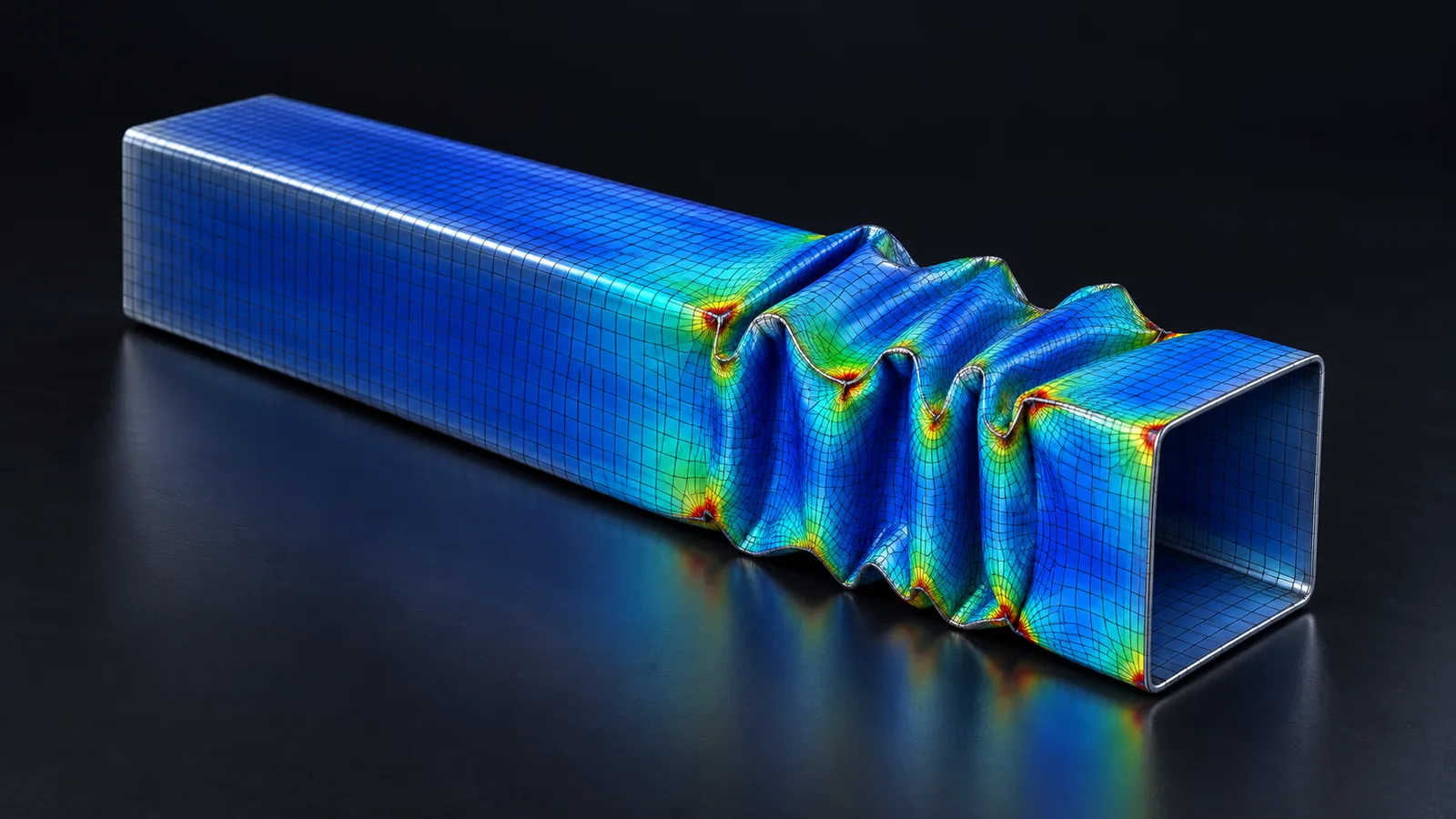
- Manage about 288 kJ through one side of the car. The bumper beam, crash boxes and front longitudinal rail on the struck side must crush progressively, folding like a concertina rather than bending or buckling. Upper load paths, such as the shotgun rail above the wheel arch, and the subframe share the load.
- Keep the cabin intact. The A-pillar must move less than 100 mm to avoid any penalty, and the steering column must stay within 90% of its limits. The pedals should move rearward less than 100 mm, and the footwell, hinge pillar and door latches must survive. Each of these is a modifier or a sliding-scale input, so engineers read them straight off the simulation and add margin.
- Tune the restraints. With the structure fixed, frontal points come from the airbag, belt pretensioner and load limiter working together. The aim is to hold chest compression close to 22 mm, keep the head on the centre of the airbag (no −1 for unstable contact), and keep femur loads under 3.8 kN through knee-bolster design. Restraint engineers iterate this in sled and occupant simulations because the scoring is so sensitive: on the chest scale, every 5 mm of compression between 22 and 42 mm is worth a full point.
2. Hold 16/16 in the side test
- Resist intrusion over a short distance. The trolley's 92 kJ arrives with only the door, B-pillar and sill between it and the ES-2 dummy. That is why B-pillar reinforcements are often hot-stamped boron steel. SSAB, for example, lists B-pillar reinforcements as an application of its press-hardening grade, with typical hot-stamped tensile strength around 1,590 MPa. Door beams, seat cross-members and the floor tie the two sides together.
- Use side airbags to limit rib deflection. The chest score depends on the worst single rib (22 mm for full points), and abdomen and pubic forces are scored too. Side chest airbags appear on every 2026 fact sheet we checked (Sierra, Brezza, XUV 7XO). All except the Brezza also list pelvis airbags.
- Design both sides. The agency picks the side, and any asymmetry in reinforcements or spot-weld density attracts modifiers. AIS-197 states that CAD data is not accepted as evidence.
3. Pass the pole
The pole test is pass or fail on the head: HIC15 below 700, peak acceleration below 80 g, and no direct head contact with the pole. In practice that means the curtain airbag must cover the head zone at the moment of contact. The sill, roof rail and B-pillar also have to stop the pole before it reaches the occupant's space. A car that fails it cannot reach 3 stars or above.
4. Engineer for variants and margin
A rating applies only to the listed variants, so every new trim, engine or fuel type has to be checked. The XUV 3XO CNG shows the process: the CNG car needed a new frontal test, but the side and pole results were carried over because the structure and safety systems were unchanged. In simulation, teams run the worst-case variant (heaviest, different engine package, added tank or battery) with deliberate margin to every limit. Test-to-test scatter and a single modifier can easily cost more than the VF6's 0.13-point margin over the 5-star line. Correlating simulation with physical tests, by matching pulses, intrusions and dummy traces, is a large part of a crash-CAE engineer's job.
If you want to build these skills, Skill-Lync's Crashworthiness Analysis using HyperMesh and Radioss and LS-DYNA for Structural Mechanics courses cover explicit crash set-up. Automotive Safety Standards covers the regulations behind the tests. For background, read our guides to crash testing for automobile applications, adult occupant protection, how airbags work and implicit vs explicit FEA.
What a 5-star Bharat NCAP rating does not tell you
A star rating is a result from a fixed set of laboratory tests, and its limits matter:
- It covers the three crash configurations above. Today's protocol has no full-width frontal test, no rear-impact test and no rated autonomous emergency braking (AEB) test. Pedestrian protection is only a fitment condition, met by AIS-100 compliance, not a scored test.
- It applies to the listed variants. Some ratings, such as the Brezza's and Kia Syros's, cover "select variants only". Check the annexure on the fact sheet before you assume your trim is covered.
- Scores are comparable within Bharat NCAP. They are not directly comparable with Euro NCAP or Global NCAP, which use different protocols and scoring.
- Because every 2026 car scored 5 stars, the star count barely separates them this year. The decimal scores and the points-lost pattern above tell you more.
What is Bharat NCAP 2.0?
MoRTH published draft rules for a revised protocol, AIS-197 Revision 1, in November 2025. Autocar India reported the details on 24 November 2025. As reported, the draft would replace the current protocol in October 2027 with a 100-point score in five pillars: crash protection 55%, vulnerable road-user protection 20%, safe driving 10%, accident avoidance 10% and post-crash safety 5%. It would add a 50 km/h full-width frontal test and a 50 km/h rear impact, and run the pole test obliquely at 32 km/h (today's runs at 29 km/h and 90°). The 5-star threshold would be 70 points for 2027-29 and 80 points for 2029-31. ESC and curtain airbags would be prerequisites for any rating. The proposal is still a draft and the final numbers could change. For crash-CAE teams, it would mean more load cases to design for, starting with cars launched from late 2027.
Frequently asked questions
Which cars got 5 stars in Bharat NCAP in 2026?
All of them, so far. As of 15 November 2026 the 2026 ratings are: Tata Punch (CNG), VinFast VF6, VinFast VF7, Tata Sierra, Kia Seltos, Hyundai Venue, Renault Duster, Nissan Tekton (Duster twin), Tata Punch.ev 2026, Maruti Brezza and Mahindra XUV 7XO, plus the November extension to the XUV 3XO CNG. Each scored 5 stars for adult and child protection.
Did the Tata Nexon EV get a new Bharat NCAP rating in November 2026?
No. The Nexon.ev's 5-star rating (29.86/32 adult, 44.95/49 child) has applied since May 2024. It was extended to the 45 kWh variants in March 2025 and to more variants in August 2025. The official portal shows no 2026 retest.
What score does a car need for 5 stars in Bharat NCAP?
At least 27 of 32 adult occupant points and 41 of 49 child occupant points. The car also needs ESC and side head protection that passes the 29 km/h pole test, with minimum fitment rates across production. Seat belt reminders and AIS-100 pedestrian protection must be standard.
Does a Bharat NCAP rating apply to all variants of a car?
Only to the variants listed in the annexure of the official fact sheet. Bharat NCAP tests the base variant, and makers can apply to extend the rating to new variants, as Tata did for the Sierra in November 2026. Ratings marked "select variants only", such as the Brezza's, do not cover every trim.
Is Bharat NCAP testing mandatory?
No. It is a voluntary programme for passenger cars under 3.5 tonnes. Manufacturers submit models for testing. The rules also allow the government to ask for a particular variant of any model to be selected in the interest of public safety.
Which 2026 car scored highest in Bharat NCAP?
For adult protection, the Kia Seltos scored 31.70/32. For child protection, the VinFast VF7 scored 45.25/49. Among all rated cars, the Tata Harrier.ev and Mahindra XEV 9e (both 2025) hold full 32/32 adult scores.
Sources and further reading
- Bharat NCAP (MoRTH / CIRT), Vehicle safety ratings, official list read 15 Nov 2026, and the model pages for the Tata Punch, VinFast VF6, VinFast VF7, Tata Sierra, Kia Seltos, Hyundai Venue, Renault Duster, Nissan Tekton, Tata Punch.ev 2026, Maruti Brezza, Mahindra XUV 7XO, Mahindra XUV 3XO, Tata Nexon.ev and Mahindra Thar Roxx
- Bharat NCAP, Mahindra XUV 3XO fact sheet, Revision 02 (Nov 2026) and Tata Sierra fact sheet, Revision 03 (Nov 2026)
- Bharat NCAP, AIS-197: Bharat New Car Assessment Programme (September 2023 version, posted 24 Apr 2024): test protocols, scoring, star thresholds, modifiers and safety assist requirements
- Press Information Bureau (MoRTH), Shri Nitin Gadkari launches Bharat NCAP (22 Aug 2023)
- Autocar India, Mahindra XUV 3XO CNG secures 5-star BNCAP crash safety rating (6 Nov 2026)
- Autocar India, 2026 Maruti Brezza scores 5-star Bharat NCAP rating (23 Jul 2026)
- Autocar India, Govt proposes Bharat NCAP 2.0 with wider crash tests and tougher ratings (24 Nov 2025)
- Ansys LS-DYNA, Dummy models overview and downloads (Hybrid III 50th and ES-2 finite element models)
- SSAB, Docol PHS 1500 press-hardening steel: B-pillar reinforcement applications, typical hot-stamped properties