New PUC Certificate Validity Rules: 3 Years for BS-VI, 6 Months for BS-IV
MoRTH's final rule, G.S.R. 991(E) in force from 16 November 2026, gives young BS-VI vehicles a three-year PUC certificate and halves validity for BS-IV and older vehicles. Here is the full table, what the gazette leaves open, how petrol and diesel PUC tests work, a smoke-opacity and lambda calculation done by script, and why BS-VI on-board diagnostics change the case.

A Pollution Under Control (PUC) certificate for a BS-VI private car or two-wheeler up to six years old is now valid for three years instead of one. The catch is that older vehicles now need the test more often: BS-IV certificates drop from 12 months to 6, and BS-I to BS-III certificates drop from 6 months to 3. The change is final. The Ministry of Road Transport and Highways (MoRTH) notified it as G.S.R. 991(E), dated 13 November 2026, in the Gazette of 16 November 2026, and it took effect on publication. The Press Information Bureau (PIB) announced it on 19 November 2026.
Below: what changed and when it applies, what the gazette leaves unsaid, how a petrol and diesel PUC test works (with a smoke-opacity and a lambda calculation done by script), why BS-VI on-board diagnostics matter, and what this means for automotive and calibration engineers.
Key facts at a glance
- 19 November 2026, 4:12 PM: PIB release 2338468 says MoRTH "has amended sub-rule (7) of Rule 115" of the Central Motor Vehicles Rules, 1989 (CMVR), the rule that sets PUC validity.
- The legal text: the Central Motor Vehicles (Sixteenth Amendment) Rules, 2026, G.S.R. 991(E), dated 13 November 2026. It was published in the Gazette of India Extraordinary No. 885 on 16 November 2026 and came into force that day.
- BS-VI non-transport vehicles: certificates now last 3 years up to age 6, 1 year from age 6 to 10, and 6 months after age 10. Age is counted from the date of first registration. BS-VI transport vehicles get 2 years, 1 year and 6 months.
- Older norms tighten: BS-IV goes from 12 months to 6 months. BS-I, BS-II and BS-III go from 6 months to 3 months.
- Transition: a certificate issued before 16 November 2026 keeps its old validity. The new period applies from its first renewal.
- Not changed: the tailpipe limits in Rule 115(2). For a BS-IV or BS-VI car these are idle CO 0.3% and HC 200 ppm for petrol, and mean smoke 1.62 m⁻¹ for diesel.
Courses: the engineering behind these numbers (combustion, air-fuel ratio, aftertreatment and calibration) is taught in Skill-Lync's IC Engine Calibration using GT-POWER and GT-SUITE and Euro VI Calibration using GT-Suite courses.
What did MoRTH change in the PUC certificate rules?
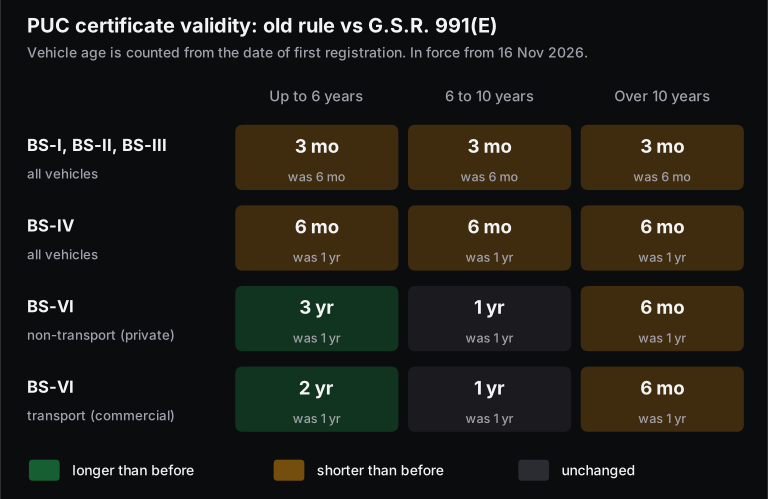
MoRTH replaced one validity for all BS-IV and BS-VI vehicles with a table set by emission norm, vehicle type and age. A BS-VI private car up to six years old now needs a PUC certificate once every three years. From age 6 to 10 it needs one every year, and after age 10 one every six months. BS-IV and older vehicles get shorter validity than before.
Until 15 November 2026, Rule 115(7) said a vehicle needed a PUC certificate once it was a year past first registration. The certificate was valid for six months, or twelve months for vehicles built to BS-IV or BS-VI norms (MoRTH's own wording, quoted by PIB on 22 July 2021). The amendment replaces that sub-rule with a new (7), which requires a valid certificate, and a new (7A) with this table:
| Vehicle category (Rule 115(7A)) | Old validity | New validity, from first registration |
|---|---|---|
| BS-I, BS-II and BS-III, all vehicles | 6 months | 3 months |
| BS-IV, all vehicles | 12 months | 6 months |
| BS-VI non-transport (private cars, two-wheelers) | 12 months | Up to 6 years: once every 3 years. Over 6 and up to 10 years: once every year. Over 10 years: once every 6 months. |
| BS-VI transport (taxis, buses, goods vehicles) | 12 months | Up to 6 years: once every 2 years. Over 6 and up to 10 years: once every year. Over 10 years: once every 6 months. |
PIB gives MoRTH's reasons as three aims: match how often vehicles are tested to their age, "reduce the compliance burden on owners of newer and cleaner vehicles", and keep "continued monitoring of emissions from in-use vehicles".
Is the new PUC rule final or still a draft?
It is final. G.S.R. 991(E) is the Central Motor Vehicles (Sixteenth Amendment) Rules, 2026. Its preamble says objections to the draft were considered, and clause 1(2) says the rules "come into force on the date of their publication in the Official Gazette". That date is Monday, 16 November 2026 (Gazette Extraordinary No. 885).
The confusion is understandable. The PIB release says MoRTH "has amended" the rule, but a line further down calls the periods "proposed". That reads like wording carried over from the draft stage. The draft was G.S.R. 664(E), dated 22 July 2026 and gazetted on 24 July 2026. It gave 30 days for comments to [email protected], and many outlets reported it in late July as a proposal. The final rule keeps the draft's periods, rewords them as "once in every three years" and so on, splits the sub-rule into (7) and (7A), and was published 115 days after the draft.
Confirmed vs reported. Everything in the table above comes from the gazette text, which we read in full. We have not used figures that appear only in news reports. The gazette and the release do not cover four things:
- Penalties. Neither document changes them or mentions them.
- Software dates. There is no date for when state PUC software, which has been linked to the VAHAN registration database since G.S.R. 527(E) of 6 June 2018, will issue certificates with the new validity.
- Boundary cases. The text does not say how a certificate issued close to a band edge is treated. Take a car aged 5 years 6 months: does it get three years, or only cover up to age 6? Ask your state transport department if this affects you.
- Brand-new vehicles. The old sub-rule started the PUC requirement "after the expiry of a period of one year" from first registration. The new sub-rule (7) does not contain those words. Neither MoRTH nor PIB has commented on the change, so we would not assume either way how it applies to a new vehicle.
When do the new validity periods apply to my vehicle?
From the first renewal after 16 November 2026. A certificate issued before that date stays valid for the period printed on it. Say a BS-VI car got a one-year certificate in October 2026: it keeps it until October 2027, and the renewal then gives three years if the car is still within six years of registration. A BS-IV owner's next renewal gives six months instead of twelve.
The amendment also adds a renewal rule that the old text did not have. If you renew within ten days before expiry, the new certificate starts on the old one's expiry date, so the early days are not lost. If you renew after expiry, it starts on the renewal date. Our script (calc.py) checks one example:
- A certificate expires on 30 November 2026. The owner renews on 22 November, eight days early, so the new certificate takes effect from 30 November 2026.
- If the owner instead renews on 5 December, the new certificate runs from 5 December. The vehicle had no valid certificate for four days (1 to 4 December).
The text covers renewal "within ten days preceding" expiry and renewal after expiry. It does not say what happens if you renew more than ten days early.
Do BS-VI vehicles need fewer PUC tests over their life?
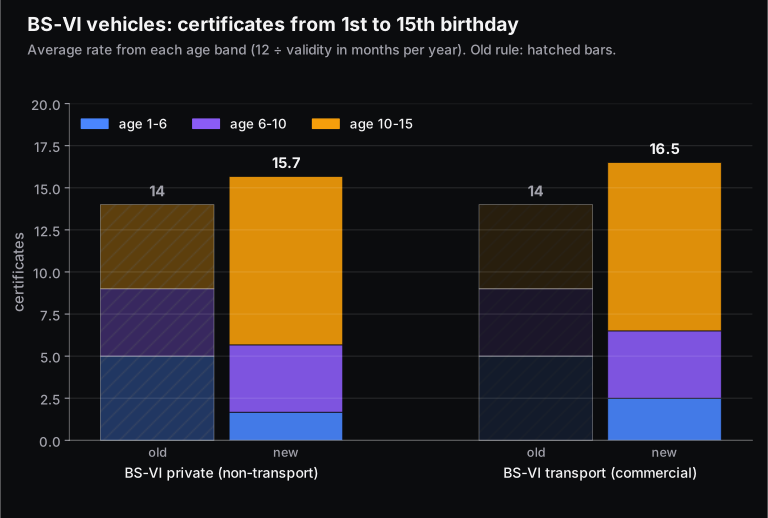
Fewer in the first six years, but slightly more over a typical 15-year life. Take a BS-VI private car from its first to its fifteenth birthday. The old rule needed 14 annual certificates. The new table needs about 15.7 on average: 1.7 in years 1 to 6 instead of 5, the same 4 in years 6 to 10, and 10 in years 10 to 15 instead of 5. The test moves from new vehicles to old ones.
The count uses the average rate in each age band, 12 divided by the validity in months, multiplied by the years spent in that band:
A BS-VI transport vehicle goes from 14 to 16.5 (2.5 + 4 + 10). A BS-IV vehicle doubles its rate, from one test a year to two, and a BS-III vehicle goes from two a year to four. The real count depends on when each renewal falls relative to the 6- and 10-year boundaries, which the gazette does not settle. Treat these as averages, not a schedule.
How does a PUC test actually work?
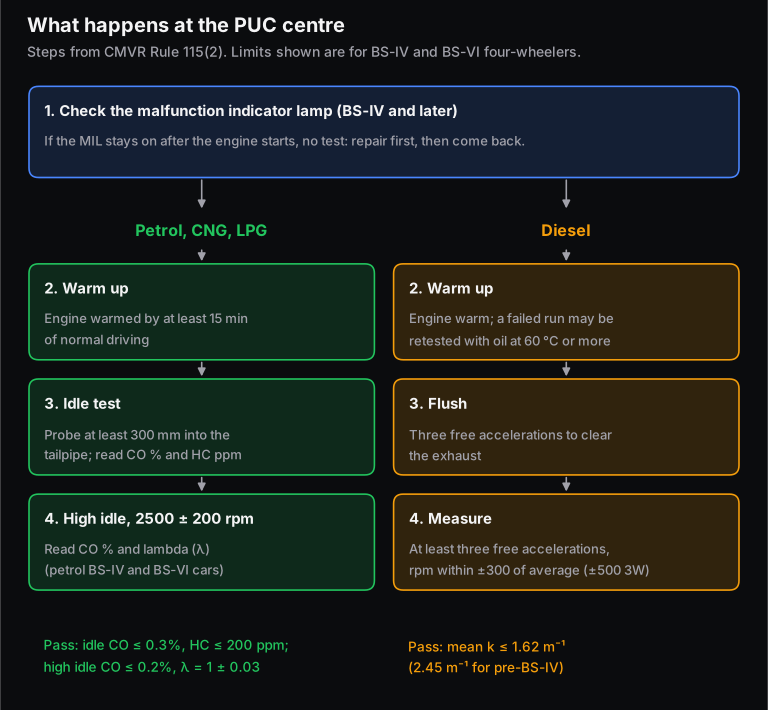
A PUC test is a short tailpipe check at idle, not a full emissions test. Petrol, CNG and LPG vehicles are measured for carbon monoxide (CO) and hydrocarbons (HC) at idle. Petrol BS-IV and BS-VI cars also get a high-idle check of CO and lambda. Diesel vehicles get a free-acceleration smoke test. Results are compared with fixed limits in CMVR Rule 115(2), using instruments type-approved under Rule 116(3).
Petrol, CNG and LPG: idle and high-idle test
The engine is first warmed by at least 15 minutes of normal driving. At idle, the analyser's probe goes at least 300 mm into the tailpipe and reads CO as a percentage by volume and HC in ppm (n-hexane equivalent). For petrol BS-IV and BS-VI four-wheelers, the engine is then held at high idle, 2,500 ± 200 rpm. CO must be 0.2% or less there, and lambda must be 1 ± 0.03 or the value the manufacturer declares. For CNG the HC limit applies to non-methane HC, taken as 0.3 × HC. For LPG it applies to reactive HC, 0.5 × HC. Bi-fuel vehicles are tested on gas.
| Petrol/CNG/LPG vehicle (Rule 115(2)) | Idle CO (%) | Idle HC (ppm) |
|---|---|---|
| 2- and 3-wheelers made on or before 31 Mar 2000 | 4.5 | 9,000 |
| 2-wheelers made after 31 Mar 2010 (2-stroke / 4-stroke) | 3.0 | 4,000 / 3,000 |
| 3-wheelers made after 31 Mar 2000 (2-stroke / 4-stroke) | 3.5 | 6,000 / 4,500 |
| 4-wheelers, pre-BS-II | 3.0 | 1,500 |
| 4-wheelers, BS-II and BS-III | 0.5 | 750 |
| 4-wheelers, BS-IV and BS-VI (plus high idle: CO 0.2%, λ 1 ± 0.03) | 0.3 | 200 |
What does lambda 1 ± 0.03 mean?
Lambda (λ) is the actual air-fuel ratio divided by the chemically correct, or stoichiometric, ratio. At λ = 1 there is just enough air to burn all the fuel. A three-way catalytic converter only cleans CO, HC and NOx together in a narrow band around that point, so a lambda far from 1 at high idle points to a fuelling or sensor fault. Here is the stoichiometric ratio for iso-octane, a common stand-in for petrol (calc.py):
So the PUC window allows about ±0.45 kg of air per kg of fuel around stoichiometric for this fuel. Commercial petrol is a blend, so its exact stoichiometric ratio differs a little, which is one reason the rule also accepts a manufacturer-declared lambda. Our adiabatic flame temperature calculator shows what happens to flame temperature away from λ = 1. It uses the equivalence ratio, which is 1/λ.
Diesel: the free-acceleration smoke test
A diesel engine has no fixed air-fuel ratio to check, so the PUC test measures smoke. The tester floors the accelerator with the engine in neutral and lets it rev to its governed maximum, then releases. This is called a free acceleration. Rule 115(2) asks for three flushing accelerations to clear the exhaust, then at least three measured ones. Each measured run must reach a peak rpm within ±300 rpm of the average (±500 rpm for three-wheelers). The result is the mean of the measured peak smoke readings. If the engine's malfunction indicator lamp (MIL) is on, a BS-IV or later vehicle is not tested and must come back after repair. A failing vehicle may be retested with engine oil at 60 °C or more.
What is smoke opacity, and how is the k-value calculated?
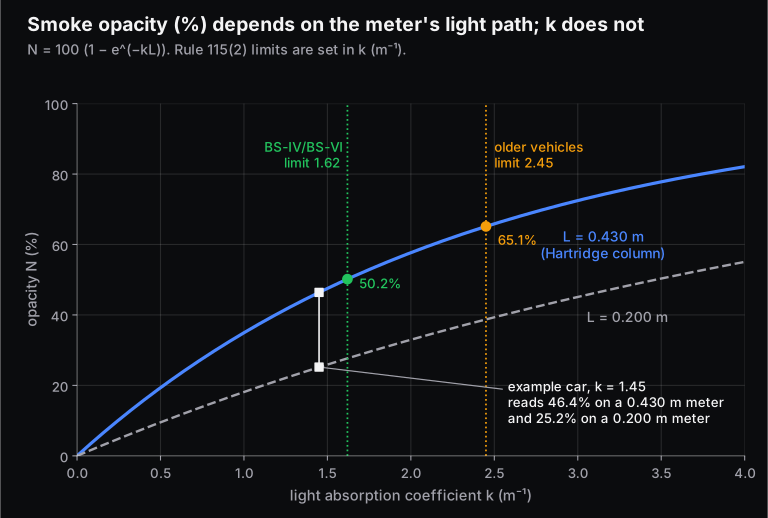
Smoke opacity is the share of a light beam that exhaust smoke blocks, in per cent. The rule's limit is set as a light absorption coefficient k, in m⁻¹, because opacity depends on how long the meter's light path is and k does not. The two are linked by the Beer-Lambert law. For BS-IV and BS-VI diesels the limit is 1.62 m⁻¹. For older diesels it is 2.45 m⁻¹.
Light of flux crosses an exhaust column of effective length and leaves with flux . Opacity N runs from 0 (clean) to 100 (fully dark):
Rule 115(2) gives each limit twice: 2.45 m⁻¹ or 65 Hartridge Smoke Units (HSU), and 1.62 m⁻¹ or 50 HSU. HSU is percentage opacity over a 430 mm column, as defined in Leslie Hartridge Ltd's patent. We can check that the two columns agree by solving for the path length each pair implies:
Both come out at about 0.43 m, so the rule's two columns describe the same smoke. Read the other way, 1.62 m⁻¹ is 50.2% opacity on a 0.430 m column and 2.45 m⁻¹ is 65.1%.
Worked example: a BS-VI diesel car
Suppose the three measured free accelerations peak at 1.40, 1.46 and 1.49 m⁻¹. These are illustrative readings, not from a real test.
That passes the 1.62 m⁻¹ limit with 10.5% margin. In opacity terms the same smoke reads very differently on two meters:
Now suppose someone takes the 25.2% from the short meter and converts it as if L were 0.430 m. They get k = 0.675 m⁻¹, less than half the true value, and a smoky engine looks clean. That is why ARAI's type-approval procedure for smoke meters (TAP-115/116, Part VIII) requires the meter to display k directly, or make it easy to calculate k from the display.
Why does BS-VI on-board diagnostics change the picture?
A BS-VI vehicle checks its own emission hardware all the time it is driven. A PUC test checks the tailpipe for a minute or two at idle, once per certificate. The on-board diagnostics (OBD) system watches parts such as the catalytic converter, EGR system and oxygen sensors. When one fails, it lights the malfunction indicator lamp, and that lamp already blocks the PUC test. This is our engineering reading. MoRTH's stated reasons are age and compliance burden, and it does not mention OBD.
Two facts support this reading:
- The tailpipe limits are not BS-VI limits. Rule 115(2) gives BS-IV and BS-VI four-wheelers the same idle and high-idle limits (0.3% CO, 200 ppm HC, 0.2% CO, λ 1 ± 0.03) and the same smoke limit (1.62 m⁻¹). A healthy BS-VI engine with a working catalyst should sit far inside them. The test catches gross failures, such as a dead catalyst, a misfiring engine or a badly worn diesel injector. It does not check that the car still meets its BS-VI type-approval limits.
- BS-VI made OBD stricter. India moved straight from BS-IV to BS-VI on 1 April 2020 (PIB, 10 June 2019). The BS-VI rules brought OBD in two stages, preliminary thresholds (BS VI-1 OBD) from 2020 and final thresholds (BS VI-2 OBD) from 1 April 2023. They also brought the first OBD requirements for two- and three-wheelers, including catalytic converter monitoring (ICCT policy update, April 2016).
The catch is what a PUC test can never see. It does not measure NOx, the pollutant diesel aftertreatment works hardest to control. It measures smoke, not particle mass or number. And it relies on the MIL being honest: a tampered or disabled OBD system defeats both checks. Catalysts and sensors also age, which is the reason the new table tightens to six months after year 10. A longer validity is a fair trade for a young vehicle whose OBD is working. It is not proof that the vehicle is clean.
What does the new PUC rule mean for automotive, emissions and calibration engineers?
For engineers the rule is a signal: regulators are leaning on OBD and durability rather than frequent tailpipe tests. Four areas of work gain weight.
- Calibration and OBD. If owners visit a PUC centre once in three years, the OBD system is effectively the inspector in between. Getting monitor thresholds right is calibration work: a fault should light the MIL before emissions drift, and a healthy engine should not raise false alarms. The two calibration courses linked at the top cover this work.
- Aftertreatment durability. The tighter tests after year 10 assume emission hardware degrades with age. Catalyst ageing, oxygen sensor drift and injector wear are design problems for powertrain teams and suppliers. Modelling the chemistry starts with combustion and kinetics, which the Internal Combustion Engine Analyst course using Python and Cantera teaches.
- Test equipment and software. Gas analysers and smoke meters must be type-approved under Rule 116(3) to ARAI's TAP-115/116 procedures. PUC data feeds VAHAN, and the PUCC form has been standard nationwide since G.S.R. 410(E) of 14 June 2021. Every state's PUC software now has to apply a validity that depends on norm, vehicle type and age band, plus the ten-day rule. That is embedded and back-end work for instrument makers and their software teams.
- Controls and diagnostics in software. OBD monitors are control software running on the engine control unit. Learning how sensors, actuators and fault logic fit together in a model is the subject of Automotive Systems and Controls using MATLAB/Simulink.
If you are a student, practise what this post did: trace a limit in a regulation back to physics. A 1.62 m⁻¹ smoke limit is Beer-Lambert over a 0.43 m column, and a λ window is stoichiometry plus catalyst chemistry. For more background, read our explainers on fuel injection in petrol engines, how vehicle pollutants form and how the industry uses GT-Power to meet emission norms. For the thermodynamics behind petrol and diesel engines, try the Otto and Diesel cycle calculator.
Frequently asked questions
How long is a PUC certificate valid for a new BS-VI car in 2026?
For a BS-VI private (non-transport) car up to six years from first registration, a certificate issued or renewed after 16 November 2026 is valid for three years. From six to ten years it is valid for one year, and after ten years for six months. A certificate issued before 16 November keeps its old validity until its first renewal.
Has the PUC validity for BS-IV vehicles changed?
Yes, it is shorter. BS-IV vehicles of any age now get six-month certificates instead of twelve-month ones. BS-I, BS-II and BS-III vehicles get three months instead of six. The new period applies from the first renewal after the rule took effect on 16 November 2026.
Is the three-year PUC rule only a proposal?
No. The proposal was the July 2026 draft, G.S.R. 664(E). The final rule is G.S.R. 991(E), the Central Motor Vehicles (Sixteenth Amendment) Rules, 2026, dated 13 November 2026, in force from its publication on 16 November 2026. The PIB release of 19 November uses the word "proposed" once, but the gazette text is final.
Does a three-year PUC mean BS-VI vehicles pollute less?
Not by itself. The PUC limits for BS-VI cars are the same as for BS-IV cars, and the test does not measure NOx or particle mass. BS-VI vehicles do have stricter on-board diagnostics that flag emission faults through the malfunction lamp, and a lit lamp blocks the PUC test. That makes a longer gap more defensible, but only while the OBD system works and has not been tampered with.
Why is diesel smoke measured in m⁻¹ and not in per cent?
Per cent opacity depends on the length of the meter's light path, so two meters give different percentages for the same smoke. The light absorption coefficient k, in m⁻¹, comes from the Beer-Lambert law and does not depend on path length. The limits of 1.62 m⁻¹ (BS-IV/BS-VI) and 2.45 m⁻¹ (older) equal 50 and 65 Hartridge units on a 0.43 m column.
Sources and further reading
- Press Information Bureau, Ministry of Road Transport & Highways, MoRTH Revises Validity Periods of PUC Certificates Based on Vehicle Age and Emission Standards, release ID 2338468, 19 Nov 2026, 4:12 PM.
- MoRTH, Central Motor Vehicles (Sixteenth Amendment) Rules, 2026, G.S.R. 991(E), dated 13 Nov 2026, Gazette of India Extraordinary Part II Sec. 3(i) No. 885, 16 Nov 2026 (CG-DL-E-19112026-278040).
- MoRTH, Draft rules, G.S.R. 664(E), dated 22 Jul 2026, Gazette of India Extraordinary No. 602, 24 Jul 2026 (CG-DL-E-27072026-274853).
- Press Information Bureau, Government standardises the Pollution Under Control Certificate (PUCC) form, 22 Jul 2021 (old Rule 115(7) wording, G.S.R. 410(E) and G.S.R. 527(E)).
- Central Motor Vehicles Rules, 1989, Rule 115 (consolidated text with amendment notes), Indian Kanoon, accessed 20 Nov 2026; and CMVR 1989 compilation, Transport Department, Government of Chhattisgarh.
- Transport Department, Government of Andhra Pradesh, Pollution testing (CMVR 115 and MIL circular), accessed 20 Nov 2026.
- ARAI, MoRTH/CMVR/TAP-115/116 (Issue 4), Part VIII, Chapter I: type approval of smoke meters.
- Council Directive 72/306/EEC, consolidated text, Annex VII (opacimeter, Beer-Lambert relation), EUR-Lex.
- R. S. Emerson (Leslie Hartridge Ltd), US Patent 4,066,364, Apparatus for measuring smoke density, 3 Jan 1978 (Hartridge Smoke Unit, 430 mm).
- Press Information Bureau, Ministry of Heavy Industries, ICAT releases India's 1st BS-VI certificate in two-wheeler segment, 10 Jun 2019.
- ICCT, India Bharat Stage VI emission standards (policy update), April 2016.