PLC vs SCADA vs DCS vs HMI: Differences, Scan Time and Plant Example
A PLC controls a machine in milliseconds; SCADA supervises many PLCs and remote units across a plant or a city. Here is what PLC, SCADA, DCS, HMI and RTU each do, where they sit in ISA-95, a worked scan-time and polling calculation, one water pumping station end to end, the protocols, IEC 62443 basics, jobs in India and the interview questions to expect.

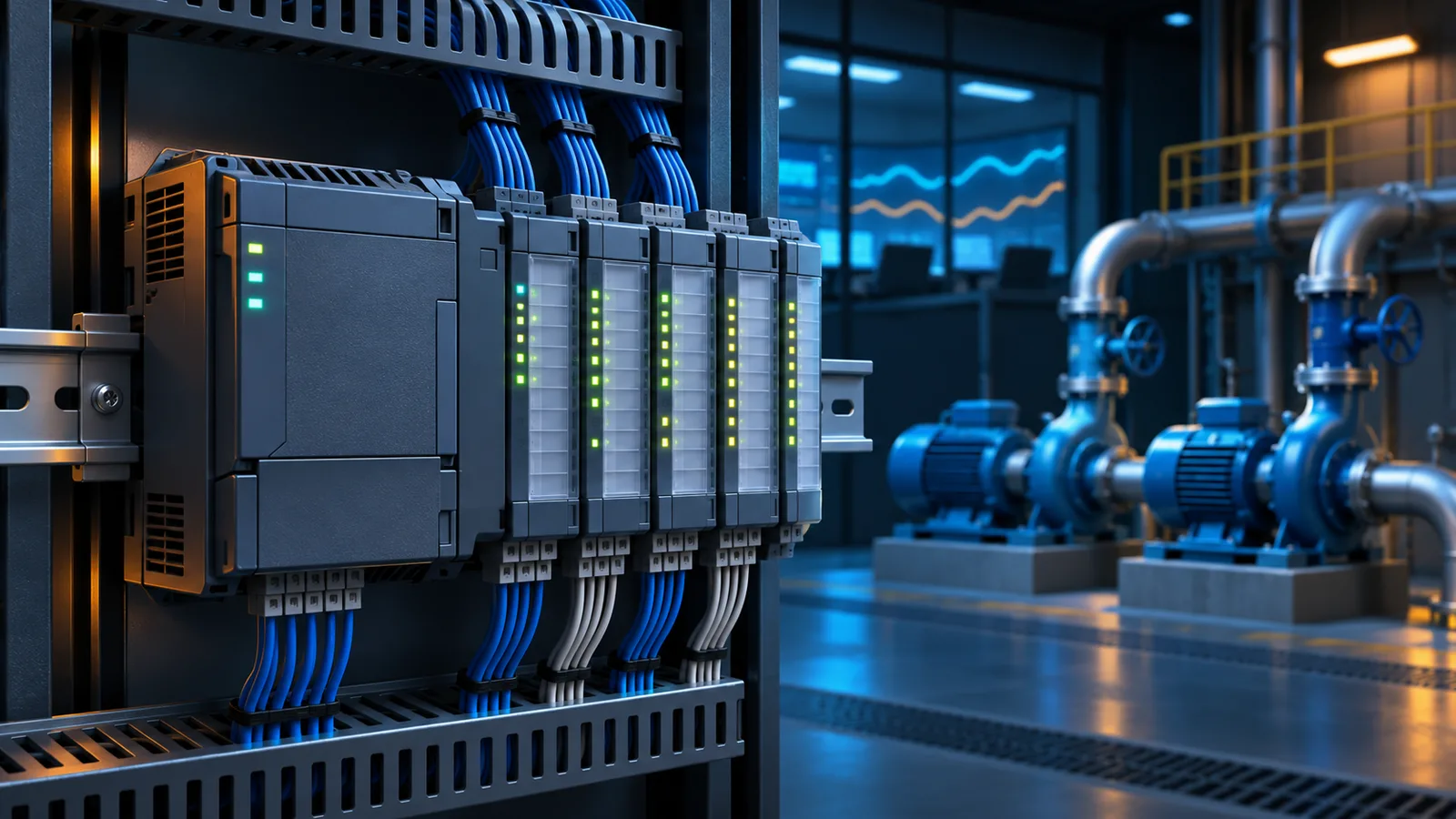
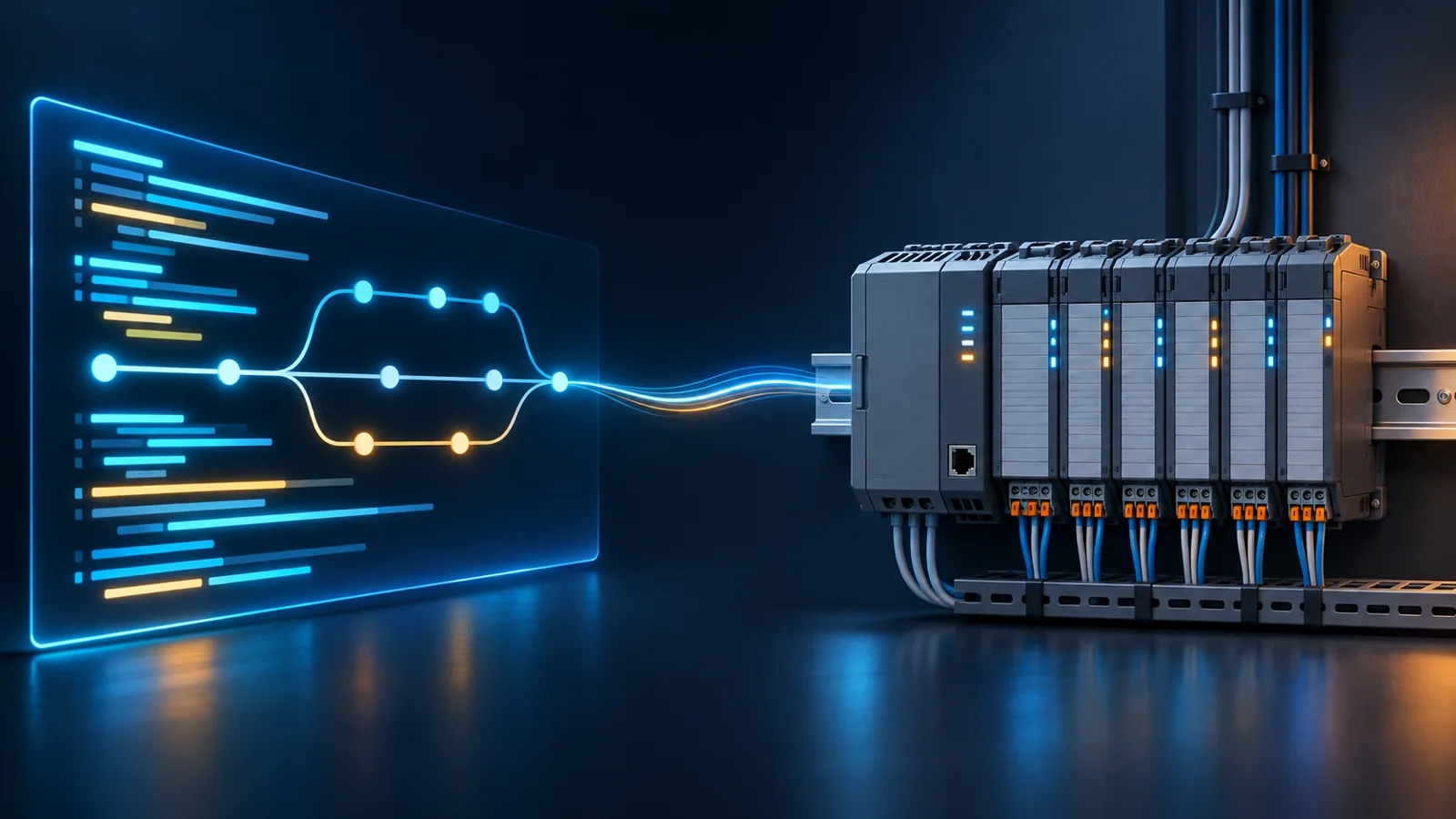
A PLC (programmable logic controller) is a rugged industrial computer that reads sensors and switches motors and valves in a fixed, repeating cycle that takes a few milliseconds. SCADA (supervisory control and data acquisition) is the software, servers and communication network that supervise many PLCs and remote units across a plant or a whole city. It shows operators what is happening, logs it and raises alarms. The PLC does the controlling; SCADA watches, records and sends commands. A DCS is one integrated control system for a continuous process plant, and an HMI is the operator screen.
This guide is for electrical, electronics and instrumentation students and freshers. It places each system in the ISA-95 automation levels, works through a scan-time and a polling calculation, and follows one water pumping station from sensor to control room. It ends with protocols, security, jobs in India and common interview questions.
In short
- A Siemens CPU 1214C executes a bit instruction in 0.08 µs, a word instruction in 1.7 µs and a floating-point instruction in 2.3 µs (Siemens data sheet 6ES7214-1AG40-0XB0).
- In our worked example, a 1,840-instruction pumping-station program gives a PLC cycle of 2.444 ms and a worst-case input-to-output response of 11.29 ms. Siemens' rule: the longest response is twice the cycle time plus the input and output delays.
- A SCADA master polling 10 outstations over Modbus RTU at 19,200 bit/s needs at least 229 ms of wire time per sweep. One dead outstation with a 1 s time-out stretches that to 1.2 s. That is why SCADA supervises and the PLC controls.
- The current PLC programming standard is IEC 61131-3:2025, edition 4.0, published on 22 May 2025. Its abstract names Structured Text, Ladder Diagram and Function Block Diagram, plus Sequential Function Chart elements (IEC webstore).
- India's CEA (Cyber Security in Power Sector) Guidelines, 2021 require "hard isolation" of OT systems from any internet-facing IT system, and certificates of conformance to IEC 62443-4 for supplied equipment.
What is the difference between a PLC and SCADA?
A PLC is a controller: hardware that runs a control program and drives outputs directly, usually for one machine or station. SCADA is a supervisory system, mostly software on servers and operator PCs, that collects data from many PLCs and RTUs, displays and stores it, and lets operators send commands. A PLC can run without SCADA; SCADA controls nothing without field controllers under it.
- Who closes the loop? The PLC. It reads the level switch and starts the pump within milliseconds, whether or not anyone is watching.
- Who sees the whole system? SCADA. It shows dozens of sites on one screen, trends levels over a month and records which station tripped, and when.
- What if the network fails? The PLC keeps running. SCADA loses sight of that site and raises a "communication failure" alarm.
Three more terms complete the picture. An RTU (remote terminal unit) is a rugged, low-power controller for unmanned remote sites. An HMI (human-machine interface) is the operator screen of one machine or station. A DCS (distributed control system) is one vendor's integrated control system for a whole process plant. Each has its own section below, and the full comparison table follows the plant example.
What is a PLC and what is inside it?
A PLC is a hardened computer built for a control panel. It has a power supply, a CPU with program and data memory, and input and output modules that are electrically isolated from the CPU. Digital inputs usually run at 24 V DC. Analogue inputs read 4-20 mA or 0-10 V signals from transmitters. Outputs drive contactors, solenoid valves, lamps and variable-frequency drives (VFDs).
The Siemens CPU 1214C is a typical compact PLC. Its data sheet lists 14 digital inputs and 10 digital outputs at 24 V DC, 2 analogue inputs at 0-10 V, 100 KB of program and data memory, and a PROFINET port. Larger modular PLCs slide extra I/O cards onto a rack or a DIN rail.
PLCs are chosen over ordinary computers because they tolerate electrical noise, heat and vibration, their I/O is built for field wiring and their program runs the same way every cycle for years. To try ladder logic as you read, use the in-browser simulator in the PLC chapter of our Mechatronics book.
How does a PLC scan cycle work?
A PLC runs its program in a loop called the scan or cycle. It copies every input into memory (the process image of inputs), solves the program top to bottom using those stored values, then writes all outputs at once (the process image of outputs). Siemens' S7-1500 manual defines the cycle in exactly these three steps. The time for one loop is the scan time or cycle time. Two consequences come up in practice and in interviews:
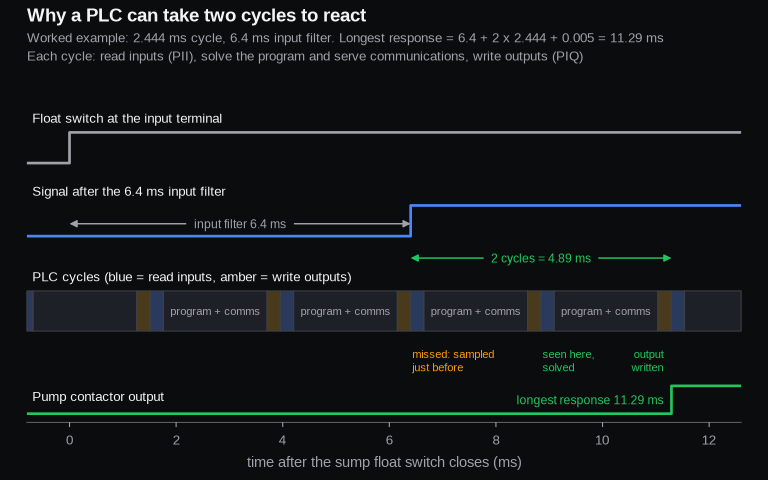
- A change can wait up to two cycles. An input that changes just after the read is not seen until the next cycle, and its output is written at the end of that cycle. Siemens says the response "fluctuates between one and two cycle times", and the longest response is twice the cycle time plus the module input and output delays.
- Short pulses can be missed. A pulse shorter than the input filter plus one cycle may not be present when the inputs are read, so encoder pulses go to hardware counters or interrupt inputs.
Worked example: scan time and response time
Take the pumping-station PLC described later. We assume its program has 1,500 bit instructions (contacts, coils, interlocks), 300 word instructions (moves, compares, timers) and 40 floating-point instructions (scaling the 4-20 mA signals). Using the typical times from the CPU 1214C data sheet:
We assume 0.5 ms for process-image transfer and the operating system, giving a quiet cycle of 1.222 ms. Communication with the HMI and SCADA stretches it: on an S7-1500 the default communication load is 50%, which Siemens says can make the cycle "up to twice as long". Budgeting for that:
With the input filter set to 6.4 ms (the 1214C offers 0.2 to 12.8 ms) and a transistor output delay of at most 5 µs, the longest response is:
The shortest response is one cycle plus the delays, 8.85 ms. The input filter is the biggest term, not the program, so halving the filter saves more than any code optimisation. For a water pump, whose contactor and motor are far slower, this is ample. For a high-speed packaging line it might not be.
What are the IEC 61131-3 PLC programming languages?
IEC 61131-3 is the international standard for PLC programming languages. The current edition, 4.0, was published on 22 May 2025. Its abstract defines Structured Text (ST) as the textual language and Ladder Diagram (LD) and Function Block Diagram (FBD) as graphical languages. It also defines Sequential Function Chart (SFC) elements for structuring programs into steps and transitions.
- Ladder Diagram (LD) looks like a relay circuit: contacts in series mean AND, in parallel OR. Maintenance staff read it easily, so it dominates machine logic.
- Function Block Diagram (FBD) wires blocks such as timers, PID controllers and comparators together, which suits analogue control.
- Structured Text (ST) is a Pascal-like text language for maths, loops and data handling.
- Sequential Function Chart (SFC) describes a sequence as steps and transitions, such as fill, heat, hold and drain.
Instruction List (IL), an assembler-like language from earlier editions, is not in the 2025 abstract's list (Annex B of the new edition lists what was added, removed or deprecated since 2013). You may still meet IL in old code.
Here is our station's pump logic in Structured Text. It runs the duty pump when the reservoir is low and the sump has water, and switches to the standby pump if the duty pump trips:
(* Duty/standby pump control, IEC 61131-3 Structured Text *)
IF ResLevel_m <= ResStart_m AND SumpLevel_m > SumpMin_m AND NOT DryRun THEN
    RunRequest := TRUE;
ELSIF ResLevel_m >= ResStop_m OR SumpLevel_m <= SumpMin_m OR DryRun THEN
    RunRequest := FALSE;
END_IF;

Pump1_Run := RunRequest AND NOT Pump1_Fault AND (DutyIsPump1 OR Pump2_Fault);
Pump2_Run := RunRequest AND NOT Pump2_Fault AND (NOT DutyIsPump1 OR Pump1_Fault);
The gap between ResStart_m and ResStop_m is hysteresis, so the pump does not cycle on and off as the level ripples around one setpoint. In ladder, RunRequest would be a seal-in rung.
What is SCADA and what does it do?
SCADA supervises processes spread over a large area, such as water networks, pipelines, power grids and metro lines. It gathers data from PLCs and RTUs, shows it on mimic screens, raises and logs alarms, stores history and lets operators send commands. It is usually called software, but a working system also includes servers, communication links and the field controllers it talks to.
Its main parts are a communication server that polls every PLC and RTU in turn, HMI clients (the operator screens), an alarm server that timestamps alarms for operators to acknowledge, and a historian: a time-series database used for trends, reports and investigations. Supervisory commands such as "start pump 2" go down to the field controller, which still decides whether it is safe to obey.
Worked example: why SCADA works in seconds
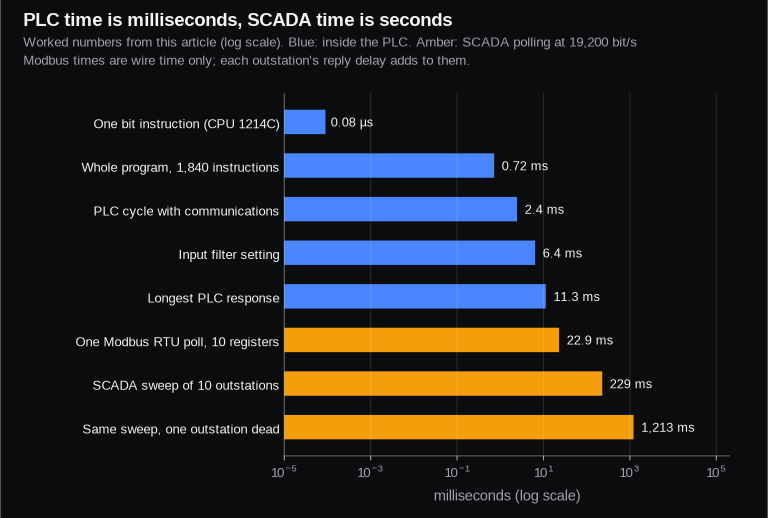
Suppose the SCADA master polls remote sites over a serial or radio link with Modbus RTU. The Modbus serial specification sends each byte as 11 bits. It separates frames with a silence of at least 3.5 character times, which must be strictly respected at 19,200 bit/s and below. Reading 10 holding registers (function code 03) takes an 8-byte request and a 25-byte reply:
Ten outstations need at least 229 ms per sweep, before each outstation's own reply delay. If one is dead, the master waits out its response time-out, which the specification says is typically 1 s to several seconds at 9,600 bit/s. With 1 s, the sweep becomes 1,213 ms, about 94 cycles of our PLC. This is why interlocks and trips stay inside the PLC and never depend on SCADA.
What is a DCS, and how is it different from SCADA?
A DCS (distributed control system) is a single vendor's integrated set of controllers, I/O, operator stations, engineering software and a shared database that controls one large process plant. It runs hundreds or thousands of tightly coupled loops on a fast plant network, often with redundant controllers. SCADA supervises spread-out assets over slower, less reliable links.
In a DCS, the vendor's controllers run the PID loops and sequences, and everything is engineered in one tool with one tag database. In SCADA, control runs in PLCs and RTUs that may come from different vendors, and SCADA mainly supervises. A DCS lives inside one plant fence and suits continuous and batch processes such as refining, power generation, chemicals and pharma. SCADA is built for distance.
The boundaries have blurred. Large PLCs now run process loops, and DCS vendors offer SCADA functions. Honeywell's Experion PKS brochure, for example, describes one platform covering continuous, sequence and batch control, as well as safety, security, electrical, SCADA and asset management. The labels describe a system's origin and strengths more than strict limits.
What is the difference between an HMI and SCADA?
An HMI is the screen an operator uses to see and control a machine or a station, usually a touch panel in the control cabinet door. SCADA is the whole supervisory system above many stations: its HMI clients are only the visible part, with polling, alarm management, a historian and reports behind them. Every SCADA system has HMIs, but an HMI on its own is not SCADA.
Where do PLC, SCADA and DCS sit in the automation pyramid?
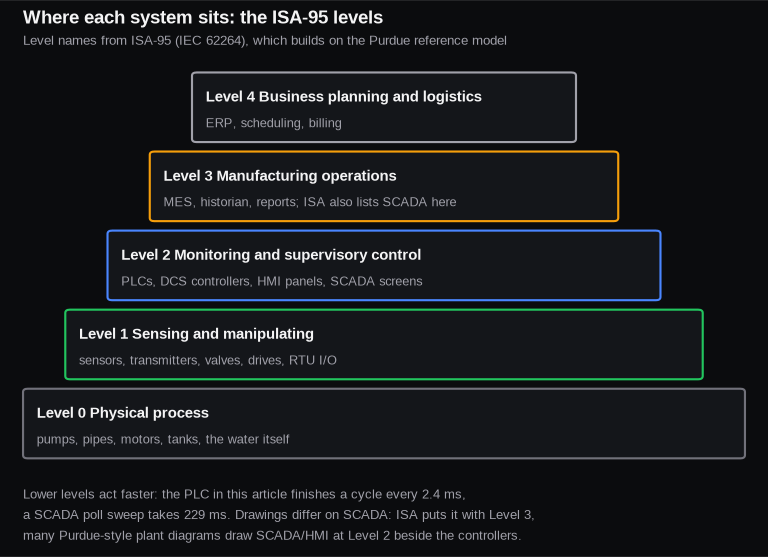
The automation pyramid comes from ISA-95 (IEC 62264), which builds on the Purdue reference model. Level 0 is the physical process and Level 1 is sensing and manipulating it (sensors, valves, smart devices). Level 2 is monitoring and supervisory control, where ISA places PLCs and DCS controllers. Level 3 is manufacturing operations (MES) and Level 4 is business planning and logistics (ERP).
SCADA is the one people argue about. ISA's summary places it with MES at Level 3; many Purdue-style plant drawings put SCADA servers and HMIs at Level 2, beside the controllers. In an interview, say both: SCADA supervises in real time like Level 2, but its historian and reports feed operations like Level 3.
How does a water pumping station use PLC, RTU and SCADA?
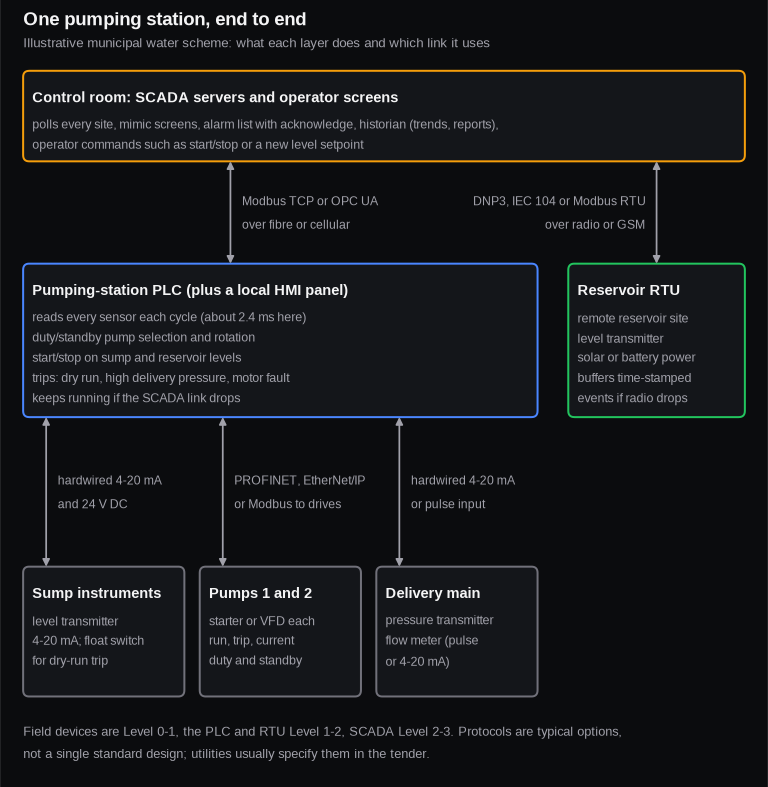
Here is one illustrative municipal scheme, from sensor to control room: a pumping station lifts treated water from a sump to a distant elevated reservoir. The protocol and design choices are typical options, not one specific city's system.
- Field (Levels 0 and 1). A level transmitter in the sump sends 4-20 mA to the PLC. A float switch gives a hardwired dry-run trip. Each of the two pumps has a starter or VFD reporting run, trip and motor current. On the delivery main, a pressure transmitter and a flow meter measure what leaves the station.
- Station PLC (Level 2). Every 2.4 ms it reads all of this, runs the duty/standby logic above, and trips a pump on dry run, high delivery pressure or motor fault. It counts run hours to rotate the duty pump, and keeps working if the control-room link fails. A local HMI panel lets technicians run the station on site.
- Reservoir RTU (remote). A solar- or battery-powered RTU reads the reservoir level and buffers time-stamped events while its radio link is down. Because pump start/stop depends on that level, the design must say what the PLC does when the value goes stale, for example fall back to a delivery-pressure stop.
- SCADA (Levels 2 and 3). The control-room servers poll the PLC over Modbus TCP or OPC UA and the RTU over DNP3, IEC 60870-5-104 or Modbus RTU. They show both on one mimic, raise alarms such as "Pump 1 tripped" or "Reservoir RTU communication failure", and store every value in the historian.
- Control room and beyond. Operators acknowledge alarms, switch the duty pump or change setpoints. Engineers use historian data for energy per cubic metre and leak analysis, and reports go to planning and billing at Level 4.
To size the pumps themselves, use our centrifugal pump calculator for head, flow and power.
Which communication protocols do PLCs and SCADA use?
There is no single protocol. PROFINET and EtherNet/IP connect PLCs to drives and remote I/O in real time. Modbus is the simple, near-universal option. OPC UA moves structured data securely between PLCs, SCADA and IT systems. Utilities reach remote outstations with DNP3 or IEC 60870-5-104.
| Protocol | Standard or body | Typical use | Key facts |
|---|---|---|---|
| Modbus RTU | Modbus Organization | Serial RS-485 links to meters, drives, RTUs | Up to 247 addressed slaves on one bus; 11-bit bytes; CRC check; max frame 256 bytes |
| Modbus TCP | Modbus Organization | PLC to SCADA, PLC to PLC over Ethernet | TCP port 502; max ADU 260 bytes; function 03 reads 1 to 125 registers |
| PROFINET | PROFIBUS and PROFINET International (PI) | Siemens-centred plants: PLC to I/O and drives | Industrial Ethernet with real-time I/O; the CPU 1214C's port can be a PROFINET IO controller or IO device |
| EtherNet/IP | ODVA | Rockwell-centred plants: PLC to I/O and drives | Common Industrial Protocol (CIP) on standard Ethernet; TCP/IP plus UDP for real-time cyclic data |
| OPC UA | OPC Foundation | PLC or SCADA to MES, historians, cloud | Released 2008; platform-independent; X.509 certificates and encryption; publish-subscribe |
| DNP3 | IEEE 1815-2012 | Power and water utilities: SCADA to RTUs | Defines subset levels from low-cost feeder devices to full systems |
| IEC 60870-5-104 | IEC | Power grids: control centre to substations | Telecontrol over TCP/IP, port 2404; edition 2.0 (2006) with Amendment 1 (2016) |
Inside substations, you will also meet IEC 61850, the series on communication networks and systems for power utility automation. India's CEA guidelines cite part of it for functional testing.
PLC vs SCADA vs DCS vs HMI vs RTU: comparison table
| Feature | PLC | RTU | HMI | SCADA | DCS |
|---|---|---|---|---|---|
| Main job | Control a machine or station | Monitor and control a remote site | Operator view of one machine | Supervise many sites | Control a whole process plant |
| Hardware or software | Hardware plus program | Hardware plus program | Panel or PC software | Mostly software on servers | Integrated hardware and software |
| Typical timescale | Milliseconds (2.4 ms cycle in our example) | Seconds; reports by exception or when polled | Screen refresh, operator actions | Polls in hundreds of ms to seconds | Fast loops plus plant-wide supervision |
| Geography | One panel | Remote, unmanned site | At the machine | Site, city or country | One plant |
| Keeps running if network fails? | Yes | Yes, buffers events | Local view only | Loses that site | Yes, with redundancy |
| Where you meet it | Machines, conveyors, pump stations | Pipelines, reservoirs, substations | Every machine panel | Water, power, oil and gas, metro | Refineries, power plants, chemicals, pharma |
When do you need a PLC, SCADA or a DCS?
Use a PLC with a local HMI to automate one machine or one station, such as a packaging machine or a single pump house. Add SCADA when you must watch and command many PLCs or remote sites from one place, as a city water network does. Choose a DCS when one large process plant, such as a refinery or power station, needs hundreds of coordinated loops, one engineering database and built-in redundancy. Such plants often keep PLCs for packaged units like compressors, linked to the DCS.
How are PLC and SCADA systems secured?
The main standard is ISA/IEC 62443, a series for securing industrial automation and control systems (IACS). It groups assets of similar risk into zones, joined by conduits that carry the traffic between them. Four security levels, SL1 to SL4, match the countermeasures to the strength of the attacker, and seven foundational requirements run from identification and authentication control to resource availability.
Its four groups are general, policies and procedures, system, and component. Asset owners work with parts such as 2-1 (security programme) and 3-2 (risk assessment), integrators with 3-3 (system requirements), and product makers with 4-1 (secure development) and 4-2 (component requirements).
Older protocols were not built for this. The 2012 Modbus application protocol defines no login or encryption; the Modbus Organization's separate Modbus Security protocol wraps Modbus in TLS on port 802 with X.509v3 certificates. OPC UA identifies every client and server with X.509 certificates.
In India, the Central Electricity Authority's CEA (Cyber Security in Power Sector) Guidelines, 2021 require power utilities to keep "hard isolation" of OT systems from any internet-facing IT system and to identify electronic security perimeters as per IEC 62443 / IS 16335. Supplied equipment must carry a certificate of conformance to IEC 62443-4. For SCADA acceptance tests the guidelines point to IS 15953:2011, "SCADA System for Power System Applications". Join a power utility or its vendors and you will meet these documents early.
Which companies make PLCs, SCADA and DCS?
These global vendors' systems are common in Indian plants. Skills in one vendor's tools transfer, because the concepts are the same.
- Siemens: SIMATIC S7-1200 and S7-1500 PLCs, engineered in STEP 7 (TIA Portal). Our post on Siemens Simatic AX covers its newer software-defined route.
- Rockwell Automation: Allen-Bradley ControlLogix and CompactLogix controllers, programmed in Studio 5000 Logix Designer.
- Schneider Electric: the Modicon range, including Modicon M580.
- ABB: ABB Ability System 800xA, a DCS.
- Honeywell: Experion PKS (process control platform).
- Emerson: DeltaV (DCS).
What skills do PLC and SCADA jobs in India need?
Entry-level automation roles in India ask for PLC programming (ladder plus Structured Text), reading electrical and P&ID drawings, field instruments and 4-20 mA loops, one SCADA or HMI package, industrial networking (Modbus, PROFINET or EtherNet/IP) and commissioning on site. Typical job titles are PLC programmer, SCADA engineer, automation or controls engineer, DCS engineer, instrumentation engineer and commissioning engineer.
The employers are system integrators (who design and commission control systems), machine builders (OEMs) and end users such as process plants, power and water utilities and metro systems. Integrator and commissioning roles often mean long spells on site. A practical learning order:
- Electrical basics and sensors. Relays, contactors, 24 V DC I/O, 4-20 mA transmitters. Fundamentals of Embedded Systems covers sensors, actuators and relays.
- PLC logic. The scan cycle, ladder, timers, counters, latches and state machines. Use the Mechatronics book's PLC chapter to practise.
- Control. PID loops and tuning. Try the PID calculator.
- Networks and data. Modbus, then OPC UA and MQTT for IIoT. Developing IoT Applications covers MQTT and the cloud side.
- Domain. For utility SCADA, learn power-system basics and protection in Introduction to Electric Power System.
For GATE Instrumentation (IN), PLC and DCS now sit in the Control Systems section of the revised 2027 syllabus; see our GATE IN syllabus analysis. For more practice, see the interview questions hub.
Frequently asked questions
What is the scan time of a PLC and what affects it?
Scan time is the time for one cycle: read inputs, run the program, write outputs. It depends on the number and type of instructions, the I/O update and the communication load. In our example, 1,840 instructions on a CPU 1214C give 0.722 ms of execution and a 2.444 ms budgeted cycle. A floating-point instruction costs about 29 times a bit instruction (2.3 vs 0.08 µs).
What happens if the PLC scan time exceeds the watchdog?
The PLC monitors its own cycle time with a watchdog. On an S7-1500 the default maximum cycle time is 150 ms. If a cycle runs longer, the CPU calls the time-error organisation block OB 80. The CPU goes to STOP if no OB 80 is loaded, or if the cycle is still not finished after a further maximum cycle time. This catches endless loops and runaway code instead of leaving the outputs frozen.
What is the difference between Modbus RTU and Modbus TCP?
Both carry the same function codes and data. Modbus RTU runs on serial lines (usually RS-485), addresses up to 247 slaves, separates frames by 3.5 character times of silence and adds a CRC. Modbus TCP runs over Ethernet on port 502 and replaces the address and CRC with a 7-byte MBAP header, for a 260-byte maximum message.
Can SCADA work without a PLC?
SCADA needs something in the field to read sensors and drive outputs, but it need not be a PLC: RTUs, protection relays and other intelligent electronic devices report to SCADA directly, especially in utilities. SCADA should not close fast loops itself, because its polling is slow and its links can fail.
Why do instruments use 4-20 mA instead of 0-20 mA?
With 4 mA as zero, a broken wire or dead transmitter reads near 0 mA, outside the valid range, so the PLC can tell "level is zero" from "signal lost" and raise a fault. A current loop also shrugs off voltage drop along a long cable better than a voltage signal.
What is the difference between an RTU and a PLC?
A PLC is optimised for fast, deterministic local control. An RTU is optimised for remote, unmanned sites: low power, wide-area protocols such as DNP3 or IEC 60870-5-104, and buffering of time-stamped events while the link is down. Modern products overlap, and many PLCs can act as RTUs.
Sources and further reading
- IEC 61131-3:2025, Programmable controllers, Part 3: Programming languages, IEC webstore, edition 4.0, published 22 May 2025 (accessed 23 Nov 2026).
- Siemens data sheet 6ES7214-1AG40-0XB0, SIMATIC S7-1200 CPU 1214C DC/DC/DC, Siemens (copy hosted by Gdynia Maritime University; last modified 12 Apr 2021).
- SIMATIC S7-1500 Cycle and response times, Function Manual, Siemens, 02/2014, A5E03461504-02.
- Modbus specifications: Modbus Application Protocol V1.1b3 (26 Apr 2012), Modbus over Serial Line V1.02 (20 Dec 2006), Modbus Messaging on TCP/IP Implementation Guide, and Modbus Security protocol, Modbus Organization.
- ISA-95 standard: enterprise-control system integration, International Society of Automation (accessed 23 Nov 2026).
- ISA/IEC 62443 series of standards, International Society of Automation (accessed 23 Nov 2026).
- IEC 62443 background: zones, conduits, security levels and foundational requirements, IEC SyC Smart Energy (accessed 23 Nov 2026).
- CEA (Cyber Security in Power Sector) Guidelines, 2021, Central Electricity Authority (copy hosted by TGTRANSCO).
- Unified Architecture, OPC Foundation (accessed 23 Nov 2026).
- EtherNet/IP, ODVA (accessed 23 Nov 2026).
- PROFINET, PROFIBUS and PROFINET International (accessed 23 Nov 2026).
- IEEE 1815-2012, Standard for Electric Power Systems Communications: Distributed Network Protocol (DNP3), IEEE.
- IEC 60870-5-104:2006, Telecontrol equipment and systems, Part 5-104, IEC webstore.
- Description and analysis of IEC 104 protocol, P. Matoušek, Brno University of Technology, technical report FIT-TR-2017-12 (TCP port 2404).
- ABB Ability System 800xA, ABB; Experion PKS brochure, Honeywell; DeltaV distributed control system, Emerson.
- Studio 5000 Logix Designer, Rockwell Automation; Modicon M580, Schneider Electric; SIMATIC S7-1200, Siemens.