NHAI MLFF Guidelines: How Barrier-Free Toll Plazas Will Be Designed
NHAI Policy Circular 17.5.104/2026 (30 Oct 2026, announced by PIB on 6 Nov) sets one barrier-less toll plaza design for four-lane and wider national highways: 8/10/12 toll lanes at 600 vehicles an hour, 3.5 m lanes, gantries with 6.0 m clearance and a back-up gantry 200-350 m on. How MLFF tolling works, what the circular fixes, and a worked delay comparison with a conventional plaza.

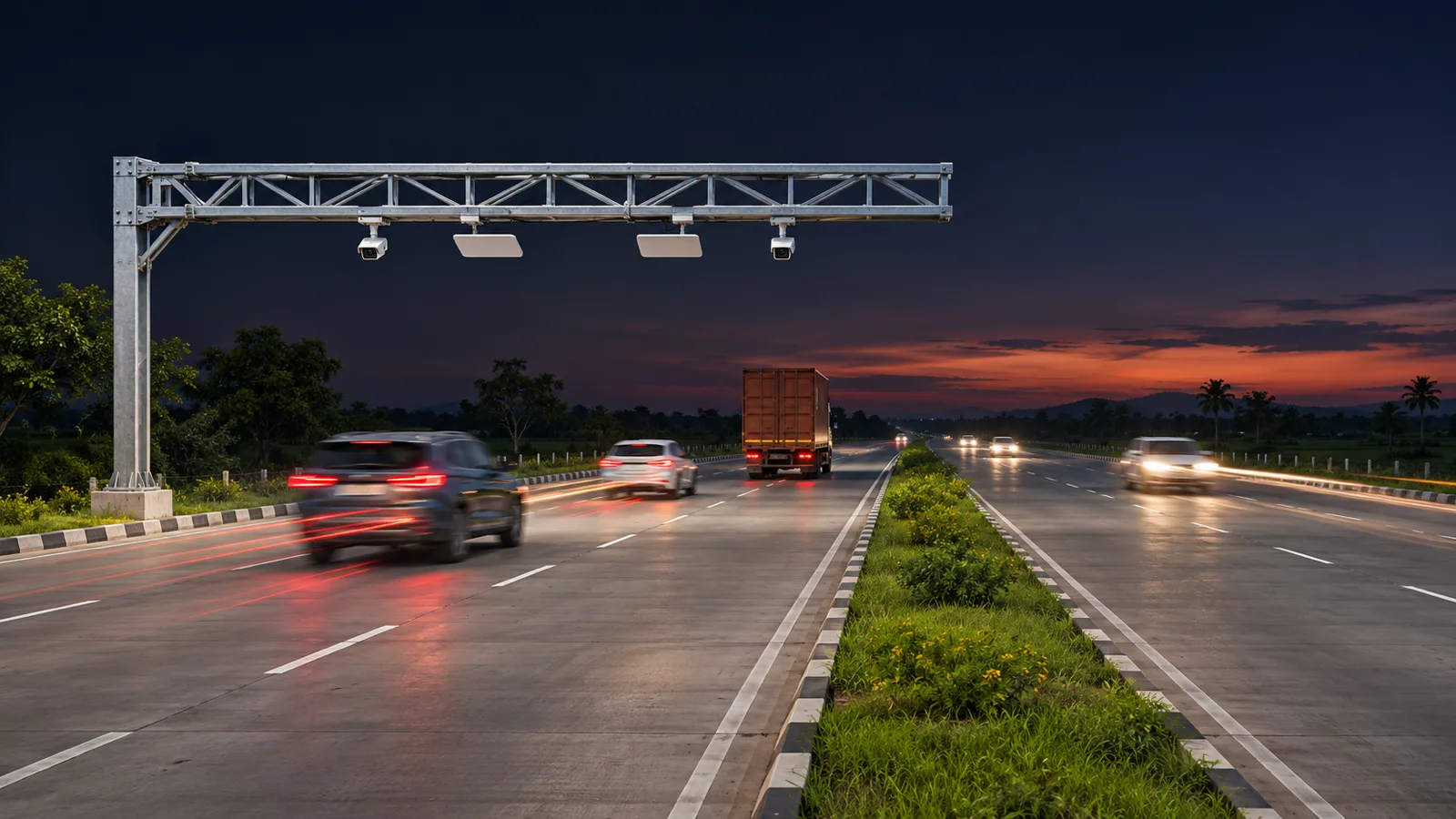
NHAI has issued one standard design for barrier-less toll plazas on four-lane and wider national highways. NHAI Policy Circular No. 17.5.104/2026, dated 30 October 2026, replaces booths and boom barriers with an overhead "pay-axis" gantry that reads FASTag RFID tags and number plates at speed, plus a back-up gantry 200-350 m further on. It fixes 8, 10 or 12 toll lanes for 4-, 6- and 8-lane highways, each lane 3.5 m wide (4.5 m for over-dimension vehicles), and at least 6.0 m of clear height under the equipment. It also covers signage, VMS boards and lighting, and applies to future and under-construction projects.
The Press Information Bureau (PIB) announced the guidelines on 6 November 2026, and the release came back round in news feeds this week. This dated explainer, built from the circular itself, covers what it standardises, how multi-lane free flow (MLFF) tolling works, a worked delay comparison with a conventional plaza, and what it means for engineers.
Key numbers at a glance
- 30 Oct 2026: NHAI Policy Circular No. 17.5.104/2026, "Toll Plaza layout and Infrastructure for Barrier-Free Tolling on future and under-construction four-lane and above National Highways Projects". PIB released it on 6 Nov 2026 (Release ID 2333654).
- 8 / 10 / 12 lanes: toll lanes at the pay-axis gantry for 4-, 6- and 8-lane highways, including the over-dimension (OD) or spare lane. The circular sizes these at 600 vehicles per hour per lane (circular, Table-1 and para 4.1).
- 3.5 m and 4.5 m: width of a toll lane and of the OD lane. Lanes are separated by spring bollards, not islands (para 4.2-4.3).
- 6.0 m: minimum clear height from finished road level to the underside of a camera or reader (para 6.1).
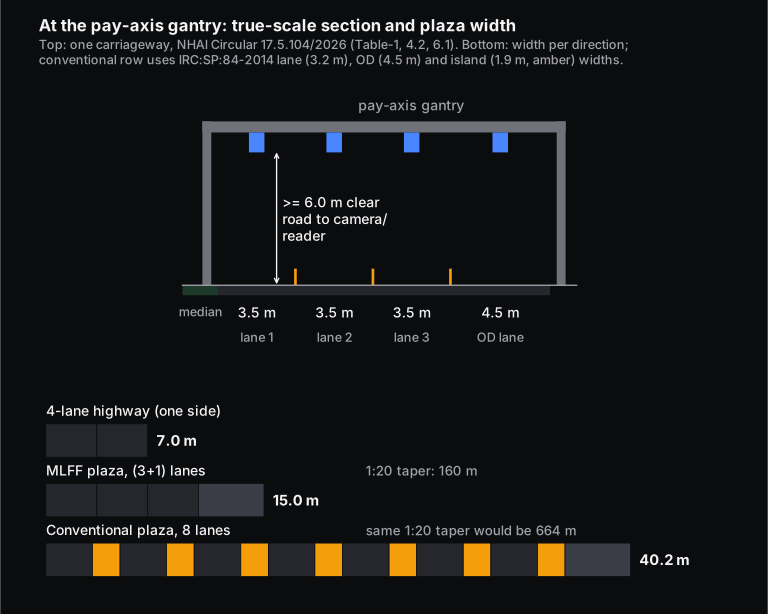
- 15.0 m vs 40.2 m: plaza width per direction on a 4-lane highway under this layout, against an eight-lane conventional plaza built to IRC:SP:84-2014 lane and island widths. That is our arithmetic, set out in the worked example below.
Related reading: NHAI's September 2026 rules for access-controlled highways, which told DPR consultants to provide for MLFF, are explained in NHAI High-Speed Corridor Guidelines. This circular supplies the plaza design.
What did NHAI issue, and when?
NHAI issued Policy Circular No. 17.5.104/2026 on 30 October 2026, under its commercial operations series. The decision was taken on an ITS Cell file of the Indian Highways Management Company Limited (IHMCL), the NHAI-promoted company that appoints the tolling service providers. The circular runs to eight bilingual pages plus three annexures: a typical plaza layout drawing, the overhead direction sign and the MLFF sign symbol.
- The circular (confirmed). Signed by NHAI's Chief General Manager (Coordination) and addressed to all NHAI headquarters and field offices. We read the signed scan hosted by the Highway Operators Association of India (HOAI). Every design number here comes from that scan.
- PIB, 6 November 2026, 5:13 PM (confirmed). "NHAI Guidelines to Standardise Design and Infrastructure for Multi-Lane Free Flow Tolling on Four-Lane and Above National Highways". It lists the scope (plaza layout, lane count, gantries, lighting, signage, VMS, the administrative building) and the implementation framework. It does not give the numbers.
- Reported. Some news reports carried the lane counts second-hand, saying the circular was not public. Their numbers match Table-1.
The circular revises the toll plaza design in NHAI Policy Circular No. 17.5.82/2021 of 24 May 2021, but only for four-lane and wider highways. Two-lane highways with paved shoulders keep regular tolling under the 2021 circular (para 12).
How does multi-lane free flow tolling work?
MLFF tolling charges a vehicle while it drives under an overhead gantry, with no booth and no barrier. Gantry-mounted RFID readers read the windscreen FASTag, Automatic Number Plate Recognition (ANPR) cameras read the plate, and the fee is deducted from the FASTag account. If the tag is missing, invalid or short of balance, the system generates an e-Notice to the owner instead of stopping the car.
Two technologies do the work, and each covers the other's blind spot:
- RFID (radio-frequency identification). A FASTag is an RFID sticker on the windscreen. The reader on the gantry sends a radio signal and the tag replies with its ID, which is linked to a prepaid or bank account and a vehicle. Think of it as a barcode that can be read by radio from several metres away.
- ANPR. A camera captures the number plate and software turns the image into text. At 80 km/h a car covers 22.2 m every second, so a camera running at 25 frames per second (our assumption for illustration) sees it move 0.89 m between frames. That is why the circular says ANPR performance "is directly dependent on the level of illumination" at the gantry (para 8.4).
NHAI describes MLFF as reading the FASTag and the vehicle registration number together (PIB, 30 August 2025), so each charge is tied to a tag and a plate. Under the circular the system has two gantries in series:
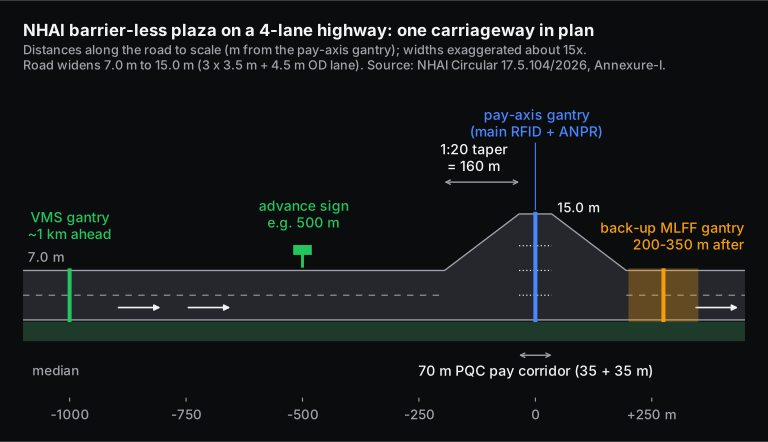
- Pay-axis gantry (FOB type). This is the main system for fee deduction. It sits at the toll plaza location and is built like a foot-over-bridge, with a maintenance walkway (1.5 m wide in the Annexure-I detail).
- MLFF gantry. A back-up system placed after the pay axis on each carriageway, "preferably within 200-350m of the pay axis Gantry" (para 5.1). At 80 km/h that is 9.0 to 15.8 seconds after the first read, a second chance for a missed read.
Enforcement is the e-Notice under Rule 14 of the National Highways Fee Rules, 2008 (circular, para 3.1). Per NHAI's releases on earlier sites, the normal fee is due within 72 hours and doubles after that; grievances can be raised within 72 hours, and unpaid notices can lead to FASTag blacklisting and VAHAN restrictions (PIB, 2 May and 25 June 2026).
What do the MLFF guidelines standardise?
They standardise the number and width of toll lanes, the paved pay corridor, the position and clear height of both gantries, advance signs, a VMS gantry, high-mast lighting, the back-office building and power, and who builds and pays for what. Each is a numbered clause a DPR consultant can carry into a bid document.
Lanes, widths and the pay corridor
| Item | Requirement | Clause |
|---|---|---|
| Toll lanes, 4-lane highway | 8 (4+4), including OD/spare lane; drawn as (3+1)+(3+1) | Table-1, Annexure-I |
| Toll lanes, 6-lane highway | 10 (5+5) | Table-1 |
| Toll lanes, 8-lane highway | 12 (6+6) | Table-1 |
| Design throughput | 600 vehicles/hour per lane | 4.1 |
| Toll lane width | 3.5 m, "to provide adequate lateral clearance" at free-flow speed and reliable reads | 4.2 |
| OD lane width | 4.5 m | 4.2 |
| Lane separators | Spring bollards | 4.3 |
| Alignment | On a straight section of highway wherever feasible | 4.4 |
| Pay corridor | 70 m of pavement quality concrete (PQC), 35 m each side of the pay axis, tapering at 1:20 | 4.5 |
The typical layout drawing (Annexure-I) adds what the text leaves out: emergency median openings beyond each end, an EV charging station near each MLFF gantry, transverse bar markings at 50, 80, 120 and 165 m for a 60-80 km/h approach, and a speed-limit sign reading 60 on each approach.
Gantries and clear height
The underside of any gantry-mounted camera or reader must be at least 6.0 m above finished road level (para 6.1). That repeats an earlier NHAI circular, No. 17.5.96/2026 of 13 March 2026, which we did not read. For comparison, NHAI's June 2026 release on the Gharaunda MLFF site described gantry clearance of "approximately 5.5 to 6.0 metres". The overhead direction sign in Annexure-II is 13.44 m wide, mounted 6.5 m above the road.
Signage, VMS and lighting
- Advance direction signs "at an appropriate distance in advance of the Plaza (for instance, at 500 m)" (para 8.1). At 80 km/h, 500 m gives a driver 22.5 seconds of warning.
- A Variable Message Sign (VMS) gantry about 1 km before the plaza, "for better control of OD vehicles" and messages to road users (para 8.2). A VMS is an electronic board whose text the control room can change, so it can send a wide load to the OD lane or warn of a lane closure.
- High-mast lighting over the plaza zone, both for night-time safety and because the cameras need it (para 8.4).
Building, power and who pays for what
For publicly funded plazas (EPC, HAM and item-rate projects), the highway contractor's scope is limited to civil and electrical works (para 9.1 A):
- the pay-axis gantry;
- all road works at and around the plaza, including the PQC;
- the administrative building-cum-O&M centre, to NHAI Circular 17.5.101/2026 of 27 August 2026, which serves as the back office;
- raw power supply and high-mast lighting, complete with foundations and poles;
- advance signage and its foundations, to designs from NHAI's DPR Cell;
- plumbing, water supply, sewerage, drainage and water tanks;
- a back-up diesel generator of at least 125 kVA.
IHMCL appoints the MLFF service provider, a bank or system integrator (para 9.1 B). It supplies, commissions, runs and maintains the electronic system on both gantries, sets up the control room, builds the back-up MLFF gantry and pays the recurring energy charges. On BOT (Toll), TOT, InvIT and RIIT projects, the concessionaire implements barrier-less plazas under its concession agreement (para 9.2).
Which projects must adopt it?
| Project stage | What happens |
|---|---|
| Under DPR | Barrier-less layout goes into the bid document |
| Awarded, appointed date pending | Adopted through a positive or negative change of scope (COS) |
| Under construction, plaza not started | Adopted through change of scope |
| Under construction, ETC equipment not procured (COD at least 6 months away) | Adopted "to the extent possible" through change of scope |
| Under construction, ETC equipment installed or procured, COD within 6 months | Plaza built as per the existing contract; barrier-less tolling added later through IHMCL |
Source: circular, Table-2 (COD: commercial operation date). NHAI regional offices, project units and DPR consultants must write these provisions into the DPRs, bid documents and schedules of all upcoming projects (para 11.1).
Worked example: how much does a barrier-less plaza save?
On a four-lane highway carrying 1,800 vehicles per hour in the peak direction, our model says a stop-and-go plaza costs each vehicle about 22-44 seconds, and an MLFF plaza nothing at 80 km/h, or about 8.5 seconds if drivers hold 60 km/h for 500 m. The plaza also needs 15.0 m of width per direction instead of about 40 m. Every number comes from a script kept with this post.
Stated assumptions. Approach speed 80 km/h, the top of the 60-80 km/h band in Annexure-I. Peak directional flow 1,800 veh/h. Braking at 2.0 m/s² for a planned stop and pulling away at 1.0 m/s². The conventional plaza has 8 lanes per direction, which is IRC:SP:84-2014's land minimum of 16 toll lanes split evenly. Arrivals are random (Poisson), service time is fixed, and drivers pick the shortest queue. These are illustrative values, not measurements from any NHAI plaza.
Step 1: how many lanes?
Lanes needed equal peak flow divided by lane throughput, rounded up:
With the circular's 600 veh/h per lane, , plus the OD lane, which is exactly the (3+1) per direction in Annexure-I. IRC:SP:84-2014 suggests 240 veh/h for a semi-automatic lane (automatic identification, manual fee), which gives lanes. For a non-stop RFID lane it suggests 1,200 veh/h; the circular's 600 veh/h is half that, a deliberate margin that gives four MLFF lanes 2,400 veh/h of design capacity.
Step 2: how wide, and how long a taper?
The conventional plaza needs a 1.9 m island between each pair of lanes to hold a booth (IRC:SP:84-2014 clause 10.4.3); bollards need almost no width. Widening a 7.0 m carriageway to 15.0 m at the circular's 1:20 taper takes m on each side. The same rate applied to a 40.2 m plaza would need 664 m. Across both directions the paved width at the gantry is 30.0 m against 80.4 m, and the 70 m PQC pay corridor works out to 2,100 m² of concrete, not counting the tapers.
Step 3: delay per vehicle
A vehicle that stops at a barrier loses time three ways, compared with cruising through: speed change, service and queueing. The speed-change loss for a full stop from speed is:
The mean queue wait comes from the M/M/c (Erlang C) formula, corrected for a fixed service time with the Allen-Cunneen approximation:
Lane utilisation is . With veh/s and 8 lanes, a 10 s service time gives .
| Case | Service time | Utilisation | Speed change | Queue | Total per vehicle | Vehicle-hours lost per peak hour |
|---|---|---|---|---|---|---|
| Barrier FASTag lane (our assumption) | 5 s | 0.31 | 16.7 s | 0.0 s | 21.7 s | 10.8 |
| IRC:SP:84 ceiling ("not more than 10 second per vehicle") | 10 s | 0.63 | 16.7 s | 0.3 s | 26.9 s | 13.5 |
| Semi-automatic lane (IRC 240 veh/h) | 15 s | 0.94 | 16.7 s | 12.1 s | 43.8 s | 21.9 |
| MLFF at 80 km/h | none | - | 0 s | 0 s | 0 s | 0 |
| MLFF, 60 km/h held for 500 m | none | - | 1.0 s | 0 s | 8.5 s | 4.3 |
Totals are computed from unrounded values, so a row can differ by 0.1 s from the sum of its rounded parts. The 60 km/h case is 1.0 s of slowing and speeding up plus 7.5 s for the 500 m at the lower speed.
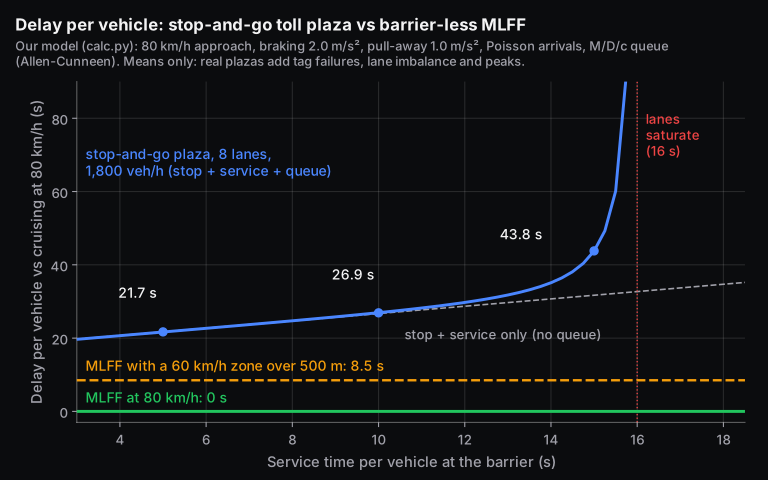
Two things stand out. Even an empty barrier plaza costs every vehicle about 17 seconds to stop and restart, before any queue forms; that is the fixed cost MLFF removes. And the queue term stays small until utilisation nears 1, then explodes, which is why a festival weekend or one closed lane can turn a 30-second plaza into a long queue.
Here is the catch. Real plazas are worse than this mean-value model: traffic peaks within the hour, lanes fill unevenly and tag failures hold up a lane. An NHAI impact study found an average waiting time of 47 seconds at fee plazas after FASTag, down from 734 seconds, as Union Minister Nitin Gadkari told the Lok Sabha on 10 August 2023 (reported by All India Radio). The reverse also holds: MLFF's 0 s assumes nobody brakes at the gantry. The typical drawing's 60 km/h sign suggests NHAI expects traffic to slow, which is the 8.5 s case.
What does this mean for civil, transport and ITS engineers?
It turns tolling from a booth-building job into a corridor systems job: highway designers lay out narrower plazas with 1:20 tapers, structural engineers design steel gantries under a 6.0 m clearance rule, electrical engineers supply lighting and back-up power, and ITS engineers integrate RFID, ANPR and the e-Notice back office.
- DPR and highway design consultants. Every upcoming four-lane and wider DPR must now carry this layout (para 11.1), and live contracts will need change-of-scope estimates (Table-2). Plaza geometry, tapers, sight lines to the gantry and PQC quantities are core highway design skills, taught in Skill-Lync's Geometric Design Fundamentals course. To model a plaza widening in software, see Designing a Roadway Project Using InfraWorks, Civil 3D, and Map 3D.
- Structural engineers. A FOB-type gantry spans the whole plaza carrying cameras, readers, sign boards and a walkway, and it must take wind load. Its columns sit on footings like any other column; our isolated footing design calculator shows that part of the job.
- Traffic and transport engineers. Lane sizing, VMS strategy for OD vehicles and before-and-after delay studies are the queueing and capacity topics of transportation engineering. They are also examined in GATE Civil transportation engineering.
- ITS, electronics and software engineers. ANPR is computer vision under motion blur, glare and dirty plates, at 22 m per second. If that interests you, start with Basics of Computer Vision using Python and our guide on how to become a computer vision engineer.
The work is already under way. IHMCL's first MLFF contract, for Choryasi on NH-48 in Gujarat, went to ICICI Bank in August 2025, and NHAI announced on 2 May 2026 that it was live, with about 41,500 vehicles crossing on day one. By 1 October 2026, PIB listed seven MLFF sites: Choryasi, Mundka-Bakkarwala (UER-II, Delhi), Shahjahanpur, Daulatpura and Manoharpura (NH-48, Rajasthan), Gharaunda (NH-44, Haryana) and Paranur (NH-179B, Tamil Nadu). No hiring numbers were announced; for pay context see our civil engineer salary data.
What is still unclear?
- How fast is "free flow"? The text speaks of "free-flow speed", while the typical drawing shows 60 km/h signs and bar markings for a 60-80 km/h approach. The circular does not state a posted limit, so expect project drawings to settle it.
- Read accuracy and enforcement. The circular says what is built, not how well it must perform. Read rates, ANPR accuracy and e-Notice handling sit in IHMCL's contracts with service providers, which we have not read. Revenue depends on plates being readable; NHAI's Gharaunda advisory asks users for compliant high-security registration plates.
- Existing plazas. The circular covers future and under-construction four-lane and wider projects. Operating plazas convert site by site, and two-lane highways stay on conventional tolling.
Frequently asked questions
What is MLFF tolling in India?
Multi-lane free flow (MLFF) tolling is barrier-less tolling on national highways. Overhead gantries carry RFID readers that read the FASTag and ANPR cameras that read the number plate, and the fee is deducted while the vehicle keeps moving. Vehicles without a working FASTag get an e-Notice instead of being stopped.
Do I still need a FASTag on an MLFF highway?
Yes. The FASTag is how the fee is paid. Without a valid, funded tag the system issues an e-Notice: pay the normal fee within 72 hours, or twice the fee after that. Unpaid notices can lead to FASTag blacklisting and restrictions on vehicle services through VAHAN, according to NHAI's 2026 releases.
How many toll lanes does an MLFF plaza have?
Under NHAI Circular 17.5.104/2026, 8 lanes on a 4-lane highway, 10 on a 6-lane highway and 12 on an 8-lane highway, counting both directions and including the over-dimension or spare lane. Lanes are 3.5 m wide, the OD lane 4.5 m, sized at 600 vehicles per hour per lane.
Will existing toll plazas become barrier-free?
Not automatically. The circular applies to future and under-construction four-lane and wider projects; operating plazas such as Choryasi, Gharaunda and Paranur are being converted one at a time. Projects whose tolling equipment is already bought, with operations due within six months, add barrier-less tolling later through IHMCL.
What is the difference between the pay-axis gantry and the MLFF gantry?
The pay-axis gantry is the main charging point, built across the plaza by the highway contractor. The MLFF gantry is a back-up placed 200-350 m after it on each carriageway, built by the tolling service provider, to catch vehicles the first gantry missed.
Sources and further reading
- NHAI, Policy Circular No. 17.5.104/2026: Toll Plaza layout and Infrastructure for Barrier-Free Tolling on future and under-construction four-lane and above National Highways Projects, 30 October 2026 (signed scan hosted by the Highway Operators Association of India).
- PIB, Ministry of Road Transport & Highways, NHAI Guidelines to Standardise Design and Infrastructure for Multi-Lane Free Flow Tolling on Four-Lane and Above National Highways, 6 November 2026.
- PIB, Ministry of Road Transport & Highways, NHAI Successfully Launches India's first Multi-Lane Free Flow Tolling System in Gujarat, 2 May 2026.
- PIB, Ministry of Road Transport & Highways, NHAI Rolls Out Multi-Lane Free Flow (MLFF) Tolling at Gharaunda Toll Plaza on NH-44, 25 June 2026.
- PIB, Ministry of Road Transport & Highways, NHAI Rolls out Tamil Nadu's First Barrierless Multi-Lane Free Flow Tolling System, 1 October 2026.
- PIB, Ministry of Road Transport & Highways, NHAI Signs Agreement to Implement India's First Multi-Lane Free Flow (MLFF) Tolling System in Gujarat, 30 August 2025.
- Indian Roads Congress, IRC:SP:84-2014, Manual of Specifications and Standards for Four Laning of Highways, section 10 (Toll Plazas), public copy.
- All India Radio News, Average waiting time at fee toll plazas reduced from 734 seconds to 47 seconds, 10 August 2023.