MeitY Revises Make in India Rules for 6 IT Hardware Products: What Changes
On 20 November 2026 MeitY changed how local content is counted for laptops, desktops, thin clients, servers, monitors and interactive panels in government purchases. The new method scores BoM-level steps such as SMT board assembly, and gives extra weight to Indian design and IP. It applies six months after Gazette publication. Here is what counts, how it maps to the 50% and 20% supplier classes, and what it means for hardware engineers.

On 20 November 2026, the Ministry of Electronics and Information Technology (MeitY) changed how six IT hardware products are scored for "Make in India" status in government purchases. The six are desktop and all-in-one PCs, laptops, thin clients, servers, computer monitors and interactive flat panel displays (IFPDs). Local content will now be counted step by step from the bill of materials (BoM). In-house R&D and Indian design and IP add weightage on top. The change takes effect six months after the notification appears in the Official Gazette.
Key facts at a glance
- What: MeitY revised its notification of 7 September 2020. That notification sets the method for calculating local content, or Domestic Value Addition (DVA), under the Public Procurement (Preference to Make in India) Order, 2017. PIB's headline says "Order 2020", but the order itself dates from 2017. Source: PIB release 2339142, 20 Nov 2026, 5:21 PM.
- When: six months after Gazette publication. The release does not give the Gazette date.
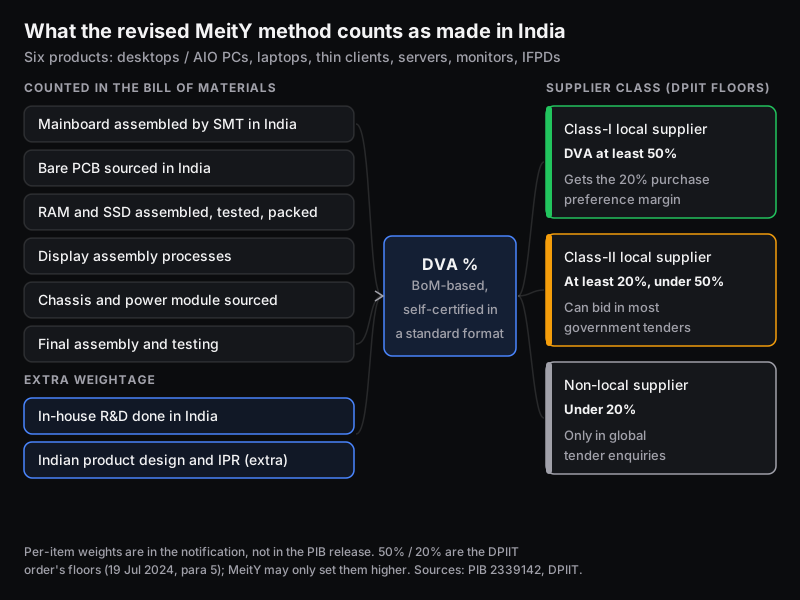
- Why the score matters: at least 50% local content makes a supplier "Class-I" and at least 20% makes it "Class-II". Class-I bids get a 20% purchase-preference margin. Source: DPIIT order of 19 July 2024, paras 5 and 6.
What did MeitY announce on 20 November 2026?
MeitY replaced the local-content method for these six products with a process-based one. A manufacturer builds up its Indian value from named steps in the BoM. The release lists these steps:
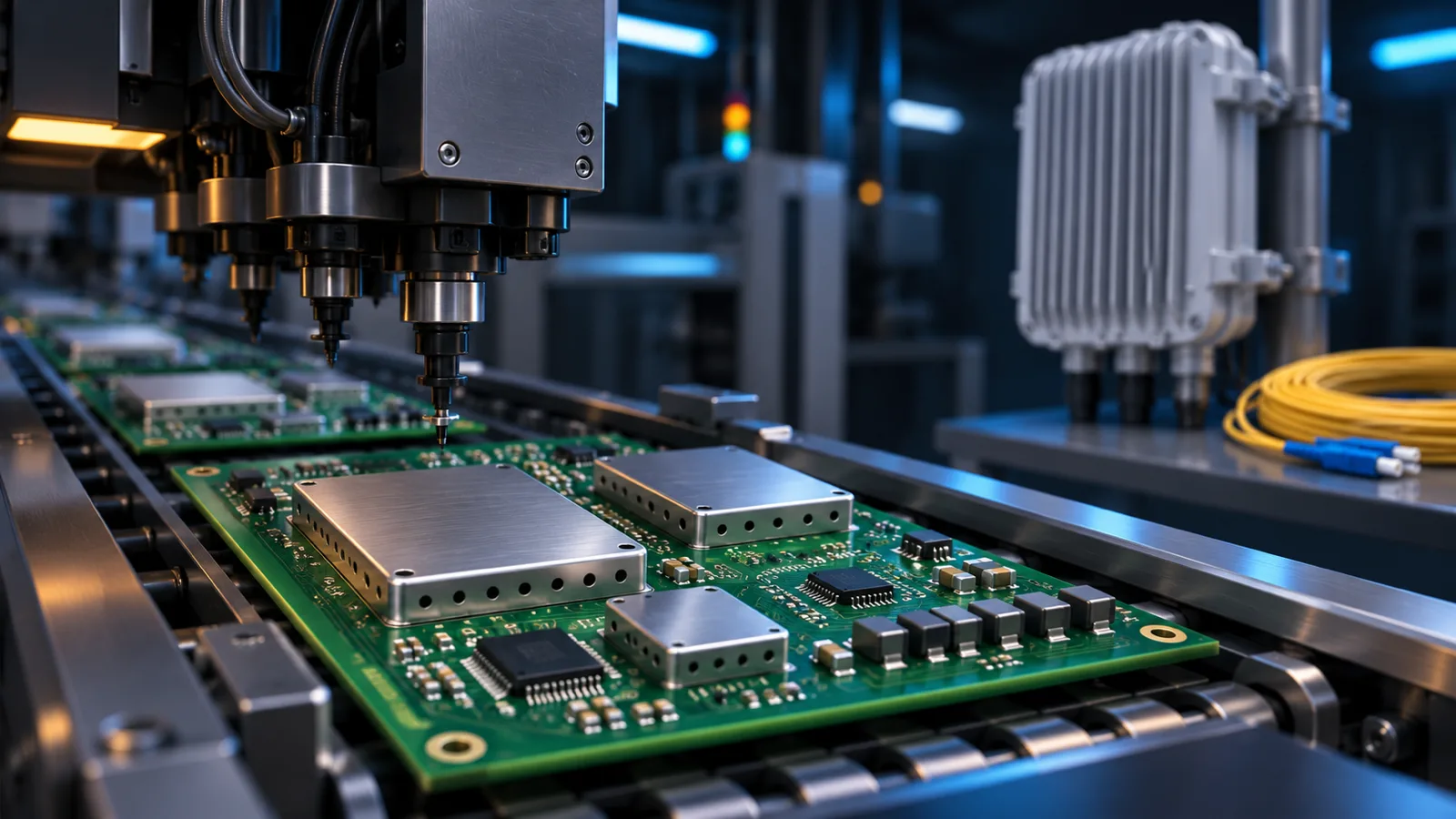
- mainboard (motherboard) assembly in India using surface-mount technology (SMT)
- a bare printed circuit board (PCB) bought from an Indian source
- assembly, testing and packaging of memory (RAM) and storage (SSD)
- display assembly processes
- a chassis and power module bought from Indian sources
- final assembly and testing
On top of these, in-house R&D in India gets "adequate weightage", in the release's words, and Indian product design and IPR get additional weightage. Manufacturers will self-certify DVA in a standard format that officials can verify when needed. The release does not publish the weight of each step. Those weights will only be known from the Gazette text.
What is Domestic Value Addition, in plain words?
DVA is the share of a product's value created in India. Under a BoM-based method, every part and process in the bill of materials gets a line. A line counts as Indian only if the notified rules say so. Take two laptops assembled in India. One uses an imported, ready-built motherboard. The other's board went through an Indian SMT line, where machines place and solder the components. The first now scores clearly lower than the second.
Why does this matter for engineers?
Government departments, PSUs and autonomous bodies buy these products in bulk. Under the order, Class-I suppliers get preference in those purchases, and non-local suppliers can bid only in global tenders. The steps that now raise a brand's score are engineering work:
- SMT and PCB assembly: process engineers for stencil printing, pick-and-place, reflow profiling and automated optical inspection (AOI).
- Memory and storage test and packaging: test, burn-in, failure analysis and yield work. These skills are close to the ones in our semiconductor OSAT explainer.
- Design in India: Indian design and IPR earn extra weight. That gives firms a reason to do board layout, signal integrity, BIOS/firmware, thermal and enclosure design here, not just assembly.
- Quality and compliance: defending a DVA self-certification line by line takes BoM costing and supply-chain tracing.
A policy creates demand, not guaranteed jobs. How much hiring follows depends on the per-step weights and on how much board-level work brands actually move to India.
What happens next?
The six months start when the notification is published in the Official Gazette. If that happens in late November 2026, the new method would apply from around late May 2027; that date is our arithmetic, not MeitY's. Until then, the 2020 method applies. The full text with weights will appear on the MeitY website and the eGazette. Separately, para 2A of the DPIIT order already treats PLI beneficiaries as Class-II suppliers for their PLI item, unless they meet the Class-I level. This lasts for the period the PLI ministry notifies.
Frequently asked questions
Which products does the revised MeitY method cover?
Six: desktop and all-in-one PCs, laptop PCs, thin clients, servers, computer monitors and interactive flat panel displays. Per the 20 November 2026 PIB release, it replaces the 2020 provisions for these six only.
When does the new DVA method apply?
Six months after publication in the Official Gazette, a date the PIB release does not give. Until then, the 7 September 2020 method continues.
What local content makes a Class-I local supplier?
At least 50% under the DPIIT order of 19 July 2024; Class-II needs at least 20%. MeitY can only raise these floors for its products. Class-I bids also get a 20% purchase-preference margin.
Does designing a product in India now count?
Yes. In-house R&D in India gets weightage, and Indian product design and IPR get additional weightage. The exact weights will be in the Gazette notification.
Learn the skills behind it: Skill-Lync's advanced PCB design course covers board layout, and the embedded systems programme covers firmware. For the wider picture, read India Semiconductor Mission 2.0 and VLSI jobs. Not sure which fits you? Talk to a Skill-Lync counsellor.
Sources and further reading
- MeitY revises Make in India local-content methodology for six IT hardware products, PIB (Ministry of Electronics & IT), 20 Nov 2026
- Public Procurement (Preference to Make in India) Order 2017, revised order No. P-45021/2/2017-PP (BE-II)-Part(4)Vol.II, DPIIT, 19 Jul 2024 (copy hosted by DoT)