Telecom Manufacturing Zone Gwalior: What 25 LoIs Mean for Engineers
On 19 November 2026, DoT and Madhya Pradesh gave land-allotment Letters of Intent to 25 companies for India's first Telecom Manufacturing Zone, in Gwalior, and announced Phase II. Here is what is confirmed and what is only reported, where the Centre's ₹493 crore goes, Madhya Pradesh's incentive maths checked against its own rules, how the zone compares with the telecom PLI, and how a telecom box is built and certified.

On 19 November 2026, the Department of Telecommunications (DoT) and the Madhya Pradesh government handed Letters of Intent (LoIs) to 25 companies that plan to set up units in the Telecom Manufacturing Zone (TMZ) in Gwalior. The handover took place at a ceremony in Bhopal, and Phase II of the zone was announced at the same event. PIB's advisory the day before called these "Letters of Intent for land allotment". Phase I covers about 170 acres, given free by the state, and the Centre is funding ₹493 crore of its infrastructure. The government has not named the 25 companies or said what each will invest.
This post separates what the official releases confirm from what was only reported. It shows where the ₹493 crore goes and checks Madhya Pradesh's incentive arithmetic against its own rules. It also compares the zone with the telecom PLI scheme and explains how a telecom box is actually built and certified in India. We end with the roles electronics and telecom engineers could target.
Key facts at a glance
- 19 Nov 2026, Bhopal: LoIs went to 25 companies investing in TMZ Gwalior, in the presence of Chief Minister Dr Mohan Yadav and Communications Minister Jyotiraditya M. Scindia, and Phase II was announced. Source: PIB release 2338585.
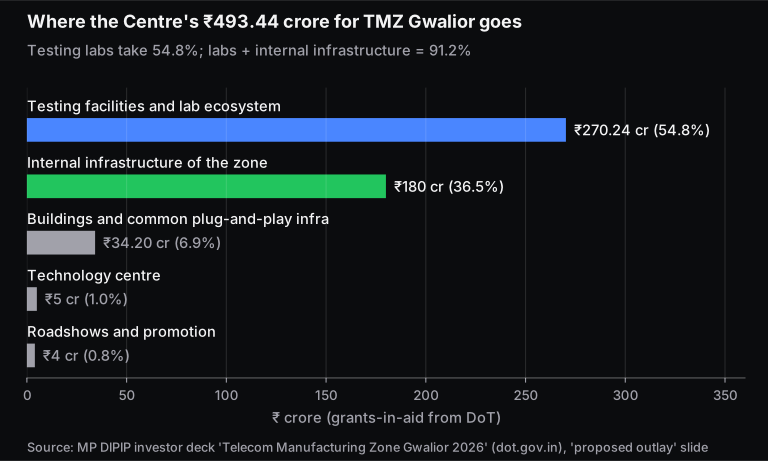
- ₹493 crore from the Centre for Phase I. In the budget shown in Madhya Pradesh's investor deck, ₹270.24 crore (54.8%) goes to testing facilities and the lab ecosystem. Sources: PIB, 30 Jul 2026; MP investor deck hosted on dot.gov.in.
- About 170 acres of Phase I land, given free by Madhya Pradesh: 100 acres in the SADA area and 70 acres in the Gwalior IT Park. The zone is run by a special purpose vehicle (SPV) owned 51% by the state and 49% by DoT. Source: PIB, 30 Jul 2026.
- ₹5,500 crore in commitments from the New Delhi and Mumbai investor meets. PIB has tied this to 18,000 jobs (Aug 2026) and "nearly 20,000" (19 Nov 2026). Sources: PIB, 4 Aug and 19 Nov 2026.
- Reported, not in PIB: the 25 LoI holders account for about ₹3,600 crore and 15,600 jobs. A further 450 acres were cleared for six more companies. Source: Free Press Journal, 19 Nov 2026, quoting Scindia.
Courses: the hands-on skills a telecom plant needs are covered in Skill-Lync's 5G Testing and Advanced PCB Design Using Altium courses.
What was announced in Bhopal on 19 November 2026?
DoT and the Madhya Pradesh government held an LoI distribution ceremony in Bhopal for 25 companies investing in TMZ Gwalior, and announced Phase II of the zone. PIB published the release at 5:29 pm on 19 November. The release describes an integrated cluster of about 170 acres for telecom equipment, components, optical fibre, software and passive infrastructure.
PIB had flagged the event a day earlier, on 18 November, as a ceremony for "Letters of Intent for land allotment ... to prospective investors". That wording matters. An LoI is a step before a plant: it tells a company it can have a plot. It is not a factory, a production licence or a disbursed incentive. PIB itself calls the handover a step towards "translating investor interest into manufacturing opportunities on the ground".
At the ceremony, Scindia said India must "move from being a services nation to becoming a product nation". The Chief Minister said the state Cabinet had approved 170 acres of land for the zone. The Madhya Pradesh government also presented the project and its roadmap, but PIB did not publish the roadmap.
| Claim | Status | Source |
|---|---|---|
| 25 companies received LoIs on 19 Nov 2026 in Bhopal | Confirmed | PIB 2338585 |
| The LoIs are for land allotment | Confirmed | PIB 2338073 (18 Nov) |
| Phase II of the TMZ was announced | Confirmed (no size, cost or date given) | PIB 2338585 |
| ₹5,500 crore committed at the Delhi and Mumbai meets | Confirmed | PIB 2294649, 2338585 |
| Names of the 25 companies | Not disclosed | Not in any PIB release |
| The 25 LoIs account for ~₹3,600 crore and 15,600 jobs | Reported | Free Press Journal, 19 Nov |
| 450 more acres approved for six more companies (~₹1,400 crore) | Reported | Free Press Journal, 19 Nov |
| Bhoomipujan with Amit Shah on 29 Oct 2026 | Announced (6 Oct). We found no record that it took place. | PIB 2319793 |
What is a Telecom Manufacturing Zone, and what scheme is behind it?
A Telecom Manufacturing Zone is a dedicated industrial estate for telecom products. Factories, shared test labs and R&D sit side by side on plug-and-play plots, so a company can rent ready buildings rather than build from scratch. Gwalior's is the first. It rests on a 30 July 2026 MoU between DoT and Madhya Pradesh, not on a nationally notified scheme. We found no DoT scheme notification for TMZs in general.
The MoU release and the state's investor deck (which DoT hosts on its website) spell out how the zone works:
- Who runs it. An SPV, set up by the state as a private limited company, owned 51% by Madhya Pradesh and 49% by DoT. Its six-member board has three central and three state nominees and is chaired by the DoT Secretary. MPIDC (the state industrial development corporation) is the master developer.
- Where it is. Phase I(A) is in the Gwalior IT Park and Phase I(B) is at Kuletha in the SADA (Counter Magnet City) area: 170.5 acres in the deck. The deck puts the site about 8 km from Gwalior railway station, 15 km from the airport and 300 km from Delhi.
- How the land is used. 52.1% of the Phase I area is for industry, 18.6% for roads, 9.2% for logistics and the rest for services, open space, housing and shops. That is about 88.8 acres of factory plots.
- How big it could get. The MoU release called the TMZ a "350-acre" cluster, with projected investment of ₹12,000-15,000 crore over time. Later releases describe a 170-acre Phase I. Phase II was announced on 19 November with no official size.
The money from the Centre is ₹493 crore in grants. The deck's line items show what kind of zone DoT is paying for. More than half of the money is for test labs, not sheds.
The deck lists two labs. Lab A covers six product domains:
- 5G core network functions (AMF, SMF, UPF and others)
- satellite terminals (VSAT, BUC, LNA/LNB)
- optical fibre cable (duct, buried, ADSS, OPGW)
- SIMs, including eSIM (eUICC)
- passive optical network (PON) gear (OLT, ONT, ONU)
- routers (BNG/BRAS, MPLS)
Lab B is a pair of security-testing labs for 5G and 4G systems, Wi-Fi CPE, IoT devices and PON equipment. The deck marks both Lab B units "Phase-I". A shared test lab inside the zone could spare a small manufacturer from sending every new product elsewhere for testing, if the labs win the accreditations and designations that certification requires.
| Date | Step | Headline numbers |
|---|---|---|
| 30 Jul 2026 | DoT-MP MoU, New Delhi; first investor roundtable | ₹3,500 crore, 14,000 jobs committed. The MoU release projected ~14,000 direct skilled jobs (3,500 in Phase I) |
| 4 Aug 2026 | Mumbai investor meet (with COAI) | +₹2,000 crore, ~4,000 jobs; total ₹5,500 crore, 18,000+ jobs |
| 22 Sep 2026 | Bengaluru roundtable | "Nearly 24 companies on board"; ₹700-800 crore more proposed |
| 6 Oct 2026 | Bhoomipujan announced for 29 Oct | "24+" companies; ₹5,500 crore; 18,000+ jobs |
| 19 Nov 2026 | LoIs to 25 companies; Phase II announced | ₹5,500 crore; "nearly 20,000" jobs |
Read the table closely. Since August the rupee figure has stayed at ₹5,500 crore, while the job figure attached to it has moved from 18,000 to "nearly 20,000". The ₹700-800 crore Bengaluru proposals have never been added to the headline total. These are commitments made at investor meets. Until LoIs turn into plots, buildings and payrolls, treat them as intentions.
What incentives does a company in the zone get?
Madhya Pradesh carries most of the incentive cost. Its package gives a 50% capital subsidy on eligible fixed capital investment (EFCI), capped at ₹200 crore. Land comes at a ₹1 premium and ₹1 per square metre a year for 30 years. A new employee earns the company up to ₹5,000 a month for five years (for units investing over ₹75 crore), plus ₹13,000 of training support. There are freight, power and R&D subsidies too. The state says it will spend nearly ₹8,000 crore to attract ₹12,000 crore of investment over 10 years.
The deck backs that up with three worked cases. A ₹50 crore unit with 170 employees gets ₹32 crore from the state (64% of project cost). A ₹100 crore unit with 270 employees gets ₹75 crore (75%). A ₹500 crore unit with 1,200 employees gets ₹350 crore (70%). The deck does not show how it reached those totals, so we rebuilt them from the three rules it itemises:
Here E is the EFCI in ₹ crore, is in ₹ crore, and are in rupees, N is the number of new employees and 60 is five years of months. For the ₹500 crore case: the capital subsidy hits its cap at ₹200 crore, employment aid is 5,000 × 1,200 × 60 months = ₹36 crore, and training is ₹1.56 crore. Together they come to ₹237.56 crore. The deck's ₹350 crore therefore includes about ₹112.44 crore from items it does not itemise, such as land value, stamp duty, the power rebate of ₹2 per unit and R&D support.
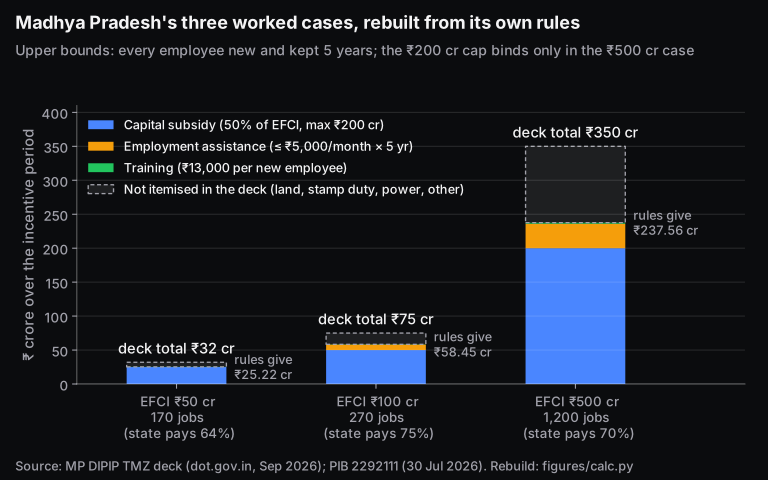
Two things stand out. First, the capital subsidy dominates: it is 57-78% of the state's support in all three cases. Second, the capital subsidy stops growing above a ₹400 crore plant (50% of ₹400 crore is the ₹200 crore cap), so for bigger plants it falls as a share of investment: to 40% at ₹500 crore.
How does the TMZ sit next to the telecom PLI scheme?
The two do different jobs. The production-linked incentive (PLI) for telecom and networking products pays a percentage of extra sales, wherever in India the product is made. The TMZ offers a place: free land, ready buildings, shared test labs and state subsidies. The anchor firms named for the zone in July (Dixon, HFCL, Tejas Networks, VVDN and Syrma SGS) all appear among the 42 PLI beneficiaries, Dixon through Dixon Electro Appliances.
| Telecom PLI (DoT) | TMZ Gwalior | |
|---|---|---|
| What it pays for | Incremental sales of eligible products over the FY2019-20 base year | Infrastructure and labs (Centre); capital, jobs, land, power (state) |
| Money | ₹12,195 crore outlay over five years | ₹493 crore central grant; state package "nearly ₹8,000 crore" over 10 years |
| Rate or size | MSME 7, 7, 6, 5, 4%; others 6, 6, 5, 5, 4%; +1% for design-led products | 50% capital subsidy up to ₹200 crore, plus per-employee aid |
| Entry bar | Minimum investment ₹10 crore (MSME) or ₹100 crore (others) | LoI for land allotment; plot in Phase I |
| Period | FY2021-22 to FY2025-26; five years from 1 Apr 2022 for design-led applicants | Phase I under development; Phase II announced 19 Nov 2026 |
| Results so far | ₹4,081 crore invested, ₹78,672 crore sales, ₹14,963 crore exports, 26,351 jobs (to 31 Jan 2025) | LoIs only; no production yet |
A worked PLI example shows the scale. The numbers are hypothetical: a non-MSME maker had net sales of ₹400 crore in the base year and ₹1,000 crore of eligible products in its first scheme year. The incentive is paid on the ₹600 crore increase, at 6% in year 1, or 7% if the product qualifies as design-led (figures in ₹ crore):
The Cabinet release adds that a qualified investor is incentivised "up to 20 times of minimum investment threshold", which is ₹2,000 crore at the ₹100 crore non-MSME threshold. Note the dates: on the periods PIB gives, the PLI's incentive years run out with FY2025-26 or FY2026-27. A Gwalior plant that starts production in 2027 or later would have to rely on the state package rather than the current PLI. We found no notified successor scheme as of 20 November 2026. None of the TMZ releases say whether a unit can claim both.
What will factories in the zone make?
The official releases list the target product areas but name no factory and no specific product. The areas are mobile devices, optical fibre, telecom equipment, components, software, passive infrastructure and 5G/6G technologies. The MoU release names routers, antennas, optical fibre and chips as critical items. The PLI covers a similar list, including core transmission equipment, 4G/5G radio access network gear, customer premises equipment (CPE), IoT access devices, and enterprise switches and routers. When the Cabinet approved the scheme in February 2021, PIB put India's telecom equipment imports at more than ₹50,000 crore.
A fair reading is that the zone's lab list shows what DoT expects to be made nearby: PON boxes, routers, 5G core and radio gear, satellite ground terminals, SIMs and fibre cable. That is our inference from the deck, not a commitment by any company. For background on two of those product lines, see our explainers on optical fibre types and on chip packaging (OSAT) in India.
How is a telecom product actually built, tested and certified?
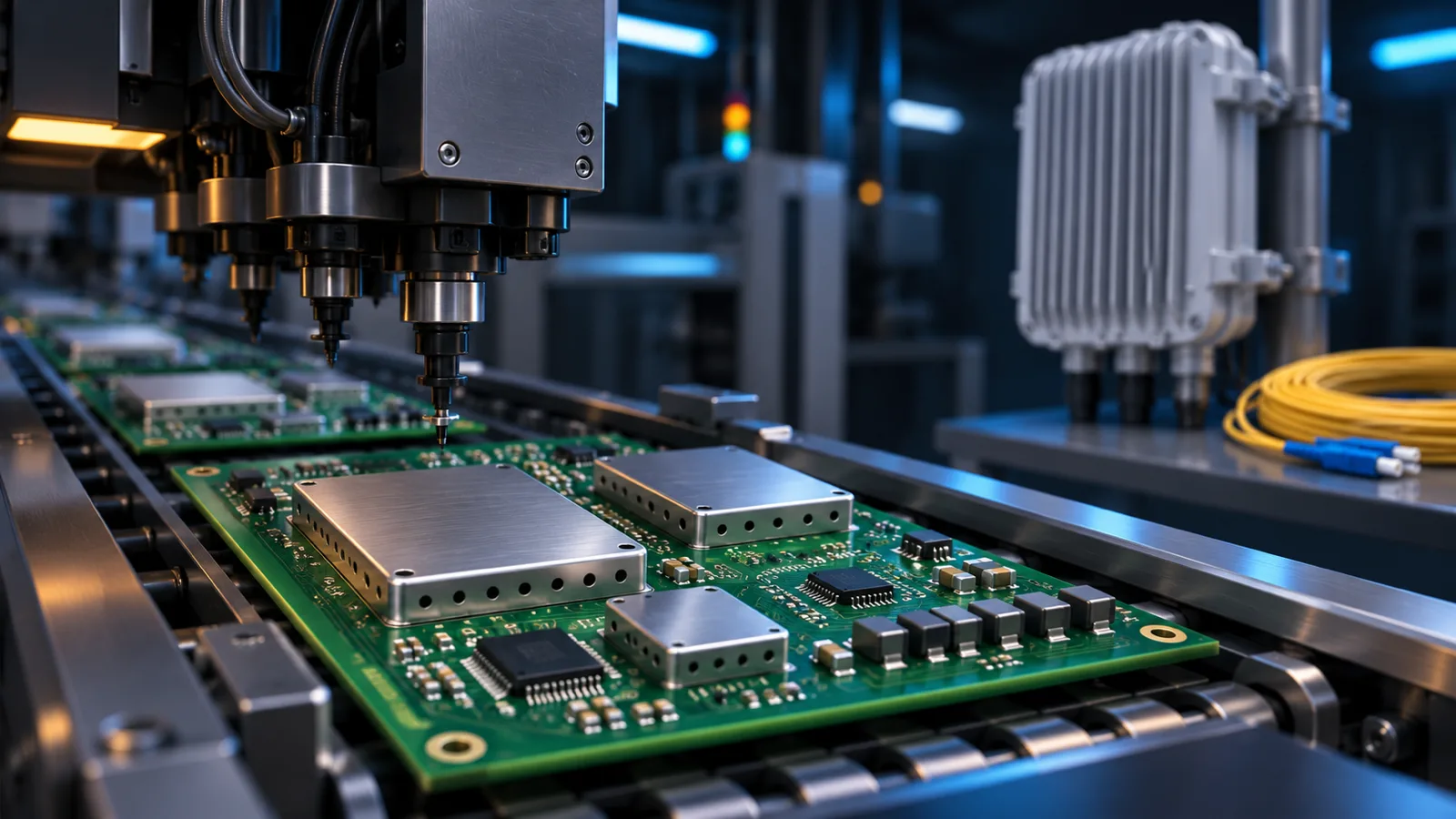
Most telecom boxes start as printed circuit boards assembled on a surface-mount technology (SMT) line. Each unit is then tested electrically, built into its enclosure and tested again, including RF tests for radios. Separately, each product model must be certified under DoT's MTCTE regime (and NCCS security testing where it applies) before it can be sold, imported or used in India.
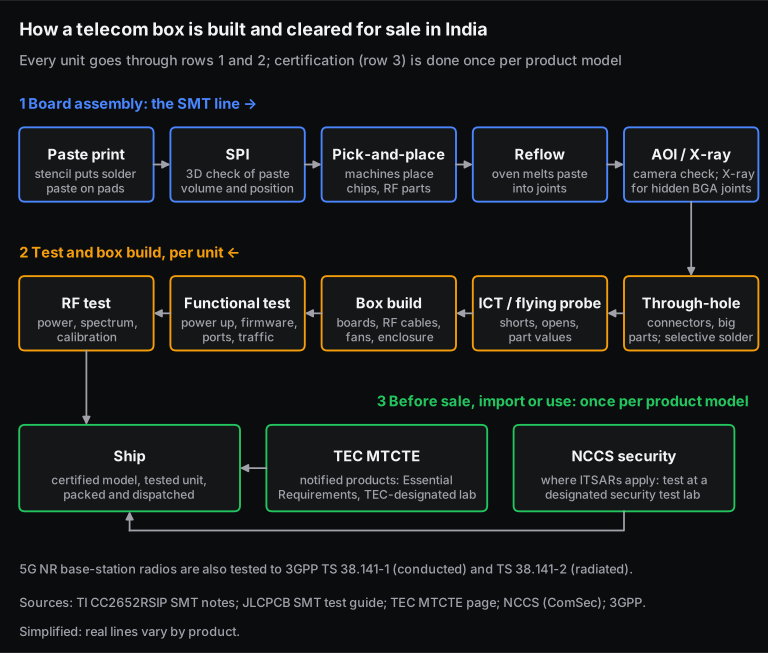
1. Board assembly on the SMT line
A stencil prints solder paste onto the board's pads. Solder paste inspection (SPI) then measures each deposit in 3D. Pick-and-place machines set down the chips, passives and RF parts, and a reflow oven melts the paste into joints. Automated optical inspection (AOI) checks the result with cameras. Parts whose joints are hidden underneath, such as BGAs, need X-ray. Texas Instruments' assembly notes for one of its wireless modules give the same core sequence (print, paste-volume check, placement, reflow) and add X-ray checks before and after reflow for bridging and voids.
2. Test and box build
On mixed boards, through-hole parts such as power connectors, terminal blocks and large capacitors go in after reflow and are wave- or selectively soldered. An in-circuit test (ICT, a fixture that probes every net), or a fixtureless flying-probe tester, catches opens, shorts and wrong part values. Boundary scan (JTAG) tests connections that probes cannot reach. The boards then go into the enclosure with fans and RF cables, and a functional test powers the box up and checks that it works as a product. Radios get RF tests for output power, spectrum and calibration. 5G NR base stations are tested to 3GPP TS 38.141-1 for conducted measurements and TS 38.141-2 for radiated (over-the-air) ones.
3. Certification before sale
India's Mandatory Testing and Certification of Telecom Equipment (MTCTE) requires telecom equipment to be tested and certified before sale, import or use. A lab designated by the Telecommunication Engineering Centre (TEC) tests each product against its Essential Requirements, and TEC issues the certificate. The procedure was framed in October 2018 and applied to the first network elements from 1 October 2019. Security is tested separately: the National Centre for Communication Security (NCCS) runs the ComSec scheme. Under it, products are tested against Indian Telecom Security Assurance Requirements (ITSARs) at designated security test labs. Lab B in Gwalior is meant to do this kind of testing.
For a hands-on view of the board side, see our PCB design courses. The radio side is covered in 5G NR Radio Access Network.
What jobs could the TMZ create for ECE and telecom engineers?
The government's job figures are projections, not hires. The July MoU release projected about 14,000 direct skilled jobs, with about 3,500 in Phase I. Investor-meet totals since then have ranged from 18,000 to "nearly 20,000". Using PIB's own ₹5,500 crore and 18,000 jobs, that is about ₹30.6 lakh of investment per job. Nobody has published a hiring timeline.
The lab domains and the process above point to concrete roles. Our earlier overview of job roles for electronics engineers in telecom covers the operator and network side; the list below is the factory side:
- SMT process and quality engineers: stencil and reflow profiles, SPI/AOI programmes, yield. These suit ECE and EEE freshers who know PCB assembly and soldering defects.
- Test engineers (ICT/FCT): fixtures, test scripts in Python, boundary scan, failure analysis. Our Telecom Testing (4G) with Python and Robot Framework course covers the scripting side.
- RF test and calibration engineers: spectrum and signal analysers, conducted versus over-the-air measurement, 3GPP test cases. Start with Fundamentals of Wireless Communication.
- Certification and compliance engineers: preparing MTCTE and ComSec submissions, reading Essential Requirements and ITSARs, working with test labs.
- Lab engineers in the shared labs: 5G core, PON, router and security testing. The labs are DoT-funded, and 5G Core and 5G Testing skills apply directly to them.
- Hardware and embedded design: the "design in India" part the ministers keep stressing (and the reason the PLI pays +1% for design-led products). See our embedded systems courses.
For pay benchmarks in adjacent roles, see Skill-Lync's embedded engineer salary page. If you are preparing for PSU or core-company routes, GATE ECE covers the analogue, communications and electromagnetics fundamentals that RF test roles use.
What is still unknown?
- Which 25 companies got LoIs, what each will make, and what each plans to invest. PIB has given only totals from earlier investor meets.
- When construction and production start. No date appears in any release after the 6 October announcement of a 29 October bhoomipujan.
- Phase II's size and cost. One report says the state Cabinet cleared 450 more acres for six companies, but no official Phase II figure has been published.
- Whether the shared labs will be accredited and designated for MTCTE and ComSec testing. That is what would make them useful to manufacturers.
We will update this post when DoT or Madhya Pradesh publishes the list of LoI holders or a construction schedule.
Frequently asked questions
What is the Telecom Manufacturing Zone in Gwalior?
It is an industrial cluster for telecom manufacturing, R&D and testing, set up under a 30 July 2026 MoU between DoT and Madhya Pradesh. Phase I covers about 170 acres in the Gwalior IT Park and the SADA area. It is run by an SPV owned 51% by the state and 49% by DoT, with ₹493 crore of central funding.
Which companies got Letters of Intent on 19 November 2026?
PIB says 25 companies received LoIs but has not named them. In July, PIB named Dixon Technologies, HFCL, Tejas Networks, VVDN and Syrma SGS among the anchors of the proposed zone. That does not confirm that any of them is among the 25.
Is the TMZ the same as the telecom PLI scheme?
No. The PLI pays 4-7% (plus 1% for design-led products) on incremental sales of eligible telecom products made anywhere in India, from a ₹12,195 crore outlay. The TMZ is a physical zone with free land, ready buildings, shared test labs and Madhya Pradesh's state incentives.
How many jobs will the Gwalior TMZ create?
Official projections range from about 14,000 direct skilled jobs (July MoU release) to "nearly 20,000" (19 November release). They are based on commitments made at investor meets. No company has announced hiring for a Gwalior plant yet.
What skills do telecom manufacturing plants hire for?
They hire for SMT process and quality, in-circuit and functional test, RF test and calibration, certification under TEC's MTCTE and NCCS security rules, and hardware and embedded design. Python scripting, RF measurement basics, PCB knowledge and familiarity with 5G and PON standards are the most transferable skills.
Sources and further reading
- Telecom Manufacturing Zone, Gwalior Gains Momentum with Distribution of Letters of Intent to 25 Companies, PIB (Ministry of Communications), 19 Nov 2026
- Union Minister of Communications to participate in Letter of Intent Distribution Ceremony in Bhopal, PIB, 18 Nov 2026
- DoT Signs MoU with Government of Madhya Pradesh for Establishment of TMZ in Gwalior, PIB, 30 Jul 2026
- Telecom Manufacturing Zone Gwalior 2026 (investor deck), Department of Industrial Policy and Investment Promotion, Government of Madhya Pradesh, hosted on dot.gov.in, Sep 2026
- Investor and strategic roundtables in Mumbai for the TMZ, PIB, 4 Aug 2026; cumulative ₹5,500 crore commitments, PIB Mumbai, 4 Aug 2026
- Third Investors' Roundtable in Bengaluru, PIB, 22 Sep 2026
- Bhoomipujan of the TMZ announced for 29 October 2026, PIB, 6 Oct 2026
- Cabinet approves PLI scheme for telecom sector, PIB, 17 Feb 2021; PLI launch, 31 companies, PIB, 14 Oct 2021; PLI extended to 42 beneficiaries, PIB, 31 Oct 2022
- PLI Scheme for Telecom and Networking Products: investment, sales, exports and jobs, PIB (Rajya Sabha reply), 21 Mar 2025; committed vs actual investment, PIB (Lok Sabha reply), 11 Dec 2024
- Mandatory Testing and Certification of Telecom Equipment (MTCTE), Telecommunication Engineering Centre, accessed 20 Nov 2026
- About NCCS and the ComSec scheme, National Centre for Communication Security, accessed 20 Nov 2026
- 3GPP TS 38.141-1 and TS 38.141-2, NR base station conformance testing (conducted and radiated)
- CC2652RSIP data sheet, SMT assembly recommendations, Texas Instruments; Types of SMT tests in PCB assembly, JLCPCB, Sep 2025; PCB assembly process: SMT, THT and soldering, LCSC, May 2026
- Land allotment letters issued to 25 investors for Gwalior TMZ, Free Press Journal, 19 Nov 2026 (reported figures)