ISRO's LOX-Methane Engine: the 200-Second Gas Generator Test Explained
On 14 November 2026 ISRO fired the full-scale gas generator of its 1,100 kN LOX-methane engine for 200 seconds at Mahendragiri, announced on 27 November. What 31.5 bar and 60% thrust mean, how a gas-generator cycle drives the turbopumps, why ISRO chose methane, and where the engine fits in the Next Generation Launch Vehicle.

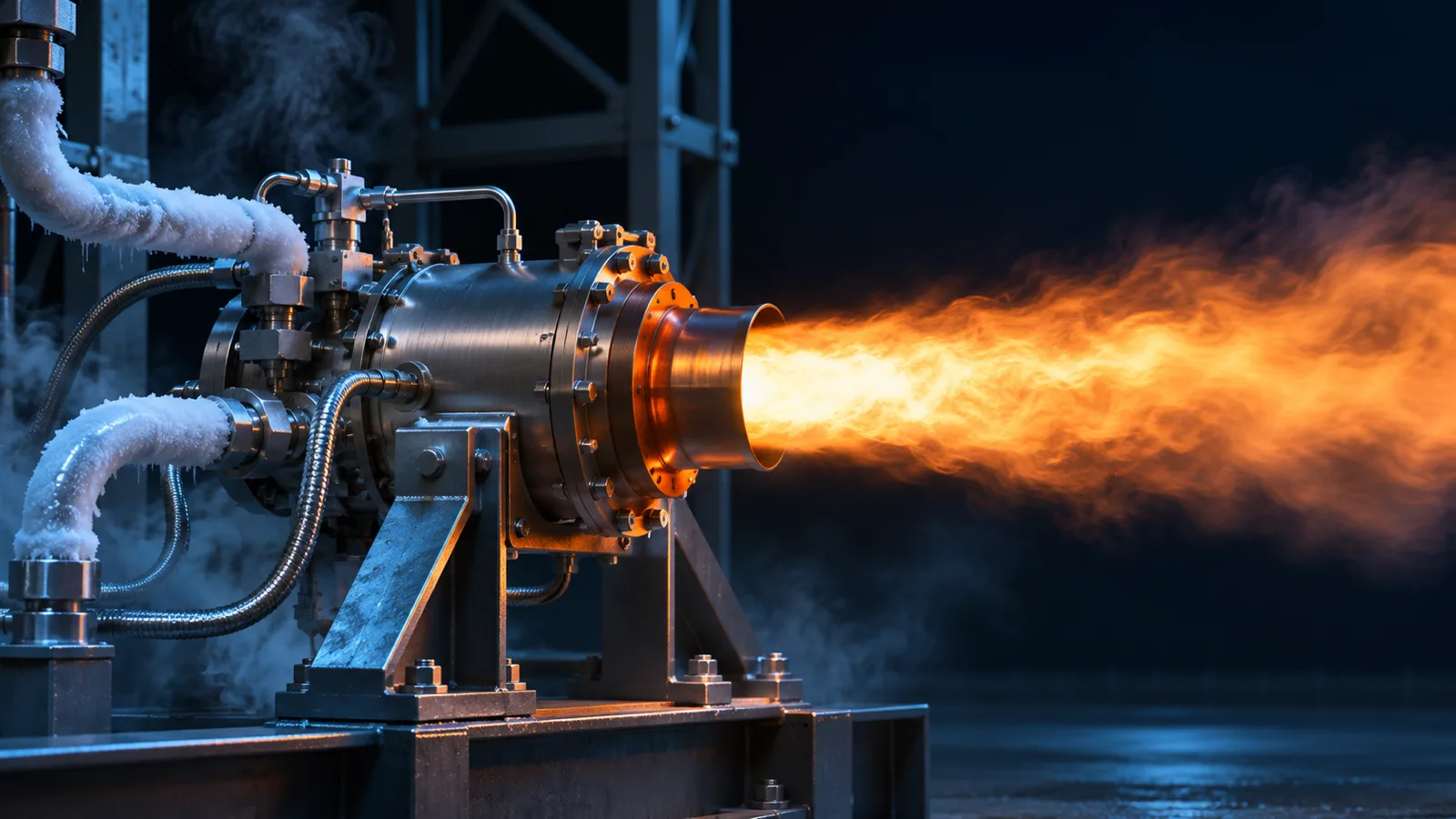
On 14 November 2026, ISRO ran the full-scale gas generator of its high-thrust LOX-methane rocket engine for 200 seconds at the ISRO Propulsion Complex (IPRC) in Mahendragiri, Tamil Nadu. The agency announced the test on 27 November 2026. The gas generator held a steady chamber pressure of 31.5 bar, which ISRO says corresponds to about 60% of the engine's thrust level, with smooth ignition and stable combustion. Two days earlier, on 12 November, the engine's LOX pump assembly had its first cold-flow test. With these two tests, ISRO says every major subsystem of the engine has completed its development test campaign.
Below: what ISRO has confirmed, what a gas generator does and why 31.5 bar maps to 60% thrust, an illustrative turbopump calculation, why ISRO is moving to methane, and where the engine fits in the Next Generation Launch Vehicle (NGLV).
Key facts at a glance
- 14 Nov 2026: 200 s hot test of the full-scale gas generator at IPRC Mahendragiri; steady-state chamber pressure 31.5 bar, equal to about 60% engine thrust level (ISRO, 27 Nov 2026).
- 12 Nov 2026: first cold-flow test of the LOX pump assembly, part of the cavitation and non-cavitation evaluation; the pump had already been spin tested to its maximum operating speed (ISRO, 27 Nov 2026).
- 1,100 kN: rated thrust of the engine, designated LME1100, a gas-generator-cycle engine whose development formally began in 2023; more than 70% of its components are additively manufactured (ISRO, 16 Oct 2026).
- 9 Oct 2026: first ignition test of the same full-scale gas generator; 27 Jan 2026: sub-scale thrust chamber hot test to 56 bar with a single-element injector (ISRO, 16 Oct 2026 and 27 Jan 2026).
- Mid-2027: the target ISRO gave on 16 Oct 2026 for the integrated LME1100 engine to be ready for hot tests, including throttling profiles.
Courses: the physics in this post is combustion and turbomachinery. Skill-Lync's computational combustion course using Python and Cantera covers flame chemistry and adiabatic flame temperature, and the turbomachinery simulation course covers the pump and turbine side.
What exactly did ISRO test on 14 November 2026?
ISRO tested one subsystem, the gas generator, not the whole engine. A gas generator is a small combustor that burns a slice of the engine's propellants to make hot gas for the turbine that drives the pumps. The 200 s run held 31.5 bar in that small combustor, the pressure ISRO says the gas generator would see when the full engine runs at about 60% thrust.
The engine is being developed by the Liquid Propulsion Systems Centre (LPSC), with IPRC and the Vikram Sarabhai Space Centre (VSSC), for the NGLV. The gas generator was additively manufactured at Indian industry and will now be used to prove the design at other operating conditions. The table separates what ISRO states from what we infer.
| Item | Status | Where it comes from |
|---|---|---|
| 200 s gas generator hot test on 14 Nov 2026 at IPRC Mahendragiri | Confirmed | ISRO release, 27 Nov 2026 |
| Steady-state gas generator chamber pressure 31.5 bar, about 60% engine thrust level | Confirmed | ISRO release, 27 Nov 2026 |
| Smooth ignition, stable combustion, design adequacy shown at the 60% condition | Confirmed (ISRO's assessment) | ISRO release, 27 Nov 2026 |
| LOX pump assembly first cold-flow test on 12 Nov 2026; performance in line with prediction | Confirmed | ISRO release, 27 Nov 2026 |
| Spark torch igniter, scaled thrust chamber, full-scale gas generator and LOX pump have completed development testing | Confirmed | ISRO release, 27 Nov 2026 |
| Engine thrust 1,100 kN (LME1100), gas-generator cycle, integrated engine targeted for mid-2027 | Confirmed as a plan | ISRO feature, 16 Oct 2026 |
| Gas generator pressure at 100% thrust about 52.5 bar | Our linear extrapolation, not an ISRO figure | This post, figures/calc.py |
| Full-engine chamber pressure, mixture ratio, specific impulse, first-flight date | Not published | None of the ISRO pages we read gives them |
What does a gas generator do in a rocket engine?
A gas generator is a small combustion chamber that burns a few per cent of the engine's propellants, usually fuel-rich so the gas stays cool enough for turbine blades, and sends that gas through a turbine. The turbine spins the pumps that force liquid oxygen and liquid methane into the main thrust chamber at pressures the tanks alone could never supply.
ISRO's own description puts it plainly: the gas generator "produces high pressure and high temperature gas by burning propellants which drives a turbine that power the turbopumps".
Gas-generator cycle vs staged combustion: what is the difference?
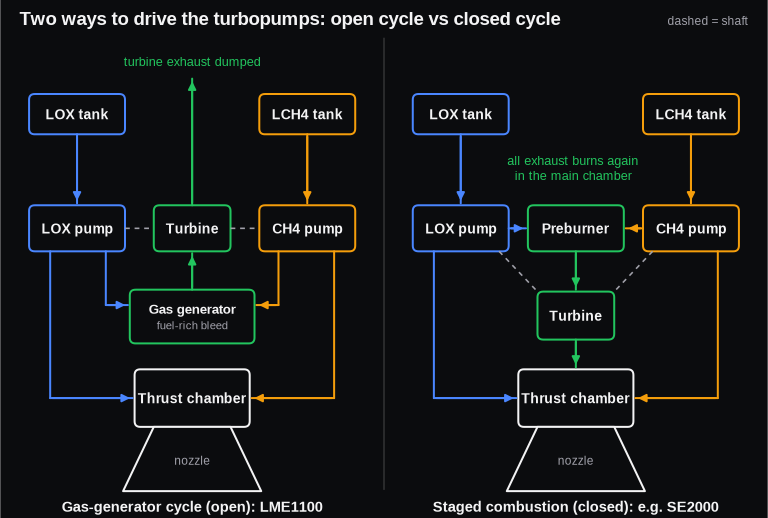
In a gas-generator (open) cycle the turbine exhaust is dumped overboard after doing its work, so the 2 to 4% of propellant it burns produces almost no thrust. In a staged-combustion (closed) cycle the preburner exhaust goes into the main chamber and burns again, so nothing is wasted, but the whole engine must run at much higher pressures.
ISRO is building both. The LME1100 is "designed as a Gas Generator Cycle (GGC) based engine where the design is optimized for industry friendliness and cost effectiveness" (ISRO, 16 Oct 2026). Its 2,000 kN LOX-kerosene SE2000 uses an oxidiser-rich staged combustion cycle at 180 bar chamber pressure, with feed pressures up to 600 bar (ISRO, 28 Mar 2025), and the design of a 2,400 kN full-flow staged-combustion LOX-methane engine is complete. The trade is the usual one: an open cycle gives up a few seconds of specific impulse for a simpler, cheaper turbopump at lower pressure and temperature, which suits a booster meant to fly again and again. (A third option, the expander cycle, drives the turbine with fuel warmed in the cooling jacket, but only works for smaller engines.) Cycle definitions follow Sutton and Biblarz's Rocket Propulsion Elements.
Why does 31.5 bar in the gas generator mean about 60% thrust?
Because, for a fixed throat, thrust rises almost in step with chamber pressure, and the gas generator's pressure has to track the main chamber's. The gas generator supplies the pumps' power, the pumps set the main chamber pressure, and the main chamber pressure sets thrust. So a gas generator at 60% of its full pressure is the state the engine would be in at roughly 60% thrust.
The chain starts at the nozzle throat. Rocket thrust is the momentum of the exhaust plus a pressure term (NASA Glenn):
The mass flow through a choked throat of area is proportional to the chamber pressure (NASA Glenn's compressible-flow pages):
where , the characteristic velocity, depends only on the gas temperature and composition. Combine the two and thrust is : at a fixed throat area and a fixed thrust coefficient , thrust is proportional to chamber pressure. Throttling a liquid engine to 60% thrust therefore means running the main chamber at roughly 60% pressure, with a pump discharge pressure to match and a gas generator producing roughly 60% of its full-power pressure.
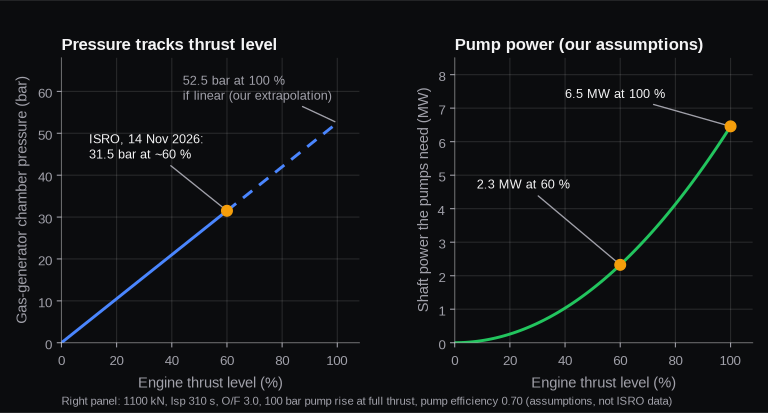
Two cautions. The relation is not exactly linear, because injector pressure drops scale with the square of flow and the gas-generator mixture ratio can be adjusted during throttling, so the 52.5 bar in the chart is a straight-line guess. And the 56 bar reached in January was in a sub-scale thrust chamber with one injector element, different hardware that should not be compared with the gas generator's 31.5 bar.
Worked example: how much power do the turbopumps need?
Under our assumptions, the LME1100's two pumps together need about 6.5 MW of shaft power at full thrust and about 2.3 MW at the 60% point ISRO tested. To supply that, the gas generator would burn roughly 12 kg/s of propellant at full thrust, about 3% of the engine's total flow. These are illustrative numbers from a script in the run folder, not ISRO data.
Assumptions (ours, not ISRO's). Rated thrust 1,100 kN (ISRO). Sea-level specific impulse 310 s, oxidiser-to-fuel ratio 3.0, pump pressure rise 100 bar at full thrust scaling linearly with thrust level, pump efficiency 0.70, turbine efficiency 0.60, fuel-rich gas-generator gas at 900 K with and , turbine pressure ratio 15. Densities at the normal boiling point from the NIST Chemistry WebBook: LOX 1,141 kg/m³, liquid methane 422 kg/m³. These are typical textbook values for a LOX-methane gas-generator booster engine; ISRO has published none of them for LME1100.
Step 1: propellant flow. Thrust divided by exhaust velocity gives the mass flow:
Step 2: pump power. A pump raising a liquid of density by needs :
Notice that the methane pump needs almost as much power as the LOX pump although it moves a third of the mass. Pump power scales with volume flow, and methane is 2.7 times less dense than LOX, so its volume flow is nearly the same. That is one reason why hydrogen engines need such large fuel turbopumps: hydrogen is 16 times less dense than LOX.
Step 3: gas-generator flow. Each kilogram of hot gas expanding through the turbine gives
so the gas generator must supply , which is 3.3% of the engine's total flow. At the 60% point, with flow and pressure rise both at 60%, the pumps need and the gas generator about 4.3 kg/s. Over a 200 s run that is under a tonne of propellant through the gas generator alone, against about 43 t for the full engine at 60%. That is why subsystems are tested on their own first.
Why is ISRO switching to LOX-methane?
ISRO gives three reasons: clean combustion, low maintenance, which helps reusability, and the ability to make methane on Mars from carbon dioxide and water ice (ISRO, 16 Oct 2026). The agency has identified LOX-methane as the primary propulsion for the NGLV and for the heavy-lift vehicle needed for its crewed lunar landing, targeted for 2040.
The numbers behind those reasons come from the propellants themselves. Densities at the normal boiling point are from the NIST Chemistry WebBook.
| Propellant | Boiling point at 1 atm | Liquid density | Tank volume per tonne |
|---|---|---|---|
| Liquid hydrogen (LH2) | 20.4 K (−252.8 °C) | 70.8 kg/m³ | 14.1 m³ |
| Liquid methane (LCH4) | 111.7 K (−161.5 °C) | 422.4 kg/m³ | 2.37 m³ |
| Liquid oxygen (LOX) | 90.2 K (−183.0 °C) | 1,141 kg/m³ | 0.88 m³ |
- Density. Methane is six times denser than hydrogen, so a methane stage needs far smaller fuel tanks and lighter structure. NASA's 2016 review of methane propulsion calls liquid methane "a promising compromise with lower specific impulse, higher bulk propellant density and compatibility with proposed in-situ propellant production concepts", against hydrogen's high performance but low density and long-term storage problems.
- Temperatures. Methane boils at 111.7 K and oxygen at 90.2 K, about 21 K apart, against 70 K between oxygen and hydrogen, so the two tanks are simpler to insulate and load. Our post on why liquids boil at low temperatures covers the physics.
- Clean burning and reuse. Hydrocarbon fuels can leave carbon deposits, called coking, inside hot cooling channels, and a reusable engine has to live with or clean off whatever its fuel leaves behind. Methane is the cleanest of the hydrocarbons: a NASA-sponsored heat-transfer study on methane cooling channels reported "no coking observed" in its heated-tube tests, while asking for further tests on copper surfaces at higher heat flux. ISRO's spark torch igniter for the engine was likewise chosen for "multi-restart capability, higher ignition reliability and also cleaner combustion products", the restarts being essential to recover a booster and relight an upper stage (ISRO, 7 Mar 2025).
- Making it on Mars. Methane and oxygen can be produced from Martian carbon dioxide and water, which is why both NASA's exploration studies and ISRO's statement cite in-situ resource utilisation.
- Cost. ESA's Prometheus, a reusable LOX-methane demonstrator of about 1 MN, was framed in 2017 around methane's availability, efficiency and "operational simplicity", with a cost target of one tenth of the Ariane 5 Vulcain 2 engine. The 1 MN class, the reusable booster role and the additive manufacturing are the same choices ISRO has made for LME1100.
The trade-off is performance. Hydrogen still gives the highest specific impulse of the common propellants, which is why ISRO's CE-20 upper-stage engine remains a hydrogen engine (ISRO, 16 Oct 2026). Methane wins on the booster, where tank mass, cost, turnaround and restarts matter more than the last few seconds of specific impulse.
Where does this engine fit in ISRO's plans?
ISRO says the NGLV "uses a reusable booster stage and two expendable upper stages" and that LOX-methane engines are its primary propulsion (ISRO, 7 Mar 2025 and 16 Oct 2026). The LME1100 is the engine being built for it. ISRO has not published, on the pages we read, how many engines each stage carries or when the vehicle will first fly, so we do not guess.
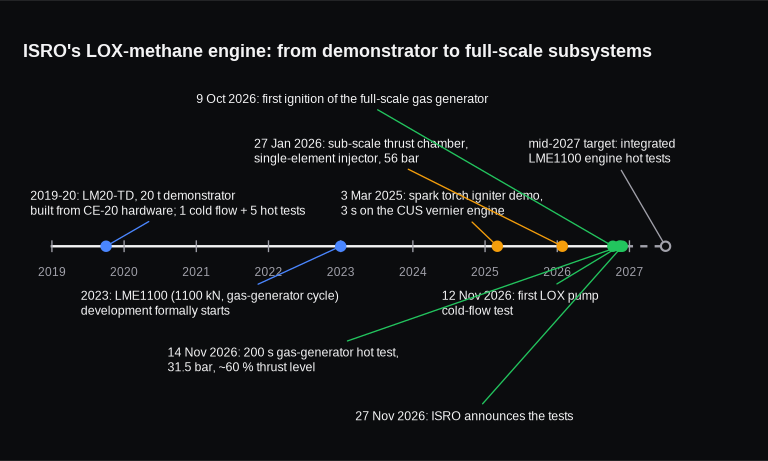
The programme has run in two phases. From 2019 to 2020 ISRO converted CE-20 hardware into a 20-tonne-thrust LOX-methane demonstrator, the LM20-TD, and ran one cold-flow and five hot tests to learn chill-down, ignition, start-up and rotor dynamics on the new propellant pair. In 2023 it formally began the LME1100, with the turbopumps, igniter, gas generator and thrust chamber developed and tested as separate subsystems. The 2026 tests close that phase. The next step ISRO has named is the integrated engine, targeted for mid-2027, to be hot tested across its operating range including throttling profiles. Beyond the NGLV, the 2,400 kN full-flow staged-combustion engine whose design is complete would be a closed cycle, the right-hand side of our first figure, for a human-rated heavy-lift vehicle.
What does this mean for engineering students?
The engine is a checklist of subjects a mechanical or aerospace student can specialise in: combustion and ignition, turbomachinery and cavitation, cryogenic fluid handling, additive manufacturing of hot-section parts, and test instrumentation. More than 70% of the LME1100's components are additively manufactured and its turbopumps, seals and bearings come from Indian companies (ISRO, 16 Oct 2026), so the skills are in demand outside ISRO too.
The LOX pump test on 12 November shows what the work looks like. A cold-flow test runs the pump on a safe fluid to measure head and flow and to find where cavitation begins: the inlet pressure at which the liquid boils inside the impeller, eroding metal and collapsing the pump's output. That margin sets the tank pressurisation system and, through it, the stage mass. Our explainer on the complexity of liquid rocket engines covers the chamber and nozzle side, and how turboprop engines work covers the turbine basics.
The centres doing this work, LPSC in Valiamala and Bengaluru, IPRC at Mahendragiri and VSSC in Thiruvananthapuram, recruit through ISRO's Scientist/Engineer SC route. Skill-Lync's ISRO Scientist/Engineer SC page tracks the current cycle's notification, cut-offs and panels, and our post on the 2026 SC result explains the GATE-based route. For the physics, the thermodynamics foundations course covers the cycle analysis in the worked example, and the Combustion CFD specialist programme simulates combustors like the one ISRO just fired.
Frequently asked questions
Has ISRO tested the complete LOX-methane engine?
No. The 14 November 2026 test was of the gas generator alone, and the 12 November test of the LOX pump assembly. ISRO says the spark torch igniter, scaled thrust chamber, full-scale gas generator and LOX pump have completed development testing, and that the integrated LME1100 engine is targeted to be ready for hot tests by mid-2027.
What is the thrust of ISRO's LOX-methane engine?
The engine under development is the LME1100, rated at 1,100 kN, a gas-generator-cycle engine whose development formally started in 2023. ISRO has also completed the design of a 2,400 kN full-flow staged-combustion LOX-methane engine for a future human-rated heavy-lift vehicle, but that is a design, not test hardware.
Why was the gas generator tested at 60% and not 100%?
ISRO says the 200 s test demonstrated design adequacy at the 60% operating condition and that the hardware will be used to prove the design at other operating conditions. A booster engine meant to be recovered must throttle, so demonstrating a partial-thrust condition is a required point on the map, not a shortfall.
What is the difference between a gas generator and a preburner?
Both are small combustors that make hot gas for the turbine. In a gas-generator (open) cycle the turbine exhaust is dumped overboard. In a staged-combustion (closed) cycle the combustor is called a preburner and its exhaust goes on into the main chamber and burns again. ISRO's LME1100 is the first kind; its SE2000 kerosene engine is the second.
Will the Next Generation Launch Vehicle be reusable?
Partly. ISRO's statement of 7 March 2025 says the NGLV uses a reusable booster stage and two expendable upper stages, and that multiple engine restarts will be essential to recover the booster and to restart the upper stage. The spark torch igniter being developed for the LOX-methane stages was chosen for that multi-restart capability.
Sources and further reading
- ISRO, ISRO successfully tests Gas Generator for high thrust LOX-Methane engine, 27 Nov 2026 (primary source for the 14 Nov and 12 Nov 2026 tests).
- ISRO, Development of LOX-Methane engine in ISRO, 16 Oct 2026 (LM20-TD, LME1100, 9 Oct 2026 ignition, mid-2027 target, 2,400 kN engine).
- ISRO, ISRO conducts testing of sub-scale thrust chamber for LOX-Methane Engine, 27 Jan 2026.
- ISRO, Multiple restarts of Launch Vehicle Stages: ISRO successfully carried out ignition trial using Spark Torch Igniter, 7 Mar 2025 (NGLV configuration).
- ISRO, ISRO achieves major breakthrough in Semicryogenic Engine development, 28 Mar 2025 (SE2000 staged-combustion figures).
- ISRO, Liquid Propulsion Systems Centre (LPSC), centre page.
- NIST, Chemistry WebBook: Thermophysical Properties of Fluid Systems, saturated-liquid densities at 1.01325 bar for methane, hydrogen and oxygen, accessed 29 Nov 2026.
- T. Brown, M. Klem and P. McRight, NASA, Foundational Methane Propulsion Related Technology Efforts, and Challenges for Applications to Human Exploration Beyond Earth Orbit, Space Propulsion 2016, Rome, May 2016.
- R. T. Cook, Rockwell International for NASA, Methane heat transfer investigation, NASA-CR-171199, Nov 1984.
- NASA Glenn Research Center, Rocket Thrust and Mass Flow Rate Equations, Beginner's Guide to Aeronautics.
- ESA, Prometheus to power future launchers, 14 Dec 2017.
- G. P. Sutton and O. Biblarz, Rocket Propulsion Elements, 9th edition, Wiley, 2017 (engine cycles, characteristic velocity and thrust coefficient; textbook reference for the relations used above).