Can You Become an FEA Engineer in 6 Months? Skills, Job and Plan
What is realistic in six months and what is not, what an FEA engineer does day to day, a month-by-month plan from mechanics to a portfolio, what recruiters test, a hand-calculation vs FE convergence check, and Skill-Lync's own CAE placement offers (snapshot 15 Nov 2026).

Yes, a mechanical or automobile graduate can become a job-ready entry-level FEA engineer in about six months of steady practice. Plan on roughly 15-20 hours a week. You will not be an independent crash or NVH analyst in that time. Six months gets you to where many fresher CAE jobs start: clean meshing in HyperMesh or ANSA, a correct linear static run in one solver, and the habit of checking every result against a hand calculation. This guide covers what the job involves day to day, a month-by-month plan, what recruiters test, a worked hand-calculation-vs-FE check, and Skill-Lync's own CAE placement numbers.
Key takeaways
- Skill-Lync placement records (snapshot 15 Nov 2026) show a median starting offer of 3.3 LPA for learners hired with an FEA / CAE engineer title (n = 249). The middle half earned 2.8-3.65 LPA. Most of these offers date from 2021-23.
- Learners who joined as graduate engineer trainees in CAE started at a median of 3.0 LPA (n = 90), so the job title on your first offer matters.
- Cyient (37 placements), Xitadel (28) and ARAI (18) hired the most Skill-Lync CAE learners in the same snapshot, followed by Expleo and Tata Elxsi (15 each).
- Altair's HyperMesh documentation says aspect ratios "should rarely exceed 5:1", that warpage up to 5° is "generally acceptable", and that a Jacobian of 0.7 or more is generally acceptable. Expect interviewers to ask what these mean.
- In our worked example, the hand calculation gives a cantilever tip deflection of 0.952 mm. A converged 2D model gives 0.958 mm. A coarse mesh of the wrong element type gives 0.274 mm, 71% short of the right answer. Catching errors like that is the job.
About the data. Based on 3,711 Skill-Lync placement records up to 7 Nov 2026 (data snapshot of 15 Nov 2026). These are learners who reported a placement, so it is a self-selected sample, not the whole job market. Most are starting offers from 2021-2023, and the recent years are thin. Treat the figures as a starting point. We will update them as new placements come in.
Who this is for: B.E./B.Tech mechanical, automobile, aerospace and production graduates in India, and working engineers moving into simulation. If you already do CAD design, you will move faster through months 1-2.
Can you really become an FEA engineer in 6 months?
Yes, for an entry-level role, if you have a mechanical background and put in regular weekly practice. Six months is enough to learn meshing, one solver, linear static and modal analysis, and to build two or three portfolio projects. It is not enough to master nonlinear crash, NVH or fatigue. Those take one to three years on real projects.
The honest split looks like this:
| Realistic in 6 months | Not realistic in 6 months |
|---|---|
| Geometry clean-up and 2D/3D meshing that passes a company's quality criteria | Owning a full-vehicle crash or NVH model |
| Linear static and modal analysis in one solver (Ansys Mechanical, OptiStruct or Nastran) | Signing off durability or fatigue life on your own |
| A first taste of contact, plasticity and explicit dynamics | Expert-level correlation of simulation with physical tests |
| Hand calculations and convergence studies that show your results are believable | Writing material models or solver code from scratch |
| Two or three projects with clean reports you can explain in an interview | Senior-level pay; see the numbers further down |
Many first CAE jobs are mostly meshing at the start. That is not a failure of the plan. It is how most teams train new analysts. Use that first year to move on to load cases, solver set-up and results.
What does an FEA engineer do day to day?
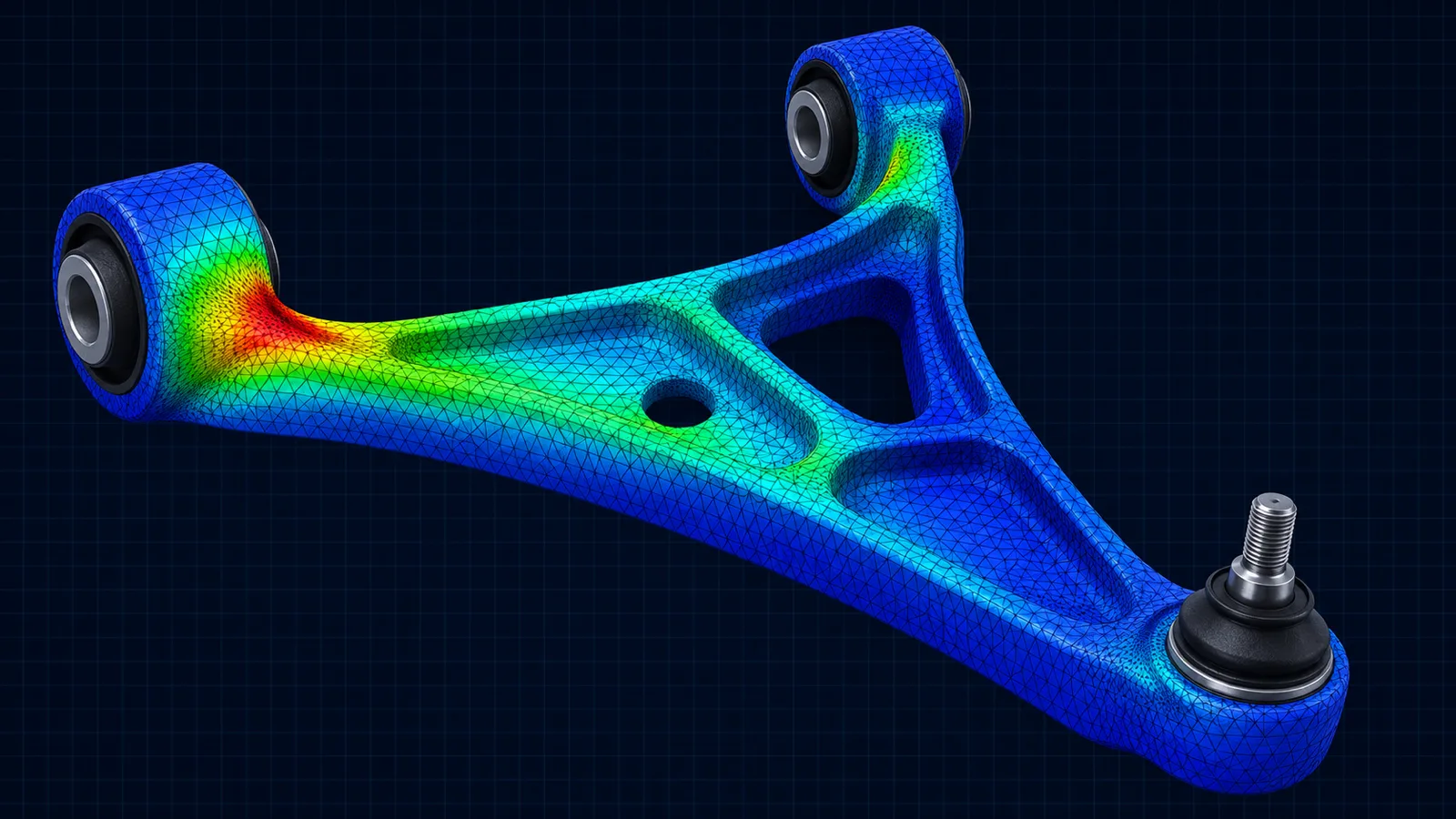
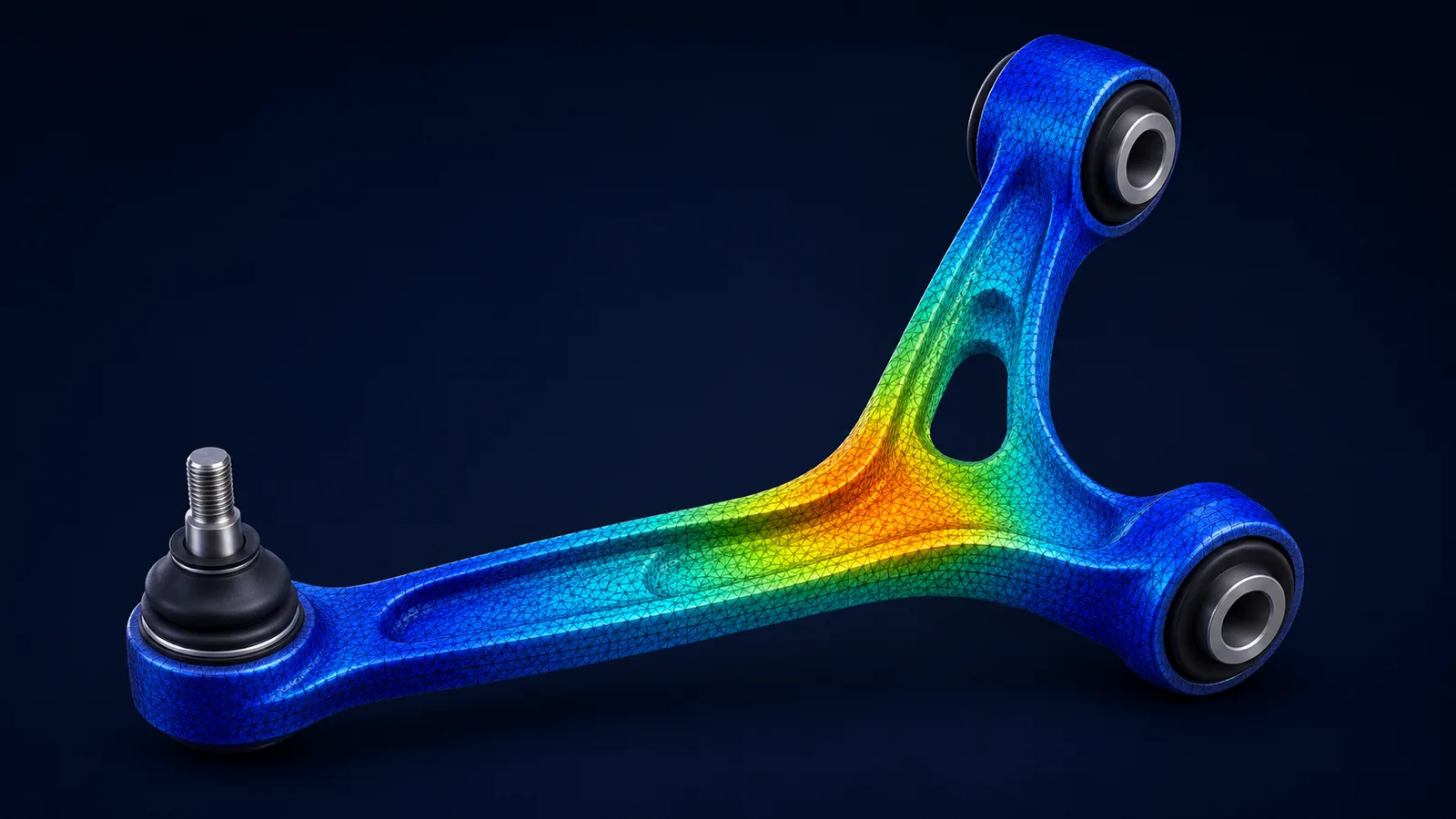
An FEA engineer takes a CAD model, turns it into a finite element mesh, applies materials, loads and constraints, runs a solver and interprets the results. The job ends with a report that says whether the design passes and what to change. Freshers often spend most of their time on clean-up and meshing. Seniors spend theirs on set-up, checks and design decisions.
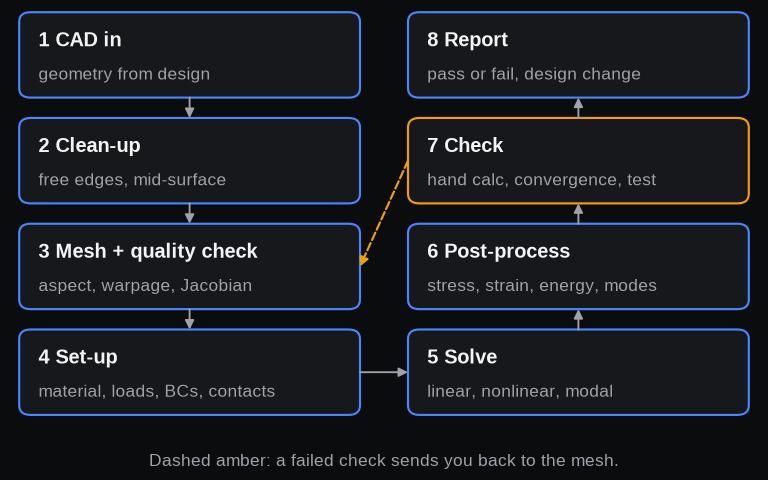
In practice, the responsibilities on an FEA or CAE engineer's job description fall into a few groups:
- Pre-processing. Clean up CAD geometry (close gaps, remove tiny features, extract mid-surfaces of sheet-metal and plastic parts). Then mesh with shells, solids, beams and connectors such as bolts and welds.
- Analysis set-up. Assign materials and properties, apply loads and boundary conditions (BCs), define contacts, and choose the analysis type: linear static, modal, nonlinear or explicit.
- Solving and debugging. Run the job, read the solver messages, and fix the cause of a failed run (an unconstrained part, a bad element, a contact that will not close).
- Post-processing. Read stress, strain, displacement, mode shapes or energy plots. Compare them with the material allowables and the client's acceptance criteria.
- Checking and correlation. Compare results with hand calculations, convergence studies and, on mature programmes, physical test data.
- Reporting and design input. Write the report and suggest design changes, such as adding a rib, changing a gauge or removing weight where the part is under-stressed. The aim is fewer physical prototypes and lower testing cost.
Common job titles for this work in India include CAE engineer, FEA engineer, CAE analyst, meshing engineer and graduate engineer trainee (CAE). Specialist roles add the domain: crash, NVH (noise, vibration and harshness), durability, or CFD for flow and heat.
What skills and software does an FEA engineer need?
You need three things: mechanics of materials (stress, strain, beams, failure theories), FEM basics (elements, stiffness, convergence), and one pre-processor plus one solver used in industry. Typical pairings are HyperMesh or ANSA with Ansys Mechanical, OptiStruct, Nastran, Abaqus or LS-DYNA. Reading CAD, writing a clear report and some scripting (Python, or Tcl for HyperMesh) set candidates apart.
| Skill area | What to learn | Tools |
|---|---|---|
| Mechanics | Stress and strain, beam bending and deflection, torsion, buckling, von Mises and Tresca, factor of safety | Pen, paper, Python |
| FEM basics | Nodes, elements, shape functions, stiffness matrix, degrees of freedom, h- and p-refinement, consistent units | A small solver you write yourself |
| Pre-processing | Clean-up, mid-surfacing, 2D and 3D meshing, quality criteria, connectors (RBE2/RBE3, bolts, welds) | HyperMesh, ANSA |
| Solving | Linear static, modal, contact, plasticity, implicit vs explicit | Ansys Mechanical, OptiStruct, Nastran, Abaqus, LS-DYNA, Radioss |
| Communication | Short reports with a clear pass/fail call, plus the checks that back it up | Any word processor; your post-processor's report tools |
Which tool should you learn first? Job listings give a rough answer. On AmbitionBox's CAE salary pages, as read by our desk on 14 Nov 2026, open listings tagged Ansys (734) outnumbered those tagged HyperMesh (204), Abaqus (165), ANSA (90), NASTRAN (72) and LS-DYNA (40). Those are keyword tags, so treat them as a guide to demand, not a ranking. HyperMesh and ANSA are also listed among the top skills on those pages. If you cannot get licensed software, Ansys Student is free for verified students. It caps structural models at 128K nodes/elements, which is plenty for learning projects.
The FEA courses hub lists Skill-Lync's options by tool. The HyperMesh and ANSA pages cover the two pre-processors most fresher roles ask for.
What is a realistic 6-month plan to become an FEA engineer?
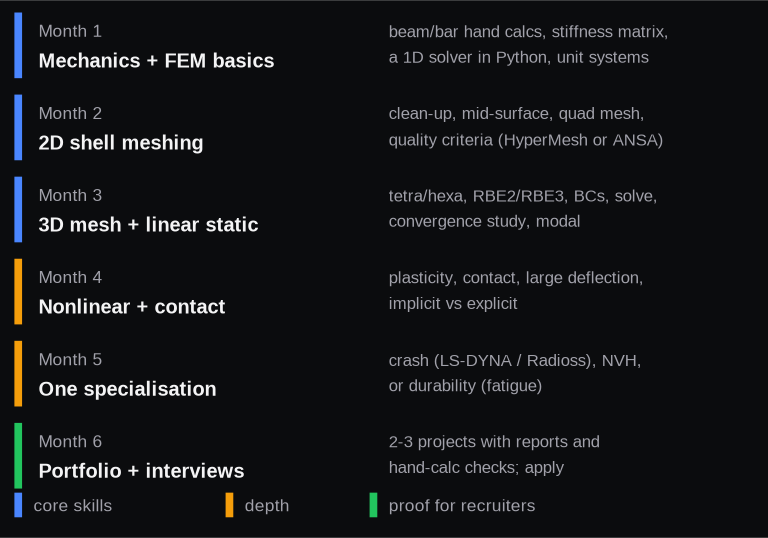
Spend months 1-3 on the core every FEA job needs: mechanics and FEM basics, 2D shell meshing, then 3D meshing and linear static analysis. Use month 4 for nonlinear analysis and contact, month 5 for one specialisation (crash, NVH or durability), and month 6 for portfolio projects and interview practice. Each month should end with something you can show.
Month 1: mechanics of materials and FEM basics
Revise beam bending, deflection, torsion, buckling and failure theories until you can solve a cantilever or a simply supported beam without looking anything up. Then learn how a stiffness matrix is assembled. Write a 1D bar or beam solver in Python. Fix a consistent unit system (tonne, mm, s, N, MPa is common) and stick to it. End-of-month proof: your own solver matching a textbook beam problem exactly.
Month 2: geometry clean-up and 2D shell meshing
Learn HyperMesh or ANSA. Practise clean-up (free edges, duplicate surfaces, small fillets), mid-surface extraction for sheet-metal and plastic parts, and quad-dominant shell meshing at a target element size. Learn the quality checks and fix every failed element. Proof: a meshed bracket or plastic cover that passes a stated set of quality criteria, with a screenshot of the check.
Month 3: 3D meshing and linear static analysis
Mesh solids with tetra and hexa elements. Connect parts with rigid (RBE2) and interpolation (RBE3) elements, apply loads and BCs, and solve linear static and modal cases in one solver. Run a mesh convergence study on every model. Proof: a linear static report where the FE stress at a simple section matches your hand calculation.
Month 4: nonlinear analysis and contact
Add material plasticity, large deflection and contact between parts. Learn why nonlinear runs need load steps and iterations, and what implicit and explicit solvers each suit. Proof: a bolted or snap-fit joint with contact, plus a note on how you checked convergence.
Month 5: one specialisation
Pick one: crash with LS-DYNA or Radioss (time step, hourglass and energy balance), NVH with modal and frequency-response analysis, or durability with fatigue basics. One domain done properly reads better on a CV than three touched lightly. Proof: one specialisation project, such as a crash-box impact, a modal study of a bracket, or a fatigue estimate for a suspension link.
Month 6: portfolio and interviews
Tidy two or three projects into short reports. Each should have the problem, model set-up, mesh quality summary, convergence evidence, results, a hand-calculation check and a conclusion. Practise explaining each one in five minutes. Start applying from the middle of this month, not the end.
If you prefer structured study, Skill-Lync's Pre-Graduate Program in Finite Element Analysis is listed at 16 weeks with 9 projects in ANSA, HyperMesh and Ansys Workbench. The Post Graduate Program in CAE is listed at 48 weeks with 17 projects and adds LS-DYNA, Radioss and crash work. Older versions of this article described a 24-week program. The current catalogue figures are the ones above.
What do recruiters test in an FEA interview?
Recruiters test whether you can tell a believable result from a wrong one. Expect questions on mesh quality criteria, on element choice (shell or solid, linear or quadratic, tetra or hexa), on BCs and units, and at least one hand calculation. Then they will ask you to explain a project: how you meshed it, what you checked and why you trust the answer.
Mesh quality criteria
Every company has its own limits, so learn what each check measures and why it matters. The definitions below come from Altair's HyperMesh element quality documentation (HyperWorks 2026):
| Check | What it measures | Guidance in Altair's documentation |
|---|---|---|
| Aspect ratio | Longest edge divided by the shortest edge (or the shortest corner-to-edge height) | Should rarely exceed 5:1 |
| Warpage | How far a quad, or a solid's face, is from flat | Up to 5° generally acceptable |
| Jacobian | How far the element is from its ideal shape, from 0 to 1 (1 = perfect) | 0.7 and above generally acceptable |
| Skew | For trias, 90° minus the minimum angle between node-to-midside vectors | Set by the company guideline |
| Min/max angle, taper, minimum length | Interior angles of quads and trias; taper; shortest edge or height | Set by the company guideline. Minimum length also sets the explicit time step |
Element choice and set-up questions
Typical questions: when would you use shells instead of solids? Why are linear tetrahedra too stiff in bending? What is the difference between RBE2 and RBE3? Why does stress keep rising at a sharp re-entrant corner as you refine? What happens if you type steel density as 7,850 in a model built in mm and tonnes? The 35 FEA interview questions with worked answers and the CAE engineer interview questions for freshers cover these in detail. The interview questions hub collects the rest.
The hand-calculation check
Most interviews include a beam, bar or plate problem worked at the whiteboard. The point is not the arithmetic. They want to see whether you use hand calculations to check your FE results. The next section shows that habit on a real model.
Worked example: does your FE model match the hand calculation?
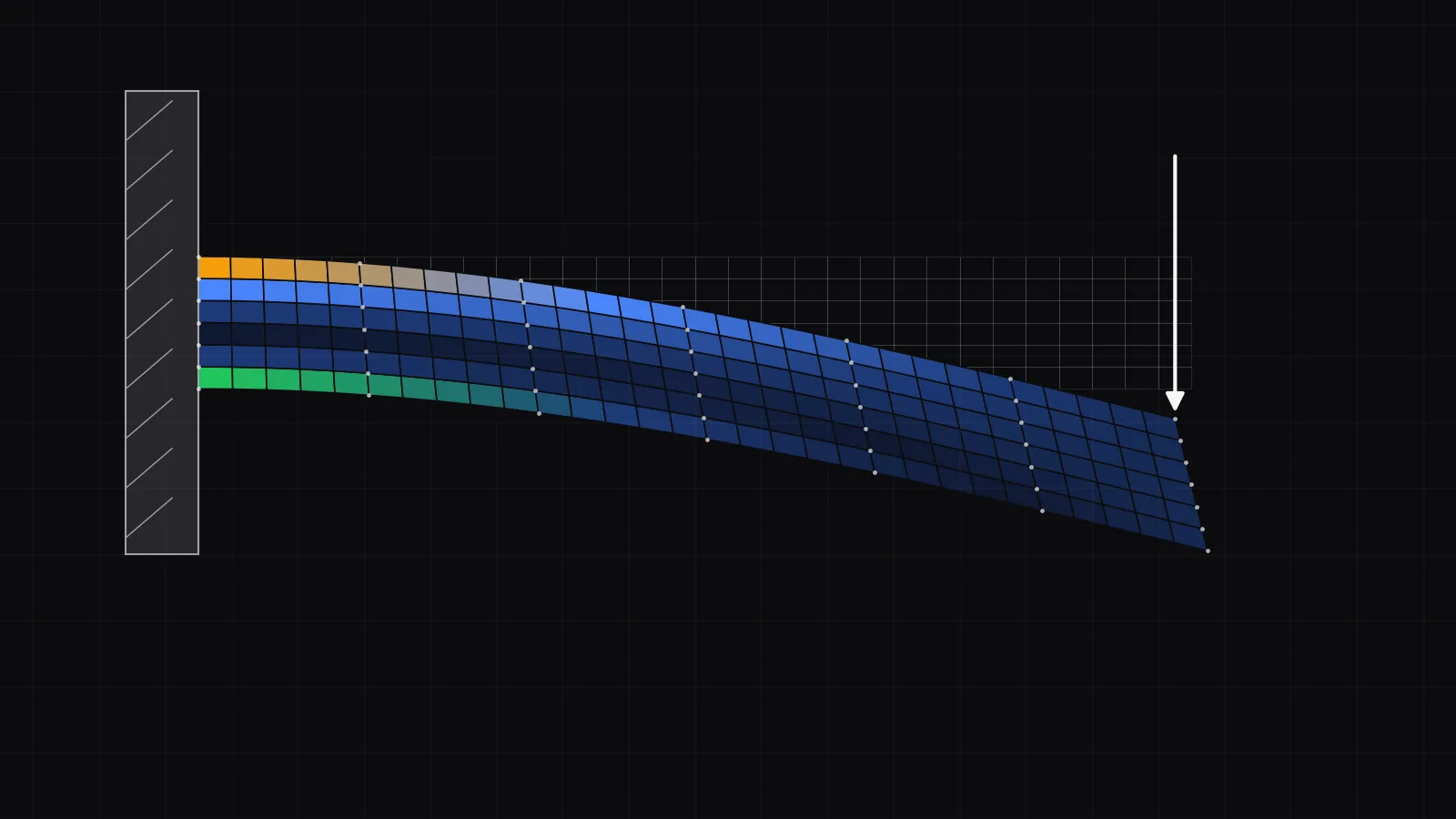
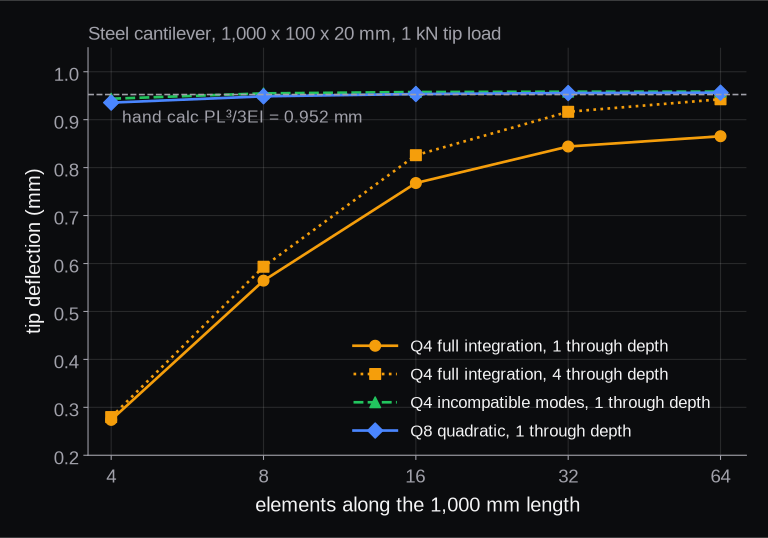
Take a steel cantilever 1,000 mm long, 100 mm deep and 20 mm thick, fixed at one end, with a 1 kN shear load at the free end. The hand calculation gives a tip deflection of 0.952 mm. A converged 2D finite element model gives 0.958 mm. A coarse mesh of linear quads with full integration gives only 0.274 mm, because those elements lock in bending.
Material: MPa, . Section: mm, mm.
Step 1: hand calculation. The second moment of area and the Euler-Bernoulli tip deflection are:
A deep beam also shears a little. Timoshenko beam theory adds , using the shear coefficient 5/6 commonly taken for a rectangle. With MPa and mm², that adds 0.0074 mm (0.78%), for 0.960 mm in total. The bending stress at the top fibre at mid-span is:
The same five lines in Python print exactly these numbers:
E, nu, P, L, b, D = 210e3, 0.3, 1000.0, 1000.0, 20.0, 100.0   # MPa, -, N, mm, mm, mm
I = b * D**3 / 12; A = b * D; G = E / (2 * (1 + nu))
d_bend = P * L**3 / (3 * E * I)        # Euler-Bernoulli tip deflection
d_shear = 6 * P * L / (5 * G * A)      # Timoshenko shear term, kappa = 5/6
sigma_mid = P * (L / 2) * (D / 2) / I  # bending stress, top fibre at mid-span
print(f"{d_bend:.3f} mm + {d_shear:.4f} mm = {d_bend + d_shear:.3f} mm, {sigma_mid:.1f} MPa")
# 0.952 mm + 0.0074 mm = 0.960 mm, 15.0 MPa
Step 2: 1D beam elements. Standard Euler-Bernoulli beam elements give 0.952381 mm with 1, 2, 4 or 8 elements. That is the exact beam-theory value every time, because the exact deflected shape under a tip load is a cubic, the same shape the element assumes. A 1D model that does not match this hand calculation has a set-up error, not a mesh problem.
Step 3: a 2D plane-stress convergence study. We meshed the same beam with three element types: linear quads with full 2 x 2 integration (Q4), linear quads with incompatible modes (Q4I, like Abaqus CPS4I), and 8-node quadratic quads (Q8). The root edge is fully clamped and the tip carries the 1 kN load as a parabolic shear stress. The reference answer is a fine Q8 mesh, 160 x 8 elements (8,320 degrees of freedom): 0.958 mm.
| Elements along length | Q4, 1 through depth | Q4, 4 through depth | Q4I, 1 through depth | Q8, 1 through depth |
|---|---|---|---|---|
| 4 | 0.274 mm | 0.280 mm | 0.944 mm | 0.936 mm |
| 8 | 0.564 mm | 0.593 mm | 0.955 mm | 0.949 mm |
| 16 | 0.768 mm | 0.826 mm | 0.958 mm | 0.953 mm |
| 32 | 0.844 mm | 0.916 mm | 0.958 mm | 0.955 mm |
| 64 | 0.865 mm | 0.943 mm | 0.959 mm | 0.956 mm |
What this teaches, and what an interviewer hopes you will say:
- The hand calculation is within 0.6% of the converged model. Here 0.952 mm compares with 0.958 mm, and the Timoshenko value (0.960 mm) is within 0.2%. The small gap comes from shear deformation and the fully clamped root. If your FE answer is 30% away from a hand calculation on a simple part, suspect the model before you suspect the theory.
- Linear quads with full integration lock in bending. With 4 elements along the length, Q4 gives 0.274 mm, only 28.6% of the right answer, and a mid-span stress of 4.71 MPa instead of 15.0 MPa. Abaqus's own benchmark of a similar cantilever calls these elements far too stiff for practical bending work. In that benchmark, the incompatible-mode CPS4I reached 0.985 of the right answer on a 1 x 4 mesh. Our Q4I gives the same ratio.
- Refining helps, but slowly, if the element is wrong. Even 64 x 4 linear quads stop at 0.943 mm. Choosing a better element (Q4I or Q8) gets within 2.5% with only 4 elements.
- Measure stress away from the clamp. The fixed corner is a singularity, so its peak stress keeps rising as you refine. Mid-span stress converges to 15.0 MPa in both good element types.
Present a study like this in a portfolio project and you have answered half the interview before it starts. For quick section properties of other shapes, the section modulus calculator helps with the hand-calculation side.
What salary does an FEA fresher get in India?
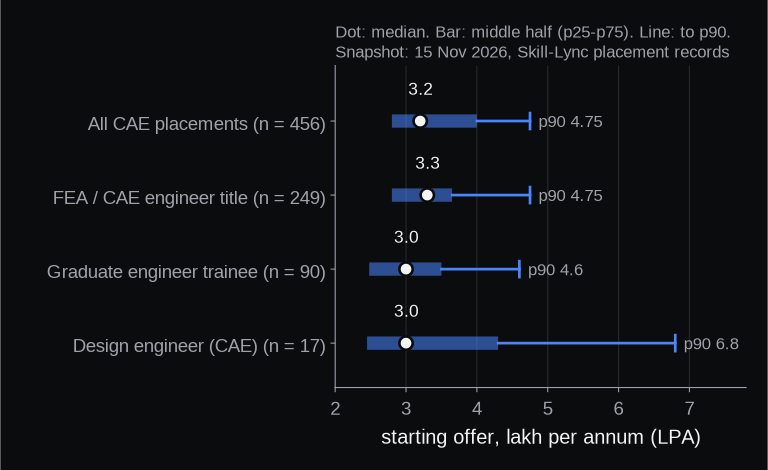
In Skill-Lync placement records (snapshot 15 Nov 2026), learners hired with an FEA / CAE engineer title had a median starting offer of 3.3 LPA (n = 249). The middle half earned between 2.8 and 3.65 LPA, and the top tenth earned 4.75 LPA or more. Across all CAE placements, the median was 3.2 LPA (n = 456).
| Group (Skill-Lync, snapshot 15 Nov 2026) | n | Median | Middle half (p25-p75) | p90 |
|---|---|---|---|---|
| FEA / CAE engineer title (CAE domain) | 249 | 3.3 LPA | 2.8-3.65 LPA | 4.75 LPA |
| Graduate engineer trainee (CAE domain) | 90 | 3.0 LPA | 2.48-3.5 LPA | 4.6 LPA |
| All CAE placements | 456 | 3.2 LPA | 2.8-4.0 LPA | 4.75 LPA |
| CAE placements in 2022 | 238 | 3.3 LPA | 3.0-3.83 LPA | 4.6 LPA |
| CAE placements in 2023 | 78 | 3.34 LPA | 3.0-4.2 LPA | 5.0 LPA |
CAE placements recorded for 2024 number only 12, too few to read a trend from, so they are not in the table. The CAE engineer salary page breaks fresher offers down by employer and city.
Third-party figures, for comparison. AmbitionBox's self-reported salaries, as read by our desk on 14 Nov 2026, put CAE engineers with 1-3 years' experience at an average of 4.3-4.7 lakh a year (2.6k salaries). FEA engineers with 1-3 years were at 5.3-5.8 lakh (488 salaries), and CAE engineers with 3-6 years at 6-6.7 lakh. These cover people already in the job for a year or more, so they sit above starting offers. The CAE and FEA salary guide covers experience, city and employer bands in detail.
Which companies hire FEA freshers in India?
Engineering service companies made most of the CAE hires in our data, with ARAI (a testing and research body) the main exception among the top names. In Skill-Lync placement records (snapshot 15 Nov 2026), the top CAE employers of our learners were Cyient (37 placements), Xitadel (28), ARAI (Automotive Research Association of India, 18), Expleo and Tata Elxsi (15 each), Alten (11), and Tata Technologies and Equilibrium Solutions (10 each).
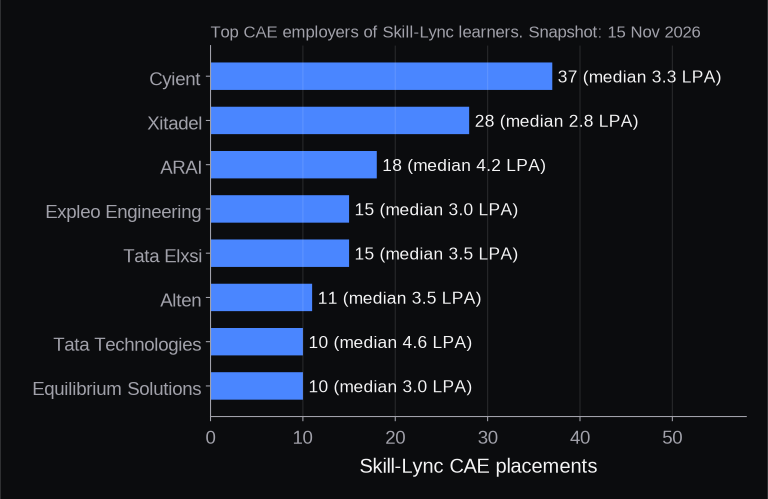
The spread between employers is wide. In this data, the median offer ranged from 2.8 LPA at Xitadel to 4.6 LPA at Tata Technologies. Before you accept a fresher CAE offer, ask about the training period, any service bond and the pay after training. The companies hiring mechanical freshers page lists more employers.
Is a 6-month FEA course enough to get a job?
A six-month course is enough to get interviews for entry-level CAE and meshing roles, provided you finish with two or three projects you can explain, along with their quality and convergence checks. It does not replace on-the-job experience. Expect your first year to deepen one domain under a senior analyst.
Whatever you study, judge it by its output. Does it make you mesh real parts to a stated quality standard? Does it make you check results against hand calculations? Does it end with reports you can show? If you also want to cover crash and nonlinear work in depth, a longer program such as the 48-week PG Program in CAE or focused courses like LS-DYNA for Structural Mechanics fit after the core. If you already use SolidWorks, FEA using SolidWorks is a gentler start before HyperMesh or ANSA. For the theory behind all of this, start with what FEA is, with three worked examples.
Frequently asked questions
Can a fresher with no experience become an FEA engineer?
Yes. Fresher CAE roles exist, often titled meshing engineer, CAE engineer or graduate engineer trainee. In Skill-Lync's records (snapshot 15 Nov 2026), 90 CAE learners joined as graduate engineer trainees at a median of 3.0 LPA. A portfolio of meshed and checked projects stands in for experience.
Which software should I learn first for an FEA job?
Learn one pre-processor and one solver. HyperMesh or ANSA covers meshing, which is what most automotive service-company roles test first. Ansys was the most common tool tag in AmbitionBox CAE listings on 14 Nov 2026 and has a free student version capped at 128K nodes/elements. Add LS-DYNA or Radioss if you aim for crash roles.
Is FEA a good career for mechanical engineers in India?
It suits engineers who like mechanics and careful checking. Starting pay is modest: a median of 3.3 LPA for FEA / CAE titles in Skill-Lync's data. AmbitionBox shows clearly higher averages after a few years. The skill also transfers across automotive, aerospace, heavy engineering and consumer products.
How many hours a day should I study to learn FEA in 6 months?
About two to three hours on weekdays, plus a longer weekend session, adds up to the 15-20 hours a week this plan assumes. Spend at least half of that time meshing and solving, not watching lectures. Meshing speed and judgement only come from repetition.
What is the difference between an FEA engineer and a CAE engineer?
The titles overlap, and many fresher roles use either one for the same work. CAE (computer-aided engineering) is the wider term: it also covers CFD and multibody dynamics. FEA (finite element analysis) refers to the structural, thermal and vibration work done with finite elements.
Sources and further reading
- Skill-Lync placement records,
placement-statsdata snapshot of 15 Nov 2026 (3,711 records up to 7 Nov 2026), as shown publicly on recent placements. Groups: CAE domain, FEA / CAE engineer and graduate engineer trainee roles, CAE by year, top CAE hiring companies. - Altair, HyperMesh Element Quality Calculation, HyperWorks 2026 help (accessed 20 Nov 2026).
- Dassault Systèmes, Abaqus 2016 Benchmarks Guide 2.3.5, Performance of continuum and shell elements for linear analysis of bending problems (university-hosted copy, accessed 20 Nov 2026).
- Dassault Systèmes, Abaqus 2016 Theory Guide 3.2.5, Continuum elements with incompatible modes (university-hosted copy, accessed 20 Nov 2026).
- G. R. Cowper, The Shear Coefficient in Timoshenko's Beam Theory, Journal of Applied Mechanics 33(2), 335-340 (1966).
- Ansys (Synopsys), Ansys Student (free for verified students; 128K nodes/elements structural limit), accessed 20 Nov 2026.
- AmbitionBox, CAE Engineer salary and FEA Engineer salary, self-reported salaries and skill-tagged listings, read 14 Nov 2026.
- The Automotive Research Association of India, ARAI (vehicle testing, certification and research), accessed 20 Nov 2026.
- Skill-Lync course catalogue: Pre-Graduate Program in FEA (16 weeks, 9 projects) and PG Program in CAE (48 weeks, 17 projects), as listed on 20 Nov 2026.
- Worked example: our own plane-stress finite element script (Q4, Q4 with incompatible modes, Q8) and the beam-theory hand calculation above, run 20 Nov 2026.