MS in Energy Engineering in the US: 9 Programs, Costs and OPT for 2027
Nine US master's programs in energy engineering checked on each university's own page: credits, thesis options, GRE rules and Fall 2027 deadlines, whole-degree tuition at 2026-27 rates in rupees, a full one-year budget, and how STEM OPT works for energy degrees.
For an MS in energy engineering in the US, the programs worth a serious look for the 2027 intake include Stanford's MS in Energy Science and Engineering, Carnegie Mellon's MS in Energy Science, Technology and Policy, Michigan's MEng in Energy Systems Engineering, the Illinois MEng in Energy Systems, Penn State's MS in Energy and Mineral Engineering, Northeastern's MS in Energy Systems, Colorado School of Mines' MS in Advanced Energy Systems, UIC's Master of Energy Engineering and ASU's MS in Clean Energy Systems. They differ far more in length, cost and focus than their names suggest.
In short
- The nine programs below run from 30 to 45 credits (or 96 CMU units). Most can be finished in two or three semesters at a full load. We checked every one on the university's own page on 21 Nov 2026.
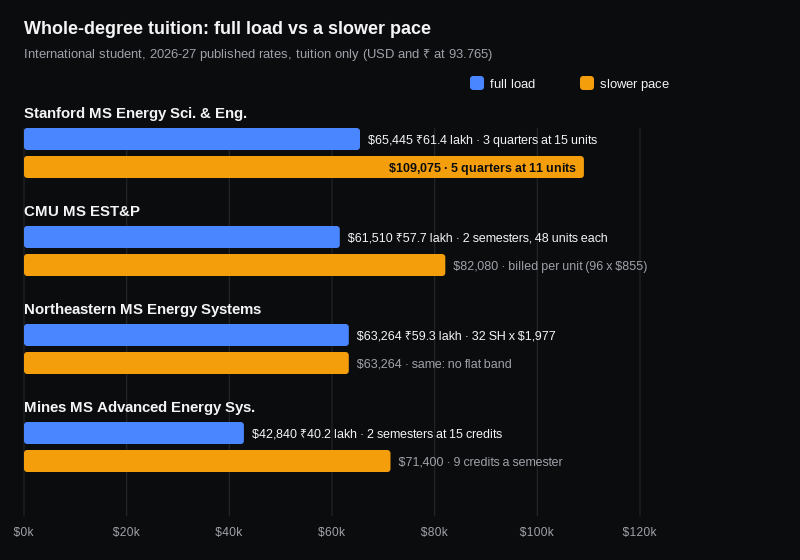
- Whole-degree tuition at a full load ranges from $42,840 (Colorado School of Mines, about ₹40.2 lakh) to $65,445 (Stanford, about ₹61.4 lakh) at 2026-27 published rates.
- Flat-rate tuition bands punish a slow pace. At Stanford, the same 45 units cost $109,075 if you take 11 units a quarter instead of 15.
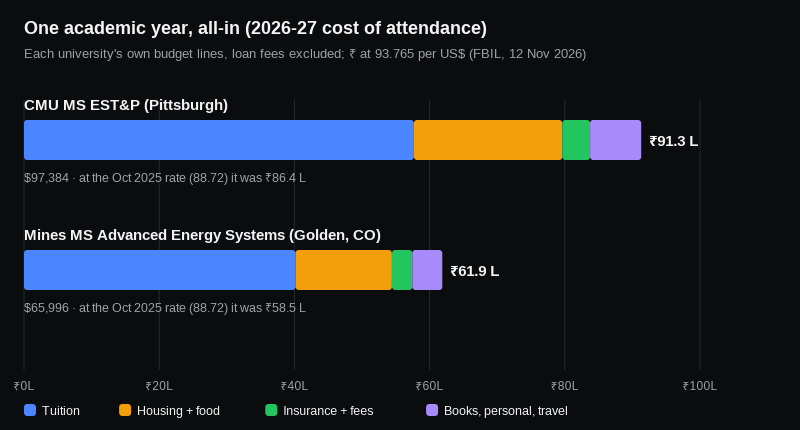
- One full academic year at CMU, with tuition, rent, food and insurance from CMU's own 2026-27 budget, comes to $97,384. That is about ₹91.3 lakh at the FBIL rate of ₹93.765 per dollar (12 Nov 2026).
- Energy Systems Engineering (CIP 14.4801), Mechanical (14.1901) and Electrical (14.1001) are all on the DHS STEM list. A degree carrying one of these codes allows 12 months of OPT plus a 24-month STEM extension: 36 months in total.
This guide is for Indian mechanical and electrical graduates planning a US master's in energy for Fall 2027 or Spring 2028. It is chapter 7 of Skill-Lync's series on master's degrees for mechanical engineers. If you have not settled on energy yet, start with chapter 3 on choosing a specialisation. The list is not a ranking. No single ranking covers these programs fairly, because some sit in engineering schools and others in sustainability or policy schools. Instead, each program is described by facts you can check: credits, thesis options, test policy, deadlines and published tuition. Costs were computed with a short script kept in our run folder.
Which US universities offer an MS in energy engineering?
The nine programs below are taught in English on a US campus (Illinois also online), accept engineering graduates and publish their requirements. They split into three types. Research-capable MS degrees (Stanford, Penn State) offer a thesis route. Professional master's degrees (Michigan, Illinois, UIC, Mines, Northeastern, ASU) are coursework-heavy and aimed at industry. CMU's degree blends engineering with energy policy and economics.
| University and degree | Size | Thesis? | What stands out |
|---|---|---|---|
| Stanford: MS, Energy Science and Engineering (Doerr School of Sustainability) | 45 units, up to 2 years | Optional (39 course + 6 research units) | Seven required courses incl. energy storage and conversion; GRE required; deadline 1 Dec 2026 |
| Carnegie Mellon: MS, Energy Science, Technology and Policy | 96 units, 2 semesters | No (projects available) | 24-unit energy core + 36-unit engineering concentration + 36 units of breadth; fall or spring start |
| University of Michigan: MEng, Energy Systems Engineering | 30 credits | No | At least 24 credits must be graded; built around career pathways and practice |
| University of Illinois Urbana-Champaign: MEng in Engineering, Energy Systems concentration | 32 hours | No (practicum or capstone) | On campus or online; self-funded, no tuition-waiver assistantships |
| Penn State: MS, Energy and Mineral Engineering (Energy Systems Engineering option) | 30 (thesis) or 36 credits | Yes or no | Funded-applicant deadline 15 Dec; self-funded 5 Mar |
| Northeastern: MS, Energy Systems | 32 semester hours (33 with co-op) | Thesis, project or coursework | Core mixes energy engineering with economics and finance; optional co-op |
| Colorado School of Mines: MS, Advanced Energy Systems (non-thesis) | 30 credits | No | Three core courses (resources and power, transportation, systems integration) plus one economics course |
| University of Illinois Chicago: Master of Energy Engineering | 36 hours | No | Expects one course each in heat transfer and thermodynamics; HVAC, CHP and industrial energy management |
| Arizona State University: MS, Clean Energy Systems (Polytechnic campus) | 30 credit hours | Thesis, applied project or portfolio | Page states "STEM-OPT extension eligible: Yes"; rolling deadlines |
Two programs on older lists, including the earlier version of this page, have changed since. ASU's Solar Energy Engineering and Commercialization master's is now marked inactive in ASU's catalogue; its MS in Clean Energy Systems is the active route. Departments move too: Stanford's Energy Science and Engineering now sits in the Doerr School of Sustainability, so search by department, not by an old program name.
What is the difference between an MS and an MEng in energy?
An MS can usually lead to a PhD and often allows a thesis. An MEng is a professional, coursework-based degree that ends in a project or practicum. Illinois says its energy MEng "is a terminal degree and not a pathway to a doctoral program". For a job in industry, either works. If research or a PhD is on your mind, pick a thesis route.
Funding follows the same split. Stanford's catalogue says MS students on financial aid "typically require two academic years" and must take the research option. Carnegie Mellon's EST&P FAQ says students "typically do not have the opportunity to obtain a research or teaching assistantship". Illinois states plainly that its MEng is self-funded. If your budget depends on an assistantship, the professional degrees are the wrong place to look for one. Penn State, by contrast, reviews applications sent by its 15 December deadline for fellowships and assistantships.
Which energy program suits a mechanical engineer, and which suits an electrical engineer?
Mechanical graduates fit thermal-heavy programs such as UIC's Master of Energy Engineering or Stanford's ESE, whose cores include heat transfer and fluids. Electrical graduates fit programs with grid and storage electives, such as Northeastern's, or CMU's degree with a power concentration. To judge any program, read its required courses, not the brochure.
- Thermal and fluids (mechanical): UIC's required list includes Heating, Ventilation and Air-Conditioning, Energy Management Solutions for Industry, and a choice of Combined Heat and Power, Electric Power Generation, Internal Combustion Engines or Air Pollution Engineering. Stanford requires Fluid Mechanics and Heat Transfer (or Multiphase Flow) among its seven core courses.
- Grid and storage (electrical): Northeastern's restricted electives include Energy Storage Systems, Smart Grid, Wind Energy Systems, Hydropower and AI in Energy Systems. CMU lets you pair the energy core with an engineering concentration, so an electrical graduate can stay in power while taking energy policy alongside it.
- Systems and economics (either branch): Mines requires one graduate economics course alongside its three energy cores. Northeastern's core includes Economic Decision Making and Financial Management for Engineers. Michigan's MEng is organised around integrative science, a program core, career pathways and immersive practice.
- Research (either branch): Stanford's research option and Penn State's thesis MS (30 credits, including 6 thesis credits) are the routes to publishable work.
Background gaps are allowed but cost time. UIC lets students take up to 9 credit hours of fundamentals (thermodynamics, heat transfer, maths) before formal admission. Northeastern has a 40-hour "Academic Link" version of its MS for students new to the thermal sciences.
How much does an MS in energy engineering in the US cost?
Tuition alone for the whole degree at a full course load runs from about ₹40 lakh to ₹61 lakh at 2026-27 rates. The four programs with published 2026-27 rates come to $42,840 at Mines, $61,510 at CMU, $63,264 at Northeastern and $65,445 at Stanford. Your course load matters as much as the school, because most universities charge a flat fee across a band of credits.
| Program | How tuition is charged (2026-27) | Full-load path | Tuition for the degree |
|---|---|---|---|
| Stanford MS ESE | $21,815 a quarter, flat for 11-18 units (standard graduate rate) | 45 units = 3 quarters at 15 | $65,445 (₹61.4 lakh) |
| CMU MS EST&P | $30,755 a semester; $855 a unit below 36 units | 96 units = 2 semesters at 48 | $61,510 (₹57.7 lakh) |
| Northeastern MS Energy Systems | $1,977 per semester hour | 32 semester hours | $63,264 (₹59.3 lakh) |
| Mines MS Advanced Energy Systems | Non-resident: $2,380 a credit, flat $21,420 for 9-15 credits | 30 credits = 2 semesters at 15 | $42,840 (₹40.2 lakh) + $3,206 fees |
Here is the worked example behind the chart. Stanford's 45 units at 15 units a quarter take 3 quarters: 3 × $21,815 = $65,445. Take 11 units a quarter and you need 5 quarters, because 4 × 11 = 44 falls one unit short: 5 × $21,815 = $109,075. Mines' flat band begins exactly where nine credits at $2,380 would reach $21,420. A nine-credit pace therefore saves nothing: 9 + 9 + 9 + 3 credits costs 3 × $21,420 + 3 × $2,380 = $71,400, the same as 30 × $2,380. Two semesters of 15 credits cost $42,840, which is $28,560 less.
Two caveats. ESE sits in Stanford's Doerr School of Sustainability, so we used the standard graduate rate. The Graduate School of Engineering rate is $23,239 a quarter ($69,717 for three quarters), so confirm with the department. CMU's billing page also notes that the actual rate "may vary depending upon the department or program". Illinois, Michigan, Penn State, UIC and ASU charge by residency, college and credit band through cost calculators, so they are not in this table. Use each university's calculator with your own credit plan.
What does one year in the US cost all-in?
For a one-year program, a realistic all-in figure is ₹60-90 lakh. Using each university's own 2026-27 cost-of-attendance lines, one academic year at CMU costs $97,384 (about ₹91.3 lakh). At Colorado School of Mines it costs $65,996 (about ₹61.9 lakh). The gap is mostly tuition. The two budgets put housing and food within $8,206 of each other.
| 2026-27 budget line | CMU (Pittsburgh) | Mines (Golden, Colorado) |
|---|---|---|
| Tuition, full load, two semesters | $61,510 | $42,840 |
| Housing and food | $23,416 | $15,210 |
| Required fees | $1,040 | $3,206 |
| Health insurance | $3,352 | not listed |
| Books, personal, travel and transport | $8,066 | $4,740 |
| Total | $97,384 (₹91.3 lakh) | $65,996 (₹61.9 lakh) |
The exchange rate is a real line in your budget. On 31 October 2025 the FBIL rate was ₹88.72 per dollar; by 12 November 2026 it was ₹93.765, a 5.7% rise. On the CMU budget that difference alone is ₹4.9 lakh (₹86.4 lakh then, ₹91.3 lakh now). If you plan to borrow, size the loan with a buffer for the rupee, not at today's rate.
Is an MS in energy engineering a STEM degree for OPT?
Usually yes, but the deciding fact is the CIP code your university reports on your I-20, not the word "energy" in the name. The DHS STEM Designated Degree Program List (last updated 22 July 2024) includes 14.4801 Energy Systems Engineering, General, 14.4802 Power Plant Engineering, 14.1901 Mechanical Engineering and 14.1001 Electrical and Electronics Engineering. A degree carrying one of these codes qualifies for the 24-month STEM OPT extension.
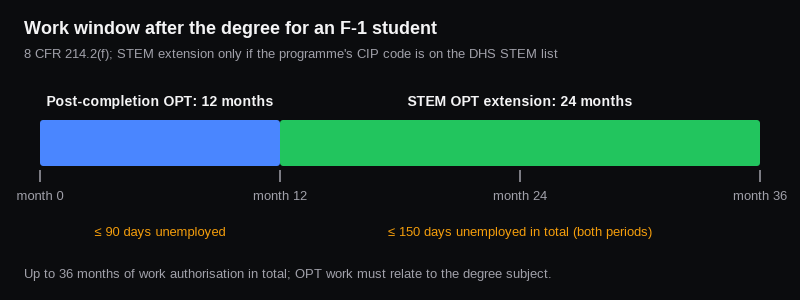
Energy degrees with a policy or management slant are the ones to check. A degree coded under a business or social-science CIP may not be on the list even if half its courses are engineering. ASU's Clean Energy Systems page says outright that the degree is STEM-OPT eligible. For the others, ask admissions for the program's CIP code before you accept an offer and check it against the DHS list yourself.
What do energy engineers earn in the US?
The US Bureau of Labor Statistics does not track "energy engineer" as a separate occupation, so use the closest ones. Its Occupational Outlook Handbook gives a 2025 median pay of $104,110 for mechanical engineers and $125,040 for electrical and electronics engineers. It projects 8% employment growth for electrical engineers from 2025 to 2035. These are medians across all experience levels, not starting offers, and they are not a promise of what a new graduate earns.
Energy jobs for mechanical graduates usually carry titles such as energy engineer, HVAC or building-energy engineer, thermal systems engineer or power-plant performance engineer. Electrical graduates go into grid, protection, power-electronics and battery-storage roles. For the wider picture of jobs after a mechanical master's, see chapter 2 on job prospects.
When should you apply for Fall 2027?
Apply between now and early March 2027, and sooner if you want funding. Stanford's deadline is 1 December 2026, Penn State's funding deadline is 15 December, and self-funded Penn State applications close on 5 March. ASU reviews applications on a rolling basis. The details:
- Stanford ESE: applications must arrive by 1 December 2026, 11:59 pm Pacific time. Official GRE scores are required, and ETS scores must reach Stanford by the deadline.
- Penn State EME: 15 December for applicants who want fellowship or assistantship support, and 5 March for self-funded applicants (5 September for spring entry). The department's admissions page says GRE scores are "recommended, but not required". The Graduate Bulletin entry still says they are required, so ask the department which applies to you.
- ASU Clean Energy Systems: rolling admission for fall and spring. ASU itself warns international students to leave time for visa documents.
- CMU EST&P: fall or spring start; the Applied Study version must start in spring.
Leave four to six weeks for transcripts, recommendation letters and an English test after you submit, and longer if your university's transcript office is slow.
What can you do in India before you apply?
Admissions committees look for evidence that you can do graduate coursework in this field. UIC asks for prior heat transfer and thermodynamics. Stanford's core assumes linear algebra and numerical methods. Every program on this list expects you to model energy systems, not just describe them. A project with real numbers, such as a battery pack model, a converter simulation or a CFD heat-transfer study, makes a statement of purpose concrete.
Skill-Lync's battery technology course in MATLAB and Simulink and the power converter design program suit electrical graduates heading for storage and grid electives. Mechanical graduates aiming at thermal and building-energy courses can build CFD evidence with aero-thermal simulation in ANSYS Fluent. For the UK route, compare this guide with our post on energy engineering for mechanical engineers in the UK. Unsure which skill fits your target program? Talk to a Skill-Lync counsellor.
Frequently asked questions
Which is the best university for an MS in energy engineering in the US?
There is no single best; it depends on your goal. For research and a possible PhD, look at thesis routes such as Stanford's research option or Penn State's thesis MS. For a one-year industry degree, look at CMU, Mines or UIC. Compare credits, thesis options, funding rules and tuition, not just the university's overall reputation.
Is the GRE required for an MS in energy engineering in the USA?
It depends on the program. Stanford's Energy Science and Engineering department says the GRE "is required of all applicants". Penn State's Energy and Mineral Engineering department calls it recommended but not required, and ASU's Clean Energy Systems page lists no GRE at all. Check each department's own admissions page for the year you apply, because policies change.
How much does an MS in energy engineering in the US cost in rupees?
At 2026-27 rates and ₹93.765 per dollar, tuition for the whole degree at a full load runs from about ₹40 lakh (Colorado School of Mines) to about ₹61 lakh (Stanford). One full year including rent, food and insurance comes to about ₹62 lakh at Mines and ₹91 lakh at Carnegie Mellon, based on each university's budget.
Can I do an MS in energy engineering after a B.Tech in mechanical engineering?
Yes. Most programs here accept mechanical graduates, and several assume thermal-science courses that mechanical B.Tech students already have. UIC expects one course each in heat transfer and thermodynamics. Electrical topics such as grids and storage are taught as electives. Northeastern even offers a longer Academic Link version for students new to thermal sciences.
Is energy systems engineering eligible for the STEM OPT extension?
Yes, if the degree's CIP code is on the DHS STEM list. Codes 14.4801 Energy Systems Engineering, 14.1901 Mechanical and 14.1001 Electrical Engineering are all listed. That gives 12 months of OPT plus a 24-month extension, 36 months in total. Ask admissions for the program's CIP code before accepting an offer.
Is an MS in energy engineering worth it for Indian students?
It can be, if you have a clear target role and a budget that survives currency swings. A one-year program costs roughly ₹62-91 lakh all-in. BLS 2025 medians are $104,110 for mechanical and $125,040 for electrical engineers, but those are medians across careers, not starting pay. Plan the loan with a rupee buffer.
Sources and further reading
- Stanford Bulletin, Master of Science in Energy Science and Engineering (accessed 21 Nov 2026); Stanford ESE, Graduate admissions (deadline 1 Dec 2026, GRE required).
- Stanford Student Services, 2026-27 graduate and professional tuition rates.
- Carnegie Mellon, EST&P foundational degrees and prospective student FAQs; CMU Student Financial Services, College of Engineering 2026-27 cost of attendance.
- University of Michigan Chemical Engineering, ESE curriculum information.
- University of Illinois catalog, MEng in Engineering, Energy Systems concentration; program tuition and fees page.
- Penn State, Graduate Bulletin: Energy and Mineral Engineering; EME department, How to apply.
- Northeastern catalog, MS in Energy Systems and 2026-27 tuition and fees.
- Colorado School of Mines catalog, Advanced Energy Systems; Mines Bursar, 2026-27 schedule of tuition and fees; Mines Financial Aid, graduate cost of attendance.
- UIC catalog, Master of Energy Engineering.
- Arizona State University, Clean Energy Systems, MS.
- US Department of Homeland Security / ICE, DHS STEM Designated Degree Program List (last updated 22 July 2024); eCFR, 8 CFR 214.2(f) (OPT and the STEM extension).
- US Bureau of Labor Statistics, Occupational Outlook Handbook: Mechanical engineers and Electrical and electronics engineers.
- Financial Benchmarks India (FBIL) USD/INR reference rate, 12 Nov 2026 (₹93.765) and 31 Oct 2025 (₹88.72), as tabulated by Clarity UPSC.