Advancements in Vehicle-to-Everything (V2X) Communication Technology
Explore how Vehicle-to-Everything (V2X) communication technology is revolutionizing road safety, traffic efficiency, and autonomous driving by enabling real-time data exchange between vehicles, infrastructure, pedestrians, and networks.
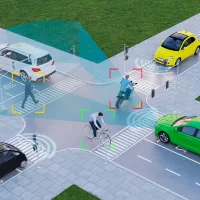
Vehicle-to-Everything (V2X) communication technology enables vehicles to communicate with other vehicles (V2V), infrastructure (V2I), pedestrians (V2P), and the network (V2N). This technology aims to improve road safety, traffic efficiency, and support autonomous driving.
Evolution of V2X Communication
- Dedicated Short Range Communication (DSRC): Initially developed for vehicle safety applications, DSRC allows vehicles to communicate within a short range. However, it faced challenges with scalability and dynamic mobility.
- Cellular V2X (C-V2X): As an alternative to DSRC, C-V2X leverages cellular networks for vehicle communication. It offers better performance in terms of latency and reliability.
- 5G V2X: The integration of 5G technology further enhances V2X communication by providing ultra-low latency, high bandwidth, and improved security.
Key Benefits of V2X Communication
- Improved Road Safety: V2X technology allows vehicles to receive real-time updates about potential hazards, such as accidents or pedestrians crossing the road. For example, if a car ahead suddenly brakes, it can send a warning signal to following vehicles, helping to prevent collisions.
- Traffic Efficiency: By exchanging data with traffic lights and other vehicles, V2X can optimize routes, reduce congestion, and improve fuel efficiency. For instance, traffic lights can communicate with approaching vehicles to adjust signal timings, reducing wait times and improving traffic flow.
- Autonomous Driving: V2X is a key enabler for fully autonomous vehicles, providing the necessary communication infrastructure for safe and efficient self-driving. Autonomous vehicles can use V2X to navigate complex traffic scenarios and make informed decisions.
Example: Smart City Implementation
Let's consider a smart city scenario where V2X communication is fully implemented. In this city, all vehicles and infrastructure are interconnected, providing seamless communication and coordination.
Imagine a busy intersection in this smart city. As a connected vehicle approaches the intersection, it communicates with the traffic light, which has real-time data about the flow of traffic from all directions. The traffic light sends a signal to the vehicle, advising it to slow down because an emergency vehicle is approaching from another direction.
Simultaneously, pedestrians equipped with V2X-enabled smartphones receive alerts about the approaching vehicles. This ensures that they cross the street safely and avoid any potential accidents.
In another scenario, a connected vehicle receives a warning from another vehicle ahead about an accident on the road. The connected vehicle can then adjust its route to avoid the accident, reducing travel time and avoiding congestion.
These examples illustrate how V2X communication technology can enhance road safety, optimize traffic flow, and support autonomous driving, making our roads smarter and safer.
Conclusion
V2X communication technology is set to revolutionize the automotive industry, offering numerous benefits in terms of safety, efficiency, and autonomous driving. As technology continues to evolve, the potential applications and impact of V2X will only expand further.
Skill-Lync offers a wide range of industry-relevant upskilling programs to get you career-ready. Click here to sign up for a FREE course demo right away, and let's launch your career together!


