Tension and Torsion test challenge
OBJECTIVE:
To perform a tension and torsion test on the specimen provided.
For the tension test, displace one end of the specimen to 18mm while keeping the other fixed. Find out the total deformation, equivalent stress and temperature of the specimen.
For the torsion test, displace one end of the specimen to an angle of 1200 degree. Find out the total deformation, equivalent stress and temperature of the specimen.
THEORY:
Explicit and implicit methods are approaches used in numerical analysis for obtaining numerical approximations to the solutions of time-dependent ordinary and partial differential equations, as is required in computer simulations of physical processes. Explicit methods calculate the state of a system at a later time from the state of the system at the current time, while implicit methods find a solution by solving an equation involving both the current state of the system and the later one.Explicit methods are used for high-energy dynamic events. Explicit solvers are mainly used for large deformation, nonlinear short-duration methods.
For example, when there is a differential equation, the explicit method expresses it as  .That is, if you know the state at n, you can calculate the state at n+1.
On the contrary, the implicit method has the state at n+1 on the right-hand side as in  .
.
The explicit method is easier to program and can be calculated within a shorter time. But its stability is so low that you need to use a step size small enough to prevent divergence.
Some of the examples of explicit analyses are crash analysis, drop test , blast tests etc

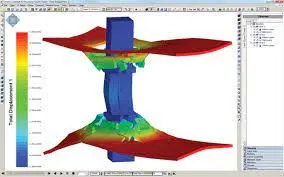
Fig 1:Crash Test Fig 2 : Blast Anlaysis
INTRODUCTION:
Tension Test:
Tensile testing, also known as tension test. It is a fundamental materials science and engineering test in which a sample is subjected to a controlled tension until failure. Properties that are directly-measured via a tensile test are ultimate tensile strength, breaking strength, maximum elongation and reduction in area. From these measurements the following properties can also be determined:
• Young's modulus • Poisson's ratio • Yield strength • Strain-hardening characteristics.
Uniaxial tensile testing is the most commonly used for obtaining the mechanical characteristics of isotropic materials
Torsion Test:
Torsion testing is a type of mechanical testing that evaluates the properties of materials or devices while under stress from angular displacement. Torsion testing can be split into two distinct categories: testing raw materials like metal wires or plastic tubing to determine properties such as shear strength and modulus, or functional testing of finished products subjected to torsion, such as screws, pharmaceutical bottles, and sheathed cables. The most common mechanical properties measured by torsion testing are:
• Modulus of elasticity in shear • Yield shear strength • Ultimate shear strength • Modulus of rupture in shear • Ductility
GEOMETRY:
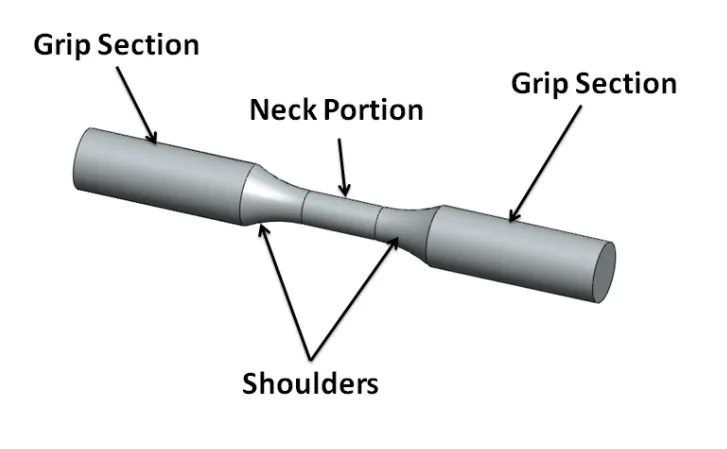
Fig 3:Geometry
MATERIAL USED:
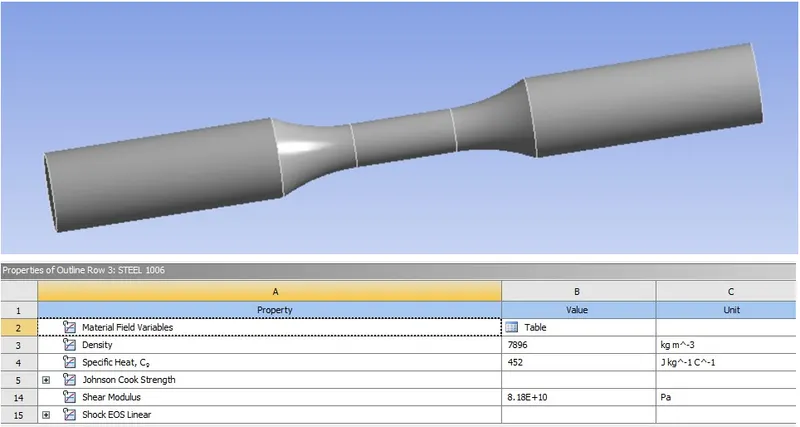
Fig 4:Material Definition
PROCEDURE:
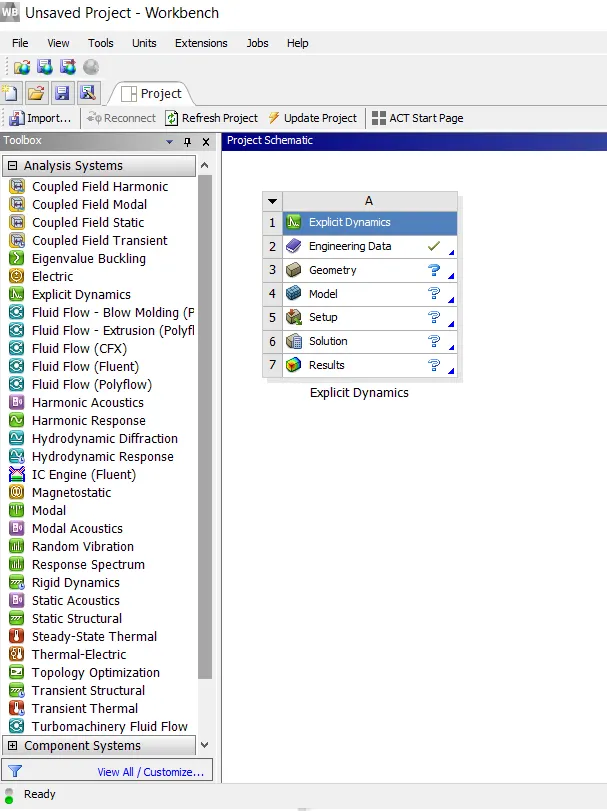
1: Open the explicit dynamics module into the ansys workbench which can be achieved by simple drag and drop.
2. Now we import the model and open it in SpaceClaim to check for any defects or abnormalities in the geometry
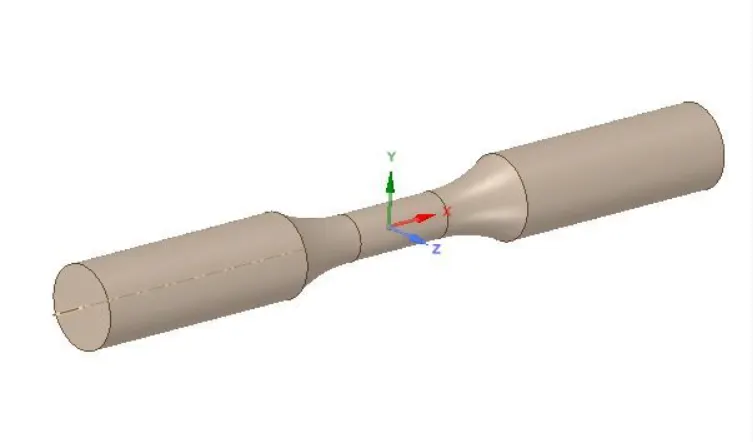
Fig 5: Geometry opened in spaceclaim
The test specimen model was provided and the same model was used for both tension and torsion test simulations. The material assigned for the test specimen is Steel 1006 and the properties are as below:
2: Meshing
In the meshing step, the specimen was meshed with tetrahedron elements using the patch conforming method. The different sections of the specimen was meshed with the help of sphere of influence. The grip sections and the gauge section had an element size of 1.5mm and 1mm respectively.
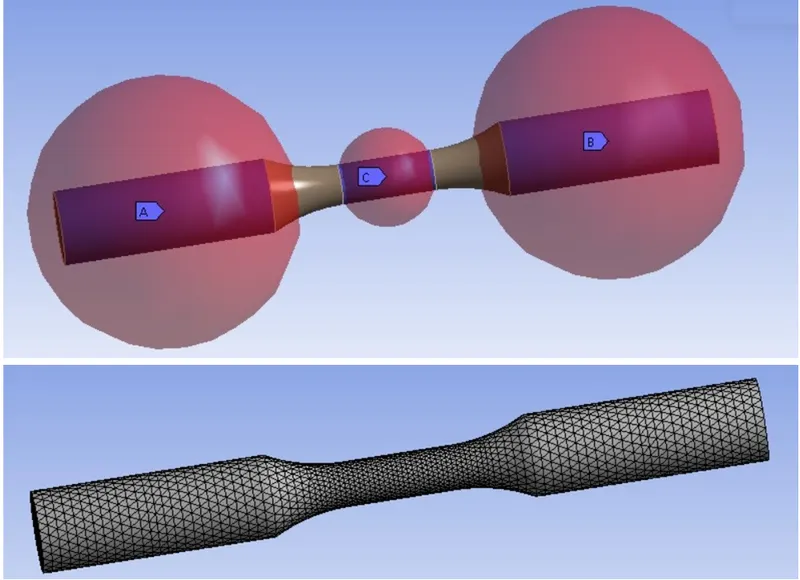
Fig 6:Meshed Model
3: Analysis settings
The analysis was carried out in a single step, with the end time step as 0.001.
The simulation was carried out using the ANSYS Explicit Dynamics module. For both tests, one end of the specimen was given a fixed condition. For tension test, the other end was given an axial displacement of 18mm and for the torsion test a circular twisting of 1200 degrees was given with respect to the global coordinate axis as shown in figure.
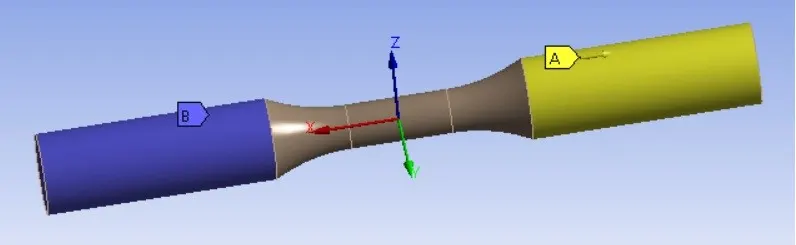
Fig 7 : Boundary Conditions
4. After the definition of boundary condition now we have to request for the output parameters in the solution section such as von-mises stress, total deformation,equivalent strain etc.
5: RESULTS
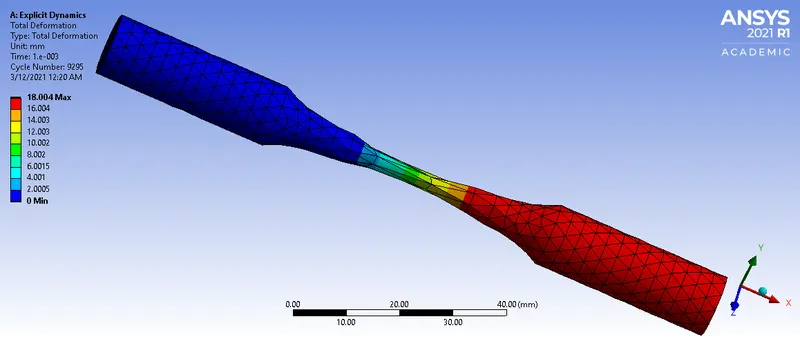
Fig 8:Total Deformation
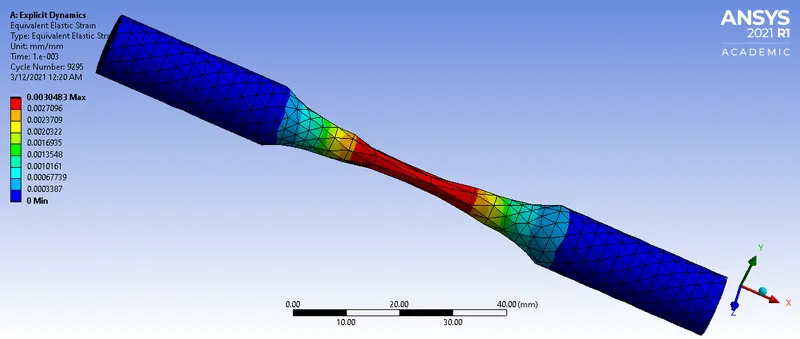
Fig 9:Equivalent Elastic Strain
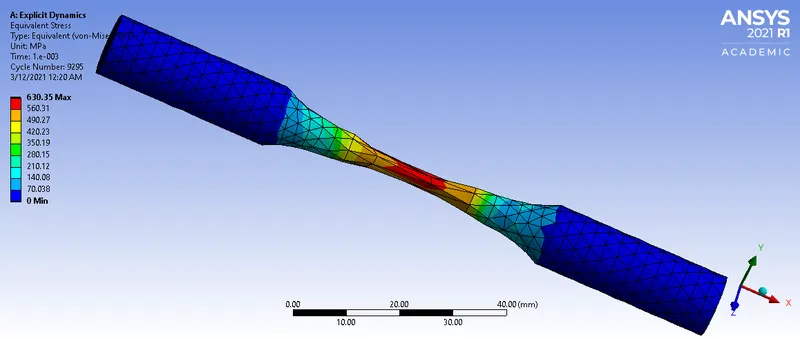
Fig 10:Von-mises stress
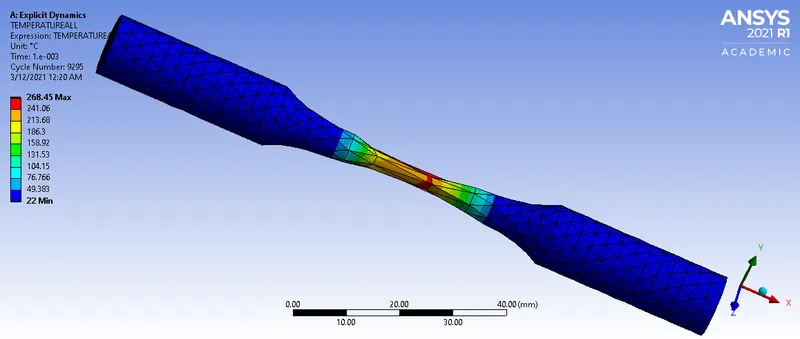 Fig 11:Temperature
CASE II:TORSION TEST
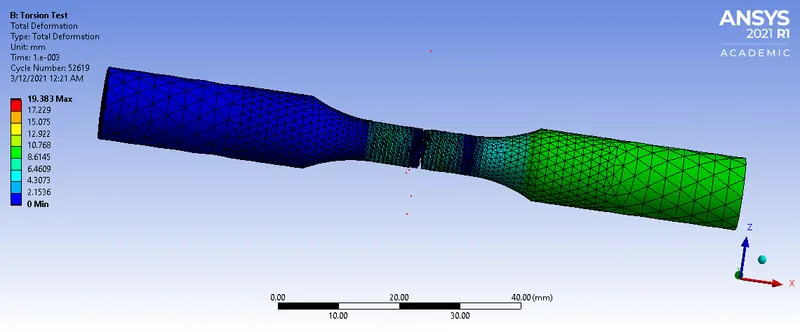
Fig 12:Total Deformation
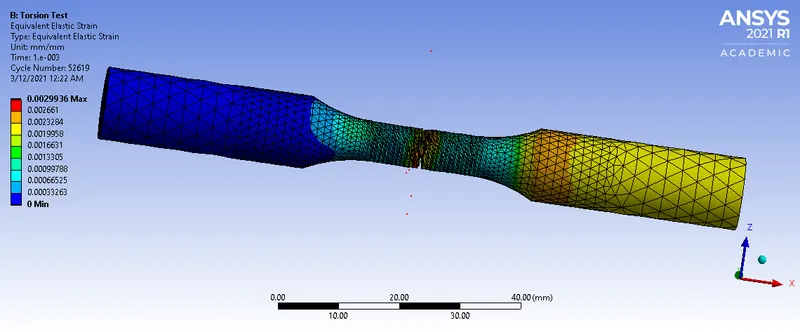
Fig 13:Equivalent Elastic Strain
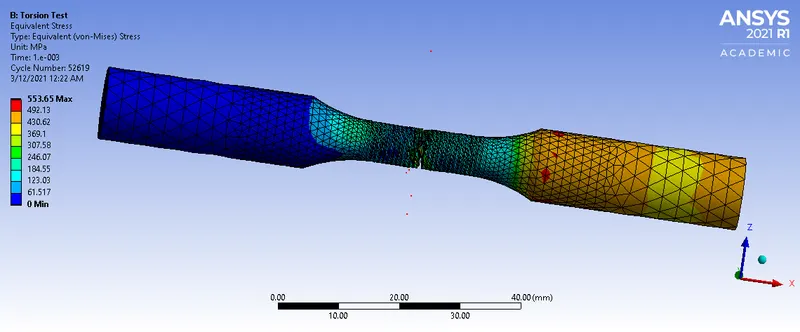
Fig 14:Von-mises stress
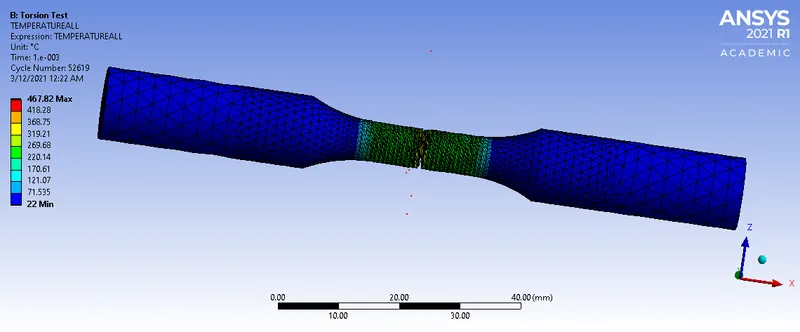
Fig 15:Temperature
|
CASE |
VON MISES STRESS(MPa) |
TOTAL DEFORMATION(mm) |
TEMPERATURE(0C) |
|
TENSION TEST |
630.35 |
18.004 |
268.45 |
|
TORSION TEST |
553.65 |
19.383 |
467.82 |
|
|
CONCLUSION:
• From the above results, we can conclude that the failure of the specimen in Tension Test is due to permanent deformation due to elongation and due to neck generation. This concludes that failure of the Specimen is due to max. Tensile Stress.
• Failure of the Specimen in the Torsion Test shows, the flat failure surface. This concludes that failure is due to Max. Shear Stress. Also it is ductile material, which indicates the failure in the Plane of maximum sheer stress perpendicular to the axis of the Specimen. • Also we can see that Temperature in Torsion Test is very high due to high shear stress.
• In Tension Test, Lateral Stress also occurs due to axial tension and reduction of the cross section area at neck portion. • In Torsion Test, Shear Stress is important due to the twisting of the specimen in the angular direction.
• As the material is Steel 1006, we know from the results that, the fracture in Tension Test initiates in the necked portion. • For the Torsion Test fracture is occurring in a flat surface, or in Shear plane, so steel is failing at large shear strains. Here the temperature is also an important factor in both the Tests, as we know that at higher temperature elongation or fracture of the material can differ.
• Effectiveness and quality of materials used in manufacturing play a crucial role in bringing about marketplace success. Tensile tests help determine the effectiveness and behavior of a material when a stretching force acts on it. Tensile tests are done under optimum temperature and pressure conditions and determine the maximum strength or load that the material can withstand.