Week 9 Tension and Torsion test challenge
TENSION AND TORSION TEST ANALYSIS USING ANSYS
OBJECTIVE:
To perform the tension and torsion test on the specimen and find out the total deformation, equivalent stress, and temperature on the specimen.
TENSION TEST:
A tensile test, also known as a tension test, is one of the most fundamental and common types of mechanical testing. A tensile test applies tensile (pulling) force to a material and measures the specimen\'s response to the stress.
TORSION TEST:
Torsion testing involves the twisting of a sample along an axis and is a useful test for acquiring information like torsional shear stress, maximum torque, shear modulus, and breaking angle of a material or the interface between two materials.
EXPLICIT DYNAMICS:
The ANSYS explicit dynamics suite enables you to capture the physics of short-duration events for products that undergo highly nonlinear, transient dynamic forces.
CAD model
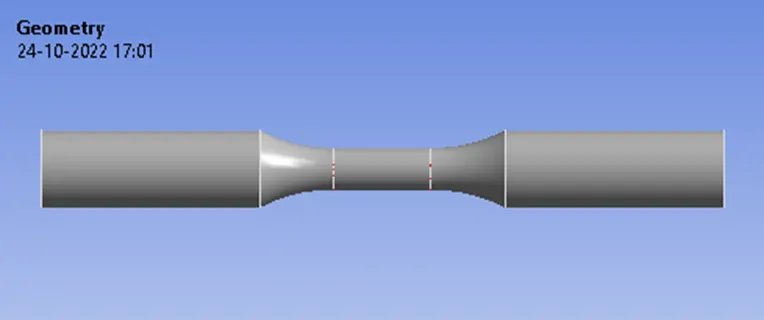
As it is a single component there is no need for contacts or joints.
Materials:
We will use Steel 1006 material for this analysis. The properties of the material are given below.
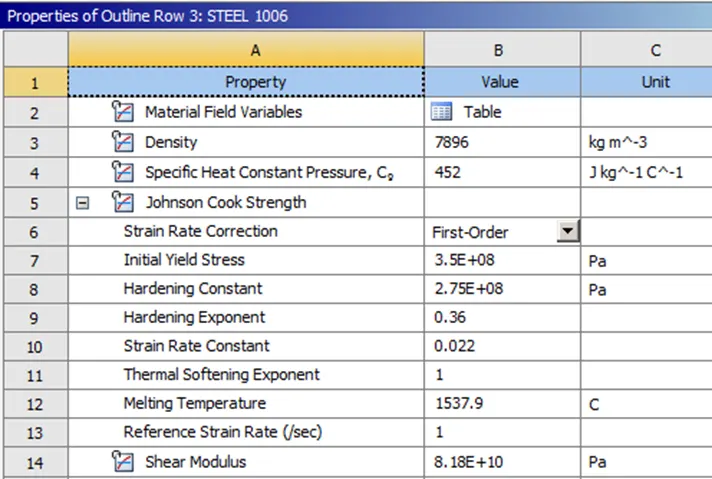
Case 1: Tensile Test
Coordinate Systems:
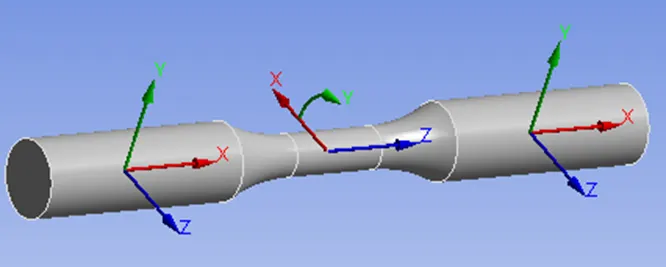
We will create two cartesian coordinate systems and one global coordinate system for the following Tensile test.
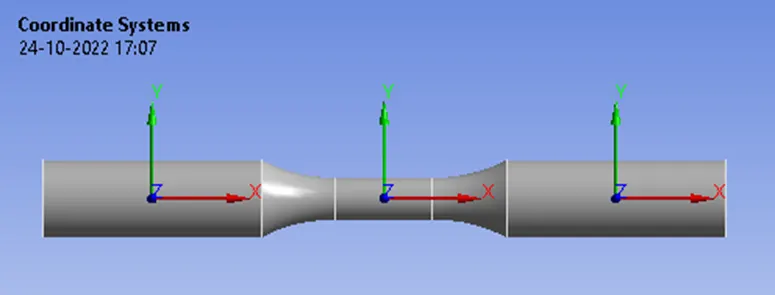
The Cartesian Coordinate system helps us in meshing the specific area using the "Sphere of influence" method and the Cylindrical Coordinate system is used for giving the rotation in the Torsion test.
Mesh:
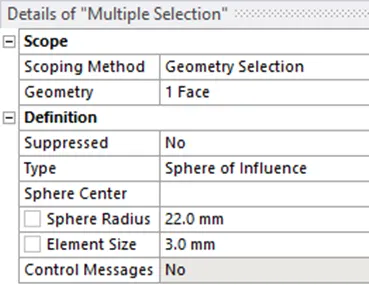
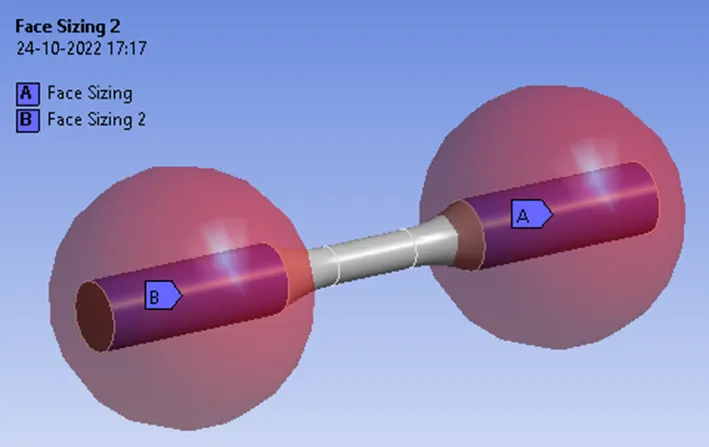
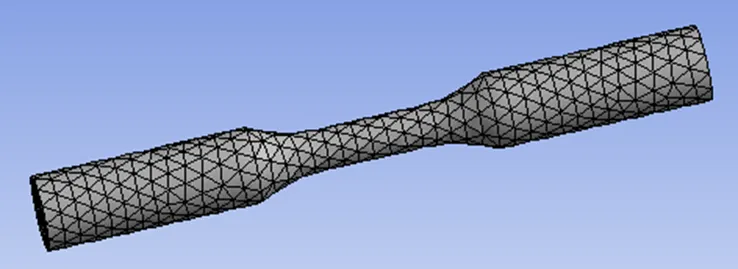
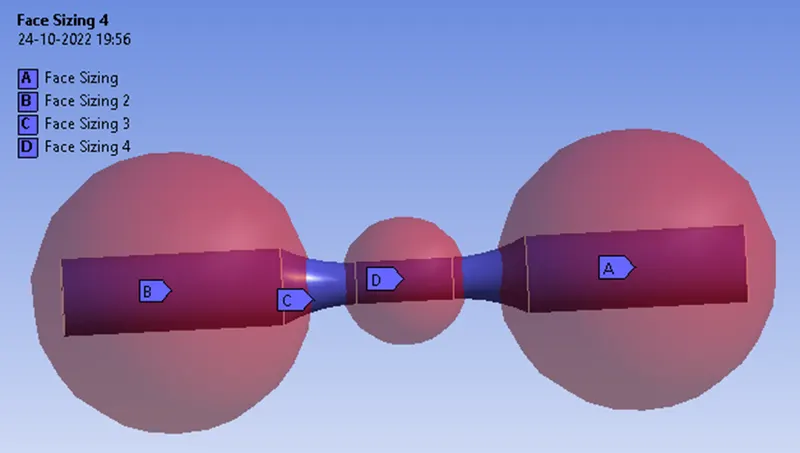
For the tension test, we have deployed the face meshing using a sphere of influence method where the element size is 3mm.
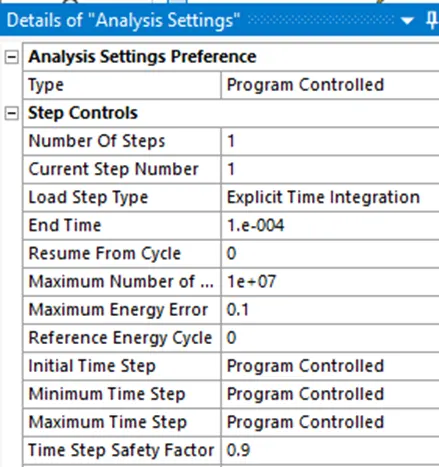
Analysis Settings:
Boundary Conditions:
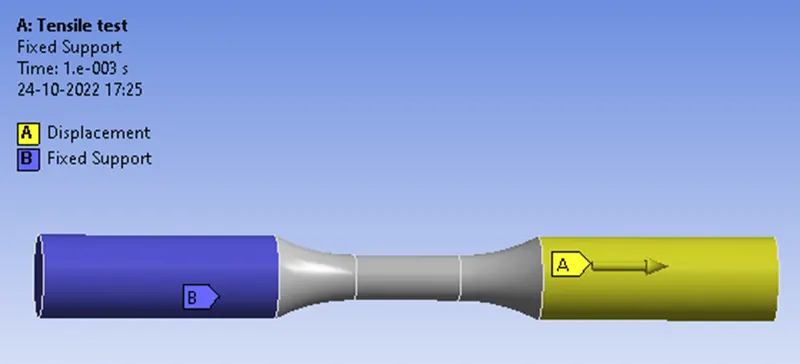
1) Tension Test :
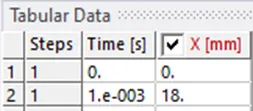
We have fixed one end of the specimen and given the displacement of 18 mm at another end.
Results of Tension Test:
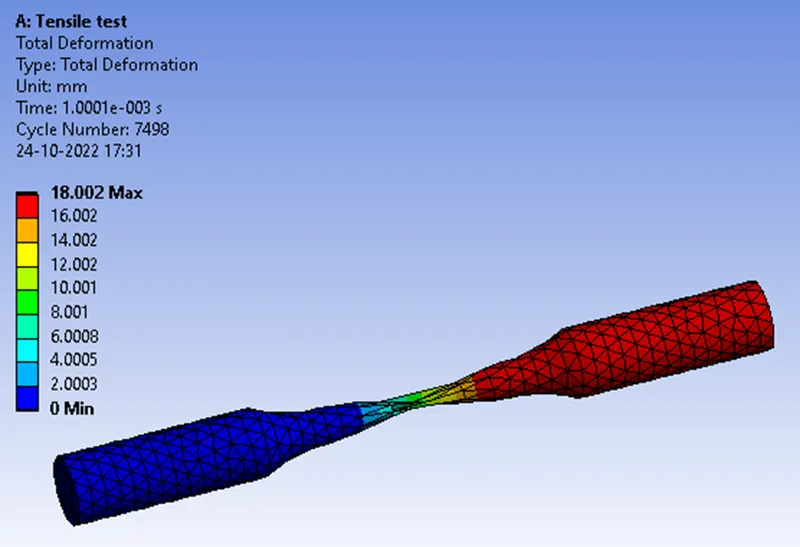
1) Total Deformation
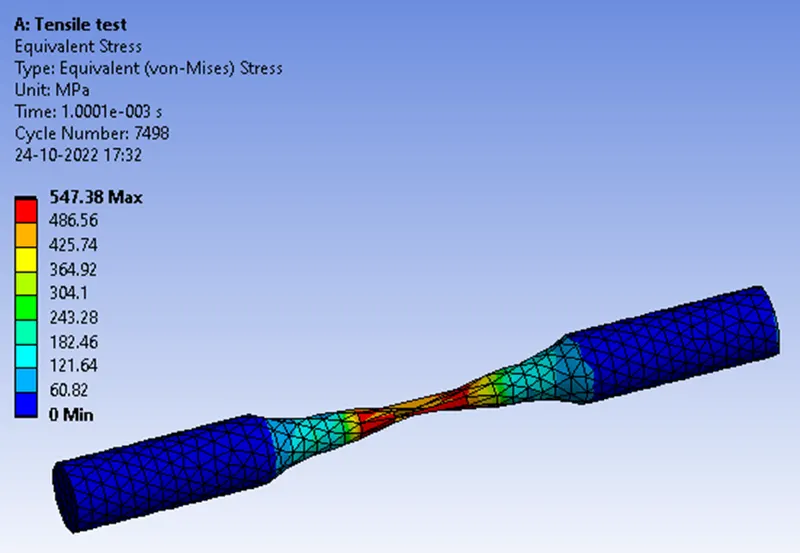
2) Equivalent Stress:
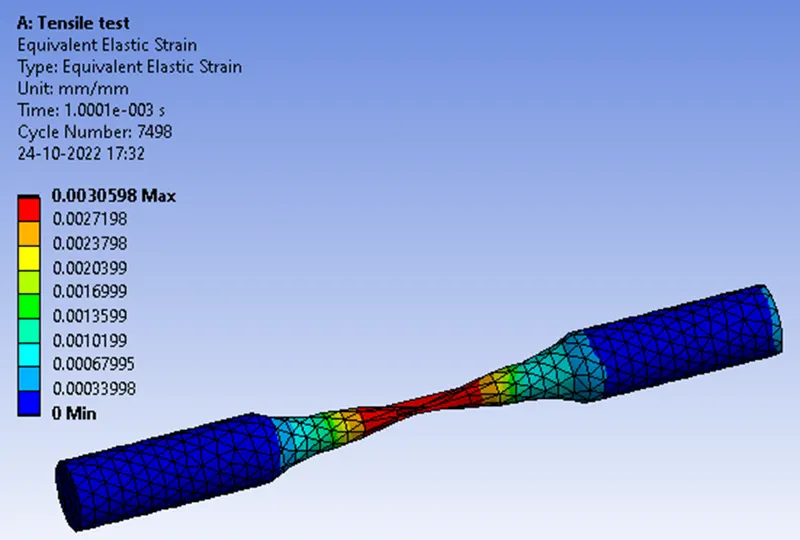
3) Equivalent Strain:
4) Temperature:
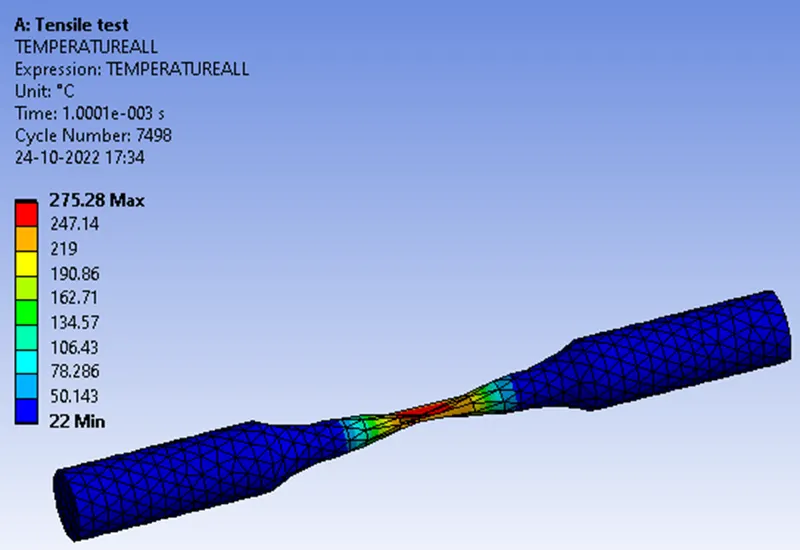
To evaluate the temperature, we use "User Defined Results"
Case 2: Torsion Test
Coordinate Systems
A cylindrical Coordinate system is used for giving the rotation in the Torsion test.
Mesh:
For the tension test, we have deployed the face meshing using a sphere of influence method where the element size is 3mm and the sphere radius is 22 mm.
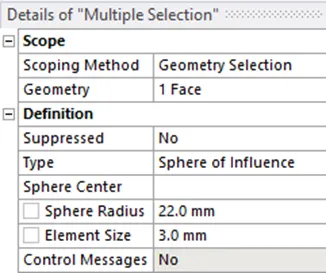
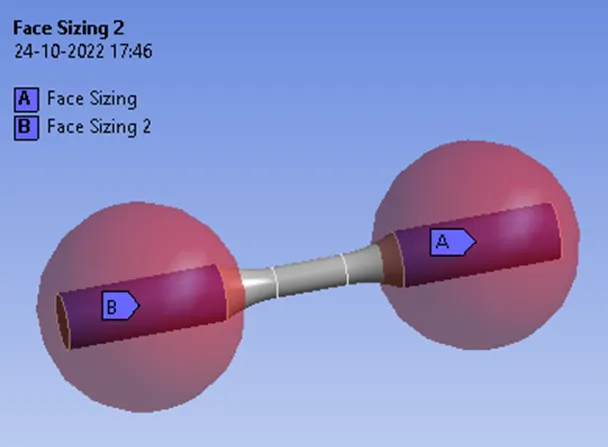
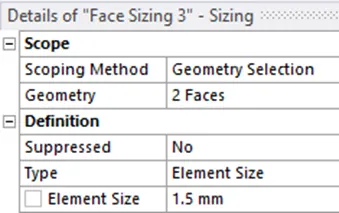
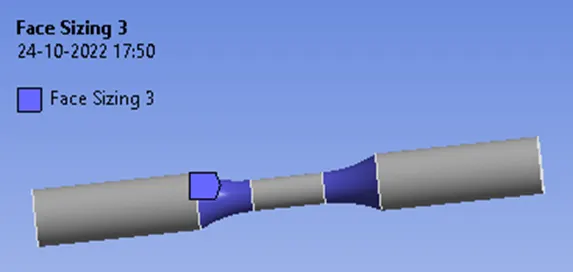
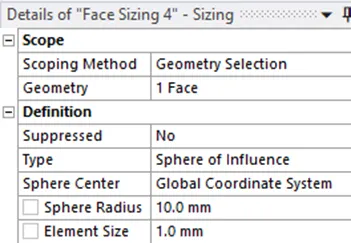
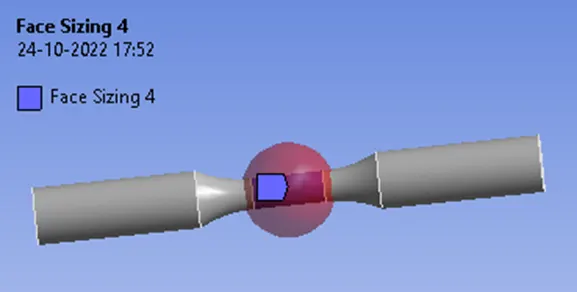
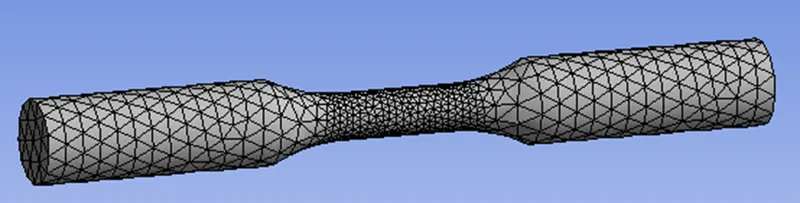
For the Torsion test, we have deployed the Tetra mesh with more refinement using the Sizing method and sphere of influence method and the element size of 2mm.
Analysis Settings:
Boundary Conditions:
Fixed Support
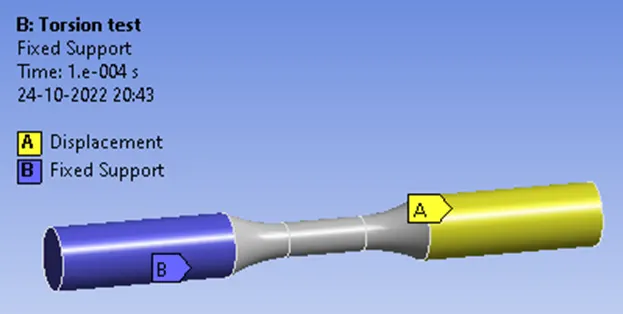
Displacement
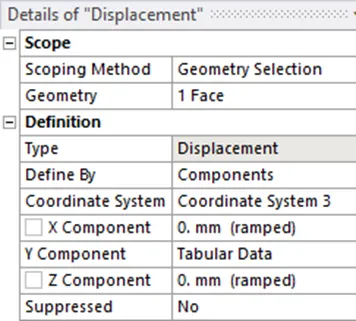
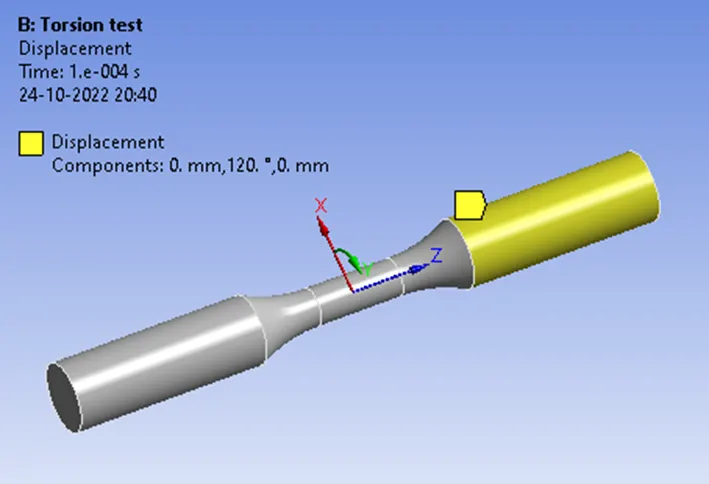
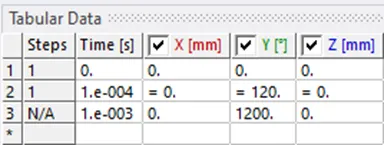
Results of Torsion Test:
1)Total Deformation
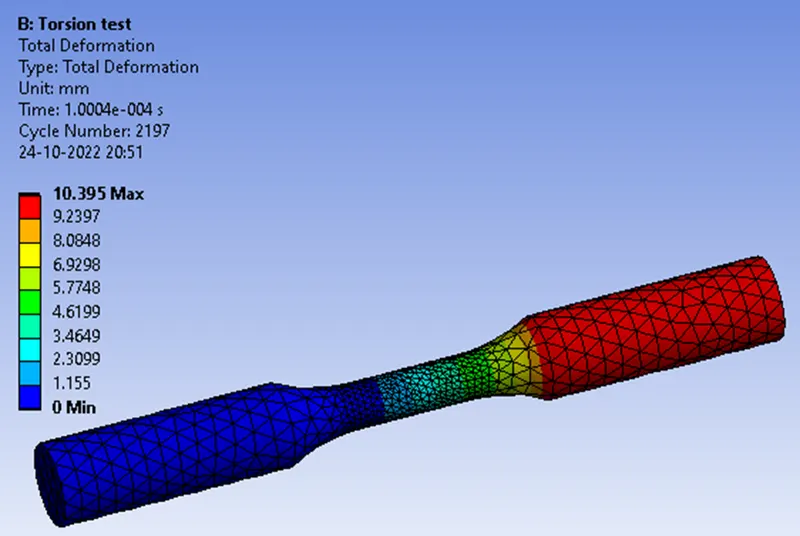
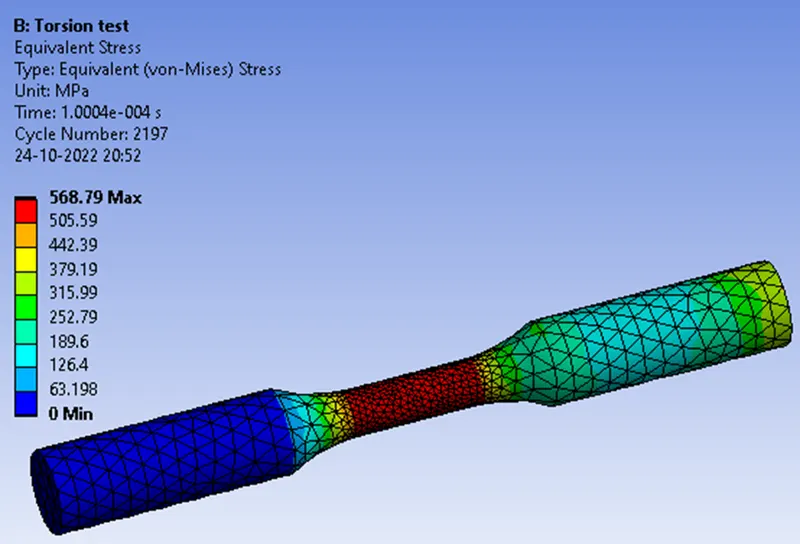
2) Equivalent stress
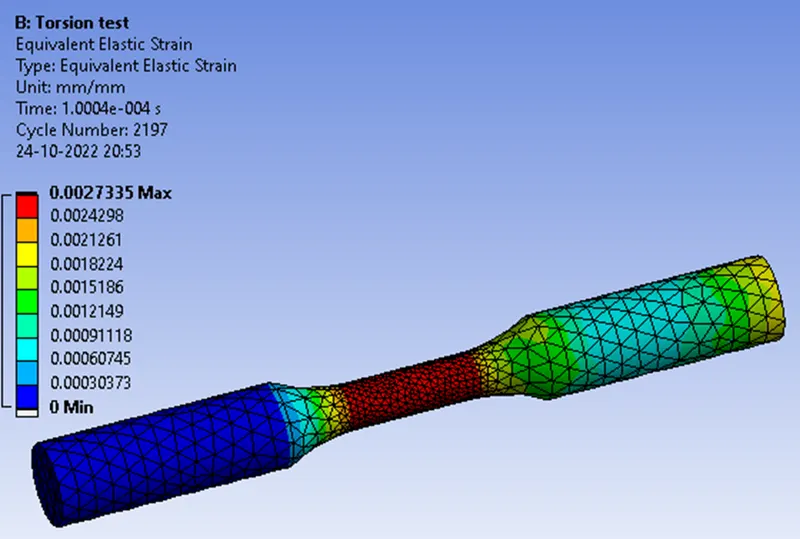
3) Equivalent Strain
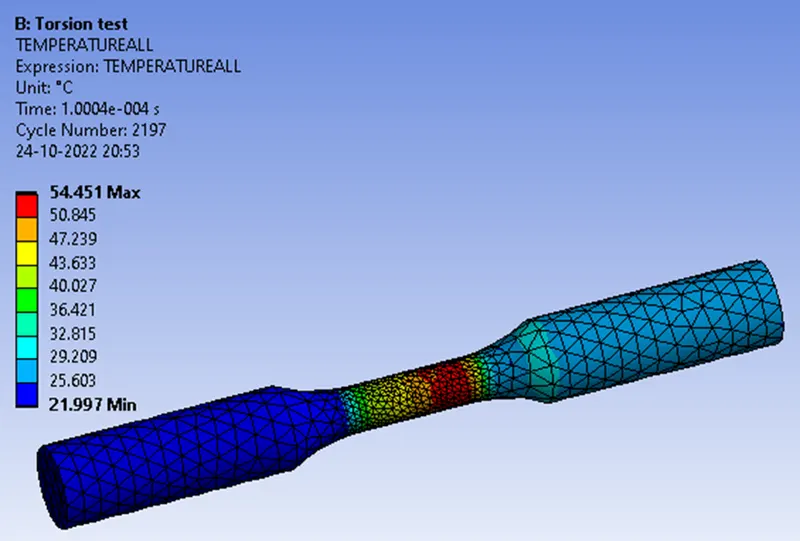
4) Temperature
Concluding Result
|
Analysis in Case |
Total Deformation in mm |
Equivalent Stress in MPa |
Equivalent Elastic strain in mm |
Temperature in ℃ |
|
1) Tensile test |
18.002 |
547.38 |
0.0030598 |
275.28 |
|
2) Torsion test |
10.395 |
568.79 |
0.0027335 |
54.451 |
From the above table, we can see that the temperature is maximum in the Tensile test because of the elongation of the specimen.
In both cases, the stress generated is maximum at the center of the specimen.
In the tension test, the fracture does not happen for the given displacement. i.e. still at 18 mm.
In the Torsion test, the fracture occurs for the given displacement i.e 1200 degrees.