Week 9 Tension and Torsion test challenge
Tension and Torsion test
Objective:
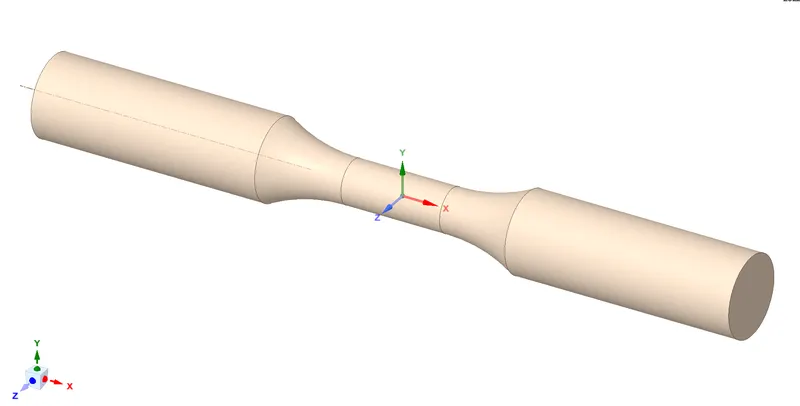
To perform the tension and torsion test on the specimen provided below the video corresponds to the challenge.
For the tension test, displace one end of the specimen to 18mm while keeping the other fixed. You will need to find out the total deformation, equivalent stress, and temperature of the specimen and attach appropriate images to show your results.
For the torsion test, you will need to displace one end of the specimen to an angle of 1200 degrees. Find out the total deformation, equivalent stress, and temperature of the specimen and attach images to show your results.
Geometry file:
Properties of Material used:

Mesh file:
As we are dealing with explicit dynamics mesh is the most important aspect to be considered while evaluating explicit dynamics. As meshing is an important task choose the whole body and set that Tetrahedrons method and face sizing on both the ends of the specimen by choosing a sphere of influence with a radius of 22mm and element size to be 1mm.
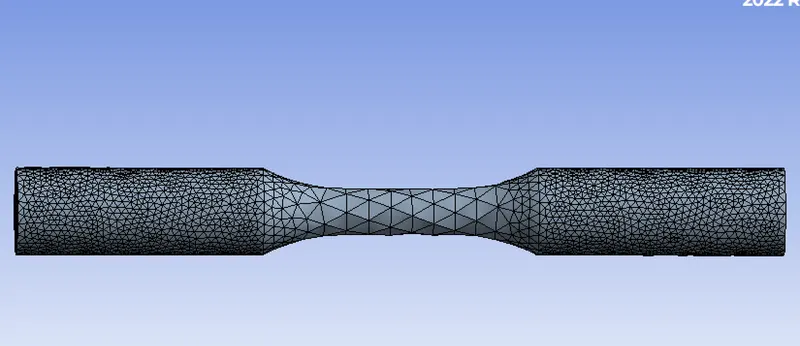
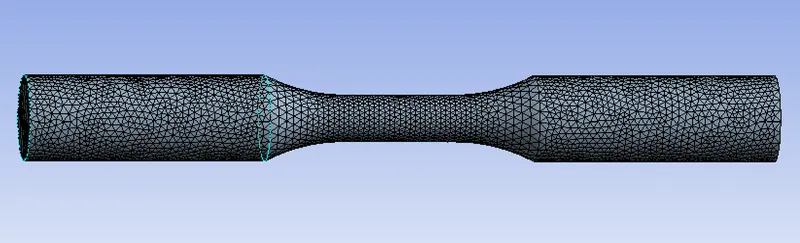
Mesh 1 Mesh 2
Analysis Settings:
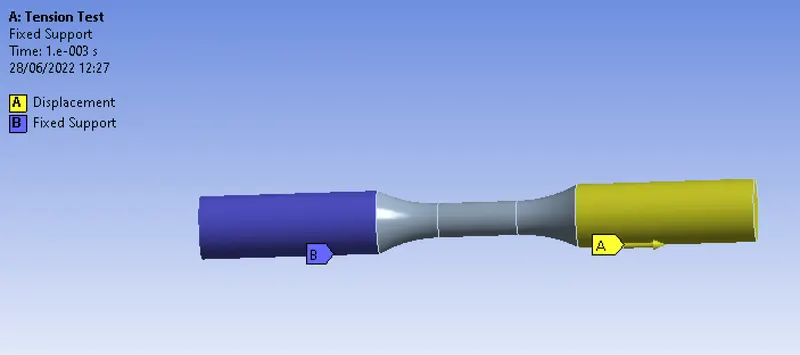
As we are dealing with explicit dynamics here reactions are considered in a fraction of time we don’t consider any time settings other than end time and end time is chosen 0.001 fractions of time.
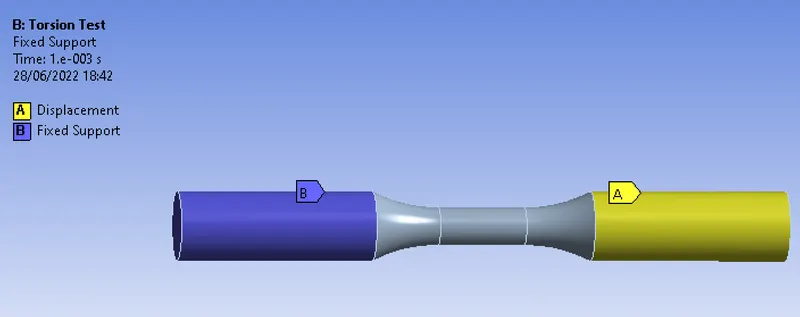
For the specimen to displace gave a displacement of 18mm with very less fraction of time on one end of the specimen and the other end to be fixed support.
Case 1
Case 2: Torsion Test
As we dealing with the Torsion test in case 2 we can see as the axis is oriented in Y-axis the displacement is given along Y-axis and the other end is chosen as fixed support.
Simulation Results:
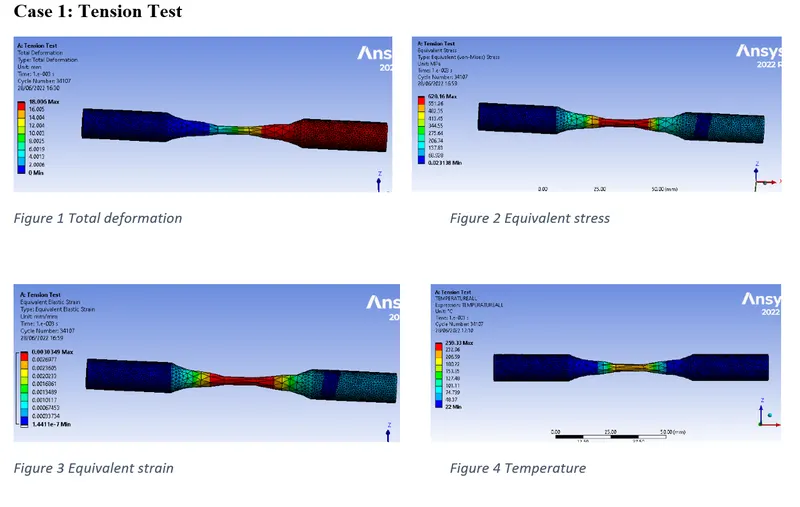
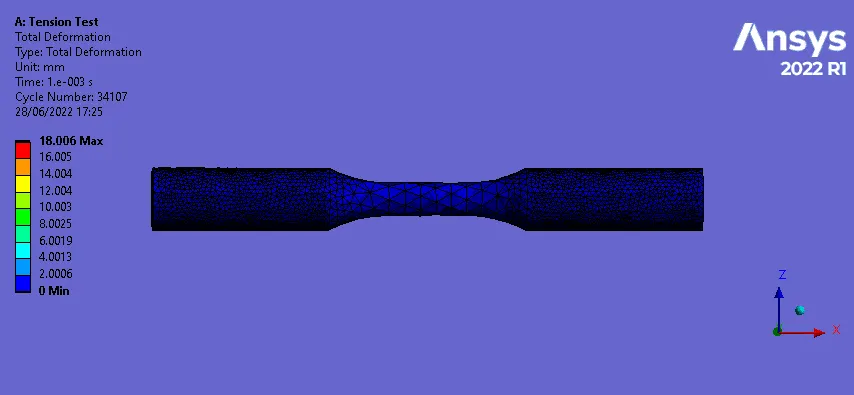
Tension Test
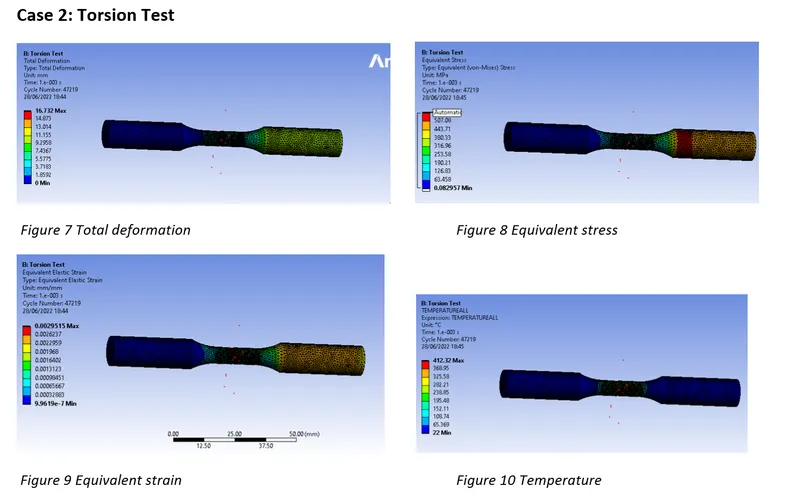
Torsion Test
Tabulated Results:
|
|
Maximum |
|||
|
Total Deformation |
Equivalent stress |
Equivalent strain |
Temperature |
|
|
Tension Test |
18.006 mm |
620.16 MPa |
3.0349e-003 mm |
259.33 °C |
|
Torsion Test |
16.732 mm |
570.46 MPa |
2.9515e-003 mm |
412.32 °C |
Conclusion:
- From the above data results, we can conclude that the failure of the specimen in the tension test is due to permanent deformation due to elongation and due to neck generation. This concludes that the failure of the specimen is due to max. tensile stress.
- Failure of the specimen in the torsion test shows the failure surface. This concludes that failure is due to max shear stress.
- As the material used is steel 1006, we know from the results that the fracture in the tension test initiates in the necked portion. Here the temperature is also an important factor in both the tests as we know at higher temperatures elongation or fracture of the material can differ.