Week 9 - Project 1 - Door Trim Lower with Engineering Features
Aim:
To Create the Door trim lower component through the given Class-A surface,And making of engineering features such as (dog house,locators,heat stakes,ribs)
Objective:
The main aim of this challenge is to create a solid body of 'Door Trim Lower' with the help of the closed surface method by using the 'Generative shape design' workbench in CATIA V5. Performing the 'Draft Analysis' on the solid part body of the Door trim.
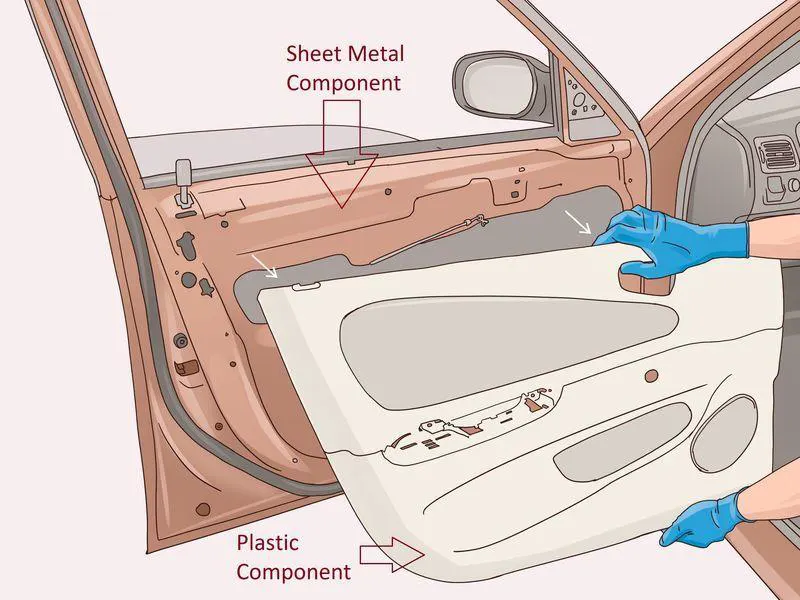
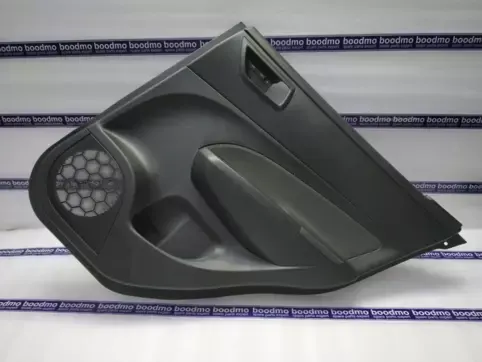
ABOUT DOOR TRIM LOWER
- An interior component attached to the inner side of the door.
- This product does more than merely improve the appearance of the vehicle interior.
- Rather, it is a vital module component that creates a more comfortable interior by providing a variety of accouterments and functions.
MATERIAL USED FOR DOOR TRIM LOWER
ABS(Acrylonitrile butadiene styrene)
WHY ABS(Acrylonitrile butadiene styrene)
- COST EFFECTIVE
- LOW MELTING POINT
- HIGH IMPACT STRENGTH
COMPAEISION OF MATERIAL TO CHOOSE FOR DOOR TRIM LOWER
| Attributes | ABS | NYLON |
|---|---|---|
| Impact strength | High | low |
| Cost | Low | High |
| Melting point | low | High |
| Plastic Type | Thermoplastic | Thermoplastic |
| Properties | ABS | Nylon |
| Melting point | 190 -270 | 268.8oC |
| Density | 1.05 g/cm3 | 1.31 g/cm3 |
| Molecular weight | 211.3 g/mol | 224.3 g/mol |
| Ultimate tensile strength | 35MPa | 85MPa |
| Elongation at break | 30% | 90% |
Comparing ABS and Nylon
| Attributes | ABS | NYLON |
| Plastic class | Engineering | Engineering |
| Impact strength | High | low |
| Cost | Low | High |
| Melting point | low | High |
| Plastic Type | Thermoplastic | Thermoplastic |
| Surface | Smooth | Smooth low friction |
| Variant | Composites e.g. ABS/PVC | Chemical variants e.g. PA 6, PA 6,,6Glass-filled nylon etc |
| Rapid prototyping | Preferred for rapid prototyping. Works in 3D printing and CNC machining. | Less common for prototyping. But can also get 3D printed and CNC machined |
| Natural color | ivory | Off white |
| UV sensitivity | high | High |
| Flammability | moderate | High |
| Moisture absorption | Low | High |
| Dimensional stability | High | Prone to warpage |
| Acid/ Alkali resistance | Good | Poor |
MECHANICAL PROPERTIES OF ABS(Acrylonitrile butadiene styrene)
-
Key Properties of ABS
- High rigidity.
- Good impact resistance, even at low temperatures.
- Good insulating properties.
- Good weldability.
- Good abrasion and strain resistance.
- High dimensional stability (Mechanically strong and stable over time)
- High surface brightness and excellent surface aspect.
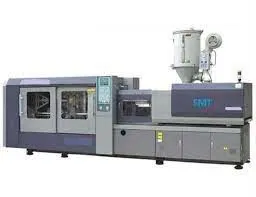
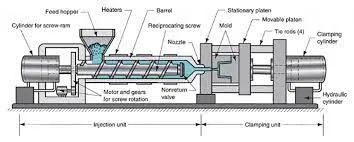
MANUFACTURING MACHING FOR DOOR TRIM LOWER
INJECTION MOLDING MACHINE
TOOLING AXIS
- The direction in which the mold or core and cavity opens is the tooling axis.
- Tooling Axis creation.
- Checking Draft analysis for created tooling Axis.
- Creating parting Surface.
- Creating Core Side.
- Creating cavity side.
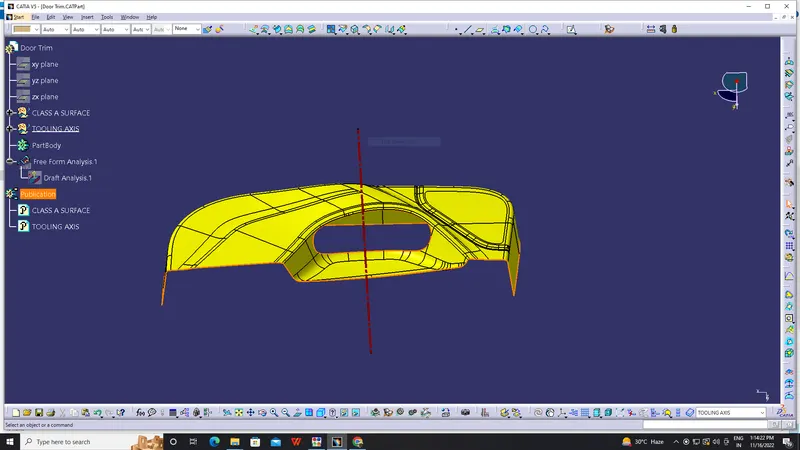
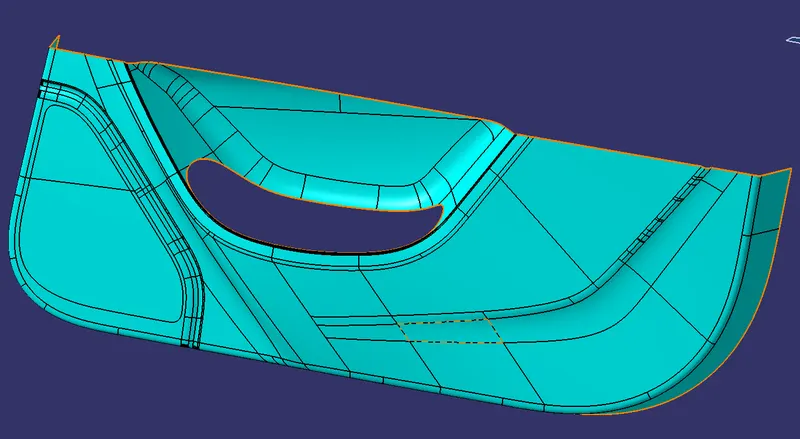
CLASS A SURFACE
- Class-A (or 'Strak') is a term used in specifically in automotive design.
- It describes the final production surface data for the aesthetic parts of the car.
- The term 'Class A' is often misunderstood, but it's generally seen as the 'Holy Grail' of surface modeling.
- Class A surface is used to show to the customer visulization,and it is a aesthetic syurface.
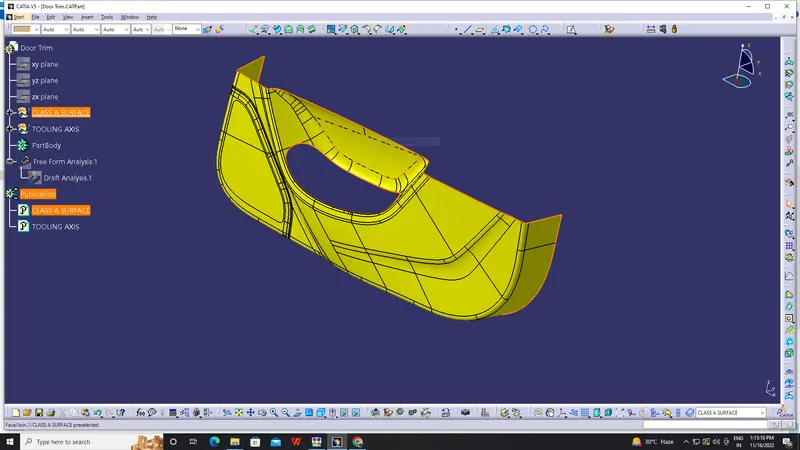
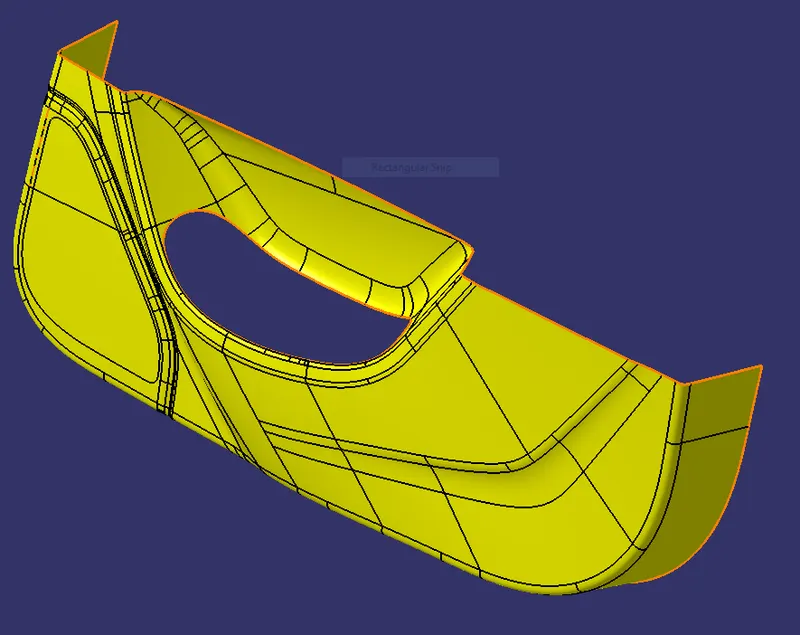
CLASS B SURFACE
- The Class B finish is a quality finish with only minimal imperfections.
- A Class B finish is the most common finish for exterior surfaces.
- It is normally specified on surfaces such as external covers, panels, and parts that are fairly prominent.
- It is a offset surface of A,Which the surface were can not able to see Over the customer.
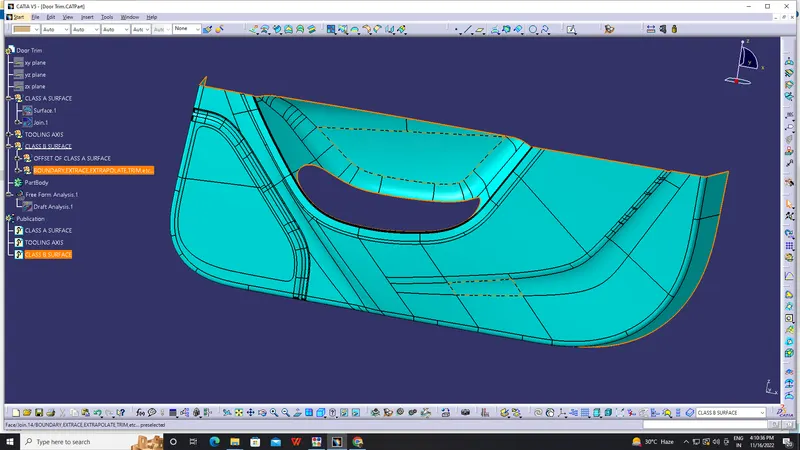
CLASS C SURFACE
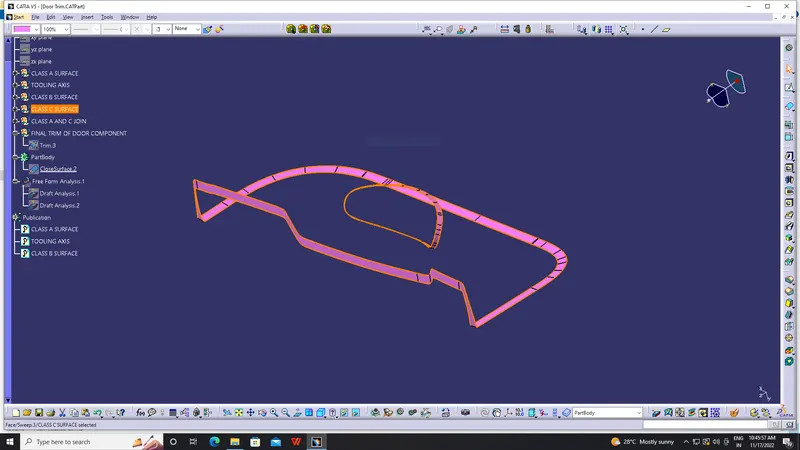
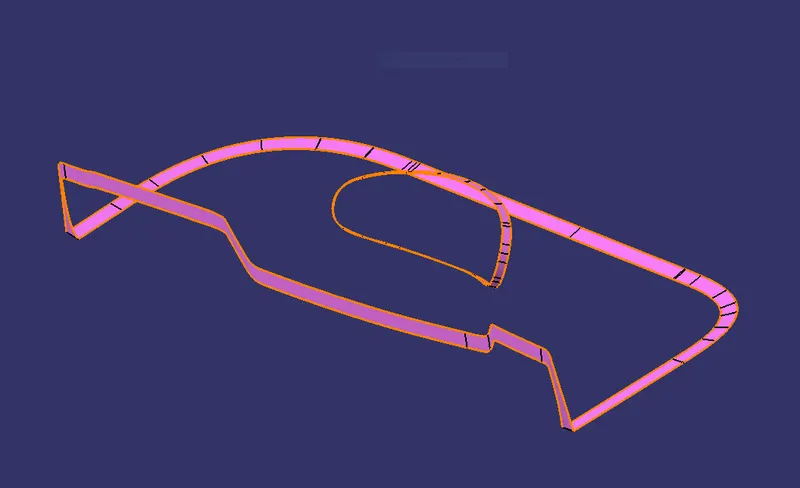
- The Class C finish allows more imperfections than Class A or B.
- Class C is often specified for interior surfaces not readily visible, surfaces that will be covered by another part when assembled, or surfaces which the Customer feels do not need to meet a high cosmetic finish.
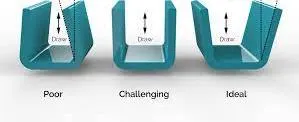
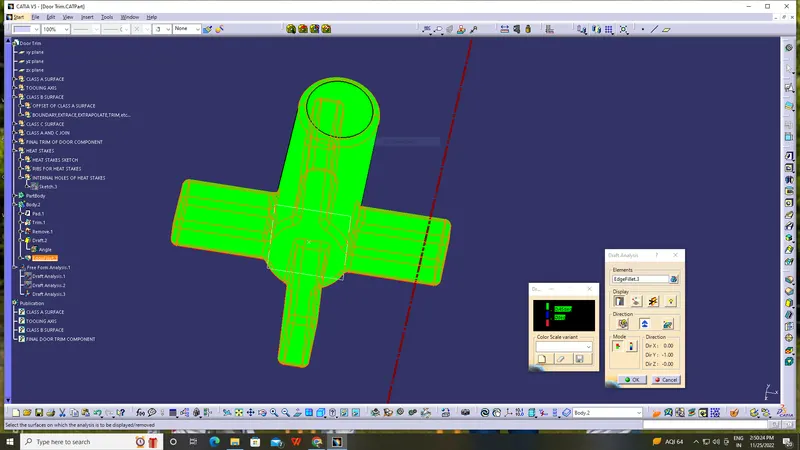
DRAFT ANALYSIS
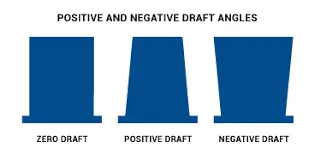
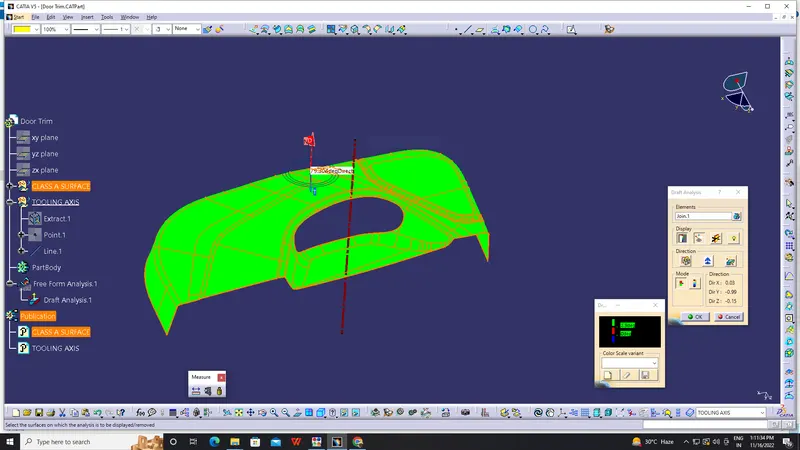
- The draft analysis technique is used to analyze whether our part model created in CAD is manufacturable based on the draft condition applied.
- Here the part should get easily removed from the panel dies .
DRAFT ANALYSIS OF DOOR TRIM CLASS A
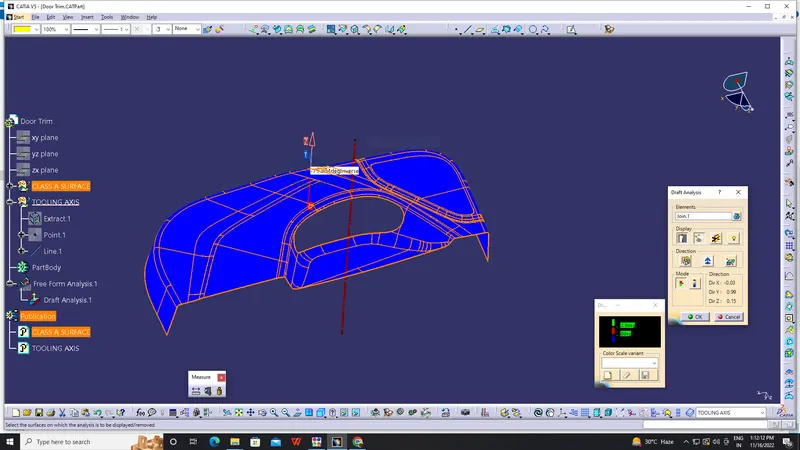
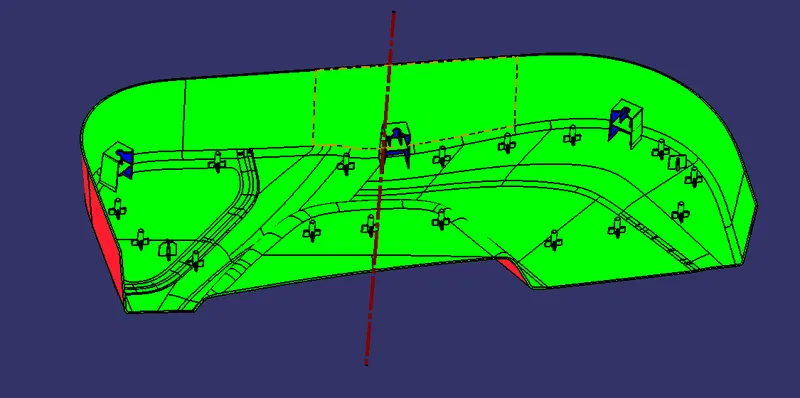
DRAFT ANALYSIS OF DOOR TRIM FINAL COMPONENT
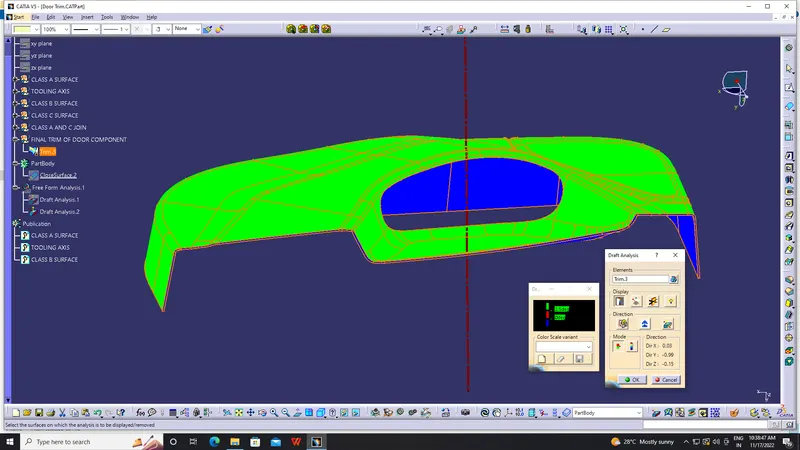
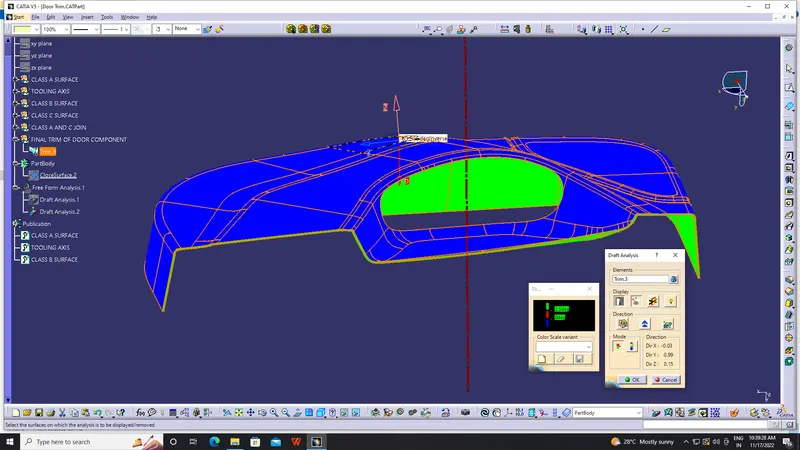
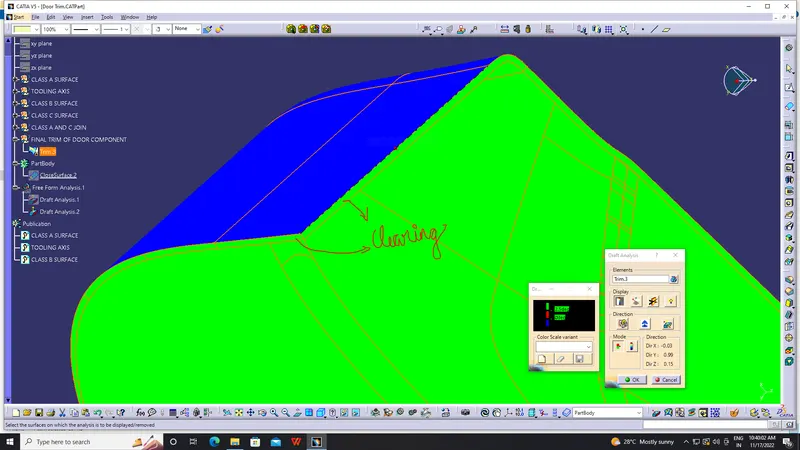
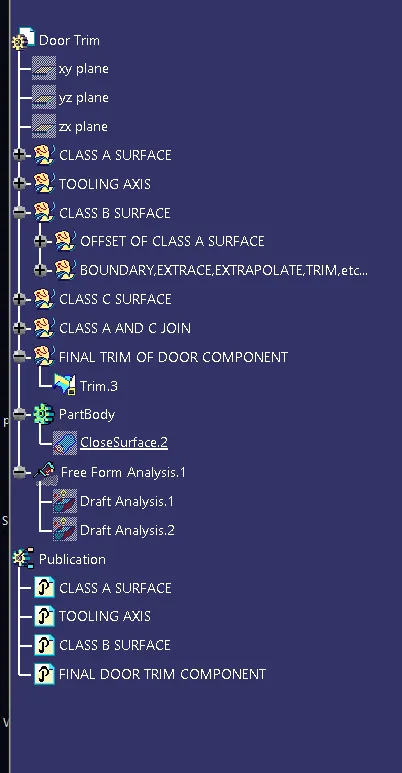
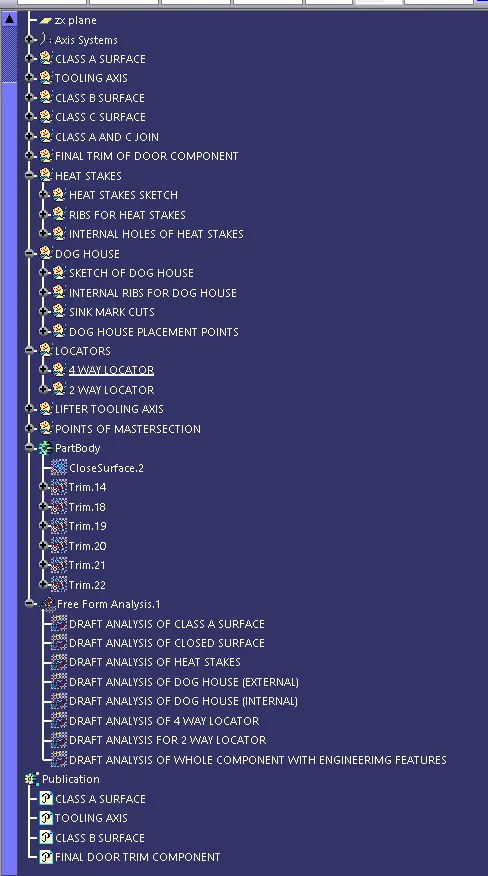
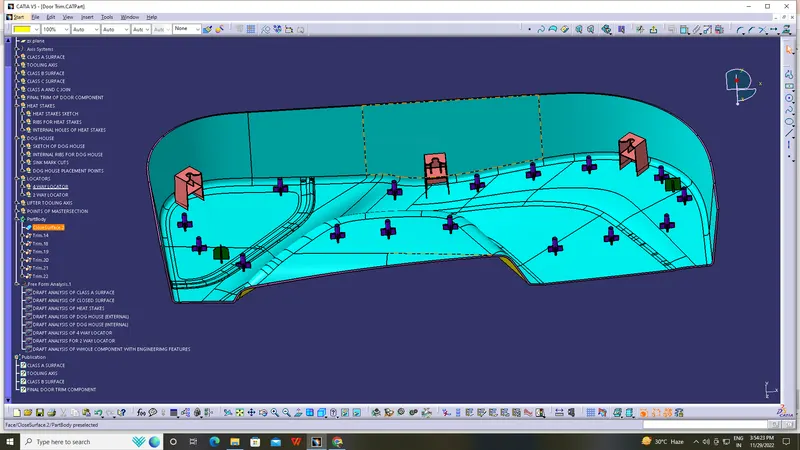
SCREEEN SHOT OF TREE STRUCTURE
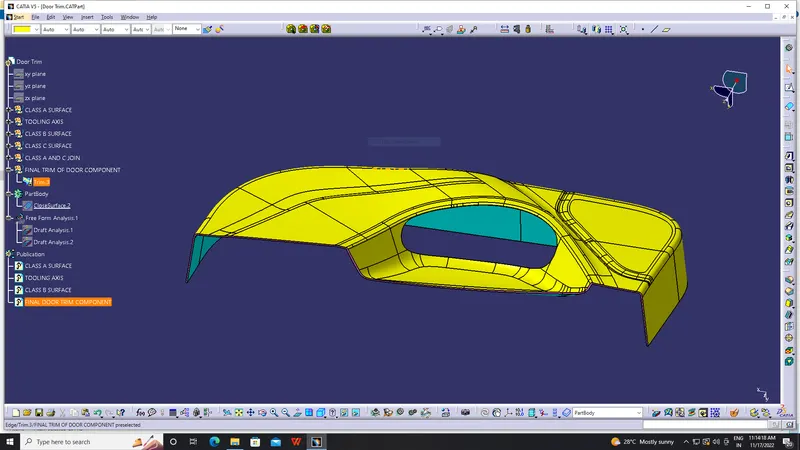
SCREEEN SHOT OF SOLID BODY WITH PROPER COLOUR COATED OF CLASSES A,B&C
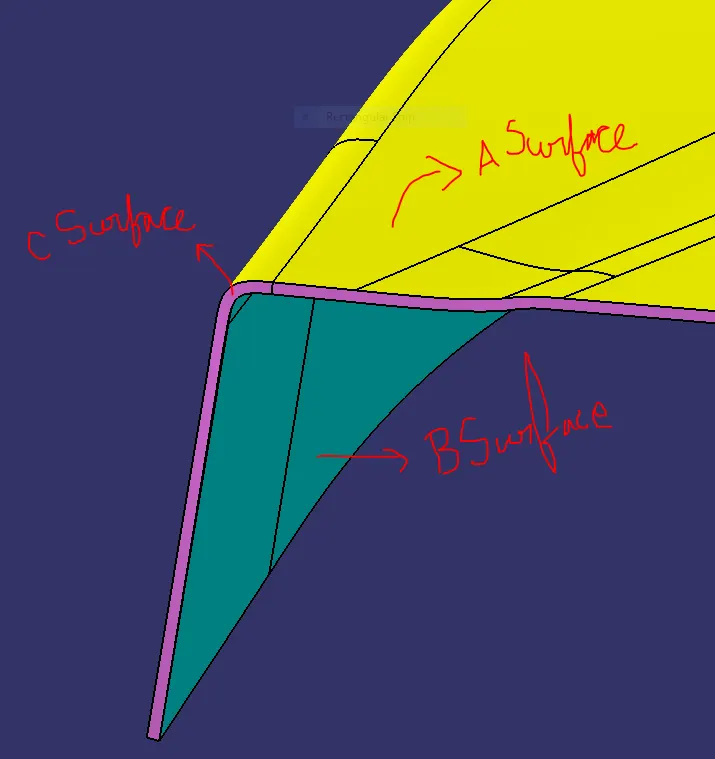
ENGINNERING FEATURES
MATERIAL SELECTION FOR ENGINEERING FEATURES
POLYPROPYLENE
WHY POLYPROPYLENE
- which toughness,
- flexibility,
- light weight, and
- heat resistance .
DOG HOUSE
- Dog house is an engineering feature used in plastic trim design.
- Dog houses are used as supporting feature.
- Sometimes other engineering features like snaps; locators etc.
- are mounded on them to increase their strength.
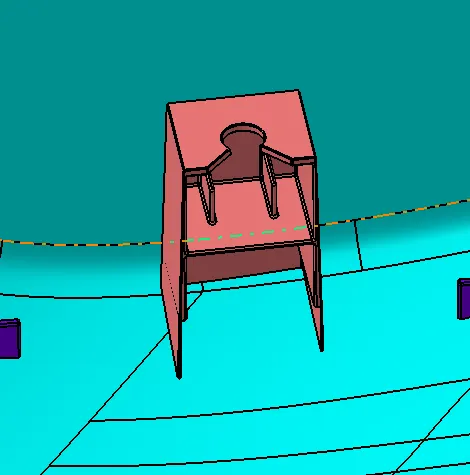
SKETCH FOR DOG HOUSE
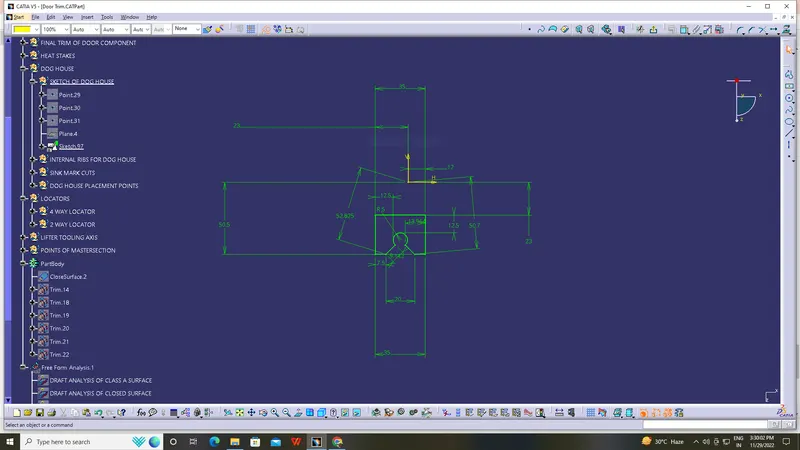
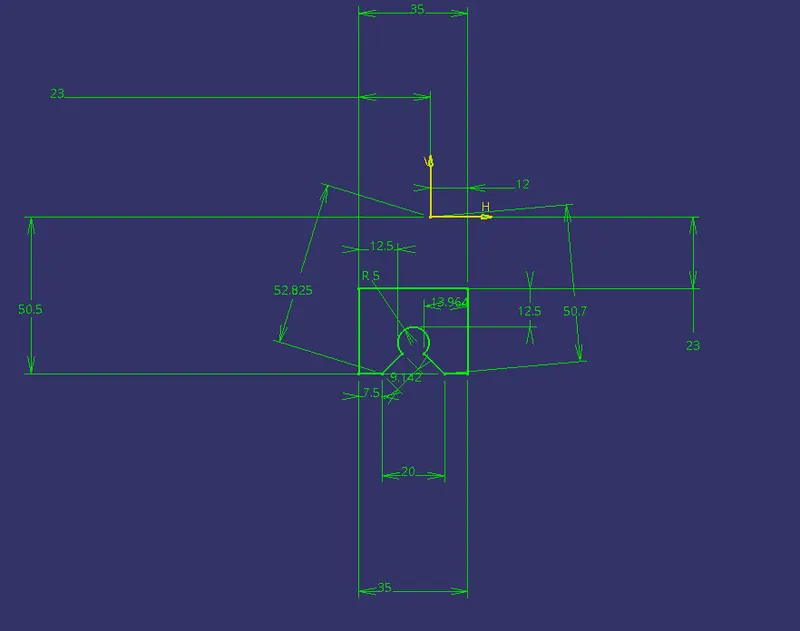
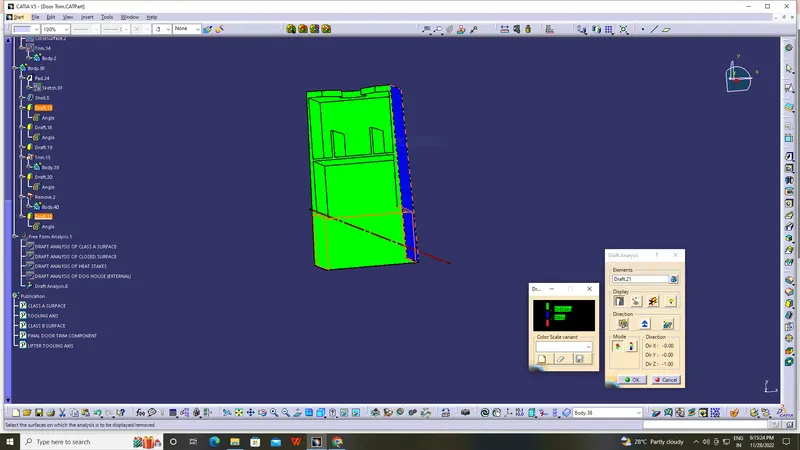
DRAFT ANALYSIS OF DOG HOUSE (EXTERNAL)
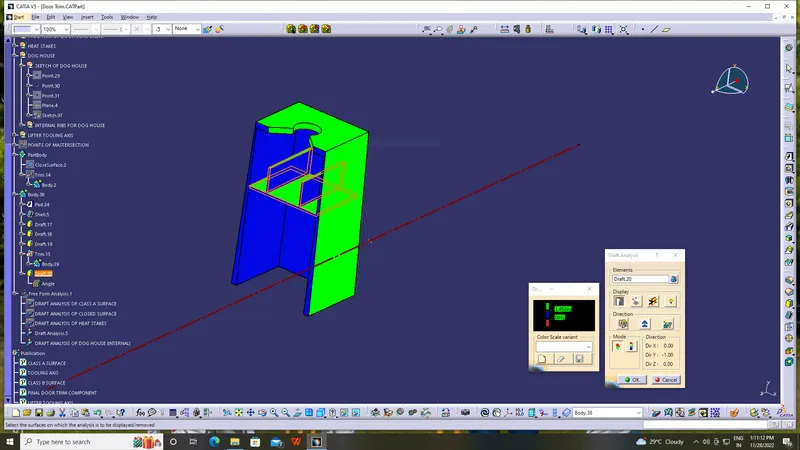
DRAFT ANALYSIS OF DOG HOUSE (INTERNAL)
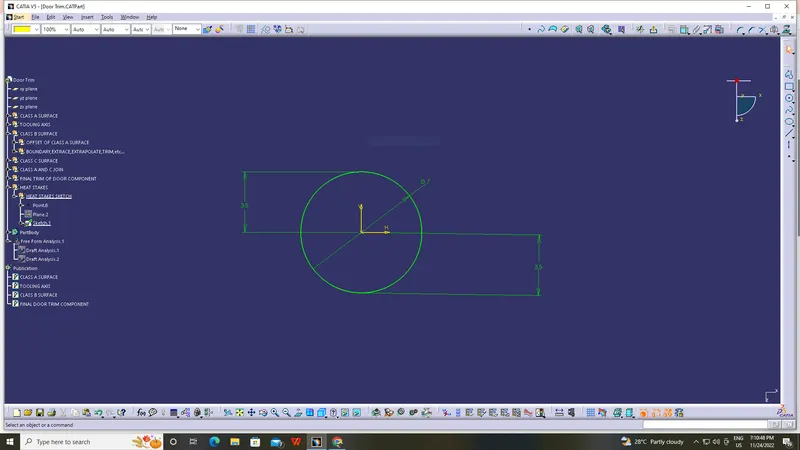
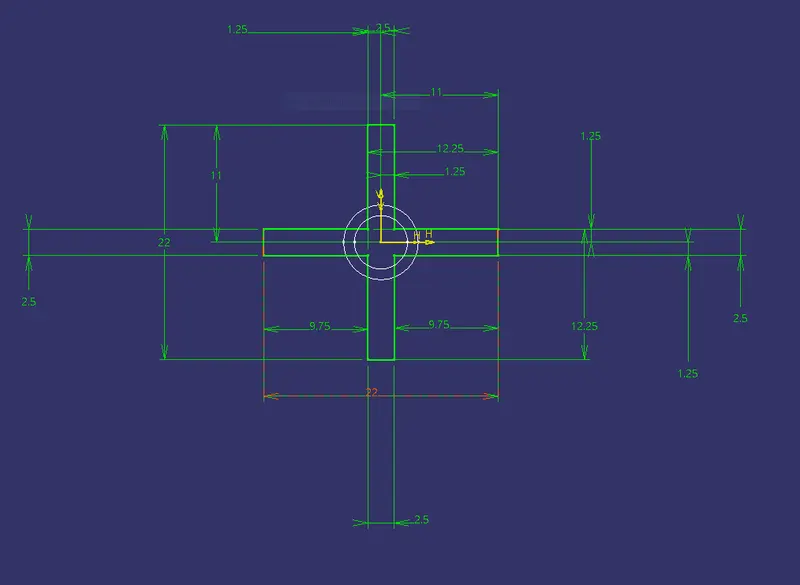
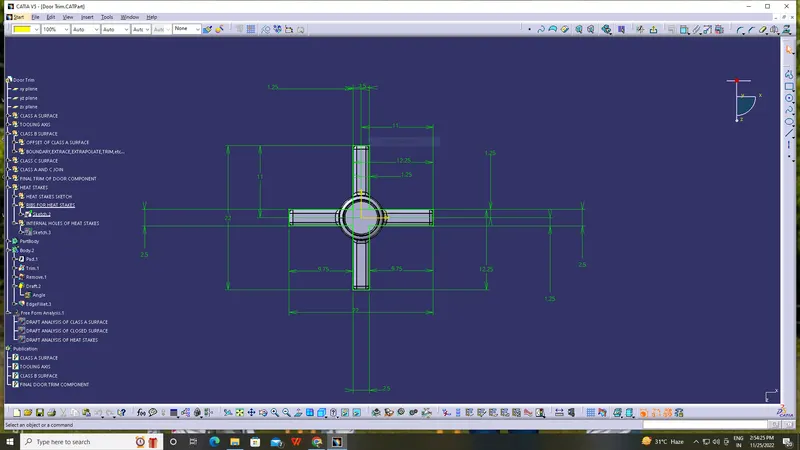
HEAT STAKES
- Heat staking also known as thermoplastic staking is the process of joining two dissimilar materials together.
- In heat staking we use local heating and cooling to raise the temperature of plastic components and allow plastic reforming to be carried out.
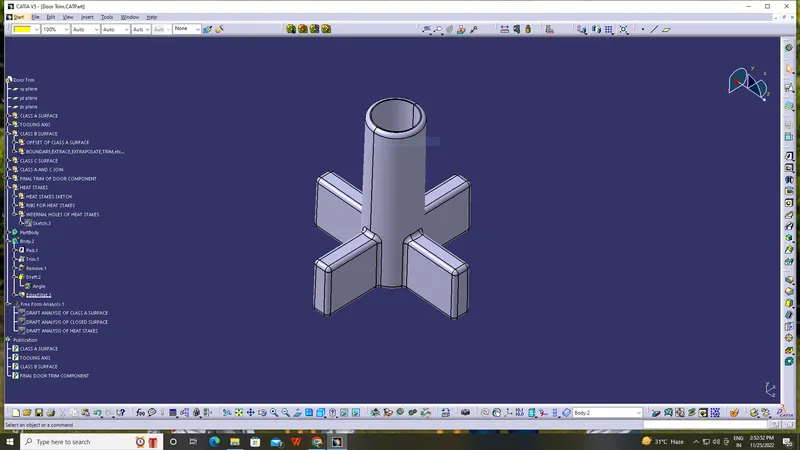
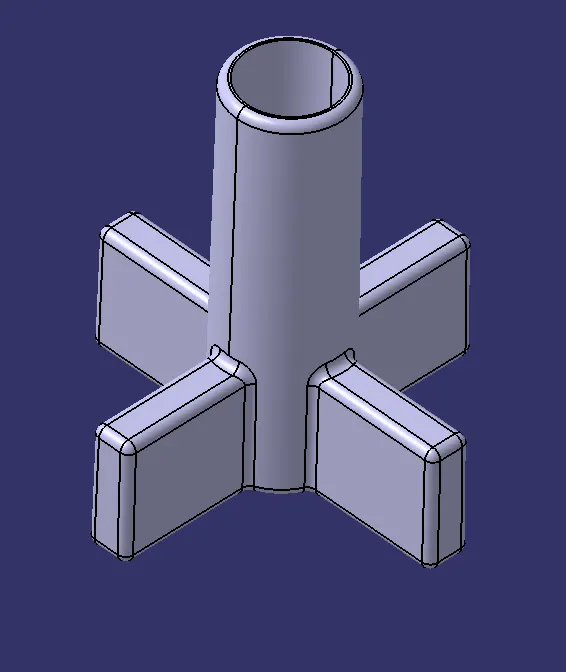
SKETCHES FOR HEAT STAKES
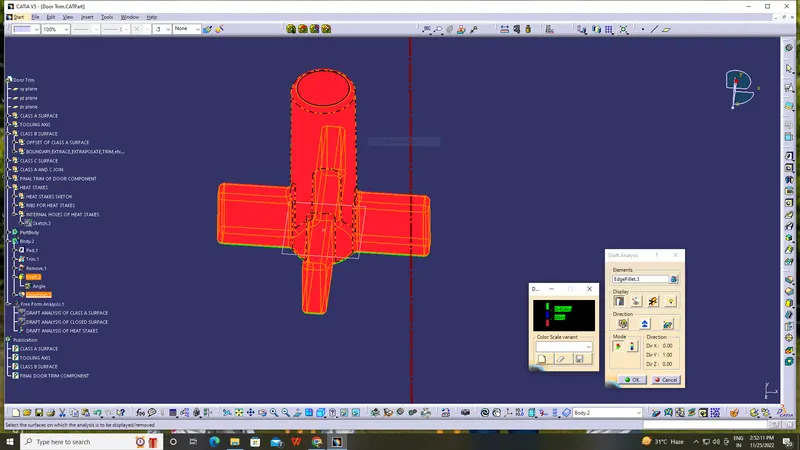
DRAFT ANALYSIS OF HEAT STAKES
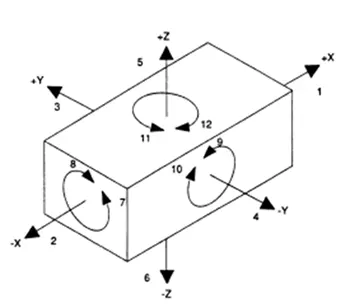
3-2-1 PRINCIPLE:
- A work-piece free in space can move in an infinite number of directions.
- For analysis, this motion can be broken down into 12 directional movements or "degrees of freedom".
- All 12 degrees of freedom must be restricted to ensure proper referencing of a work-piece.
- Notice the 6 axial degrees and 6 radial degrees of freedom.
- The axial degrees of freedom permit straight-line movement in both directions along the 3-principle axis shown as X, Y & Z.
- The radial degrees of freedom permit rotational movement, in both clockwise & counter clockwise radial directions around the same three axes.
LOCATORS
- The device to establish and maintain the position of the workpiece in work holders such as jig and fixture to ensure repeatability of work holder.
- The locating device for a work holding device mainly depends on the property of workpiece and the overall machining process.

4-WAY LOCATORS:
- 4-way mean you prevent movement at 2 axes (+X, -X, +Y and -Y) on the plane. Generally,
- you have cylindrical pin on the fixture and circular hole at workpiece part.
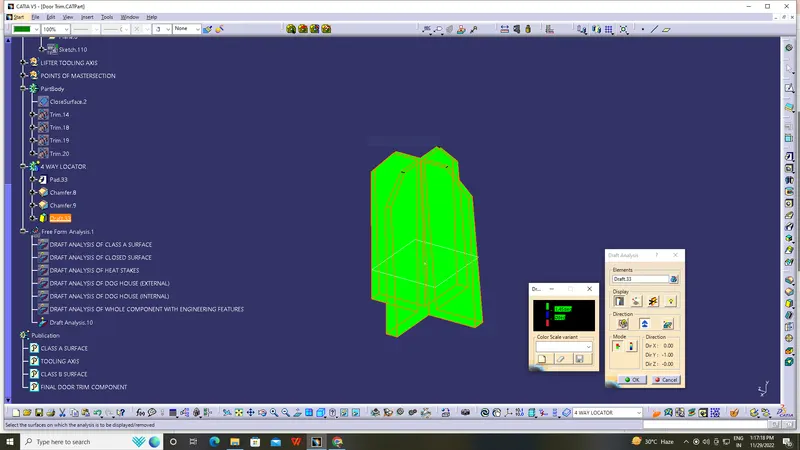
DRAFT ANALYSI OF FOUR WAY LOCATORS
2 WAY LOCATOR
- A 2-way locating pin restricts motion along 1 axis (or 2 degrees of Freedom), like a round pin in a slot.
- Likewise, a 4-way pin restricts 4 degrees of freedom along 2 axes. A round locating pin located concentrically in a hole is a common application of a 4-way pin, and helps to further secure the piece.
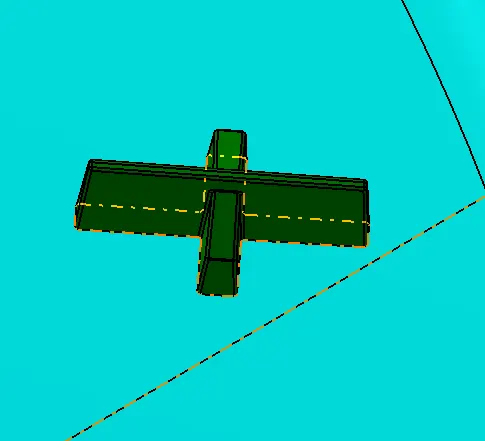
DRAFT ANALYSIS OF 2 WAY LOCATORS
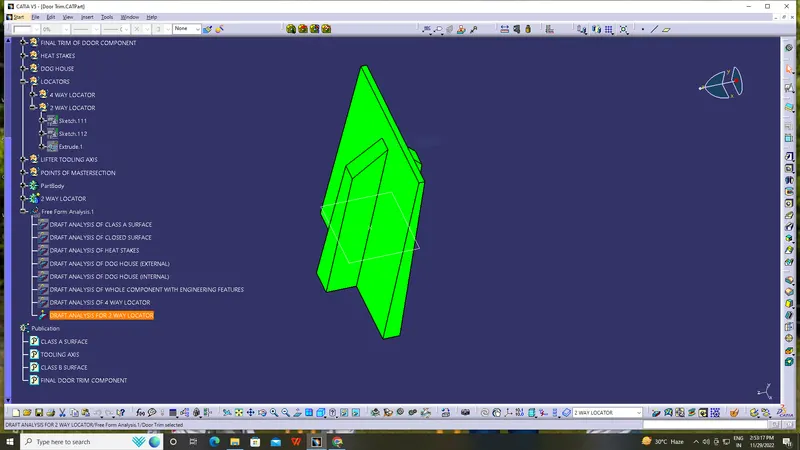
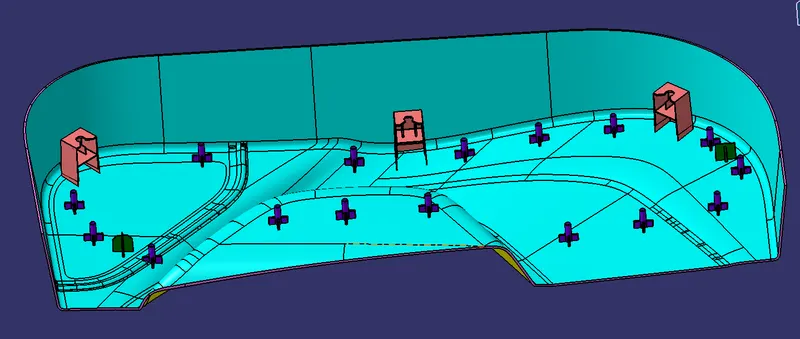
DRAFT ANALYSIS OF FINAL DOOR TRIM PANNEL WITH ENGINEERING FEATURES
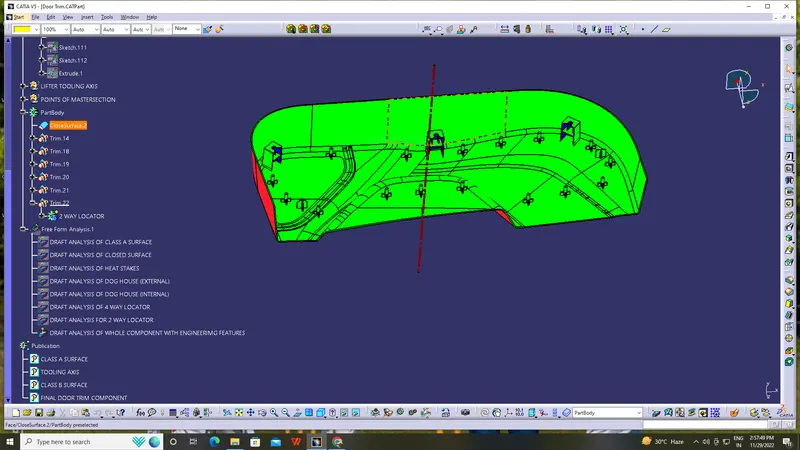
TREE STRUCTURE
FINAL COMPONENT OF DOOR TRIM PANNEL WITH ENGINEERING FEATURES
Conclusion:
1. The Door trim is created using a generative shape design, Part workbenches.
2. The model is designed with the nominal draft angle of 3 degrees for the component and
0.5 degrees for the Attachment features.
3. The Closed body of the model is created using close body command in part design
workbench.
4. The attachment features in the model are designed following the design rules.
5. The tree structure is maintained clearly.