Week 9 Machining with Planer Challenge
1. Objective
We will need to perform an explicit dynamic simulation to find out the Equivalent stress, Total deformation and also insert user-defined results to calculate the temperature of the body.
There are 2 cases: 1. There is a cutting velocity of 20000 mm/s and 2. Cutting velocity of 15000 mm/s
2. Case setup and Execution
Case 1
Select STEEL 1006 from the list of explicit materials in engineering data sources
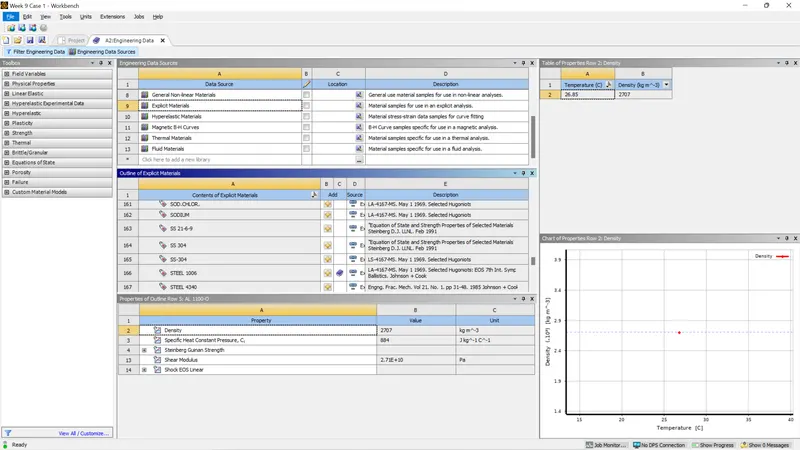
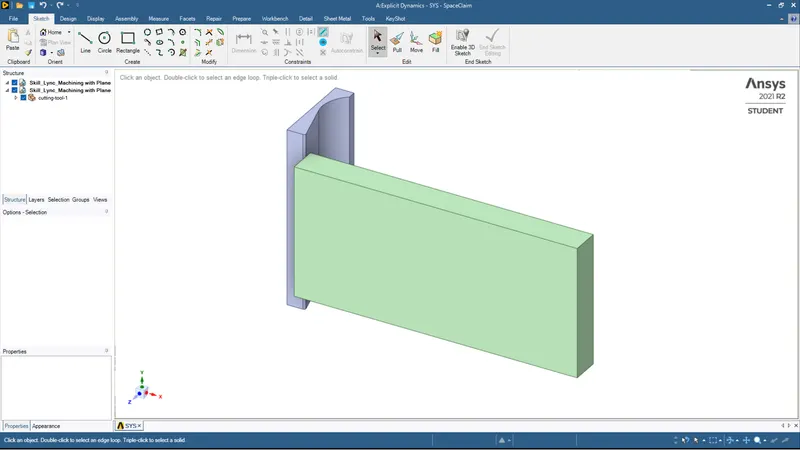
Import CAD geometry file in SpaceClaim and check for any abnormalities
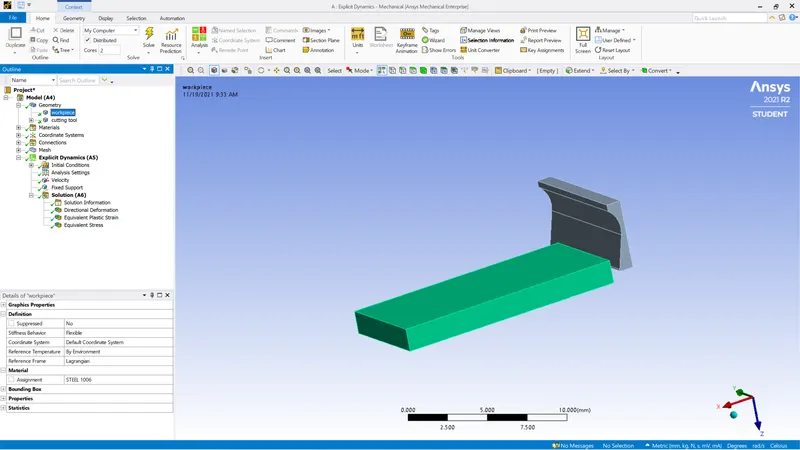
Assign workpiece name to 1 part of an assembly and material as STEEL 1006
Assign cutting tool as another name to the part and material as structural steel and make the behavior as rigid
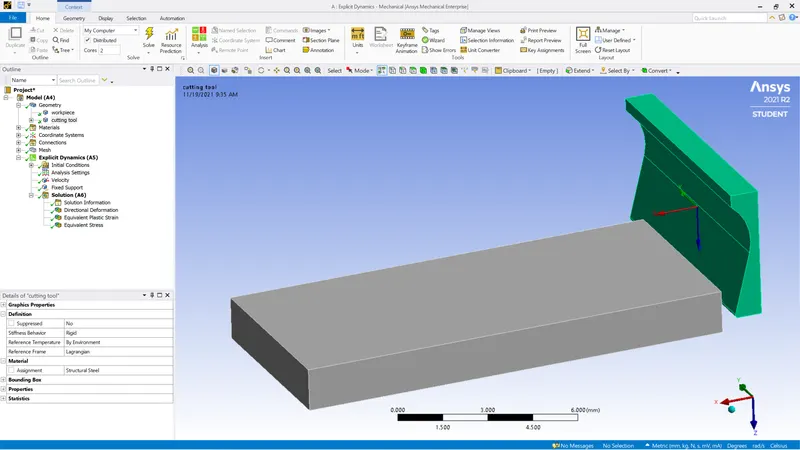
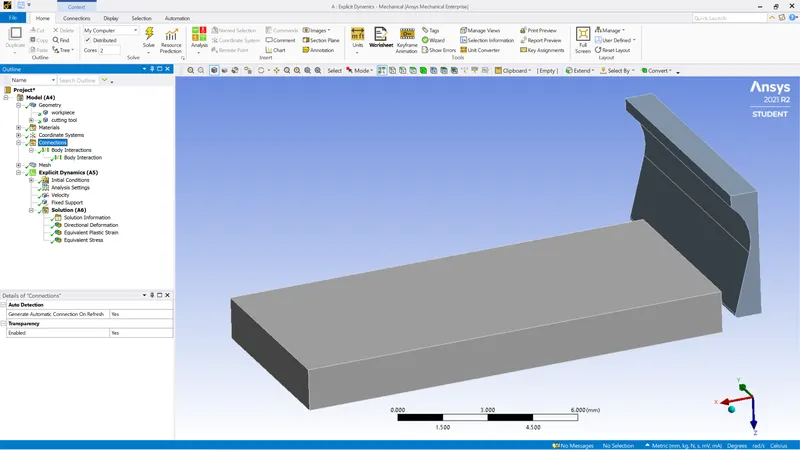
Remove default contact created between tool and workpiece
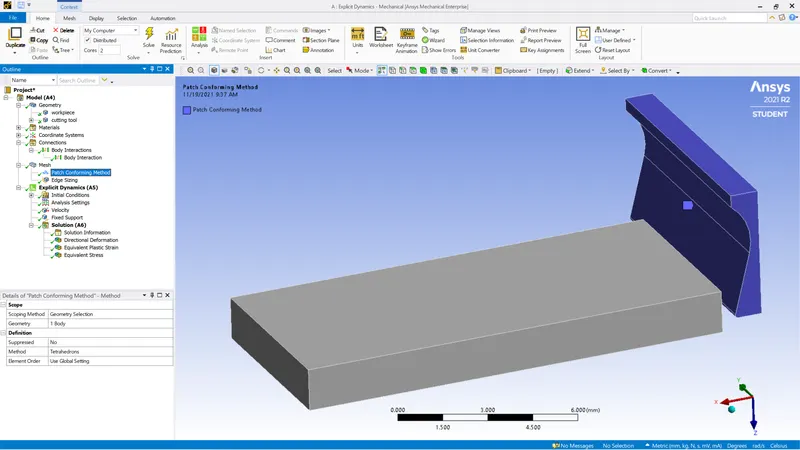
Use patch conforming meshing using tetrahedral elements
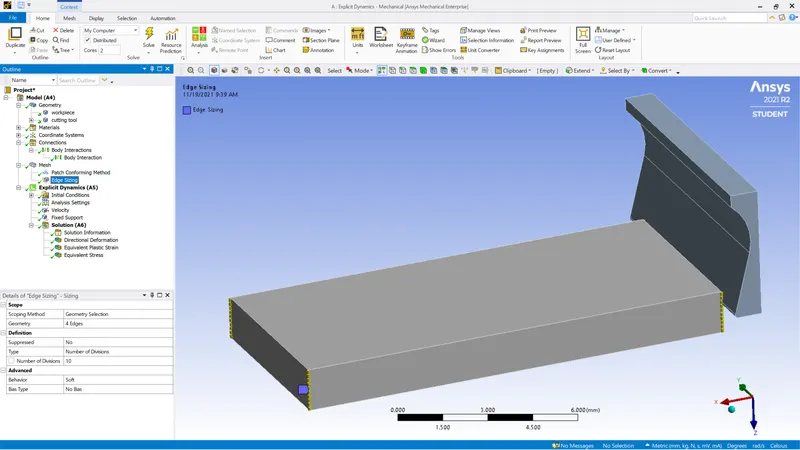
Select 4 side edges of a workpiece with 10 divisions. Keep behavior as soft
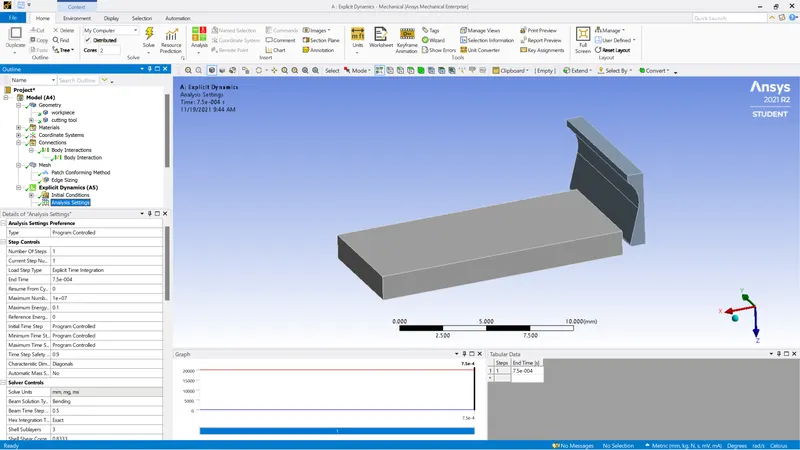
In analysis settings, change load step type to Explicit time integration. End time is 7.5e-4s. If we run the simulation once, we can also resume from the end cycle of the previous simulation. This makes the Explicit simulation method more accurate but time-consuming.
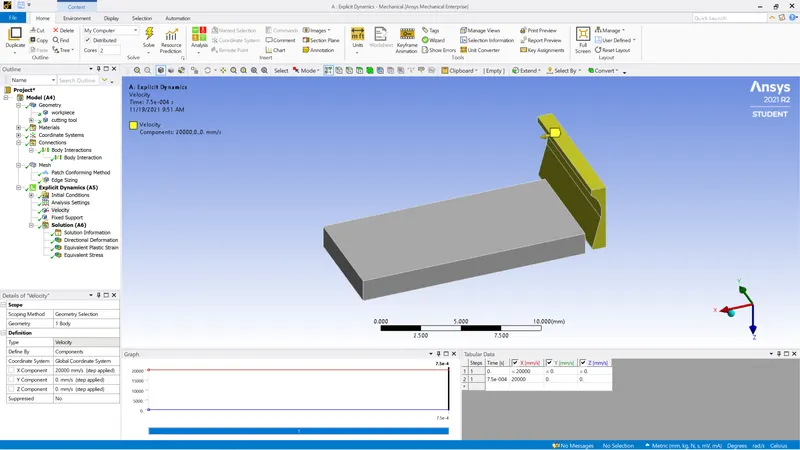
Provide velocity of 20e3 mm/s to the cutting tool in the X-direction. We will need to constrain the Y and Z direction to avoid cutting tool flying off after making contact with the workpiece. Make sure the local X-direction is in correlation with the global X direction.
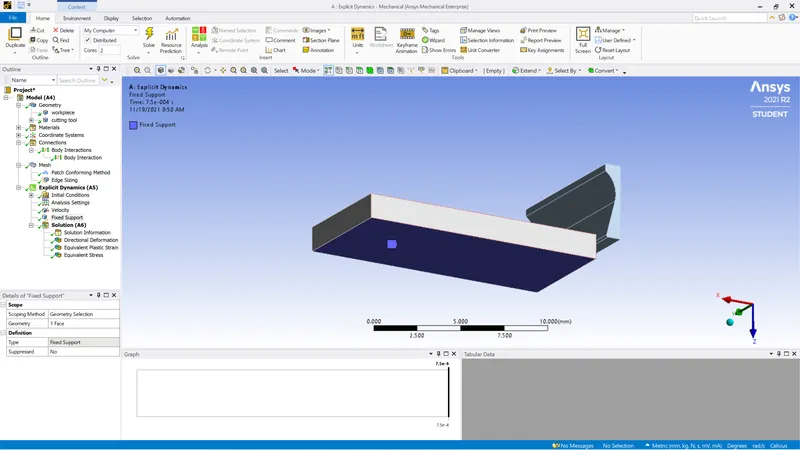
Apply fixed support to the bottom face of the workpiece
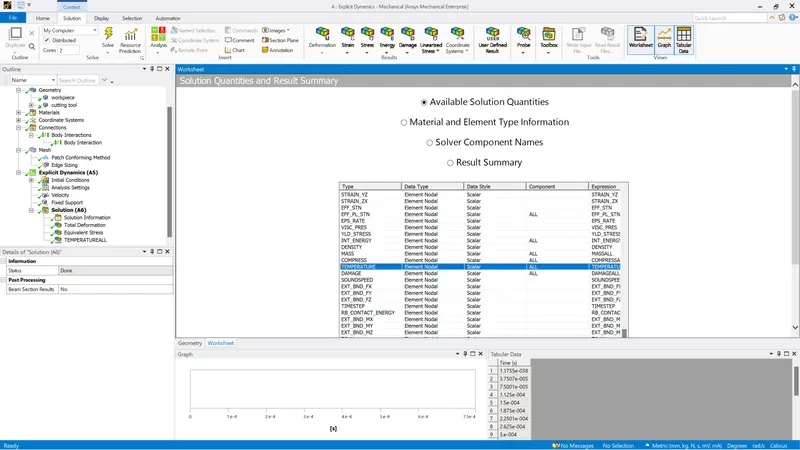
Insert user-defined results to find the temperature of the body by using WorkSheet. Select the type of user-defined result to be displayed in the solution.
Case 2
For this case, only velocity that is applied to the cutting tool will change from 20e3 mm/s to 15e3 mm/s. Rest all the steps remain the same.
3. Results of case 1
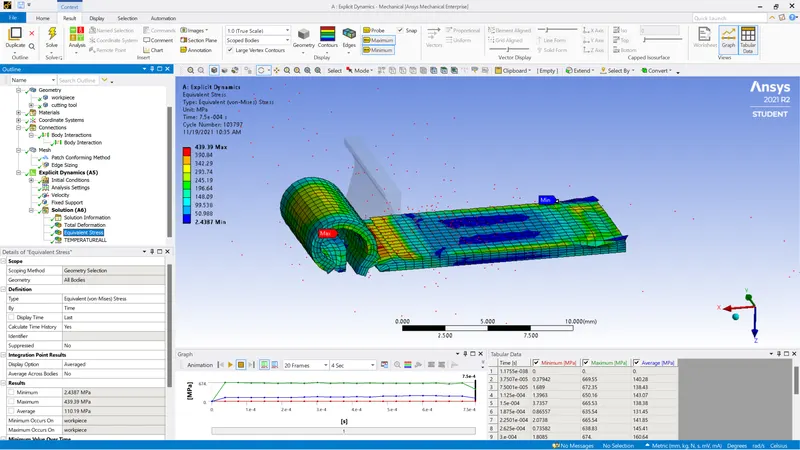
Equivalent stress (Animation: https://drive.google.com/file/d/1aF-LYsmxqy9KlStzrM-oCURSVzlyfNt3/view?usp=sharing)
Total deformation (Animation:https://drive.google.com/file/d/1Ghvbn36WqZwMYwOiUZFOIcGW1pJ2zuBi/view?usp=sharing)
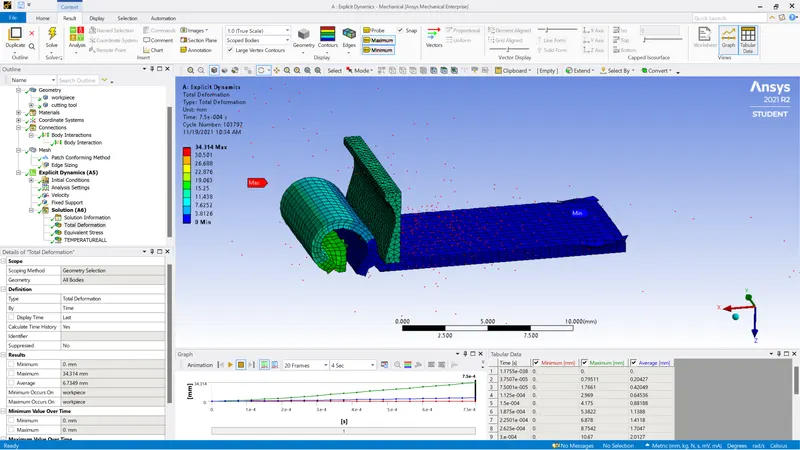
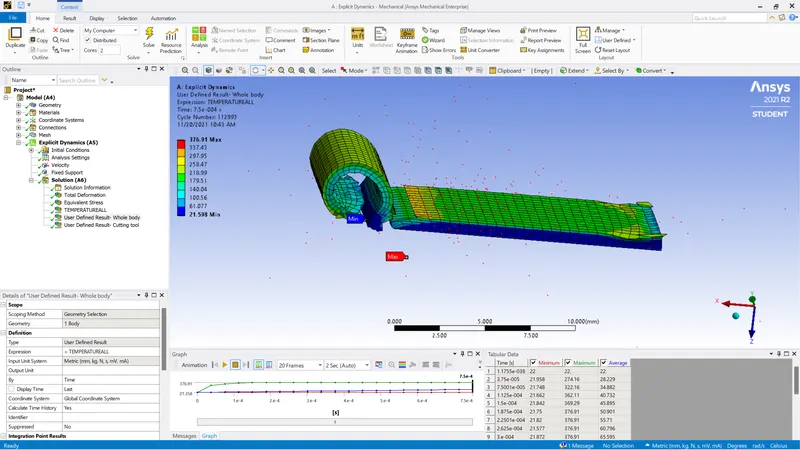
User-defined result (Temperature of the body) (Animation: https://drive.google.com/file/d/1nwDDfTiZbUHA-urt86RG5KTIdUblI31s/view?usp=sharing)
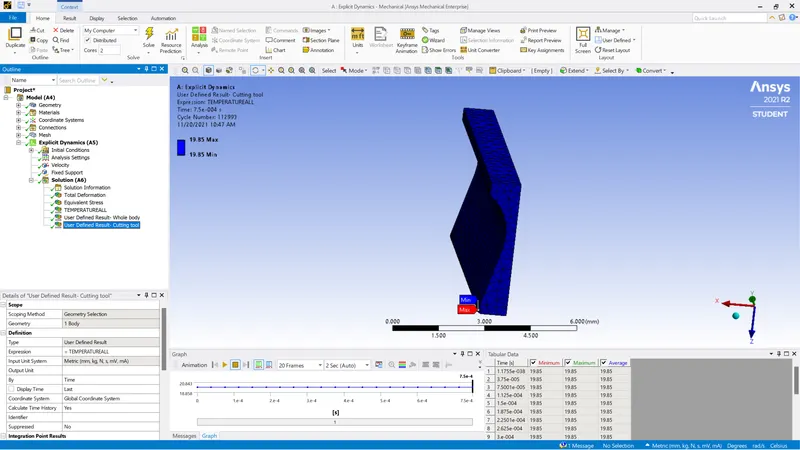
User-defined result for the temperature of the cutting tool (Animation: https://drive.google.com/file/d/1KcK0_KZa63STpgoiYS-f3aFaKOguEOAj/view?usp=sharing)
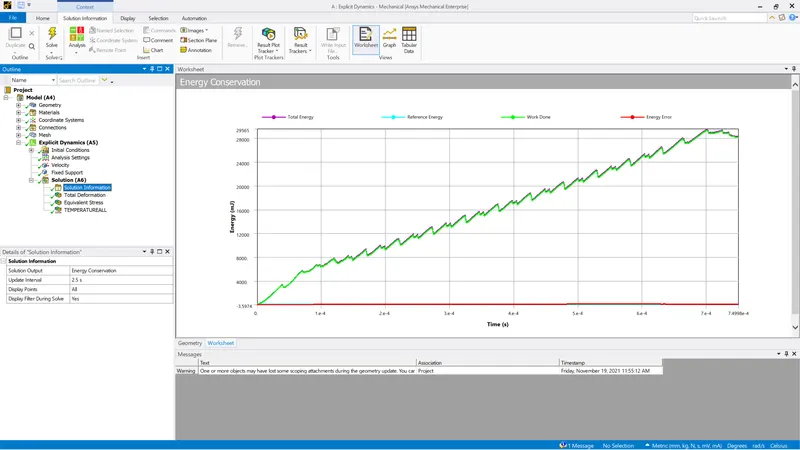
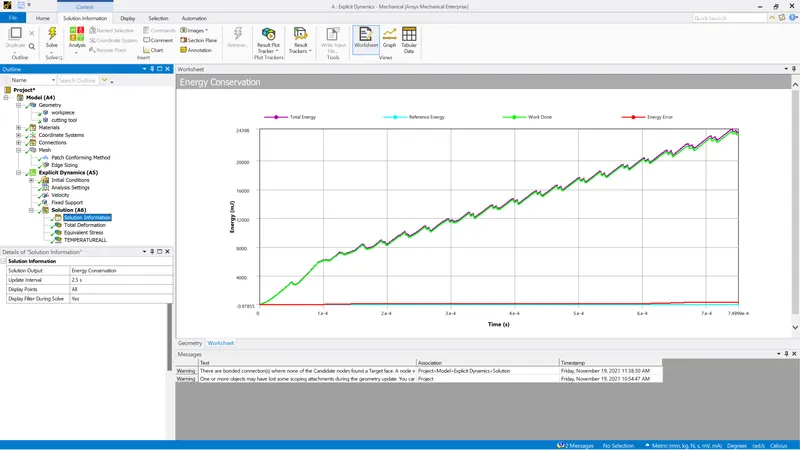
Energy conservation
4. Results of case 2
Equivalent stress (Animation: https://drive.google.com/file/d/1NXglba96vtlHN622O681LpSNSW9Qt6de/view?usp=sharing)
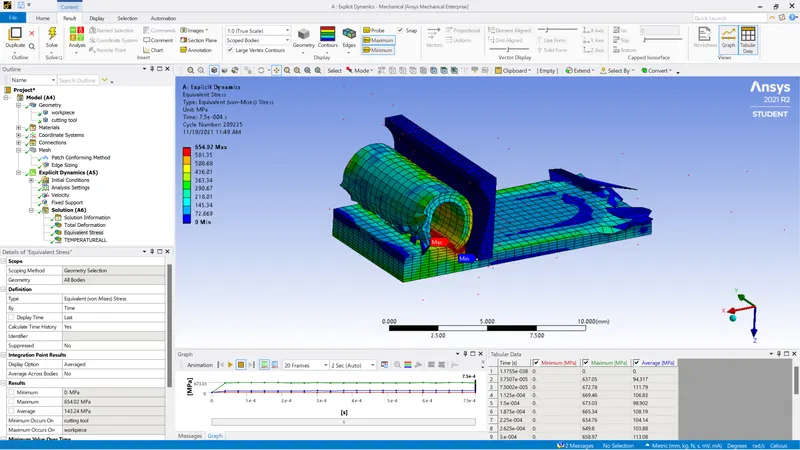
Total deformation (Animation: https://drive.google.com/file/d/1AlG-yyLkfxvjaCP1jyJs1B2A2CD9TPPq/view?usp=sharing)
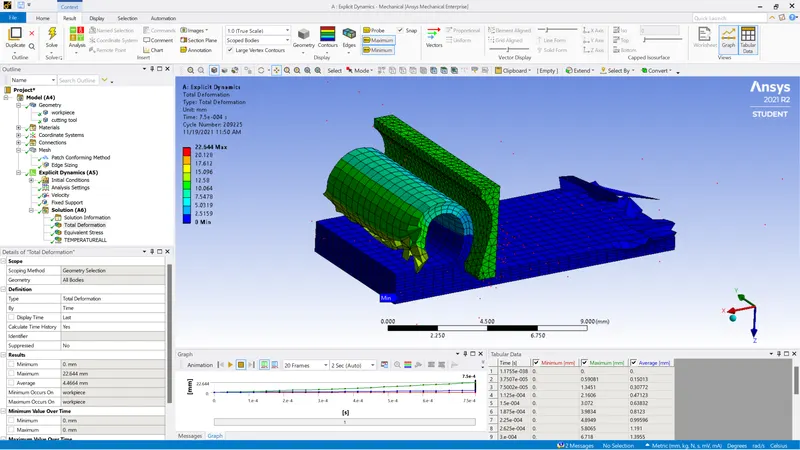
User-defined result (Temperature of the body) (Animation: https://drive.google.com/file/d/1mffaqLjZ8N1xTQnJOOXsVSFCTcdyPfFN/view?usp=sharing)
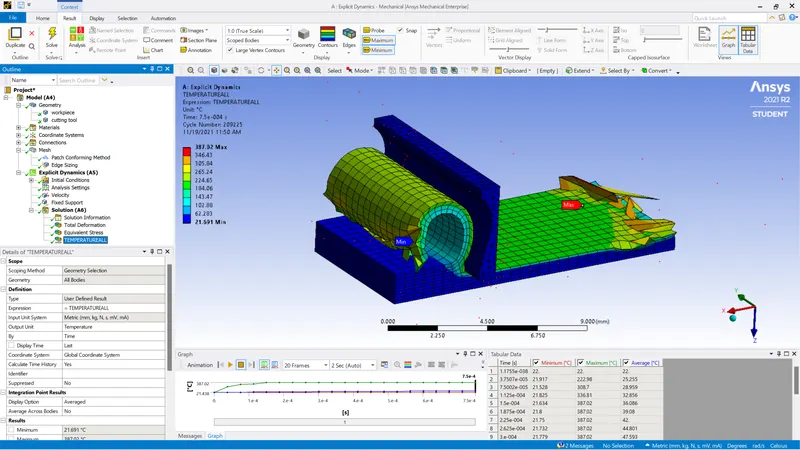
User-defined result temperature of the cutting tool (Animation:https://drive.google.com/file/d/1yQwAJjvKXA8kVmXsJNdXiu4zZcySXzz0/view?usp=sharing)
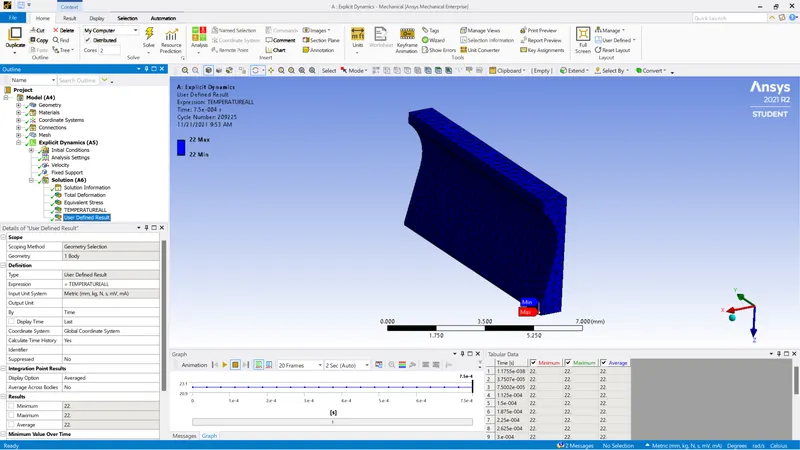
Energy conservation
5. Results, Conclusion and Report presentation
Case 1
| Equivalent stress | 493.01 MPa |
| Total deformation | 29.271 mm |
| User-defined temperature of the body | 376.91 deg C |
Case 2
| Equivalent stress | 654.02 MPa |
| Total deformation | 22.644 mm |
| User-defined temperature of the body | 387.02 deg C |
If we compare equivalent stress values for both cases, case 2 has a significantly higher amount of stress generated as there is more surface area contact between the cutting tool and workpiece. It is like the cutting tool sticks with the workpiece during the operation. Moreover, there is a high amount of heat generation due to increased frictional stress at the point of contact. Another reason is the workpiece material particles come in contact with air which helps in the cool down. The values of user-defined results clearly explain this phenomenon. But on the contrary, there is less total deformation of the body in case 2 compared with case 1 as there is a rapid change in the microstructure of workpiece material due to the high velocity of a cutting tool.
6. Simulation files
Files are attached