Week 9 Machining with Planer Challenge
Objective:
The aim of this challenge is to simulate the working of a planar operation and find out the total deformation, equivalent stress and temperature in the workpiece.
Case setup and execution:
First the explicit dynamics module was opened. In the engineering data, steel 1006 material was added to the material library.
Then the geometry was imported. In the Ansys Mechanical module, the parts were renamed as workpiece and cutting tool. The workpiece was assigned the steel 1006 material while cutting tool was of structural steel.
Then the existing contact was deleted.
For meshing, the workpiece was provided the edge sizing by selecting the 4 shortest edges of the workpiece. The number of divisions provided was 10.
In the Analysis settings, the end time of 7.5 e-04 seconds was provided. Rest of the settings were kept unchanged.
The bottom face of the workpiece was given a fixed support. The cutting tool was given the velocity of 20000 mm/sec in positive X direction.
The output was requested for equivalent stress and total deformation. The model was run. After getting the results, user defined result for temperature was inserted.
In case 2, the model was duplicated and the cutting tool was given the velocity of 15000 mm/sec. Rest of the model was unchanged.
The results for both the cases are shown below:
Results:
Case 1 : velocity = 20000 mm/sec
Animation
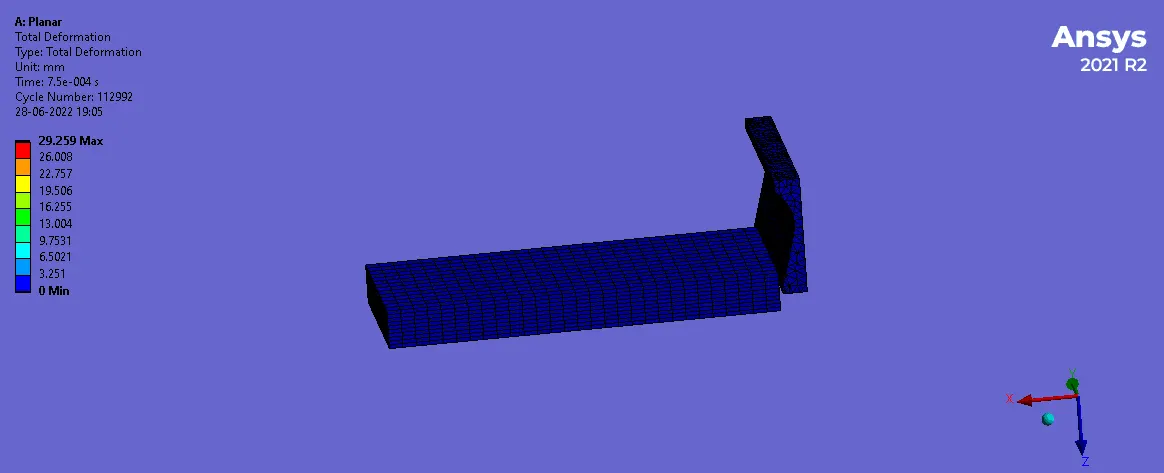
Equivalent stress
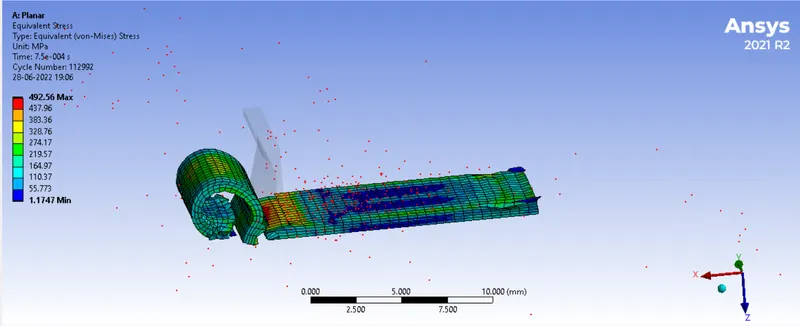
Total deformation
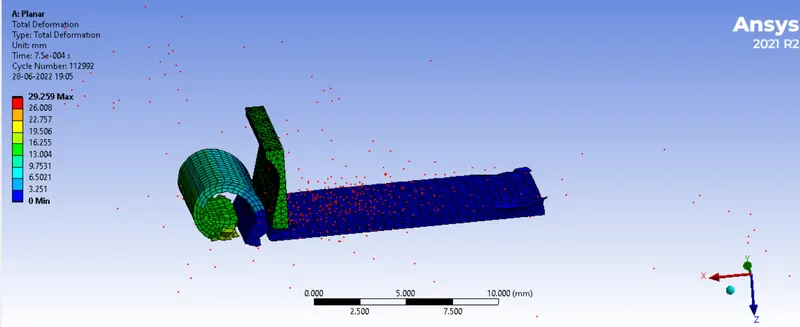
Temperature
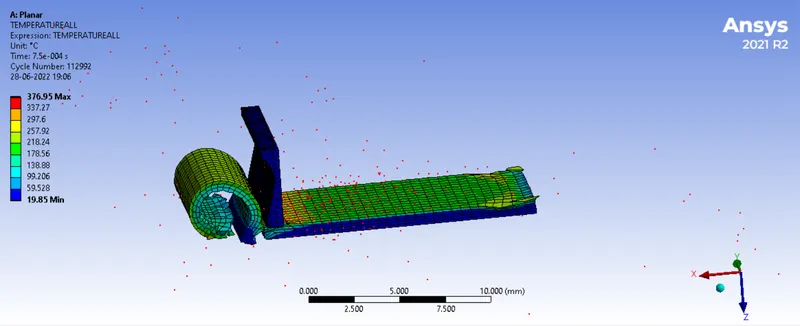
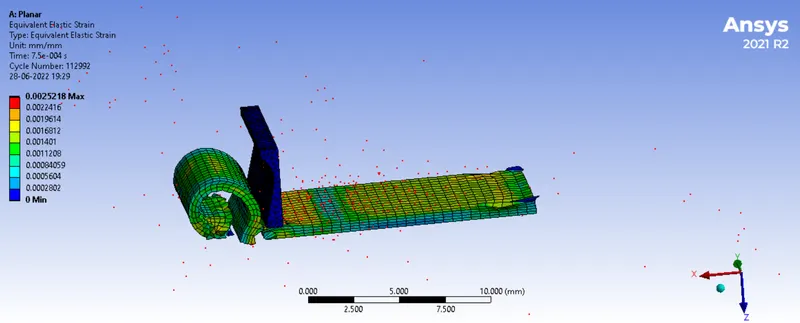
Equivalent elastic strain
Case 2 : Velocity = 15000 mm/sec
Animation
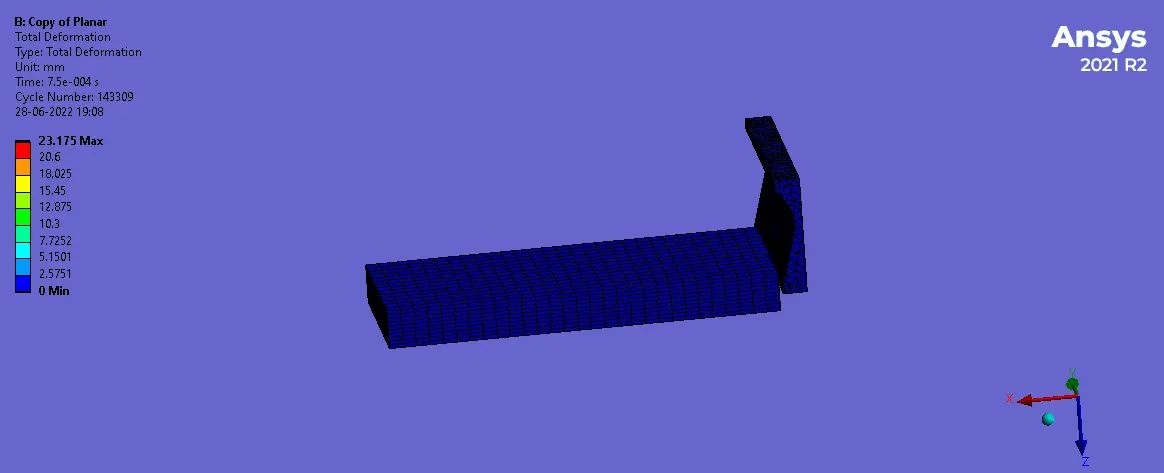
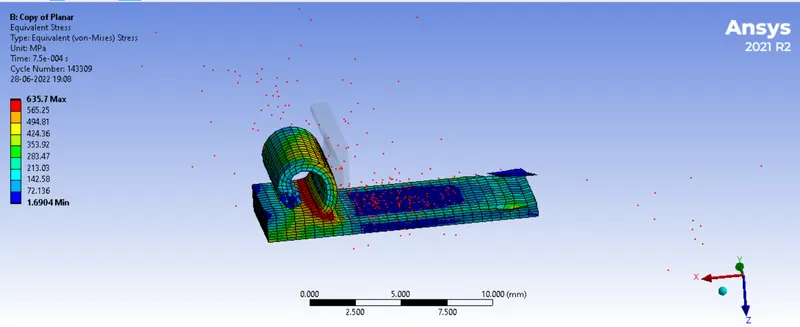
Equivalent stress
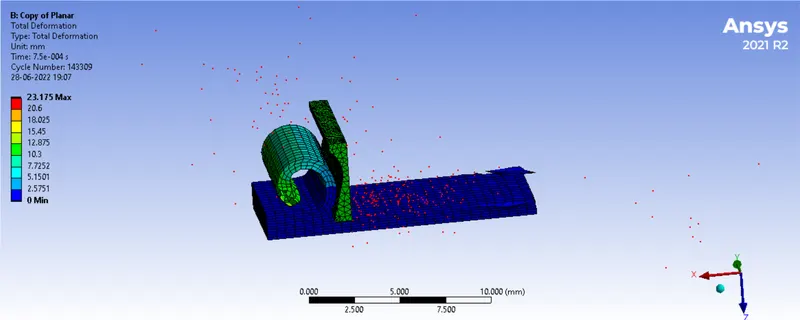
Total deformation
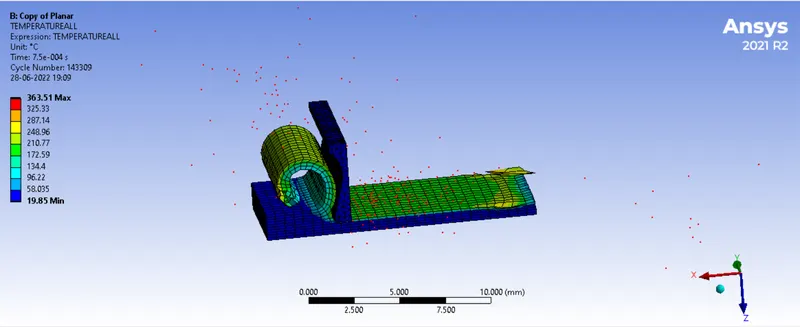
Temperature
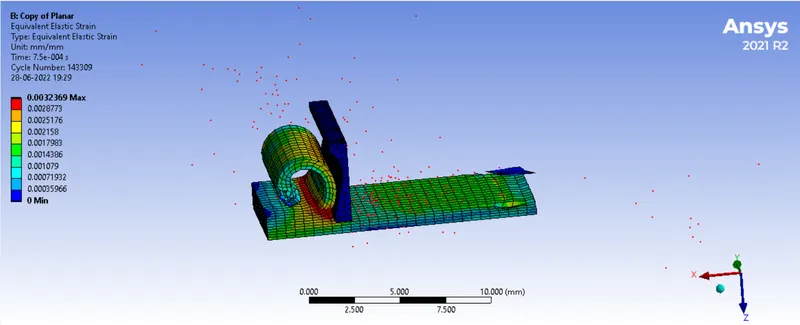
Equivalent elastic strain
| Vel = 20000 mm/sec | Vel = 15000 mm/sec | |
| Total deformation (mm) | 29.259 | 23.175 |
| Equivalent stress (MPa) | 492.56 | 635.7 |
| Temperature (Celsius) | 376.95 | 363.51 |
| Equivalent elastic strain | 0.0025218 | 0.0032369 |
Conclusion:
Thus, the total deformation is lower in Case 2 due to lower velocity with the same end time as in Case 1. But in case 2, due to lower velocity, the quality of machining is better, which results in higher strain. In case 1, higher velocity sometimes leads to gliding of the cutting tool instead of actual cutting. Hence strain is lower in Case 1. As a result, the equivalent stress is lower in Case 1. This is clear from the strain values in the above images. The simulation files are attached in zip format with the report.