Week - 4 - Crash Box Simulation
Aim:
The aim of the challenge is to perform the simulation of the crash of a crash box in a rigid wall. The desired outputs include the binary d3 plot, section force, accelearion of a node, directional stress and strain and energy plots.
Explanation:
The meshed file for the crash box was given. The rigid wall was created using the RIGIDWALL option in the CREATE ENTITY.
The crash box was assigned the shell section and elastic material MAT_001. The properties of steel were used.
The unit system used is gm-mm-ms.
The crash box was given the initial velocity of 50 kmph which is equal to 13.89 mm/ms.
The termination time was given as 1 ms.
In the contact, the check for initial penetration was given. Also the check for hourglass was given due to presence of shell elements.
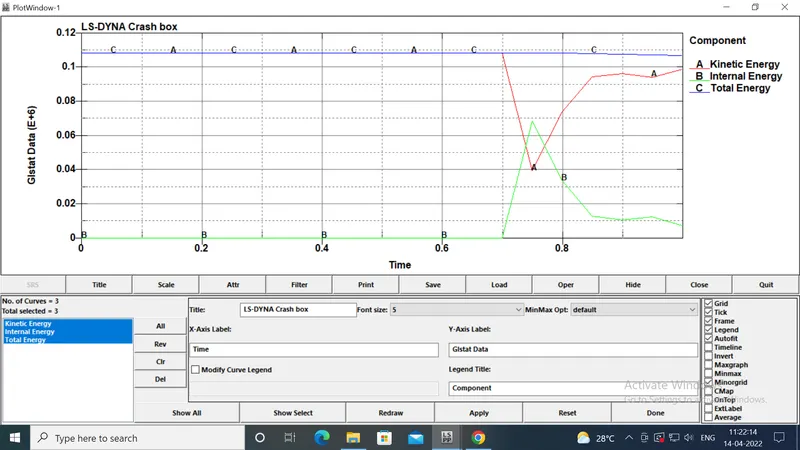
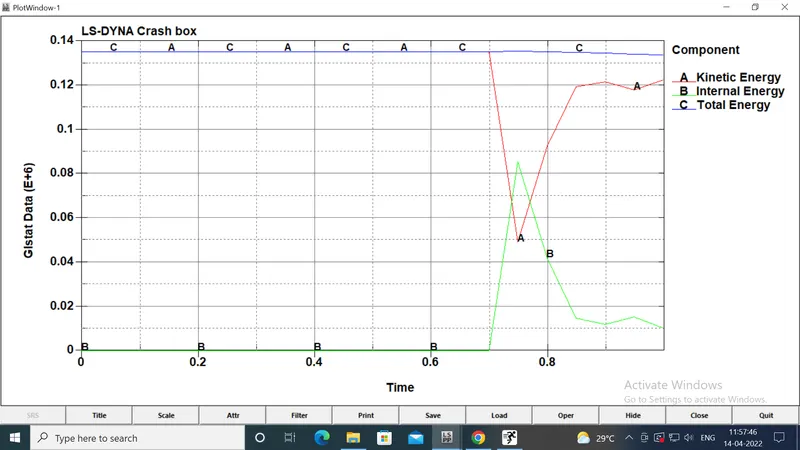
For the output, the binary d3 plot was requested. In ASCII options the GLSTAT, SECFORC, RCFORC were requested with the timstep of 0.05 ms.
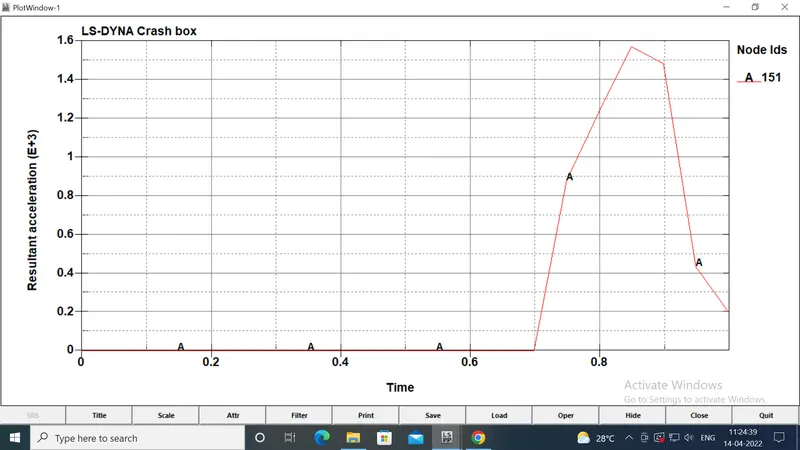
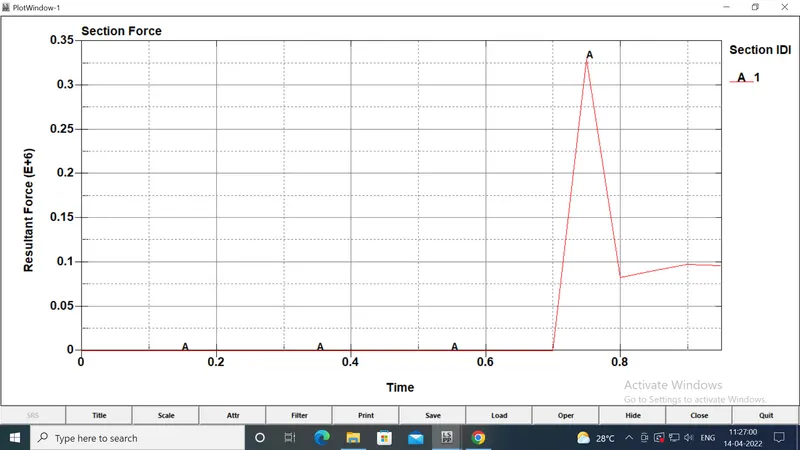
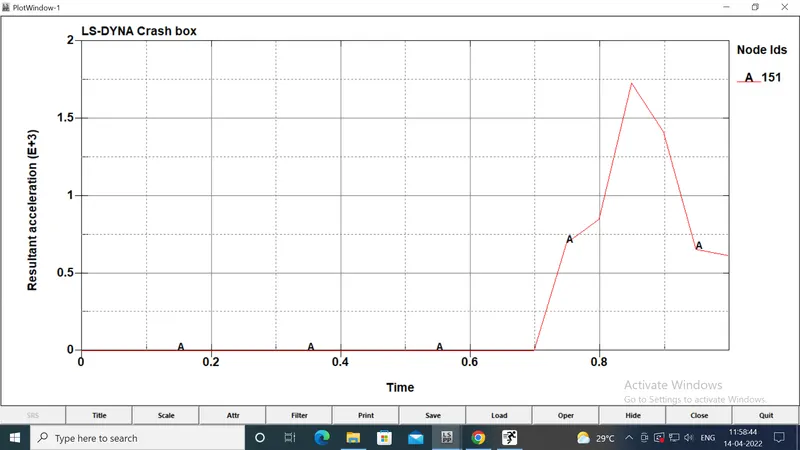
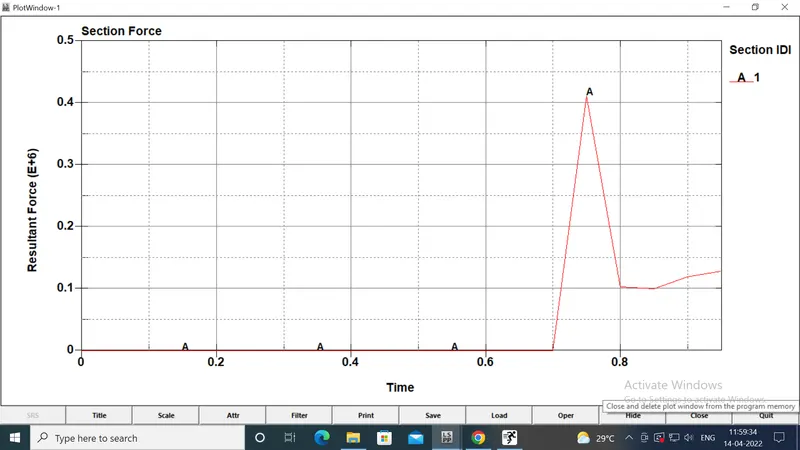
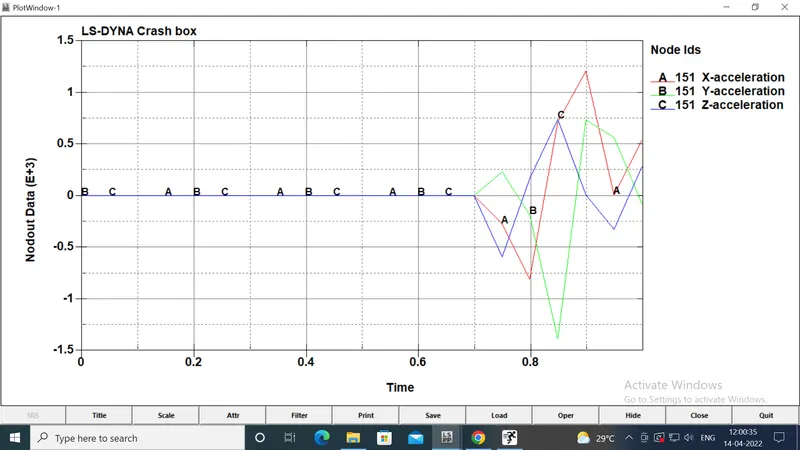
Also the NODOUT option was used to check the acceleration of the node in the middle of the crash box. SECFORC was used to find forces on the section chosen in the middle of the crash box.
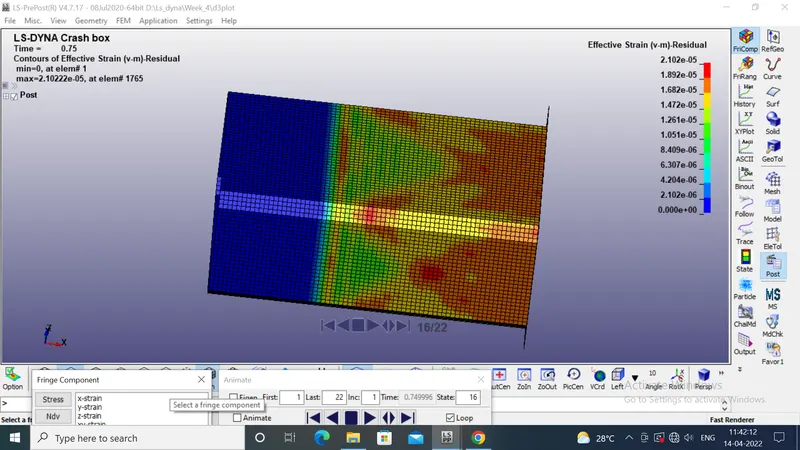
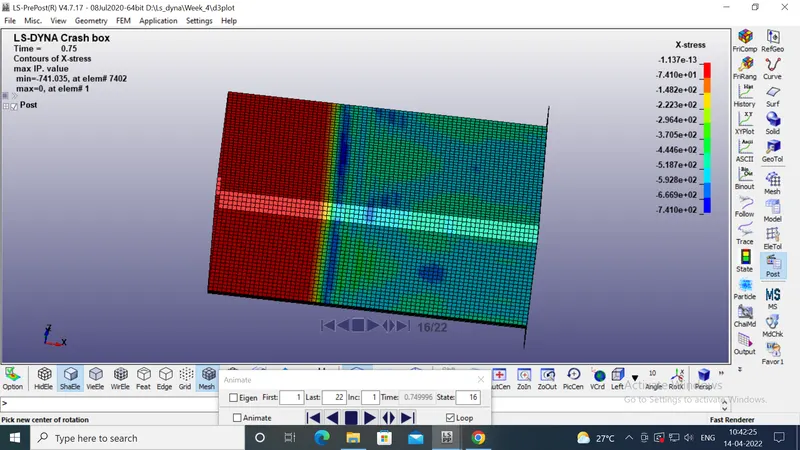
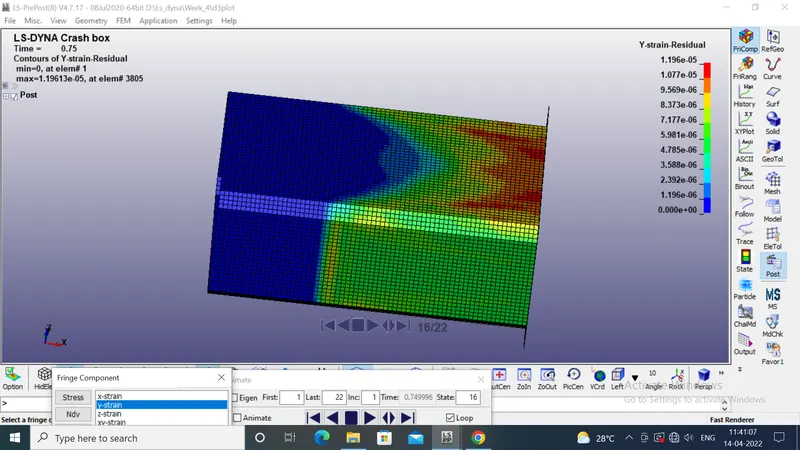
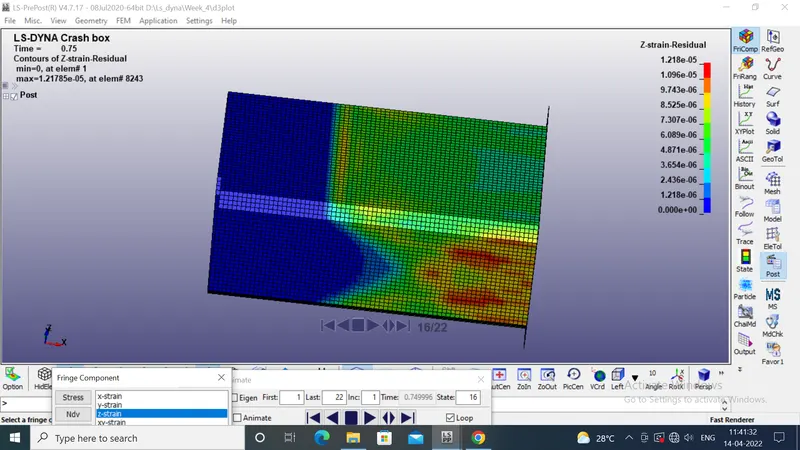
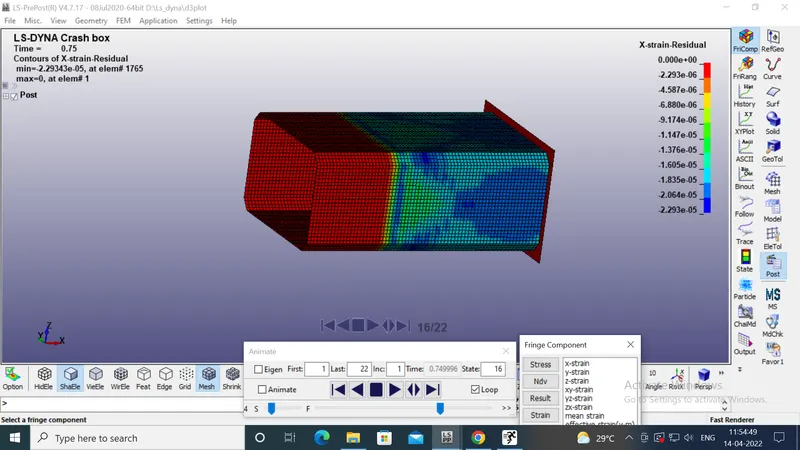
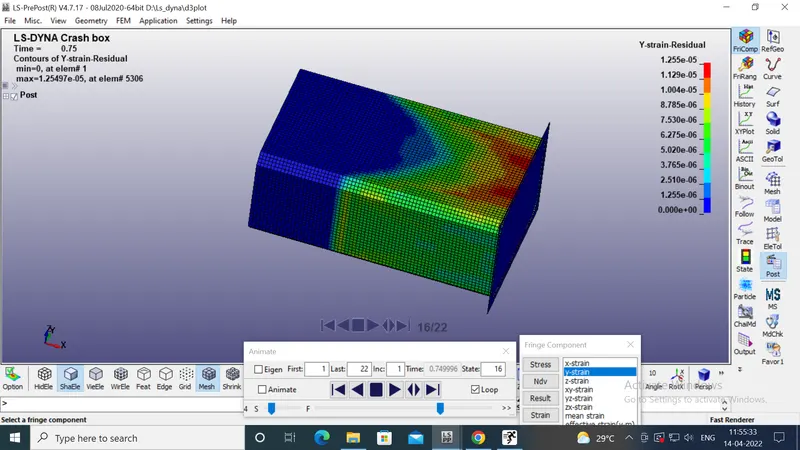
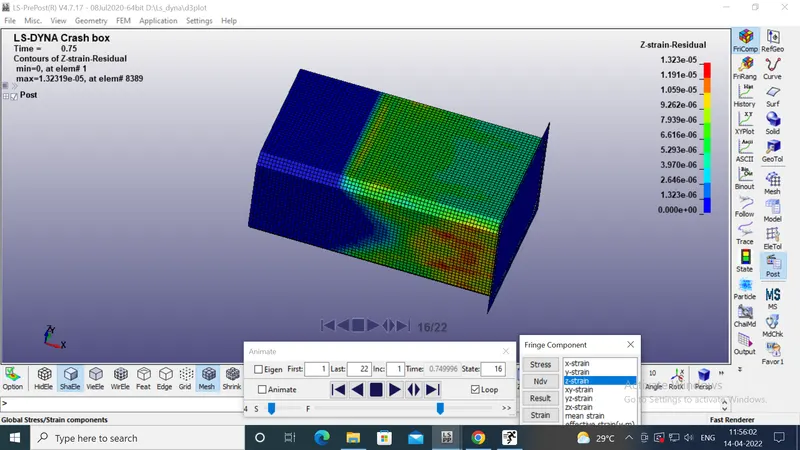
The simulation was done in 2 cases: one in which thickness of crash box was 1.2mm and the other in which the thickness was 1.5 mm. The plots for both the cases are shown below:
For 1.2 mm thickness:
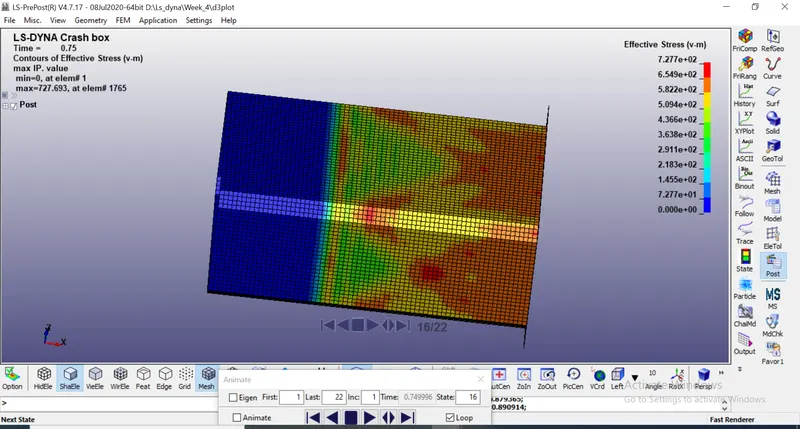
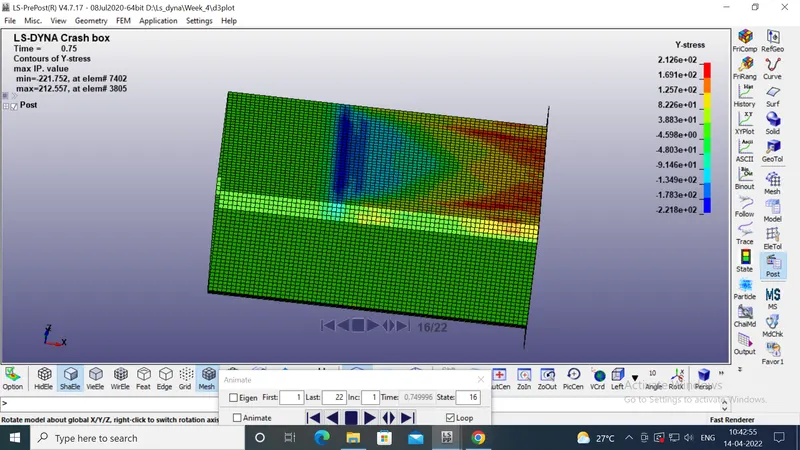
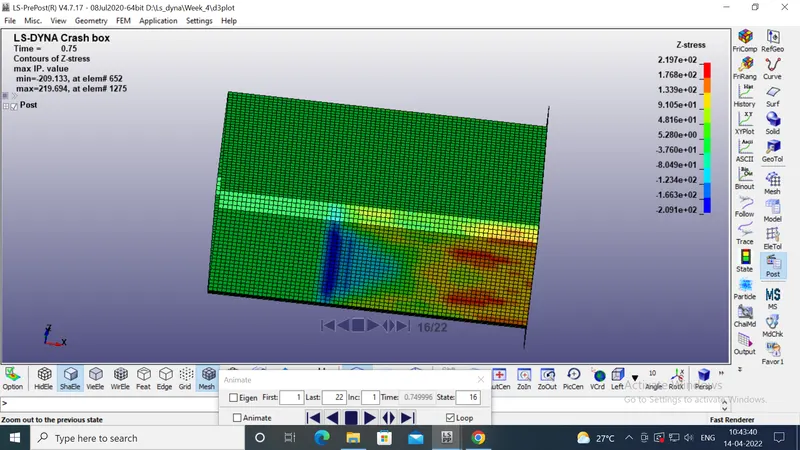
Maximum von mises stress: 727.7 gm.mm/ms2
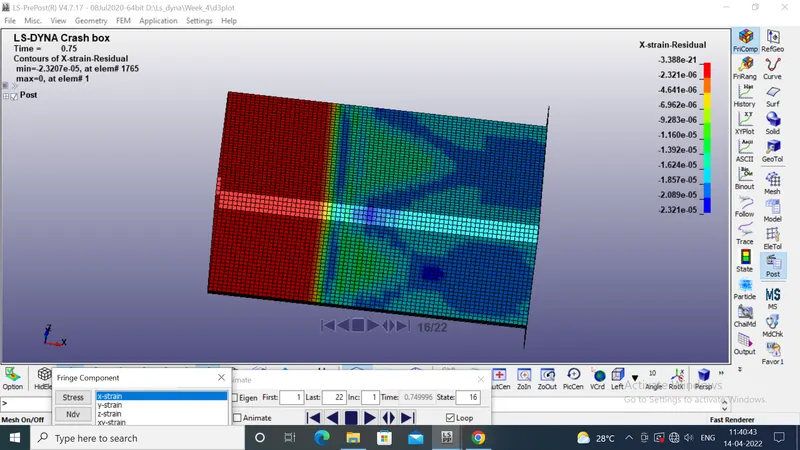
Maximum von mises strain: 2.1 e-5
For 1.5 mm thickness:
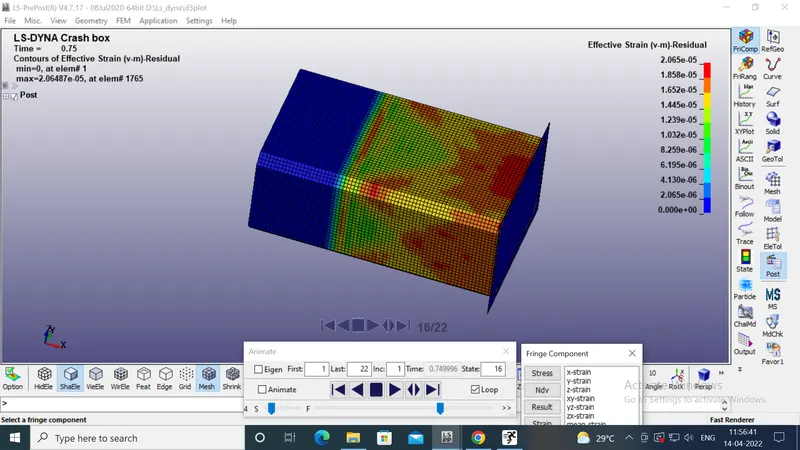
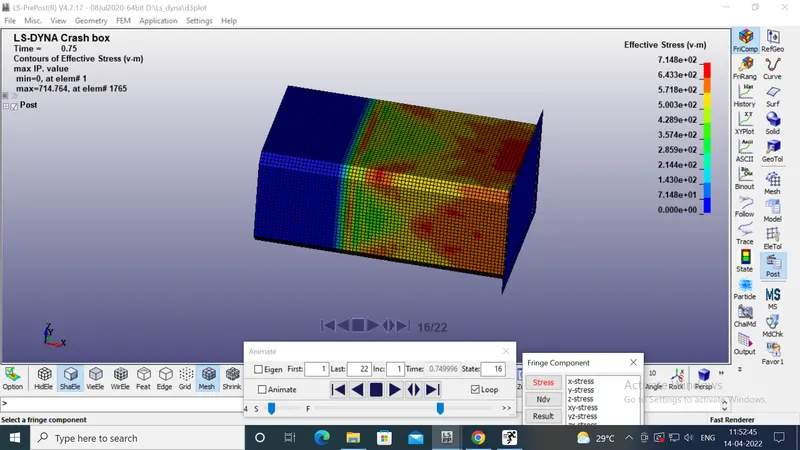
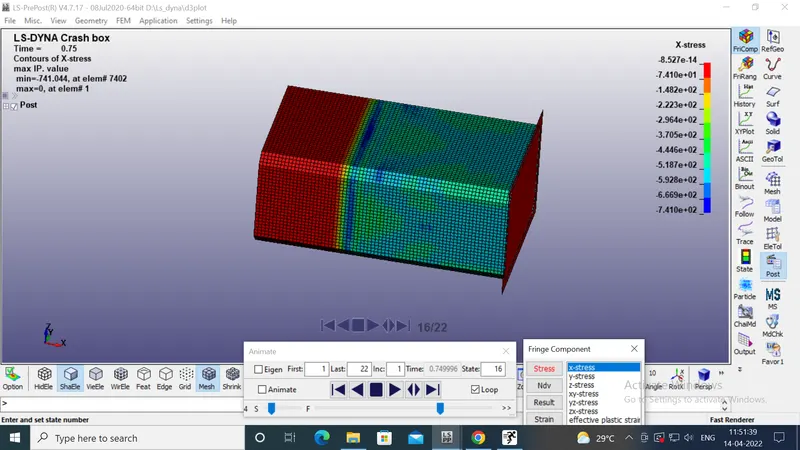
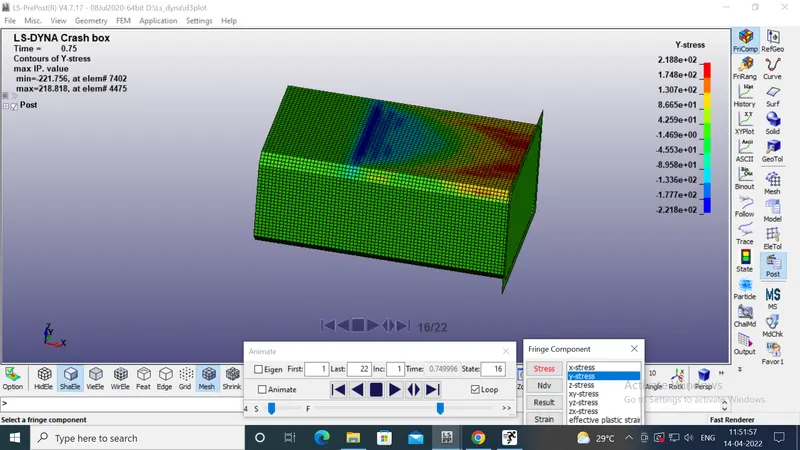
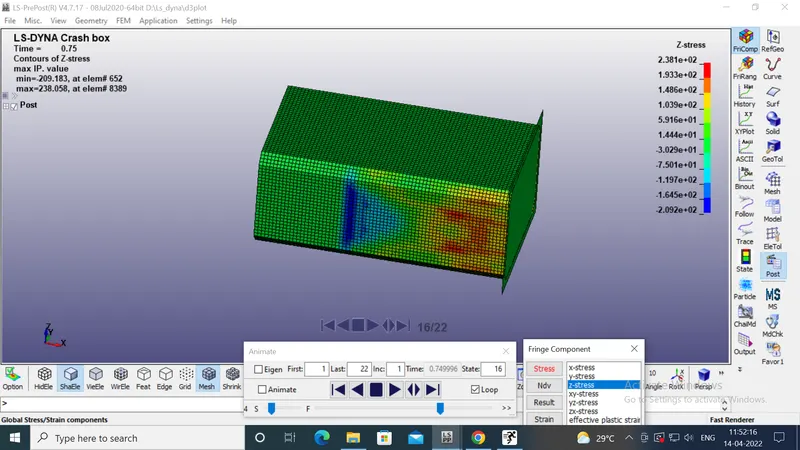
Maximum von mises stress: 714.8 gm.mm/ms2
Maximum von mises strain: 2.065 e-5
Comparing both the cases:
| Crash box thickness | 1.2mm | 1.5mm |
| Maximum von mises stress (gm.mm/ms2) | 727.7 | 714.8 |
| Maximum von mises strain | 2.1 e-5 | 2.065 e-5 |
| Maximum Nodal acceleration (mm/ms2) | 1.58 e+3 | 1.7 e+3 |
As can be seen from the above table, the stress is reducing with the increase in thickness, which is obvious as more thickness increases the cross-sectional area.
But the strain in both the cases remains approximately the same, given the boundary conditions in both cases are the same.
In both the cases, as the crash box is rebounding after hitting the rigid wall, the internal energy, section force, nodal acceleration are initially increasing and then desreasing. There is also lateral strain. The hinetic energy is initially decreasing and then increasing.
Conclusion:
The simulations in both the cases ran smoothly with normal termination. The output plots were also obtained with relative ease. As the thickness of the crash box increases in the second case, the stress decreases, but the strain remains approximately the same.