Week 9 Machining with Planer Challenge
Aim: To perform an explicit dynamics simulation to find out the Equivalent Stress, Total Deformation and also insert a User-defined result to calculate the temperature of the body.
Objective: To perform this for 2 cases. One will be with a cutting velocity of 20000mm/s and the other will be with a cutting velocity of 15000mm/s.
Procedure:
1) To verify welds in the setup, we use the Explicit Dynamic tool in the analysis system toolbox to define the geometry and other input parameters for the same.
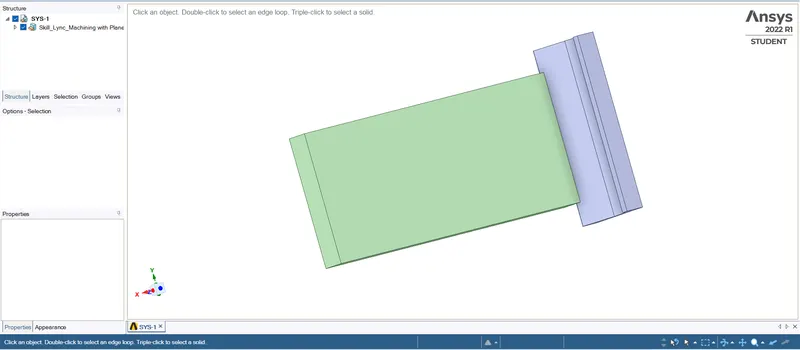
First, we open SpaceClaim to identify and rectify the errors in the geometry. In the below geometry we can see the Machining With Planar Model.
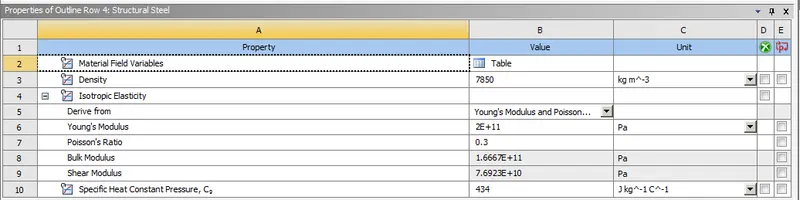
2) In the engineering data we input the material and its properties. In this case, we are using two different types of materials i.e., Structural Steel and Steel 1006 and their properties are shown below.

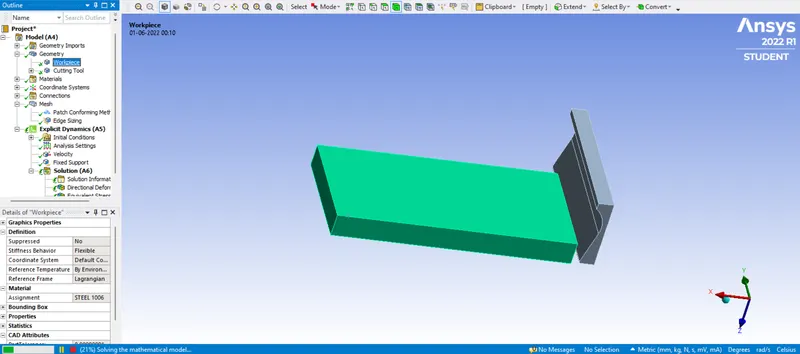
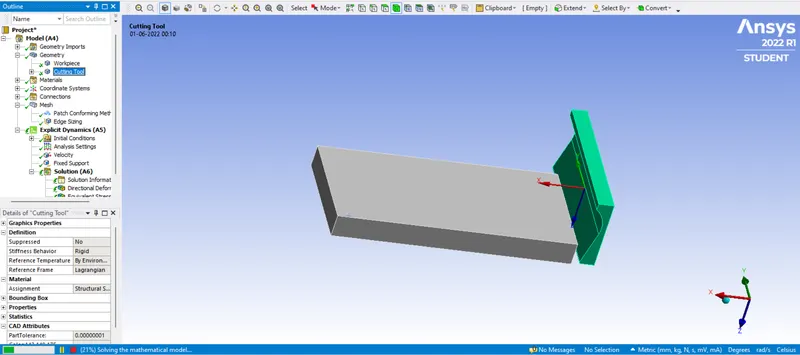
3) In the geometry of the model, Cutting Tool is made up of Structural Steel and Workpiece is made up of Steel 1006.
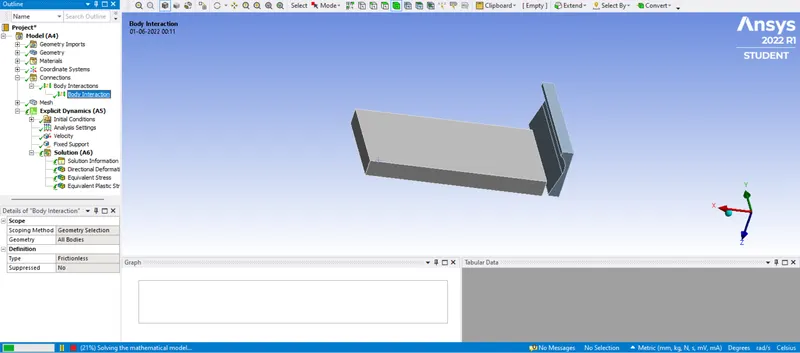
4) In Connections, defining Body Interaction of the geometry for Frictionless Type.
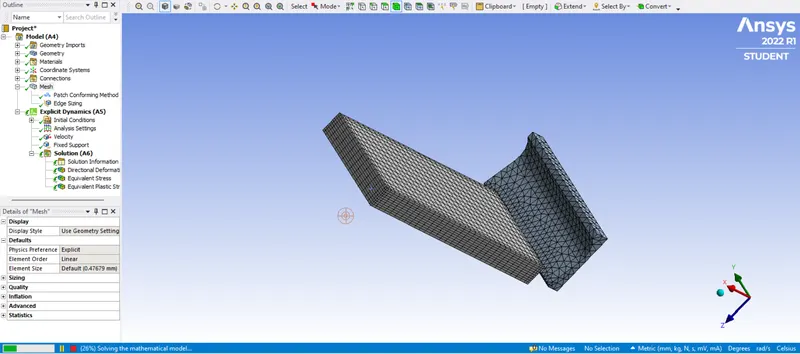
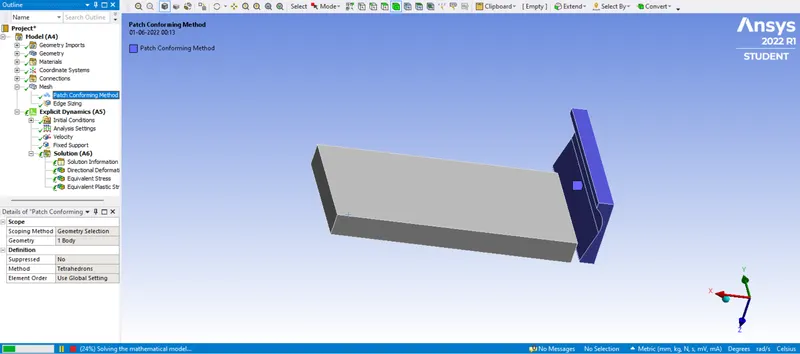
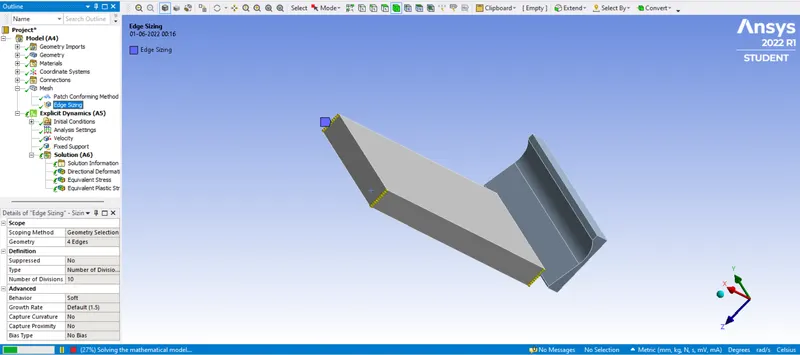
5) By opening the modelling tab, we mesh the geometry with element size as default and finer mesh size where contacts are present. Tetrahedrons Method meshing is used for Cutting Tool. Edge Sizing is used for Workpiece by selecting four small edges with 10 divisions. Generating the mesh thereafter by right-clicking on the Mesh icon.
6) We open the analysis setting where stimulation is run for 1 step with End Time as 7.5e-4 for Velocity and Fixed Support.
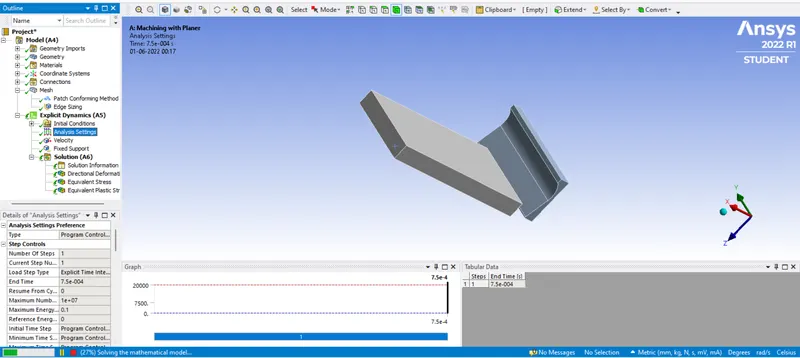
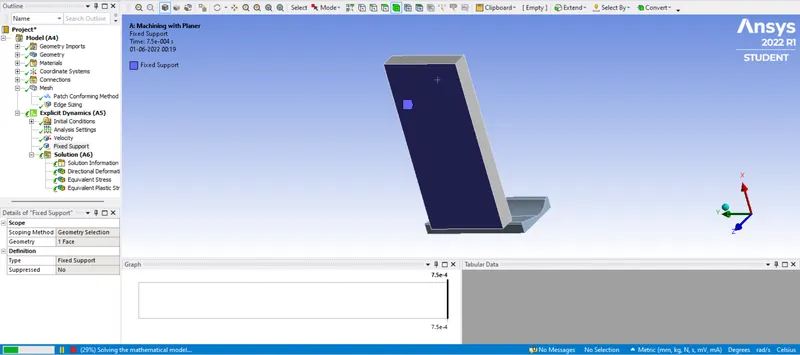
Fixed Support is given for the base of Workpiece.
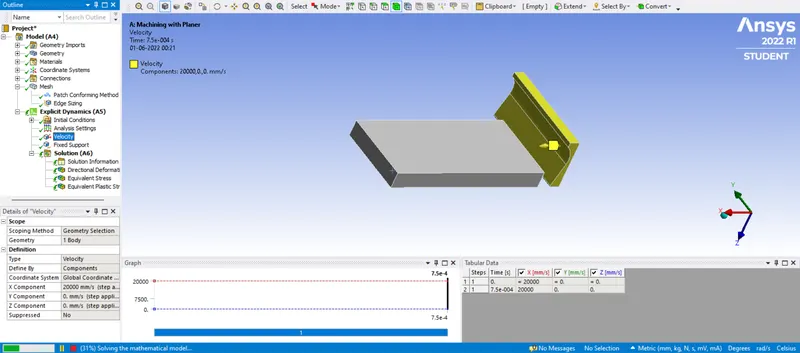
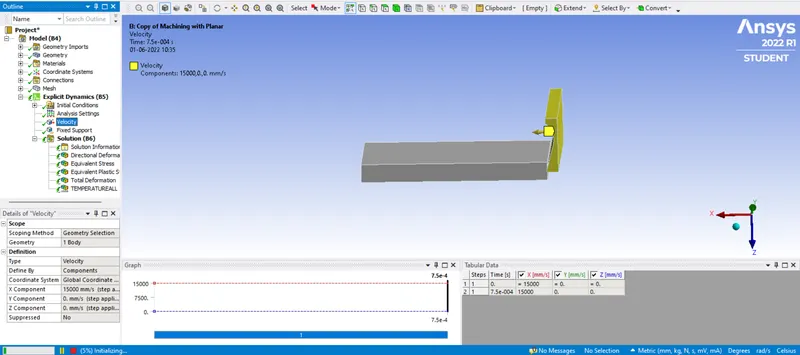
Velocity is given for Cutting Tool in X-axis in two Cases as shown below
Case 1: Velocity of 20000 mm/sec
Case 2: Velocity of 15000 mm/sec
7) Setting up the solution:
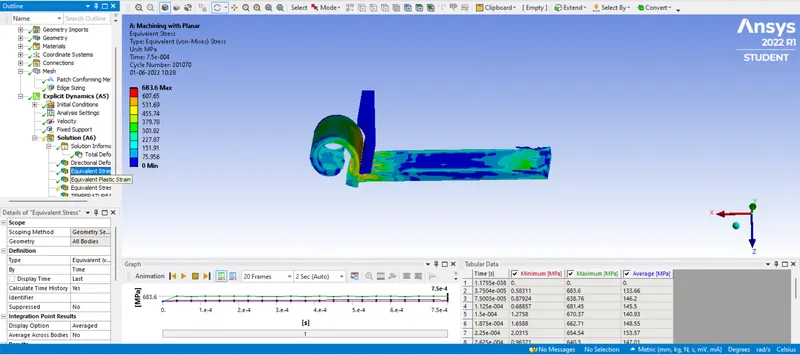
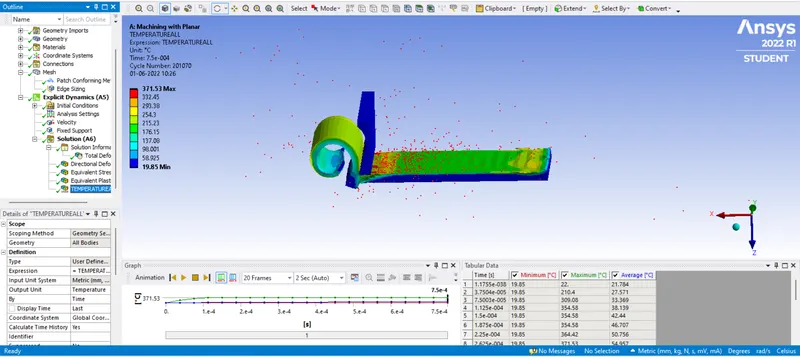
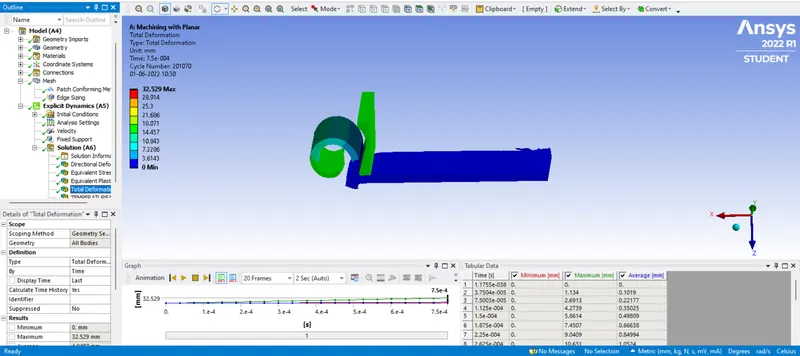
Case 1: Velocity of 20000 mm/sec
a) Equivalent Stress:
b) Temperature:
c) Total Deformation:
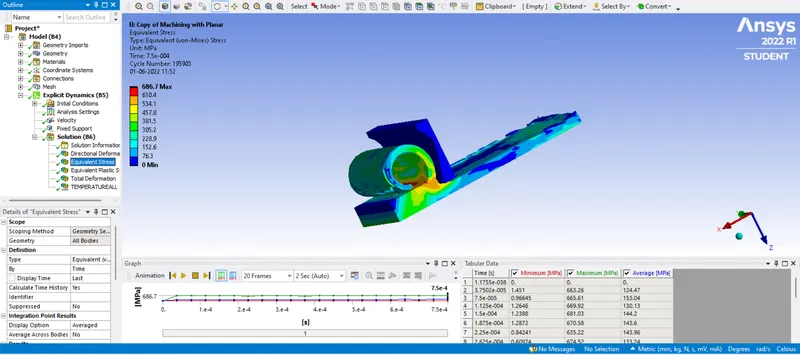
Case 2: Velocity of 15000 mm/sec
a) Equivalent Stress:
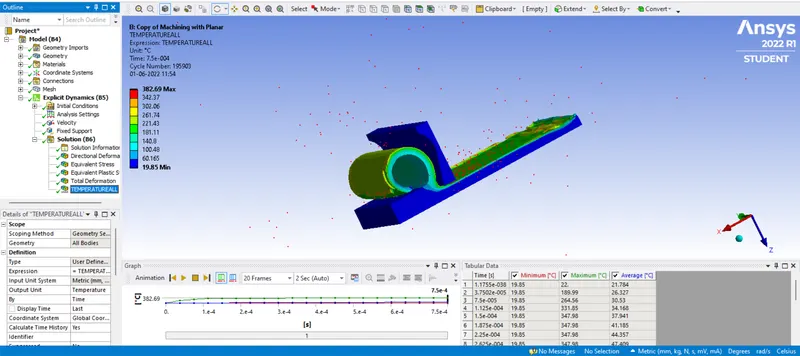
b) Temperature:
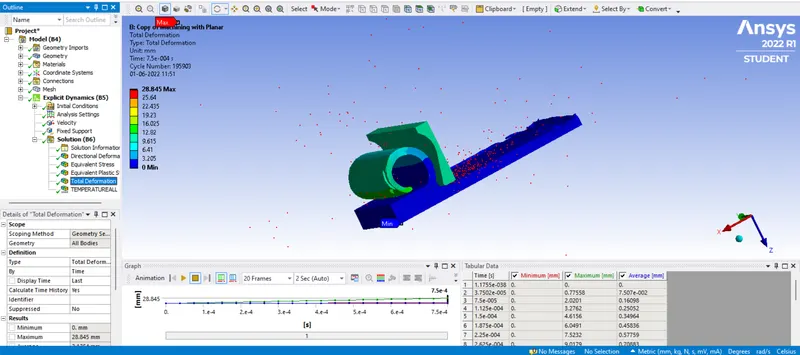
c) Total Deformation:
Result:
| Material | Case 1 | Case 2 |
| Equivalent Stress in MPa (Maximum) | 683.6 | 686.7 |
| Equivalent Stress in MPa (Minimum) | 0 | 0 |
| Temperature in °C (Maximum) | 371.53 | 382.69 |
| Temperature in °C (Minimum) | 19.85 | 19.85 |
| Total Deformation in mm (Maximum) | 32.529 | 28.845 |
| Total Deformation in mm (Minimum) | 0 | 0 |
Conclusion:
- From the above result, we can conclude that the equivalent stress is maximum in Case 2 maximum compared to Case 1 i.e., an increase in velocity stress decreases.
- When cutting velocity is the removal of materials is more and with an increase in cutting velocity removal rate is also higher.
- Temperature also decreases with higher velocity as we can see in Case 1. The temperature of Case 1 is lower than Case 2.
- Deformation is higher in Case 1 with higher velocity. An increase in velocity leads to higher deformation.
Note: google drive link is provided below in a text file. Please check the link for the model.
Thank You...