Week 9 - FVM Literature Review
AIM: Literature review on FVM and FDM. Review on interpolation schemes and flux limiters.
THEORY:In computational fluid dynamics there are 3 numerical method based solvers to solve the governing navier strokes equations these are:
- Finite Difference Method.
- Finite Element Method.
- Finite Volume Method.
Finite Difference Method:
The grid in linear and aligned so that all grids points lies in a straight line. Main thing is that the properties are considered to concentrated at a single point.
Finite Element Method:
The properties are valid over an elemental area. The properties assumed to be concentrated at area centre.
Finite Volume Method:
The method is applied over a volume such that the governing equation is valid over the entire volume, also the properties are assumed to be concentrated at the geometric centre of the volume concerned. FVM computes solution at each finite volumes where as FDM computes solution at each point. Here in FVM governing equations are solved in an integral form so it serves to conserve the properties in a better way than FDM.
1)Interpolation Schemes
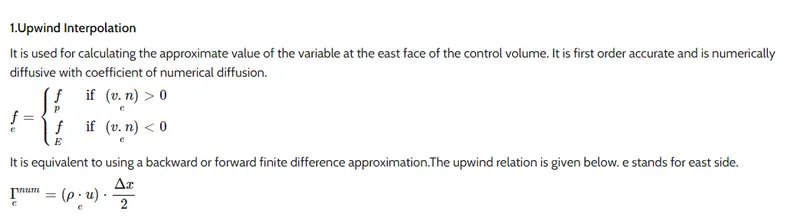
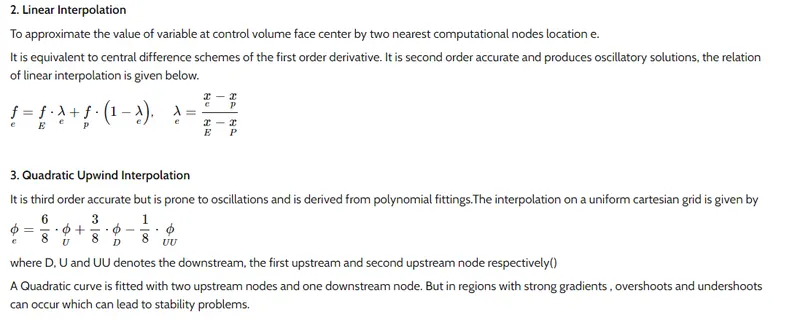
The approximation of surface and volume integrals may require values of the variable at the location other than the computational nodes of the CV. Values at these location are obtained by the interpolation scheme.
For example in 1D linear Heat Conduction Equation in steady state, the source and alpha values are function of temperature and we need to calculate the temperatures separately to that particular face by taking the temperatures from the adjoining cells by the usage of interpolation schemes.
2)Flow Limiters
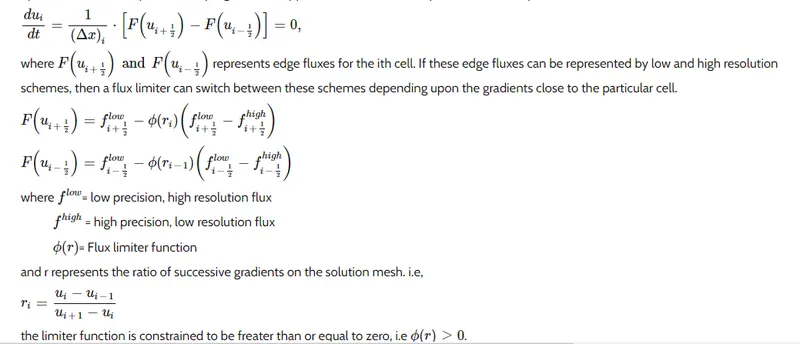
Flux Limiters are used in high resolution schemes - numerical schemes used to solve problems especially in fluid dynamics problems described by PDE's. They are used in high resolution schemes, to eliminate the spurious oscillations that would have occured with high order spatial discretization schemes due to shocks, discontinuities or sharp changes in the solution domain with a point of inflexion. Use of flux limiters, together with an appropriate high resolution schemes makes the solution total variation diminishing.
The main moto of flux limiters schemes is to limit the spatial derivatives to realistic values concerned with certain science and engineering problems that usually means physically realisable and meaningful values.They are used in high resolution schemes for solving problems described by PDEs and is only considered or taken into account when sharp wave fonts are present. For smoothly changing waves, the flux limiters does not operate and can be represented by higher order approximations without any introduction of spurious oscillations.