Week 9 - FVM Literature Review
Objective:
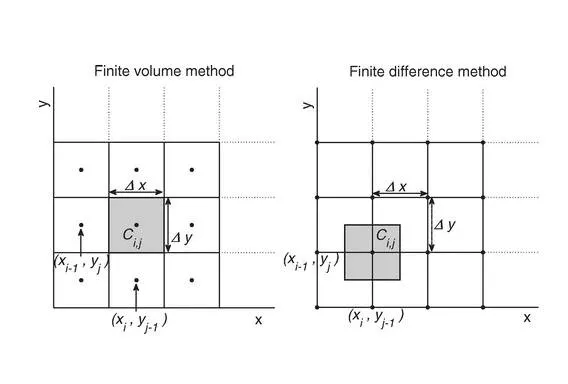
Describe need for interpolation schemes and flux limiters in FVM by using the 1D linear heat conduction equation and also differntiate between FDM & FVM.
Discritization:
Discritization is termed as a first step making them suitable for numerical evaluation by converting partial differntial equations to alzebric form. in mathematics, discretization is termed as process of transferring continuous models and equations into discrete counterparts.
Various methods of Discritization:
1)Finite volume method
2)Finite difference method
3)Finite Element Method
Finite Volume Method:
1) in Finite volume method discritization may be of any shape or geometry
2) FVM is a method for representing and evaluating in the form of algebraic equations
3) They follow conservative law because the flux entering a given volume is identical to that leaving the adjacent volume, these methods are
4)In FVM , volume integrals in a partial differential equation that contain a divergence term are converted to surface integrals
Finite difference Method:
1) FDM is a numerical techniques used for solving differential equation by approximating derivatives with finite differences using taylors equation

2) The error in this method is defined as the difference between the approximation and the exact analytical solution.
3) FDM is approximate solution to a problem, one must first discretize the problem's domain. by dividing the domain into a uniform grid
4) Finite-difference methods produce sets of discrete numerical approximations to the derivative, often in a "time-stepping" manner.
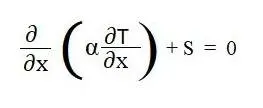
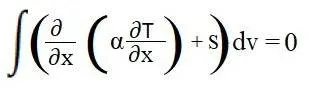
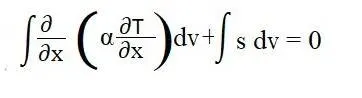
1D heat conduction eqution:(Using FVM)

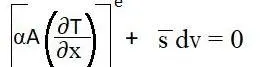
3)Finite Element Method:
1)FEM is commonly used method for solving problems in engineering & mathematics
2) FEM is a numerical method for solving partial differential equations in two or three space variables
3)FEM it uses two types of boundary conditions 1)Dirchlet boundary conditions 2)Nueman boundary conditions
Interpolation schemes:
1) Approximation of surface and volume integrals requires values of variable at location other than the computational nodes of the CV.
2)Values at these locations are obtained using interpolation formulae.
1) Upwind interpolation
2) Linear interpolation
3) Quadratic upwind interpolation (QUICK)
4) Hybrid scheme
5) Flux limiter
Upwind interpolation:
1)The upwind interpolation (UDS) for approximating the value of a
variable at the east face of a control volume is given by
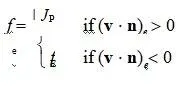
2) Scheme is equals to either backward or forward finite difference approximation depends on flow direction
3) It satisfies the bounded criterion
Linear interpolation:
1)Approximate the value of the variable at CV face centre by linear interpolation of the values at two nearest computational nodes. Thus, at location ‘e’ on a Cartesian grid, the variable value is approximated by
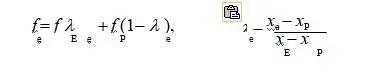
2) linear interpolation is equivalent to the use of central difference formula of the first order derivative,
3) scheme is termed as central difference scheme.
4)This scheme is second order accurate
Quadratic upwind interpolation (QUICK):
1)A quadratic upwind interpolation (QUICK) scheme can be derived using polynomial fitting.
2) QUICK interpolation on a uniform Cartesian grid is given by
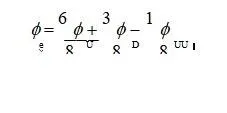
3)where D, U and UU denote the downstream,
4) QUICK scheme is third order accurate
Hybrid scheme
1) it is combination of central differnce scheme and upward difference scheme
2) Based on the peclet number it uses either central or upward difference scheme
3) For smaller peclet number (|Pe| < 2) it uses central differencing scheme
4) For larger peclet number (|Pe| > 2) it uses upwind differencing scheme
Flux limiter:
1) Flux limiters are used in high resolutionschemes numerical schemes used to solve problems in CFD by solving partial differntial equations(PDE's).
2)They are used in high resolution schemes to avoid the spurious oscillations (wiggles)n.
3)Use of flux limiters, together with an appropriate high resolution scheme, make the solutions Total variation diminishing

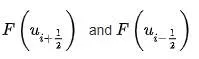
Edge fluxes for ith cell
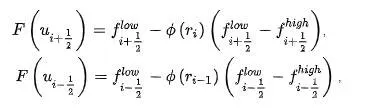
 low resolution flux,
  high resolution flux,
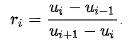
 flux limiter function, r= Sucessive gradient on solution mesh
Comment:
1)Generally partial differntial equations are 1)Eliptical equations 2)Parabolic equations 3) hyperbolic equations
2) Generally in Eliptical equations Shock waves are produced in that shock flow problems flux limiters are used
3) in case of higher Mach numbers various interpolations are used
4)in case of fluid flow is Dominating in either direction (east or west) interpolation schemes are usewd