Week 9 - FVM Literature Review
FDM
1. Governing equations are in the differential form.
2. Solution computed at each node i.e., intersection of mesh lines.
3. Requires the use of structured grid, difficult to implement for complex geometries.
4. Easy to obtain higher order schemes, so preferable for applications that require very high accuracy.
5. All flow variable need to be differentiable and continuous over the entire domain, unsuitable for handling discontinuities.
6. Does not ensure conservation.
FVM
1. Governing equations are in the integral form.
2. Solution computed at the cell centroids.
3. Can handle unstructured grid and hence complex geometries with ease.
4. Deriving schemes higher than second order is next to impossible due to the complexity involved.
5. Can handle discontinuities, due to the nature of integral equations.
6. Imposes and ensures conservation at both cell and domain levels.
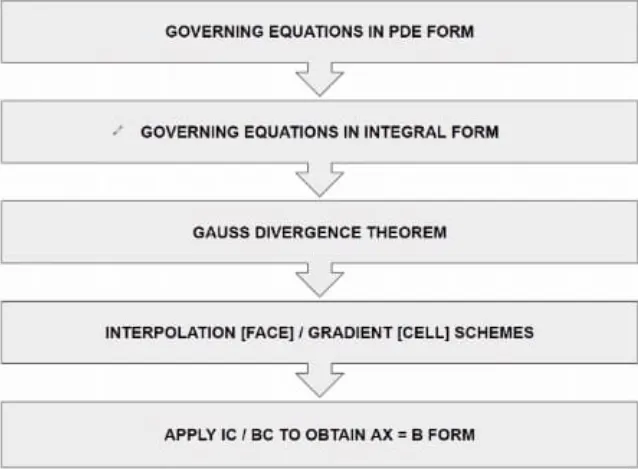
Working of FVM
FLUX LIMITERS:
For convective fluid flow it has been observed that low - order schemes are usually stable but quite dissipative in nature
around points of discontinuity or shocks while the higher order schemes are unstable in nature and show oscillations in the
vicinity of discontinuity. Highly accurate and Oscillation free schemes are known as High Resolution Schemes.
Flux limiter functions are used to tune high order and low order schemes in such a way that the resulting scheme gives a high
order accuracy in the smooth region of the flow and maintains first order accuracy in the vicinity of shocks and discontinuities.
For such a scheme TVD (Total Variation Diminishing) criteria is maintained.
Interpolation Schemes in Finite Volume Method:
The approximation of surface and volume integrals may require values of the variable at locations other than the computational nodes of the CV. Values at these locations are obtained using interpolation formulae.
Some commonly used interpolation schemes are: as follows,
1. Upwind Interpolation Scheme: (UDS)
2. Central Differencing Approximation: (CDS)
3. Quadratic Upwind Differencing Scheme: (QUICK)
4. Hybrid Interpolation Schemes: (Both CDS and UDS)