Week 9 - FVM Literature Review
- Finite volume method is a technique of discritizing the partial differential equations in to algebriac equations.
- In FVM, PDEs that contain divergence term are converted to surface integrals using divergence theorem. Then these values are calculated as fluxes at surface of each finite volume.
- Essentially in the Finite Difference Method, the PDEs were discritized at the nodal point and were summed to get the solution.
- Whereas in Finite Volume Method, the PDEs (PDEs are converted to Integral Form) are discritized at the center of the cell volume, which are the average value of any given parameter. This is because the equations are conserved for entire volume.
For Example,

Lets solve 1D Temperature equation for the above grid.
The Blue points are cell centers; Average values of properties are stored.
The integral form of the equations is given by,
`int((del/(delx)(alpha(delT)/(delx))) + S) = 0`
`int(del/(delx)(alpha(delT)/(delx))Adx + int(SdV) = 0`
After integrating, the end result is,
`alphaA((T_E - T_P)/(trianglex)) - alphaA((T_P - T_W)/(trianglex)) + bar(S)dV = 0`
The above equation can be further discritzed with different schemes depending upon how information is taken from neighbouring cells.
Need of Interpolation Schemes and Flux Limiters:
Flux Limiters: They are used in high resolutions schemes inorder to limit the oscillations that are produced by shock waves and makes sure we dont end up with high gradient values.
Interpolation Scheme:
- Interpolation schemes are used to evaluate the properties at the face of the cell. And this is generally done using the interpolation schemes. There are many schemes out there among which some are discussed below.
- Now, depending upon the accuracy required and boundedness of the solution, different schemes are formulated.
1) Linear Interpolation or central differencing:
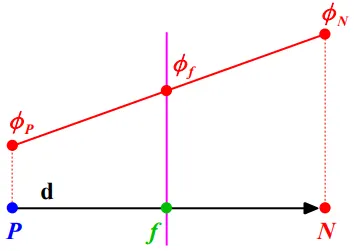

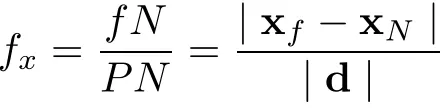
- This is second order accurate.
- However this type of technique may generate oscillations.
2) Upwind Differencing:
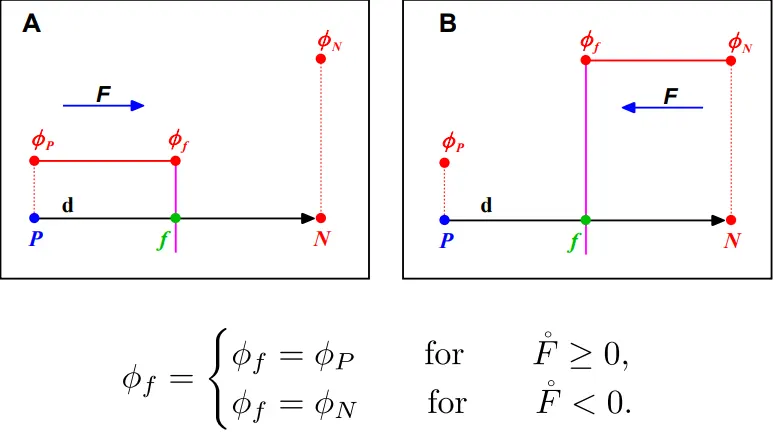
- It is first order accurate.
- It is bounded (non-oscillatory) but diffusive.
3) Second Order Upwind Differencing:
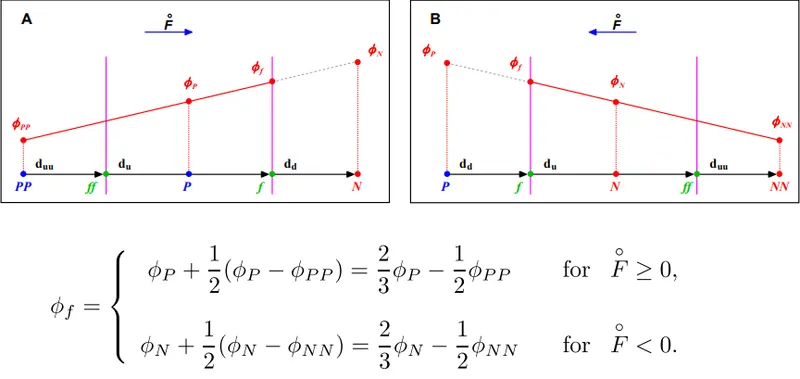
- It is also know as Linear Upwind Differencing or Beam-Warmer and it is second order accurate.
- This is oscillatory for high convective flows or presence of strong gradients.
- To avoid oscillations we add gradient limiter or slope limiter functions.
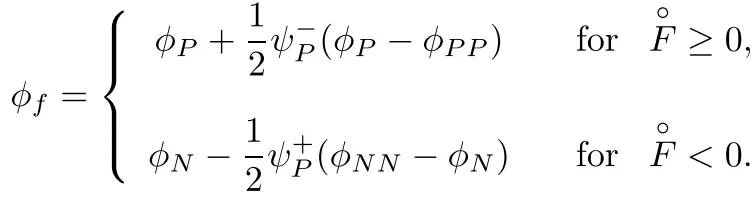
- When it sense strong gradients, it switches locally to low resolution upwind.