Week 9 - FVM Literature Review
FINITE VOLUME METHOD(FVM):
Finite volume refers to small packets of volume enclosing a grid pointin a mesh.Here the governing equations generally deals with integral terms.In this ,volume integrals having divergence term in them are converted to surface integrals using the divergence theorem.These surface integrals are termed as flux terms and since flux entering a volume is equal to one leaving it , this methos id conservative in naturei.e we dont have to change out equation type to make it conservative unlike Finite Difference Method(FDM).
It transforms and integrated the PDEs into balance equation over an element.This is carried over by formation of semi algebraic equations by converting the volume and surface integrals to algebraic equations over a cell. Then this relation is tereansformed to equation by choosing suitable interpolation techniques to find the variation of variables within the cell and on surfaces.
DIfferences between FVM and FDM:
| FINITE DIFFERENCE METHOD(FDM) | FINITE VOLUME METHOD(FVM) |
| Discretization is done to the differential form of governing equations. | Discretization is done to the integral form of governing equations. |
| Solution variables are stored at regular grid points in a mesh. | Solution variabes are found at centroid of each cells in a mesh. |
| Simple mesh to be used. | Cell can take any shape ,hence complex meshes can be considered. |
| Using unstructured grid need transforming equations. | Since integration over surface takes place,no such difficluty is found. |
| In order to have conservation the type of equations has to be changed. | Conservation property is always included. |
Interpolations Schemes:
CFD schemes compute solution at centroid of each cells in the mesh.At centroid we know the value of the solution variable.But we need to find the values of solution variables at the interfaces or cell faces. Here we come forward with the help of certain interpolation schemes.
- Linear/Central Differencing
- Upwind Differencing
- Second order/Linear Upwind Differencing
- QUICK
We need to know that the analysis has somem conditions . Those are as follows:
- The owner cell and neighbour cell are adjacent having common faces.
- there is no restriction to the shape of the the mesh cell.
- Boundary faces and Internal faces need different treatment.
- we are only considering one of the neighbouring cell.
Linear/Central Differnecing:
`phi_f = psi*phi_n + (1-psi)*phi_p`
where `psi= abs ((x_f -x_p)/(x_n -x_p))`
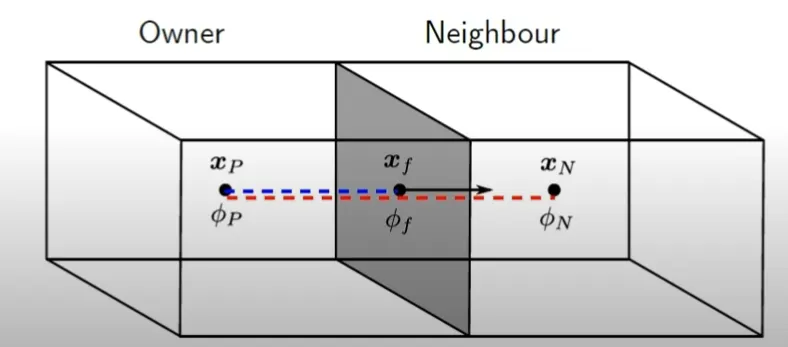
It is only used for diffudion terms and not convective terms.It is recommended for convective terms only in case of eddy flow. The reason been it gives accurate results.
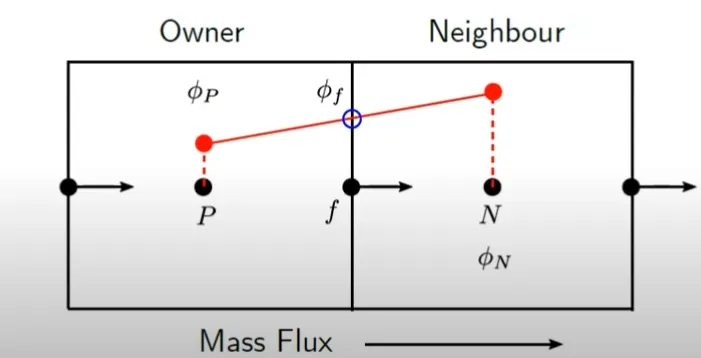
The variation is linear hence it is second order accurate and gives accurate results.But the solution is said to be unbounded and is prone to oscillations due to geometry and forcing conditions.
Upwind Differencing:
This type of differencing actually takes in some information of the flow and add it to the information of solution variables.
Here it depends on the direction of the Mass Flux i.e the mass flow rate from the interface.
`F_f =rho_f*A_f*(U_f*hat n)`
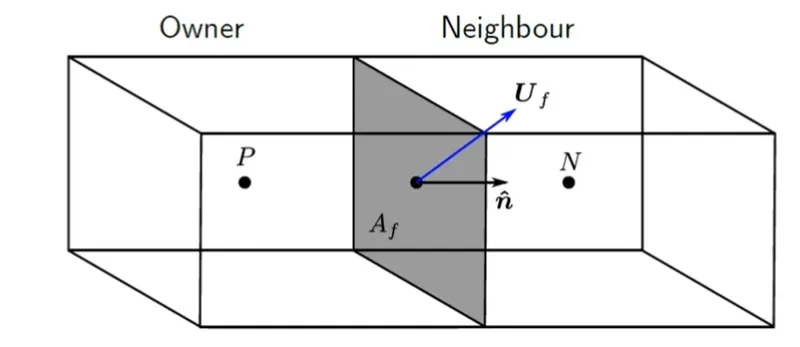
If `F_f>0 :Outflow`
If `F_f<0 : Inflow`
and the solution varible becomes as `phi_f= phi_p if F_f>0` and `phi_f = phi_n if F_f<0`.
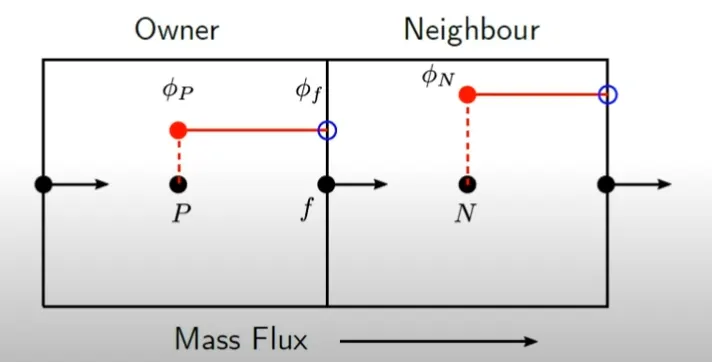
It can be clearly observed that `phi` is not varying linearly .It is constant between the cell centroid and cell face. Hence it is first order accurate.Clearly the solution is going to be very stable but not much accurate since only first order accuracy can be obtained.We can use this scheme to genetrate intial solutions if our solution is diverging quickly .
Linear Upwind Differencing:
It is the most popular scheme.It also depends on the mass flow rate but is more accurate than the Upwind Differencing.
Here we use a gradient to increase the accuracy of the extrapolation.
`phi_f= phi_p +(nablaphi)_p *r ;F_f>0`
`phi_f= phi_n +(nablaphi)_n *r ;F_f<0`
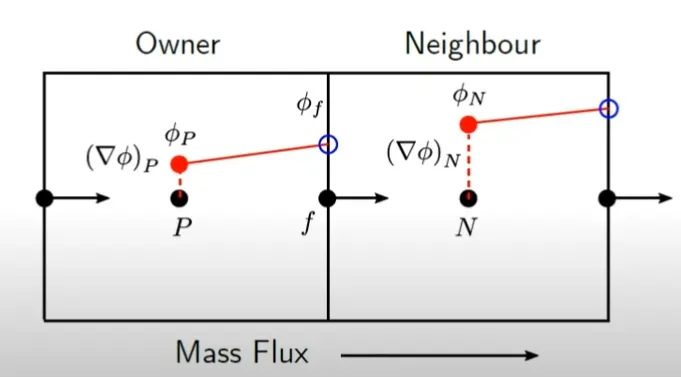
Here we are projecting the value of variable at centroid to the face but it is not linear.
Here the accuracy is imrved by the term `grad phi` .
Hence it is still linear but with imrpoved accuracy .Therefore it is considered to be a second order accurate scheme.It must be taken care that this scheme is used for convection terms and not diffussion terms.
It is stlighly unstable because there is chances of peak values at the faces considered to the owner cell variables. These peak values can cause oscillation leading to instability and causing difficulty in convergence.Thus we use gradient limiters to reduce this effect.
QUICK:
QUICK or Quadratic Upwind Interpolation for Convective Kinematics considers the second order derivatives and ignores the third order derivatives and hence it is tird order accurate.It uses values form three computaional nodes , one downstream and two up stream. It is generally used for convective-diffusion equations with second order central difference for diffusion term and the scheme is third order accurate in space and first order accurate in time for the convective terms.
Flux Limiters:
Flux limiters or gradient limiters or slope limiters are used to prevent local Maxima /Minima by controlling the gradient terms.
`phi_f =phi_p + psi*(gradphi)_p*r` where `0<=psi<=1`.
They are used in high resolution schemes to control the spatial derivatives and to limit the oscillations in the solution near shocks and discontinuties.
If the limiter is equal to zero then the flux is represented by low resolution schemes and if it is equal to one then it is representes by high resolution schemes.
Use of lux limiters along with high resolution schems makes the solution Total Variation Diminishing(TVD).
some of the flux limiters used in cfd are:
- CHARM
- HQUICK
- HCUS