Week 9 - FVM Literature Review
Finite Volume Method: it is a method of representing and evaluating the partial differential equation in the form of algebraic equations. by using the gauss divergence theorem, the volume integrals in a partial differential equation that contains the divergence of a vector field converts into a surface integral of a vector field. then these surface integral terms are evaluated as a flux at the surface of each finite volume. FVM is a conservative method because the amount of flux entering into a given volume is identical to leaving from an adjacent volume.
Advantage of FVM: it is easy to apply on an unstructured grid/mesh.
Note: Finite volume refers to a small volume that surrounds each node of the mesh.
The difference between FDM and FVM:
| FDM | FVM | |
| 1. | used only for structured mesh. | can also be used for unstructured mesh. |
| 2. |
compute the properties at every node
|
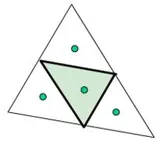
compute the properties at every cell instead of node
|
|
3. |
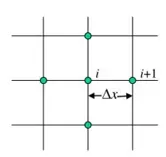
use differential form `(delf)/(delx)=(f_(i+1)-f_i)/(Deltax)` |
use integral form `intint(delf)/(delx)dxdy=intfdy=c*Area` |
| 4. | Use Taylor series | Use Divergence theorem |
| 5. | 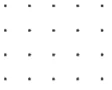 |
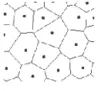 |
Consider 1-D heat conduction equation.
`del/(delx)(alpha(delT)/(delx))+s=0`
now integrate over the finite volume dV
`intdel/(delx)(alpha(delT)/(delx))dV+intsdV=0`
`int_w^edel/(delx)(alpha(delT)/(delx)).Adx+int_w^es.Adx=0`
`alpha(T_E-T_P)/(Deltax)-alpha(T_P-T_W)/(Deltax)+S_u+S_PT_P=0`
Heat flux out-Heat flux in+Source term=0
Need for interpolation scheme:
we are finding the temperature gradients `((delT)/(delx))_w and ((delT)/(delx))_e`at west face and east face with the help of temperatures at grid pint W and E by using liner interpolation method.
Interpolation schemes are:
1. linear interpolation scheme
2. Quadratic interpolation scheme
3. Hybrid interpolation scheme
4. Upwind interpolation scheme