Week 9 - FVM Literature Review
Objective:- What is Finite Volume Method(FVM), write down the major differences between FDM & FVM. Also, describe the need for interpolation schemes and flux limiters in FVM. You can use the 1D linear heat conduction equation as an example.
FINITE VOLUME METHOD(FVM)
The Finite volume method(FVM) is based on the approximate solution of the intergral form of the conservation equations. The problem domain is divided into a set of non-overlapping control volumes called finite volumes. The conservation equations are applied to each finite volume.Integral occurring in the conservation equations are evaluated using function values at computational nodes.
- FVM Solution Process
Discretize the solution domain by a grid and define the computational nodes at which variables are to be evaluated. Apply the integral form of conservation law to each finite volume. Approximate the surface and volume integrals using approximate quadrature formulae in terms of the function values at computational nodes.
- Solution Process
Collect the algebraic equations for all the finite volumes to obtain a system of algebraic equations in terms of unknown values of the variable at computational nodes. Solve the resulting system of algebraic equations to obtain values of the variable ar each computational node.
- Types of Volume Grids
- Cell-centred approach
CVs are defined by a suitable grid and computational nodes are assigned ar the centre.
- Face-centred approach
Nodal locations are defined first and CVs are then constructed around them so that C faces lie midway between the nodes. It can be used only with structured grids. 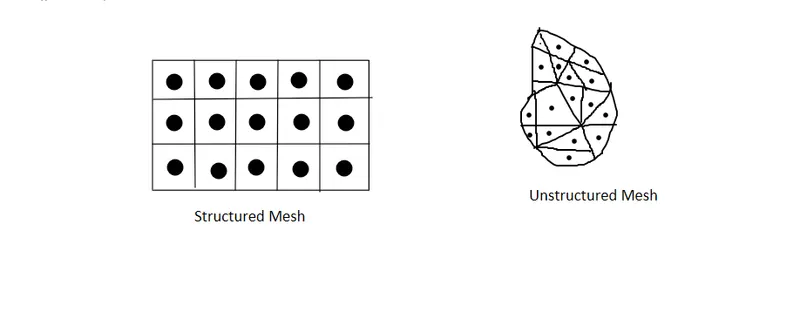
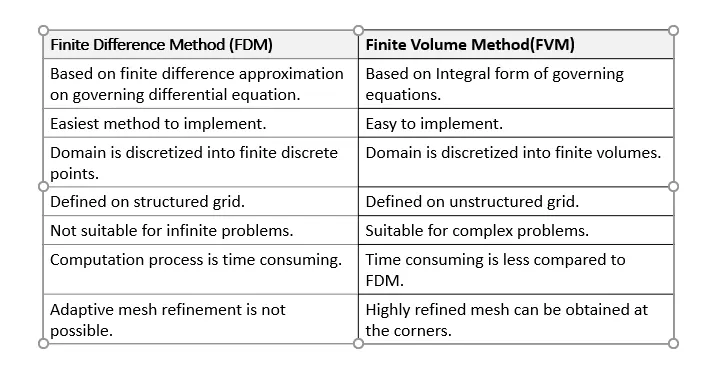
Differences between FDM & FVM
Interpolation schemes in finite volume method(fvm)
- Upwind Interpolation Scheme(UDS).
- Central Differencing Approximation(CDS)
- Quadratic Upwind Differencing Scheme(QUICk)
- Hybrid Interpolation Scheme.
- Total variation Diminishing Scheme(TVD).
Need for Interpolation schemes and Flux Limiters.
As we know, we need evaluation of surface and volume integrals in our finite volume formulation but the surface as well as volume integrals they require the value of the unknow variable at locations other than the computational notes of the CV, so somehow we have to cover with some sort of schemes or mathematical to compute the values at these locations and that is why we need various types of interpolation schemes in the Finite volume Method.
The Flux Limiters tries to limit the contribution from the second order correction near the discontinuity.Flux Limiters are used in the numerical schemes to solve problems of fluid dynamics, by highly coupled non-linear Partial Differential equations.If we used lower order numerical schemes for solving the equations then we migth get unstable solution near discontinuity and if we use higher-order numercial scheme for more accuracy then we migth exploit the computational power unnecessarily, so here comes the Flux Limiters it is used to limit the spatial derivative terms near discontinuities to physical real values so as to maintain physical consistency.Flux Limiters are used in numerical schemes to solve fluid dynamic problems, using highly coupled nonlinear partial differential equations, numerical scheme for more precision so that we could use the computing power unnecessarily, so here come the Flux Limiters that are used to express the terms of the spatial Limit derivation in the vicinity of the discontinuities to real physical values in order to maintain physical consistency.