Week 9 - FVM Literature Review
Objective -
To describe Finite Volume Method (FVM).
In computational fluid dynamics there are 3 numerical method based solvers to solve the governing navier strokes equations these are:
1. Finite difference method
2. Finite element method
3. Finite volume method
Finite Difference Method (FDM):
A finite difference method (FDM) discretization is based upon the differential form of the PDE to be solved. Each derivative is replaced with an approximate difference formula (that can generally be derived from a Taylor series expansion). The computational domain is usually divided into hexahedral cells (the grid), and the solution will be obtained at each nodal point. The FDM is easiest to understand when the physical grid is Cartesian, but through the use of curvilinear transforms the method can be extended to domains that are not easily represented by brick-shaped elements. The discretization results in a system of equation of the variable at nodal points, and once a solution is found, then we have a discrete representation of the solution.
Finite Volume Method (FVM):
A finite volume method (FVM) discretization is based upon an integral form of the PDE to be solved (e.g. conservation of mass, momentum, or energy). The PDE is written in a form which can be solved for a given finite volume (or cell). The computational domain is discretized into finite volumes and then for every volume the governing equations are solved. The resulting system of equations usually involves fluxes of the conserved variable, and thus the calculation of fluxes is very important in FVM. The basic advantage of this method over FDM is it does not require the use of structured grids, and the effort to convert the given mesh in to structured numerical grid internally is completely avoided. As with FDM, the resulting approximate solution is a discrete, but the variables are typically placed at cell centers rather than at nodal points. This is not always true, as there are also face-centered finite volume methods. In any case, the values of field variables at non-storage locations (e.g. vertices) are obtained using interpolation.
Finite Element Method:
A finite element method (FEM) discretization is based upon a piecewise representation of the solution in terms of specified basis functions. The computational domain is divided up into smaller domains (finite elements) and the solution in each element is constructed from the basis functions. The actual equations that are solved are typically obtained by restating the conservation equation in weak form: the field variables are written in terms of the basis functions, the equation is multiplied by appropriate test functions, and then integrated over an element. Since the FEM solution is in terms of specific basis functions, a great deal more is known about the solution than for either FDM or FVM. This can be a double-edged sword, as the choice of basis functions is very important and boundary conditions may be more difficult to formulate. Again, a system of equations is obtained (usually for nodal values) that must be solved to obtain a solution.
Drawbacks of Finite Difference Method:
1. we cannot use FDM directly to a body whose grid points are not aligned properly along the x, y directions. these may occur due to complex geometry ,folds, cuts in the structure.
2. as it is not aligned we cannot calculate the properties at the next adjacent point exactly, but we can make some correction factor and approximate it, this method is called as 'Variable Transformation Method' which basically seeks to create grid using different variable space which look very similar to cartesian grid.
3. variable transformation method gives an approx solution of property but it is time consuming and complex.
4. for complex profiles, this method is less prferred.
That's why Finite Volume Method (FVM) is used
Finite Volume Method
The finite volume method (FVM) is a method for representing and evaluating partial differential equations in the form of algebraic equations. In the finite volume method, volume integrals in a partial differential equation that contain a divergence term are converted to surface integrals, using the divergence theorem. These terms are then evaluated as fluxes at the surfaces of each finite volume. Because the flux entering a given volume is identical to that leaving the adjacent volume, these methods are conservative. Another advantage of the finite volume method is that it is easily formulated to allow for unstructured meshes. The method is used in many computational fluid dynamics packages. "Finite volume" refers to the small volume surrounding each node point on a mesh.
In FVM instead of writing the equation in a single point, equations are written in an entire volume. It means for a considered volume no assumptions are made over the shape of the volume. Inside the particular volume the flow is conserved, flow quantities are conserved, energy is conserved, mass is conserved, momentum is conserved and so on. This is called as 'Finite Volume Representation' which begins with 'Integral form of governing equation:
Steps involved:
1. Obtain integral form of governing equation.
2. Apply Gauss divergence theorem
3.Get descretized form which can be solved using computer ("Flux Terms").
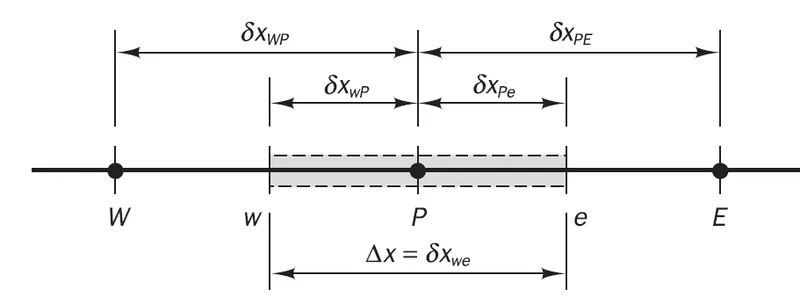
Consider example of 1D steady state heat conduction equation with source term
`∂/(∂x) (α (∂T)/(∂x))+S=0`
S is source term.
`(∂T)/(∂x)` is tempetaure gradient in x direction.
`α` is thermal diffusivity.
`∫( ∂/(∂x) (α (∂T)/(∂x))+S)dV=0`
`∫∂/(∂x) (α (∂T)/(∂x))dV+∫SdV=0`
`dV=Adx`
`[α (∂T)/(∂x)]_ω^e+S^ ̅ dV=0`
where `S^ ̅` is average value over finite volume.
`αA[(T_E-T_p)/(Δx)]-αA[(T_P-T_W)/(Δx)]+S ̅dV=0`
Above equation shows amount of heat transfer is conserved over control volume.
GRADIENT SCHEME :
To find the gradient at face of volume various gradient scheme is used in which temperature of the both the neighbouring cells are used
INTERPOLATION SCHEME :
to find the temperature at the face various interpalation scheme are there
1. Upwind interpolation scheme
2. Linear interpolation scheme
3. Quadratic Upwind Interpolation for Convective Kinematics (QUICK) scheme
4. Hybrid Scheme
5. Total Variation Diminishing (TVD) scheme
Upwind interpolation scheme :
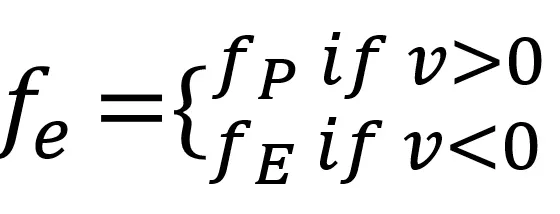
The Upwind interpolation scheme takes into account the direction of fluid flow and based on it, the value of solution variable at the face is approximated by its value at the upstream computational node. For instance, if the fluid is moving from west to east then:
`ϕ_e≈ϕ_P`
And if the fluid is moving from east to west then:
`ϕ_e≈ϕ_E`
Total Variation Diminishing Scheme :
`f_e=f_P+1/2 ψ(r)(f_E-f_P )`
where `ψ` is flux limiter and r is specified function which depends on local flow condition.
FLUX LIMITERS :
For convective fluid flow, it is observed that the low order schemes are usually stable but quite dissipative in nature around the points of discontinuity or shocks while the higher order schemes are unstable in nature and show oscillations in the vicinity of discontinuity or shocks. Highly accurate and oscillation free schemes are known as High Resolution Schemes.
Flux Limiter functions are used to fine tune the higher order and lower order schemes in such a way that the resulting scheme gives a higher order accuracy in the smooth region of the flow and maintains first order accuracy in the vicinity of shocks and discontinuities. For such a scheme TVD scheme is employed.
`F(u_(i+1/2))=f^(low) (i+1/2)+1/2 Φ(r_i )(f^(low) (i+1/2)-f^(high) (i+1/2))`
`F(u_(i-1/2))=f^(low) (i-1/2)+1/2 Φ(r_i )(f^(low) (i-1/2)-f^(high) (i-1/2))`
`f^(low)` is low precision flux
`f^(high)`is high precision flux
`Φ(r )` is flux limiter function and `r=(u_i-u_(i-1))/(u_(i+1)-u_i )`