Week 9 - Attachment Feature Creation (Ribs & Screw Boss) - Challenge 1
AIM:
- To Create the Door Handle Component from the given Class-A surface.
- To Create the tooling axis for the given Class-A Surface meeting the requirements of the draft angle.
- To Attach B side Features in the component.
- To perform the Draft analysis on the model.
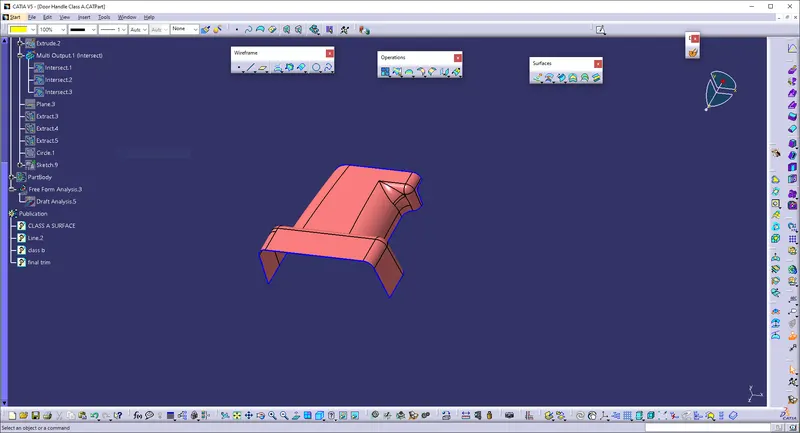
TOOLING AXIS:
There are three types of tooling axis :
- concerning the axis (X, Y, Z)
- normal to the surface
- bisecting surface
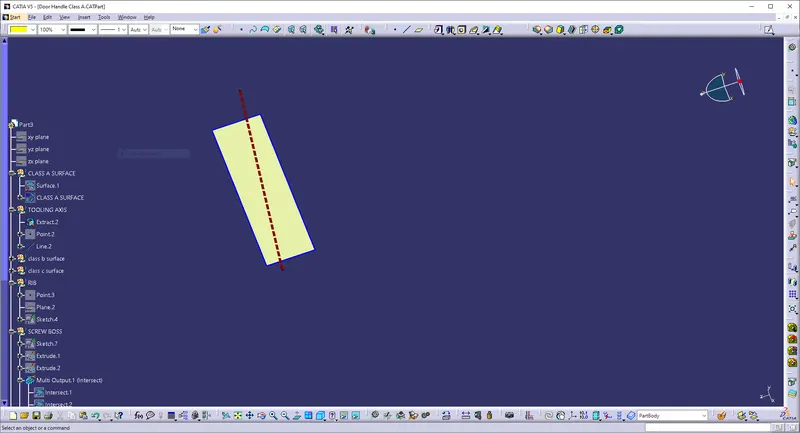
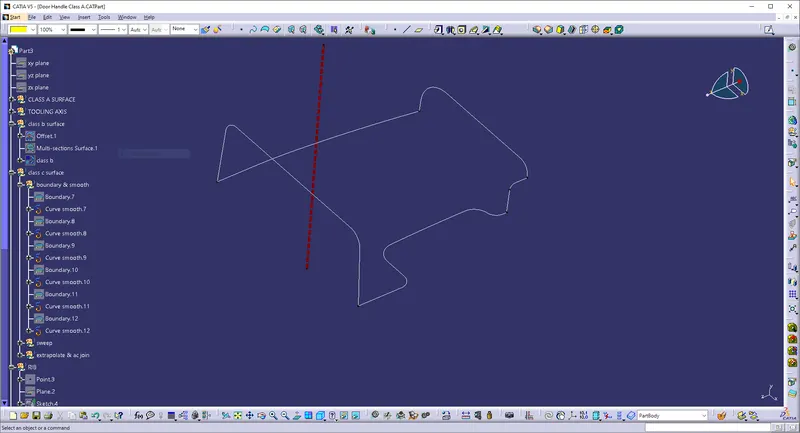
We should observe and study the class A surface to create the 'Tooling Axis' for the DOOR TRIM LOWER. First, we create a tooling axis along the X, Y, and Z axis but all the features are not visible while taking those axes Therefore the main tooling axis is normal to the surface (base surface)and only possible because it is a tilted profile.
MATERIAL SELECTION :
-
Polypropylene (PP)
- Polypropylene (PP) is one of the most commonly used thermoplastics in the world.
- It has good chemical resistance and electrical properties, a hard material with water absorption.
- Easy to manufacture
- Fast crystallization, fast cooling.
- Better temperature resistance than HDPE
- Lower density than HDPE
DRAFT ANALYSIS OF CLASS A:
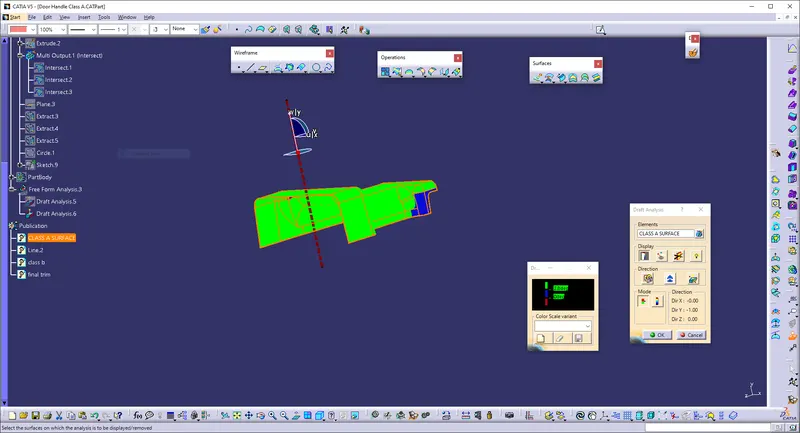
Draft analysis is required to check whether a part has required a draft. The draft is required so that a part can be ejected from its mold. The Draft analysis using the Featured Draft Analysis tool in the tools. Then after opening the draft analysis toolbox go for the compass and place the compass aligned to the tooling axis and click on the lock symbol after aligning further click on the surface it shows green color means it is the correct draft angle blue color means it is some minor defect but it is allowable to manufacture else red shows it cant be manufactured.
CLASS B SURFACE:
It is the invisible Surfaces. Surfaces mostly don't have textures, The surface needs to be created according to class-A surface.
having all features(Rib,boss,snap etc) in B-side surface only.Surfaces which is having TANGENT CONTINUITY ARE CALLED class-B. Initially extracting the right side using the extract option from the Class A surface. Then perform Extrapolate to increase the length now trim the surfaces to the required surfaces then Offset the surface to get the required thickness which is 2.5 mm Similarly, offset it to the desired value and now trim to get the required surface now fillet the surface to the required amount using fillet rule.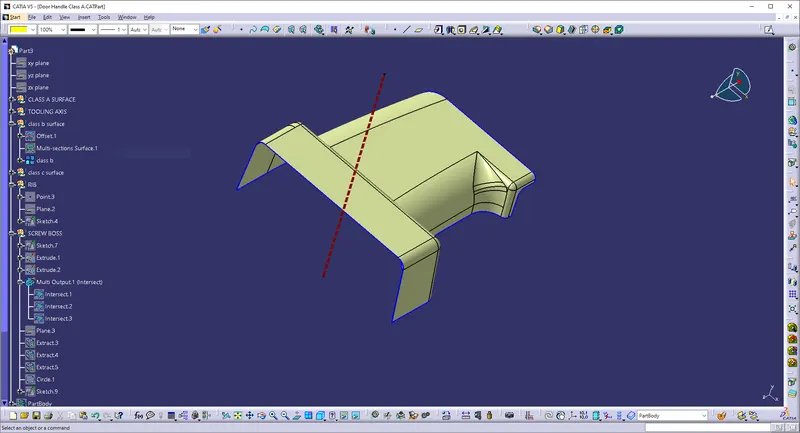
CLASS C SURFACE:
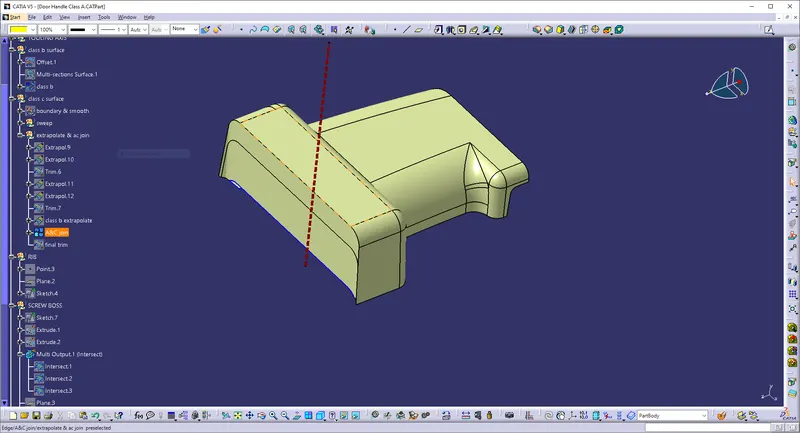
It is the combination of Class A and Class C . it connects the class A and class C surfaces. select the outer boundary and the tooling axis surface gives 90 deg in the angle because it wants to be a flat surface.
B-SIDE FEATURES CREATION
RIB CREATION
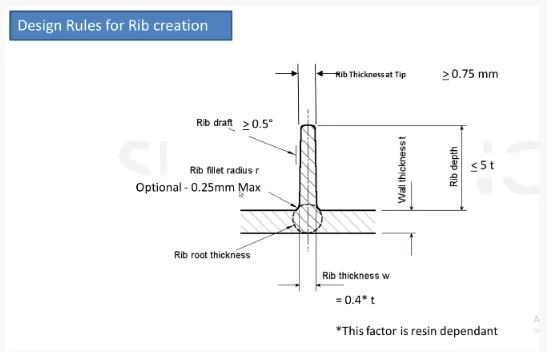
- Design Principle for Rib Creation
- RIB
Ribs are thin wall protrusions that extend perpendicularly from a wall or plane. They are usually found in clusters offering support to a plane that would have otherwise been too thick, but can also be stand-alone support for a single wall. They are commonly used to provide additional support and strength to a part. Thickness and location are essential to rib design.
First, the base surface where the rib has to be created is extracted using the Extract command. A positioned sketch is created and the profile for the rib is drawn.
Next, the profile is extruded, to find the height,h=Wall thickness * 5
=2.5*5
= 12.5 mm
Therefore, the height is 12.5 mm
The extruded surface is thickened,
Thickness,w=0.6*t
=0.6 * 2.5
=1.5mm
Therefore, the thickness of the rib is 1 mm
The draft is applied to the sides of the ribs. As per the design rule, the ideal draft angle is 0.5 deg
Then fillet is applied to the faces of the rib. As per the design rule, the fillet can be 0.25 mm.
Now, we have to check for the Rib root thickness.
To check for the Rib root thickness, We have to take an Intersection with the XY plane and the Coin holder component. Once we get to the intersection we have to create a tri-tangent circle at the rib area and measure it. The value must be within 30% greater of the wall thickness.
- SCREW BOSS
- Design Principle for Screw Boss Creation
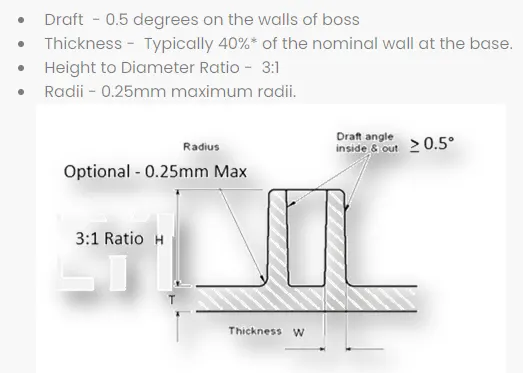
Screw Boss features are commonly found in injection molding designs. They are used to aid in the assembly of molded parts by providing a channel for a screw. Their primary use is to strengthen holes or slots in the surface present in the part model.
Design rules consider while creating a screw boss
• Thickness
• Draft
• optional radii
• Boss gussets
• Type of ejection
The construction process of creating the screw boss is explained below:
For thickness, the design rule is as follows,
Thickness,w=0.6*T
=0.6*2.5
=1.5 mm
Therefore, the thickness of the boss can be 1.5 mm per side.
In this case, we have considered the size of the screw boss as M04.
SOLID PART :
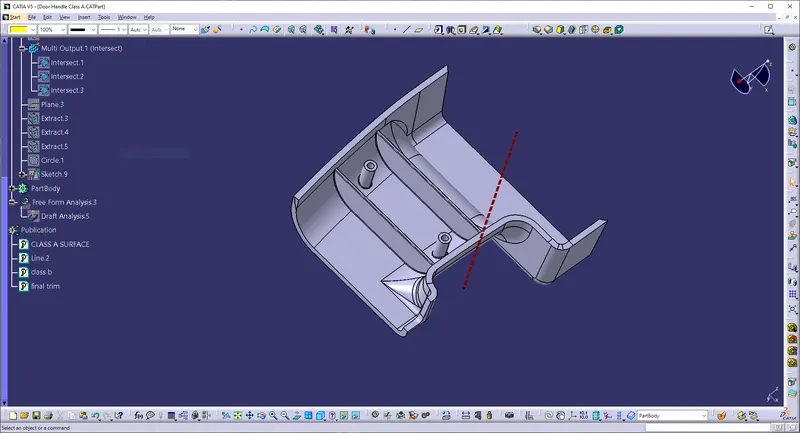
DRAFT ANALYSIS OF THE WHOLE PART(SOLID PART):
Draft analysis is required to check whether a part has required a draft. the same procedure as the CLASS A SURFACE draft analysis but we have done it here for the solid component.
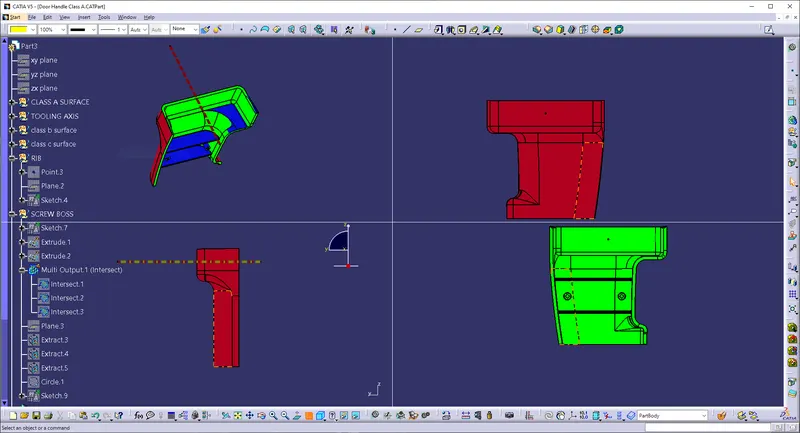
CONCLUSION:
The Design of the Plastic Component - DOOR TRIM LOWER from Class A is completed using concepts of Draft angle, Draft Analysis, Tooling Axis, Class B, and Class C creation, and converting the Closed surface to a solid part