Week 8 - Challenge 3 - Coin Holder Design
AIM:
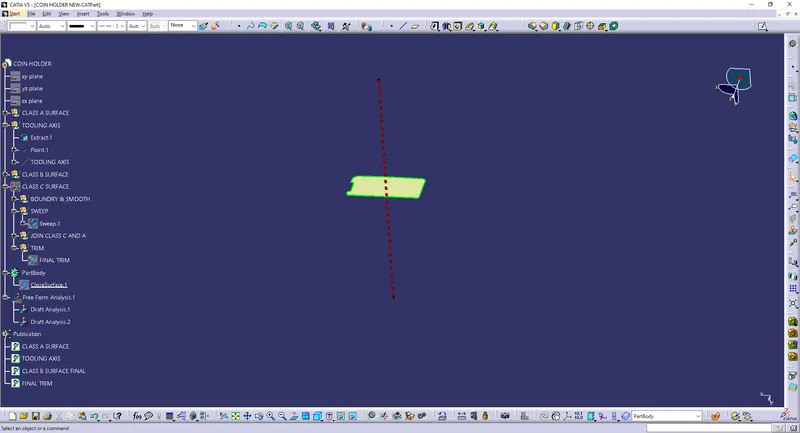
Create the coin holder Plastic component through the given Class-A surface. To begin with, the tooling axis for the given Class A Surface should be created meeting the draft angle requirements and performing the Draft analysis on the model at the end.
TOOLING AXIS:
There are three types of tooling axis :
- with respect to the axis (X, Y, Z)
- normal to the surface
- bisecting surface
We should observe and study the class A surface to create the 'Tooling Axis' for the coin holder. First, we create a tooling axis along the X, Y, and Z axis but all the features are not visible while taking X and Yaxes Therefore the main tooling axis is Z.
MATERIAL SELECTION :
Polypropylene (PP)
- Polypropylene (PP) is one of the most commonly used thermoplastics in the world.
- It has good chemical resistance and electrical properties, a hard and tough material with water absorption.
- Easy to manufacture
- Fast crystallization, fast cooling.
- Better temperature resistance than HDPE
- Lower density than HDPE
DRAFT ANALYSIS OF CLASS A:
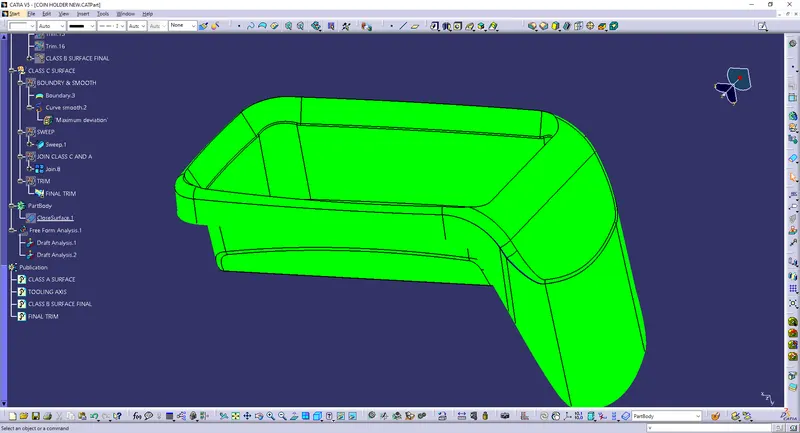
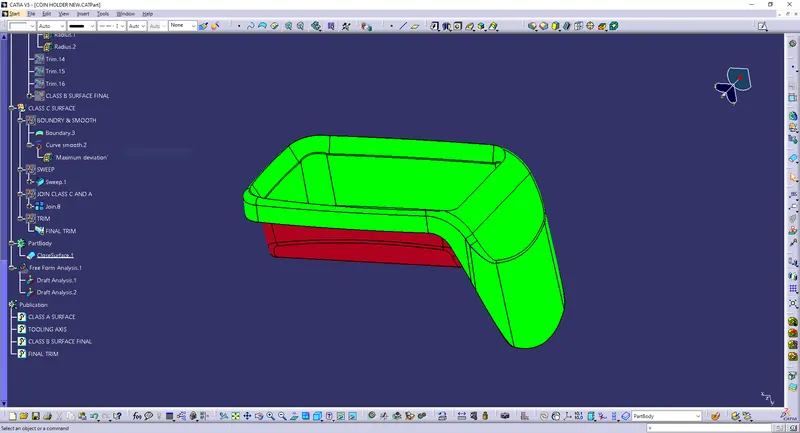
Draft analysis is required to check whether a part has required a draft. The draft is required so that a part can be ejected from its mold. The Draft analysis using the Featured Draft Analysis tool in the tools. Then after opening the draft analysis toolbox go for the compass and place the compass aligned to the tooling axis and click on the lock symbol after aligning further click on the surface it shows green color means it is the correct draft angle blue color means it is some minor defect but it is allowable to manufacture else red shows it cant be manufactured.
CLASS B SURFACE:
It is the invisible Surfaces. Surfaces mostly don't have textures, The surface needs to be created according to class-A surface.
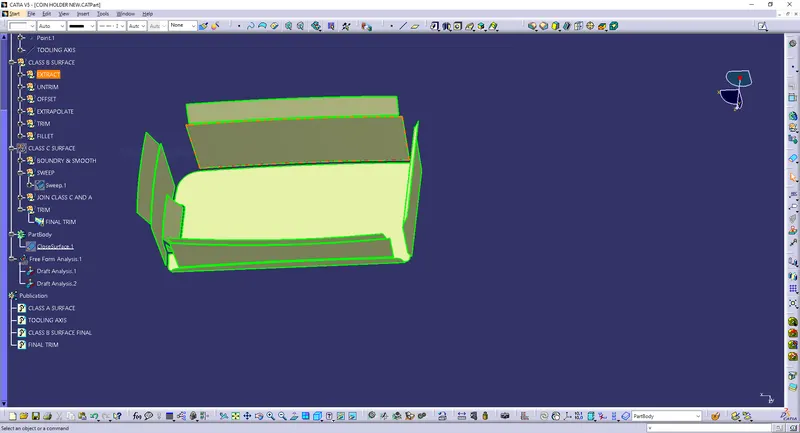
having all features(Rib,boss,snap etc) in B-side surface only.Surfaces which is having TANGENT CONTINUITY ARE CALLED class-B. Initially extracting the right side using the extract option from the Class A surface. Then perform Extrapolate to increase the length now trim the surfaces to the required surfaces then Offset the surface to get the required thickness which is 2.5 Similarly, offset it to the desired value and now trim to get the required surface now fillet the surface to the required amount using fillet rule.
OPERATIONS DONE IN CLASS B SURFACE:
1. EXTRACT:
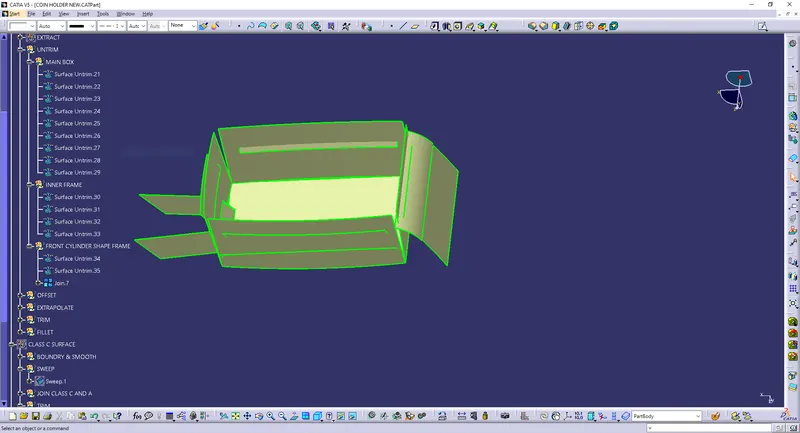
2. UNTRIM:
3. OFFSET:
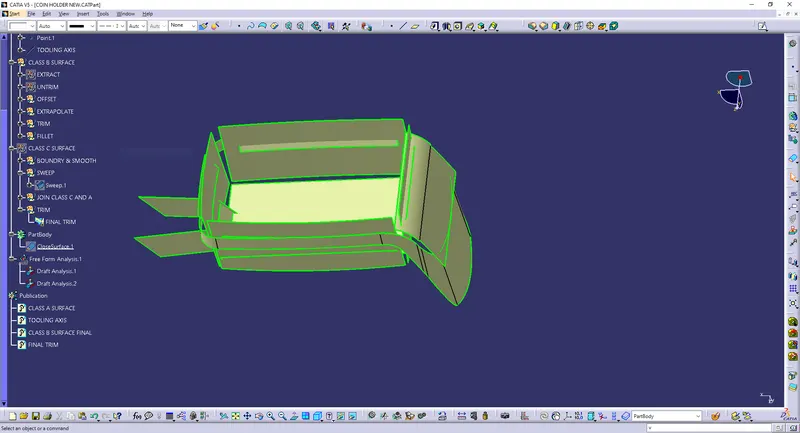
4. EXTRAPOLATE:
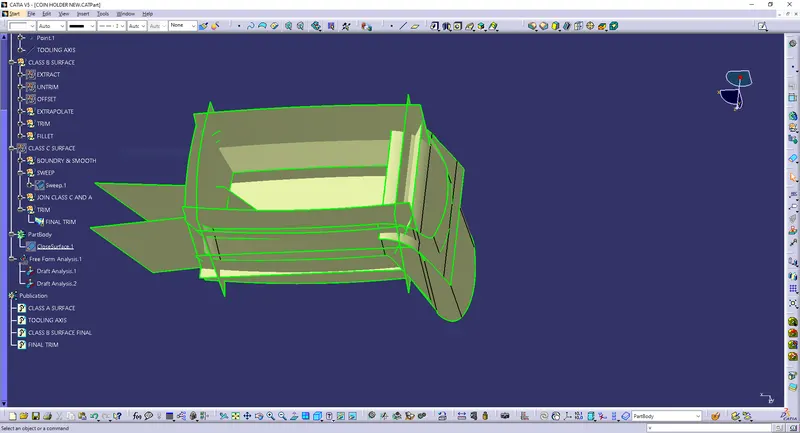
5.TRIM :
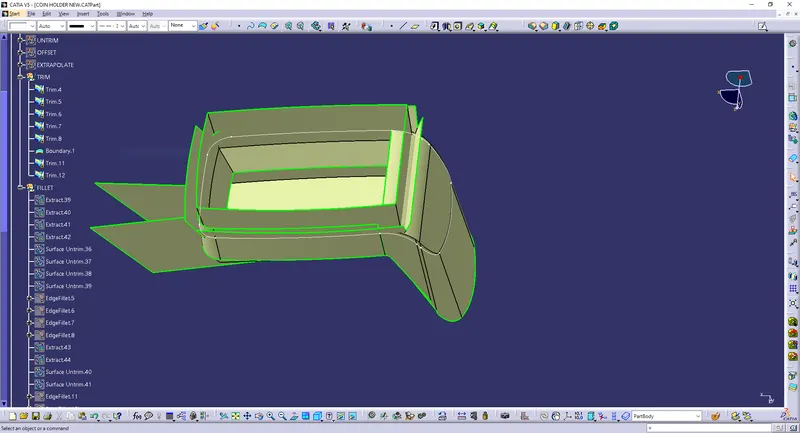
6. FILLETS :
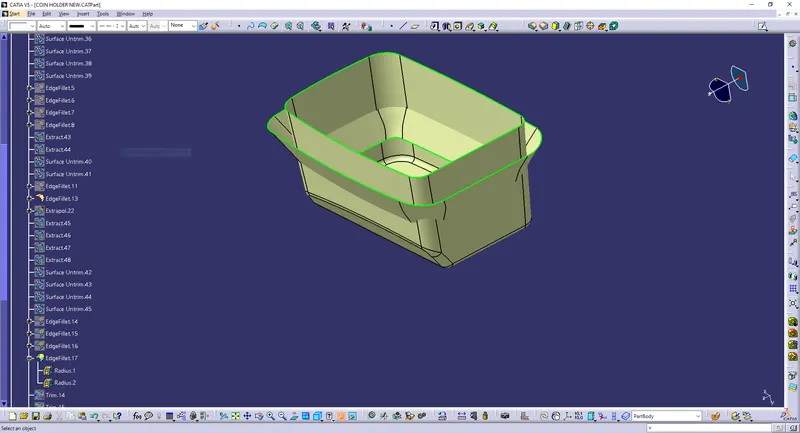
CLASS B FINAL :
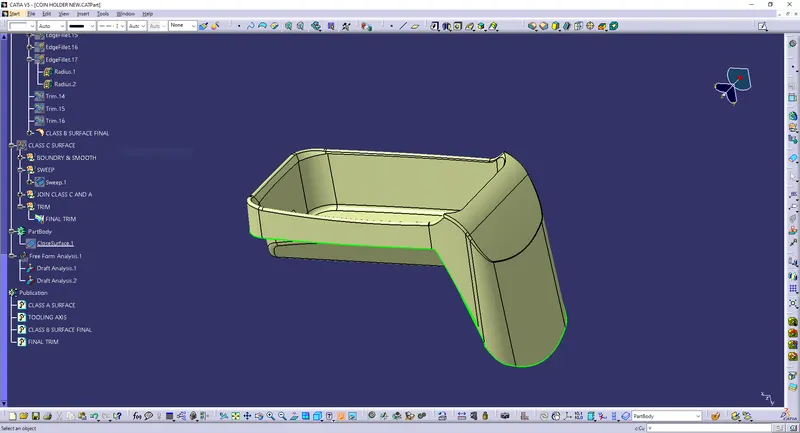
CLASS C SURFACE:
It is the combination of Class A and Class C . it connects the class A and class C surfaces. select the outer boundary and tooling axis surface gives 90 deg in the angle because it wants to be a flat surface.
OPERATIONS DONE IN CLASS B SURFACE:
1. BOUNDRY AND SMOOTH CURVE :
2. SWEEP:
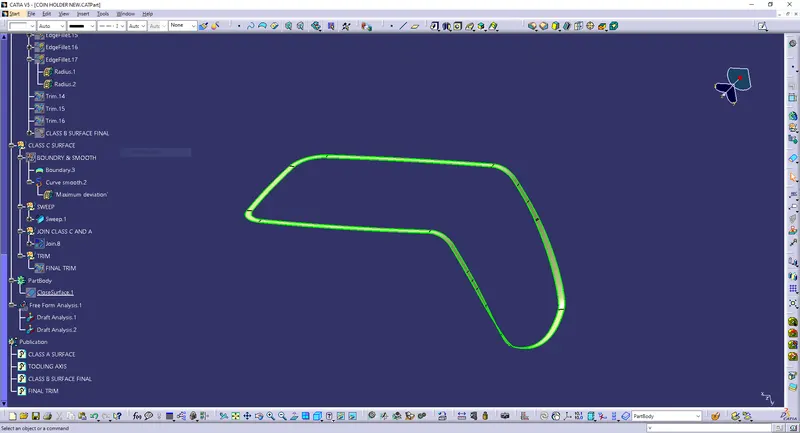
3. JOIN A & C:
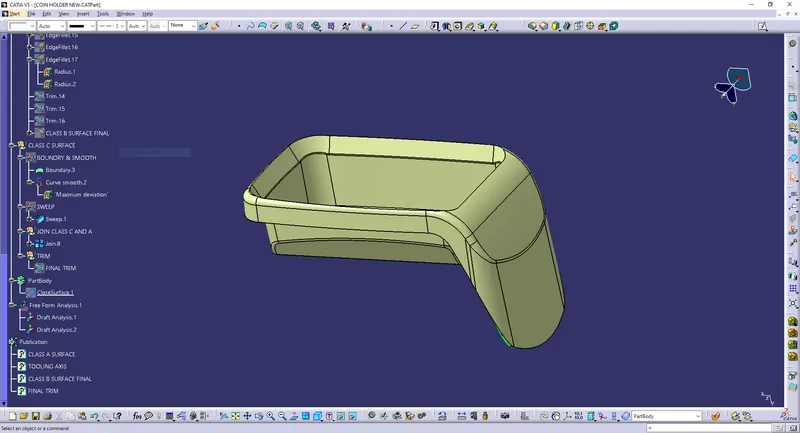
4. FINAL TRIM:
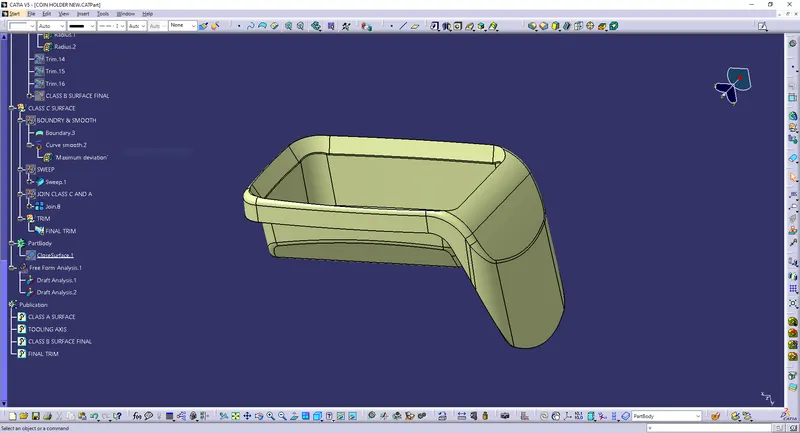
SOLID PART :
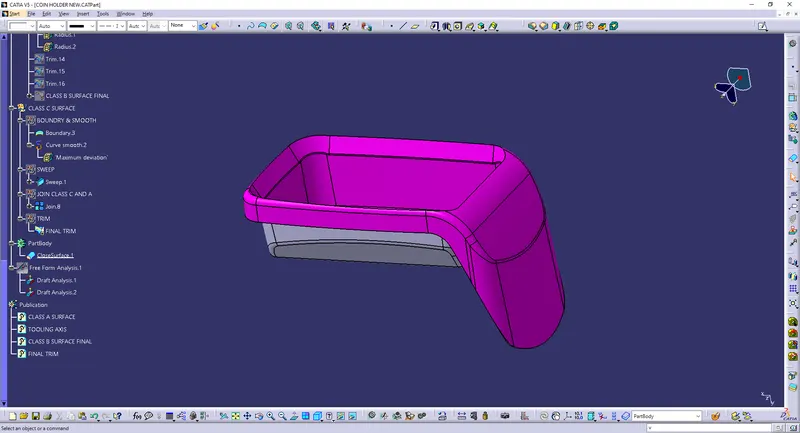
DRAFT ANALYSIS OF THE WHOLE PART(SOLID PART):
Draft analysis is required to check whether a part has required a draft. the same procedure as the CLAAS A SURFACE draft analysis but we have done it here for the solid component.
CONCLUSION:
The Design of the Plastic Component - coin holder from Class A is completed using concepts of Draft angle, Draft Analysis, Tooling Axis, Class B, and Class C creation, and converting the Closed surface to a solid part.