Week 9 - Attachment Feature Creation - Challenge 2
AIM
- To create screw boss for a centre console coin holder component.
- To create dog house for a centre console coin holder component.
THEORY
With plastic injection moulding, it is important to design for manufacturability. To do this, every step of the process must be taken into consideration. A draft angle will help avoid most of these issues.
A draft angle is a slant that is applied to each side of most features of an injection moulded part. The angle, which is positioned to run toward the direction of a mould’s pull and parting line, helps with releasing the part from the mould.
When developing parts for plastic injection moulding, applying draft (or a taper) to the faces of the part is critical to improving the mouldability of the part. Without it, parts run the risk of poor cosmetic finishes, and may bend, break, or warp due to moulding stresses caused by the plastic cooling. Equally important, an absence of draft may prevent parts from ejecting from the mould, damaging not only the parts, but possibly the mould itself.
Draft analysis is a method of checking the draft angle on various faces of a part with a particular direction. Designers of plastic parts and mould tooling manufacturers can use the Draft Analysis tool to check the correct application of draft to the faces of their part. With draft analysis, they can verify draft angles, examine angle changes within a face, as well as locate parting lines, injection, and ejection surfaces in parts.
Ribs are thin wall-like structures that add support and rigidity to injection molded parts. They are thinner than primary walls and are used to support these walls by running perpendicular to these structures. Ribs are often used to replace thick wall sections to avoid sink marks, warp, and voids. The necessary support and rigidity can be retained in a part by placing ribs in a load bearing direction, such as long unsupported stretches, while eliminating problems caused by thick walls.
In plastic parts, bosses are typically used to assist in assembly, as a receptacle for a screw or threaded insert or as the locator for a mating pin on another part.
Bosses serve two purposes. Their primary use is to strengthen holes or slots in the surface of a part. Bosses reinforce fracture prone features like screw holes, penetrations or mounting slots without impacting the cost or looks of a design. The secondary use of bosses is to create points at which the assembled product can be fastened together. Properly designed plastic parts bring down costs by being designed for rapid assembly. The bosses line up and show how parts fit, and then those bosses will hold the parts in place, ready for a fastener or clip to permanently fix them in place.
A dog house is a 4 sided box attached to a flat surface which usually requires a riser/slide to mold. It has 3 sides and a “roof”, where the roof usually has a hole for attachment purposes.
TOOLS USED
- Extract
- Point
- Sketch
- Sweep
- Surface Untrim
- Plane
- Extrapolate
- Trim
- Split
- Intersect
- Pad
- Translate
- Edge Fillet
- Thick Surface
- Draft Angle
- Circle
- Add
- Feature Draft Analysis
PART IMAGES
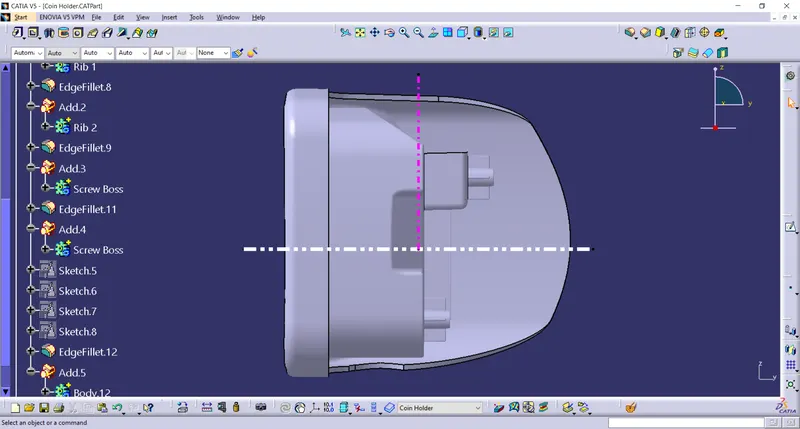
- Front View :
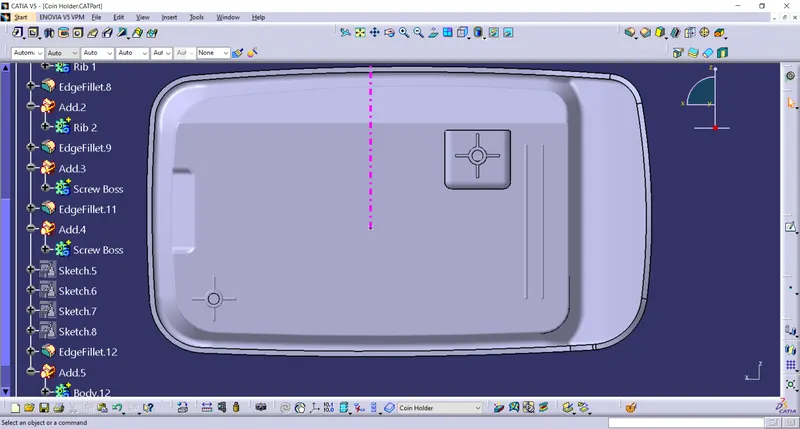
- Side View :
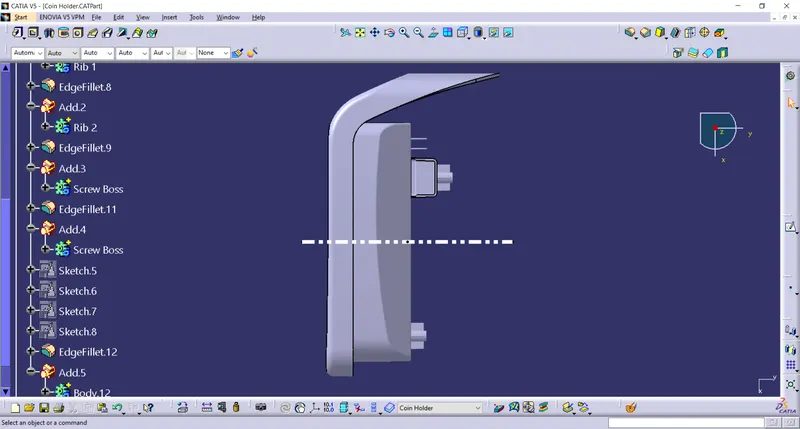
- Top View :
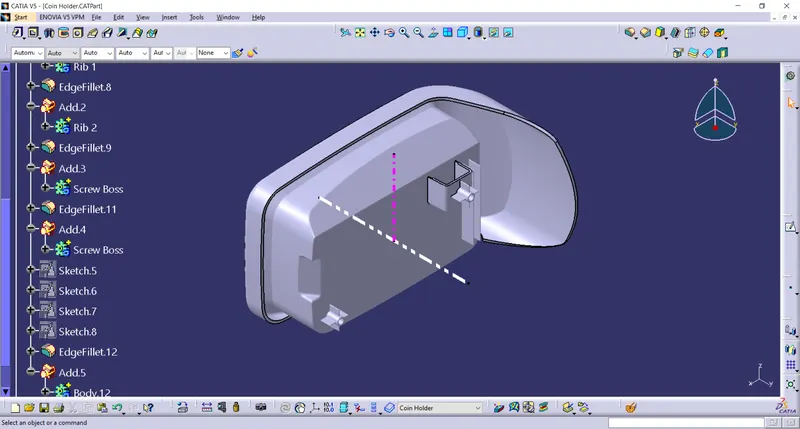
- Isometric View :
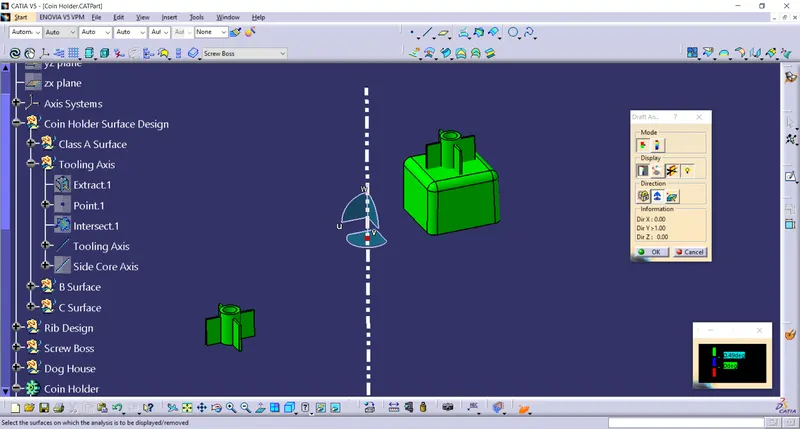
- Draft Analysis with main tooling axis :
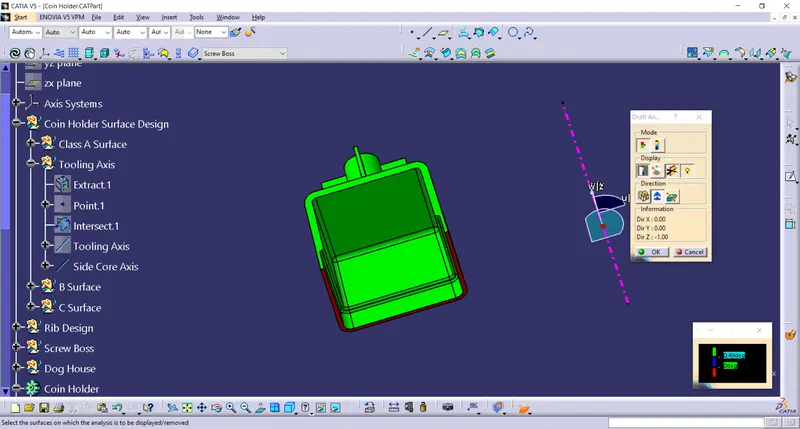
- Draft Analysis with side core tooling axis :
CONCLUSION
- Screw bosses were created for a centre console coin holder.
- Screw bosses passed draft analysis wrt to main tooling axis.
- Dog house was created for a centre console coin holder.
- Dog house passed draft analysis wrt main and side core tooling axes.