Design, Modelling, Assembly and Rendering of a Sunseeker Predator Yacht
DESIGNING, MODELLING, ASSEMBLY AND PHOTO-REALISTIC RENDERING OF A SUNSEEKER PREDATOR YACHT
OBJECTIVES
- To design and create models of the parts of a Sunseeker Predator Yacht using Solidworks.
- To assemble the parts modeled for the Sunseeker Predator Yacht using Solidworks.
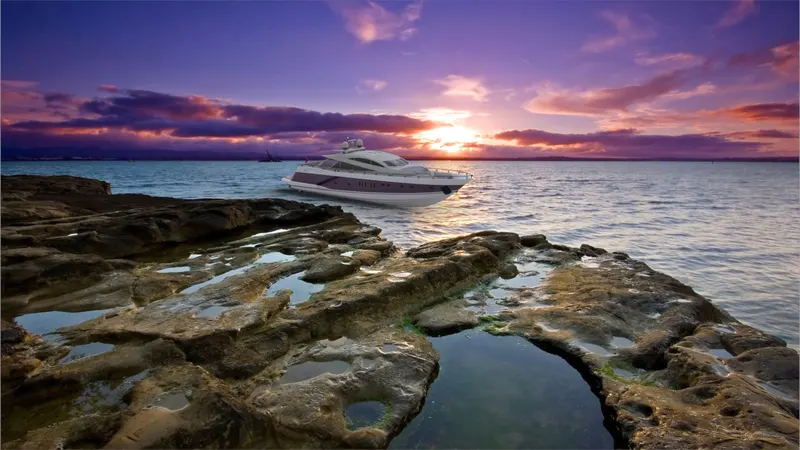
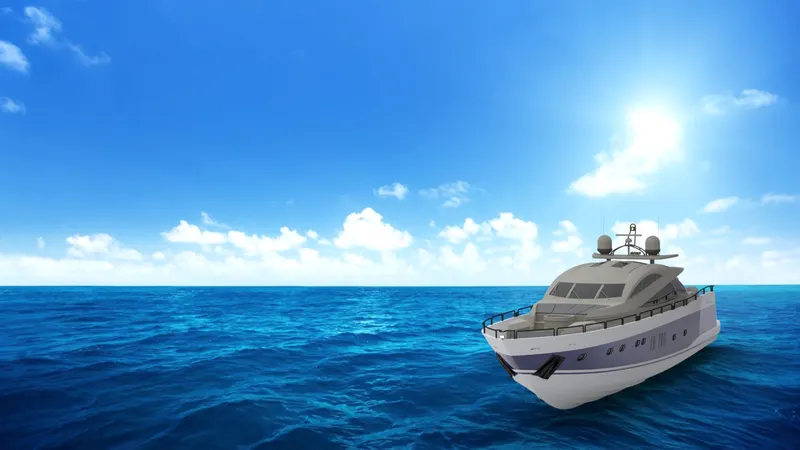
- To create a photo-realistic rendering of the Sunseeker Predator Yacht using Solidworks Photoview 360and Solidworks Visualize.
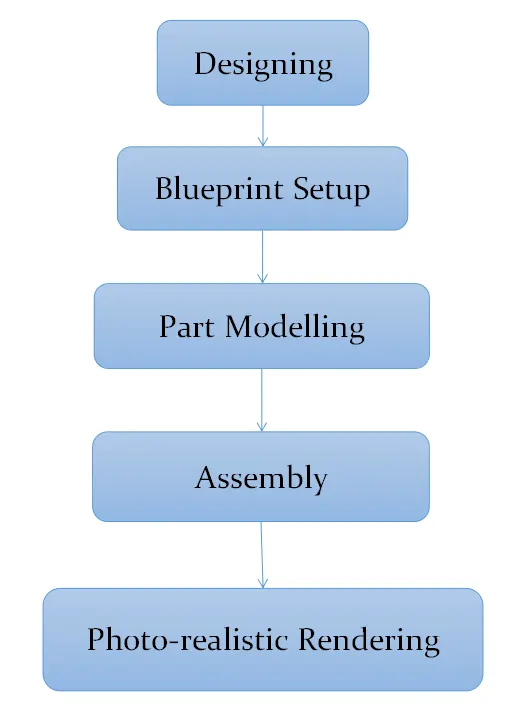
DESIGN METHODOLOGY
FEATURES USED
- 2D Sketch: Two dimensional drawings to be created with respect to a plane of view.
- 3D Sketch: Sketches of the model to be created in the three simensional space.
- Line: Creates a straight line or a construction line in a sketch.
- Circle: Creates a circle in a sketch
- Rectangle: Creates a rectangle in a sketch.
- Spline: Creates a curved line in a sketch which can be controlled using midpoints and spline direction vectors.
- Arc: Creates an arc in a sketch.
- Slot: Creates various slot shapes in a sketch.
- Project Curve: Creates a 3D curve which is projected on the basis of two 2D curves.
- Offset: Creates an offset sketch at a specified distance.
- Extruded Boss: Creates three dimensional models from two dimensional
- Revolved Boss: Creates axi-symmetric three dimensional parts from
- Extruded Cut: Removes material from a solid according to shapes given by a two dimensional sketch. It is the opposite of Extrude Boss.
- Fillet: Creates a rounded edge on a part.
- Chamfer: A chamfer is an angled slope that’s added along edges to make them less sharp.
- Extruded Surface: Creates surface by moving a sketch along a straight path.
- Swept Surface: Creates surface by moving a sketch along a curved path.
- Lofted Surface: Creates a surface between multiple curves with least
- Extend Surface: Extends a surface from an edge along its direction.
- Trim Surface: Trims a surface wherever required.
- Knit Surface: Knits together multiple surfaces to form a single surface.
- Convert Entities: Converts projection of edges and points on to a sketch.
- Swept Cut: Removes material along a curve in a specified 2D shape.
- Appearance: Gives a part the appearance of the material it is made of, or of custom paints and decals.
- Lofted Boss: Creates parts with variable cross section along a given These cross sections are linearly blended from one section to the other.
- Dome: Creates a dome over a place surface.
- Split: Creates multiple parts from an existing part.
- Trim Entities: Trims or extends sections of a sketch.
- Dynamic Mirror: Mirrors selected entities across a plane
- Combine: Used to combine multiple bodies to form a single body.
- Shell: Used to create a hollow material out of a solid part with a specified
- Pattern: Parts can be repeatedly constructed as arrays along linear or curved sketches. It can be linear, circular or curve driven.
- Mirror: Mirrors the selected parts across a specified plane.
- Sweep: Creates a 3D shape by moving a 2D shape along a sketch path.
PARTS MODELED
- Radar
- Propeller
- Hull
- Garage Door
- Front Seat
- Middle Seat
- Rear Seat
- Superstructure
- Radar Mast
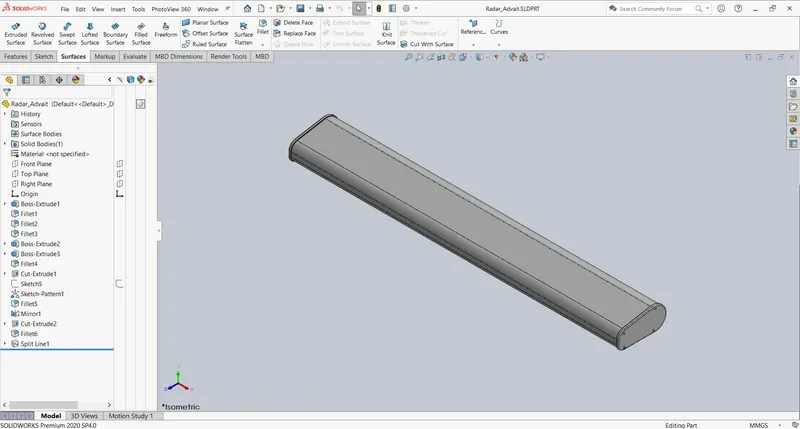
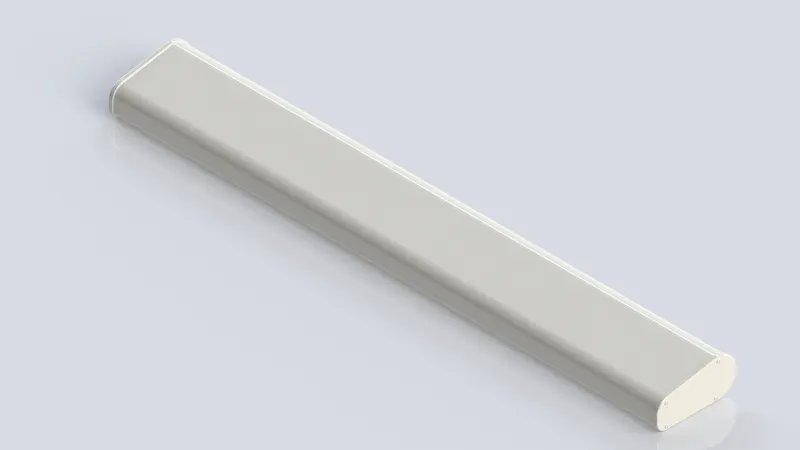
i)Radar
A radar is used to detect the position, range and velocity of other objects in the vicinity of the yacht. The radar keeps rotating to detect objects from all directions.
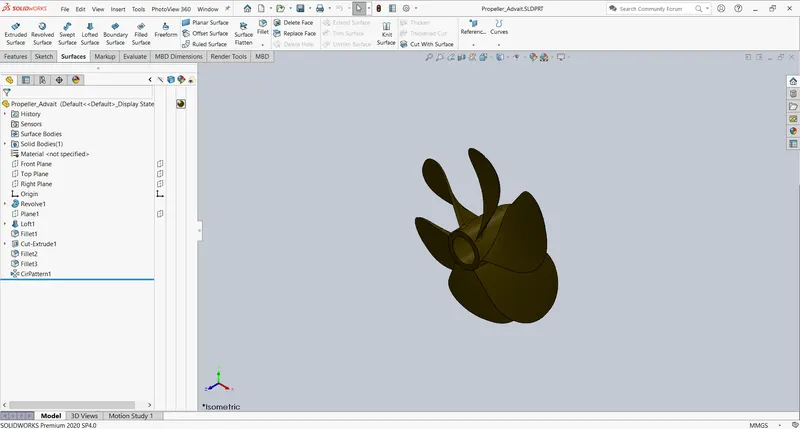
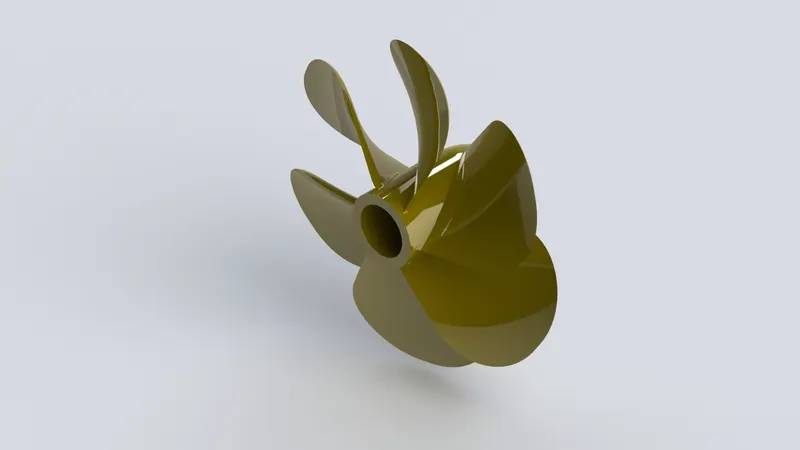
ii) Propeller
Propeller is a device which transforms the rotational motion from engine to linear translation of the yacht.
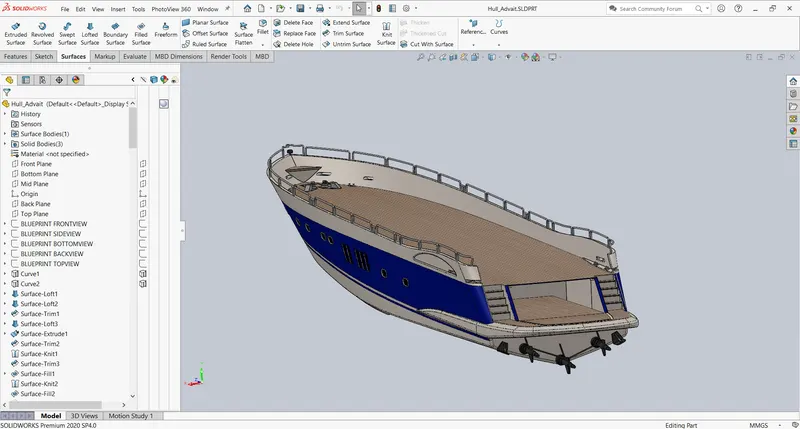
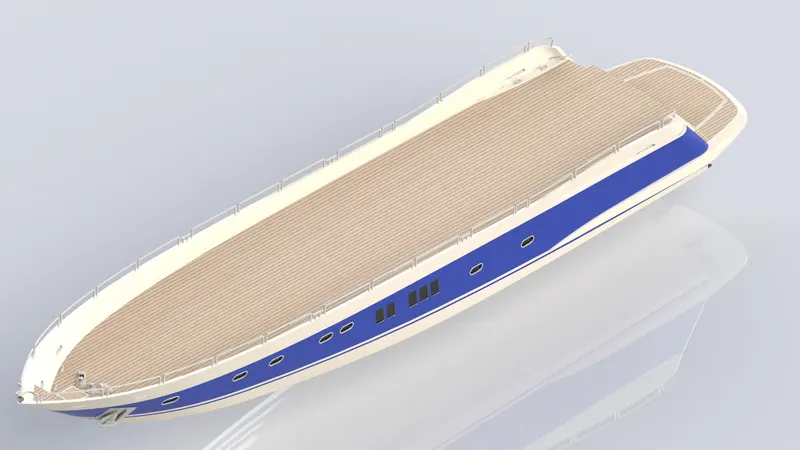
iii) Hull
Hull is the watertight main body of the yacht. Every other structure is built on to the hull.
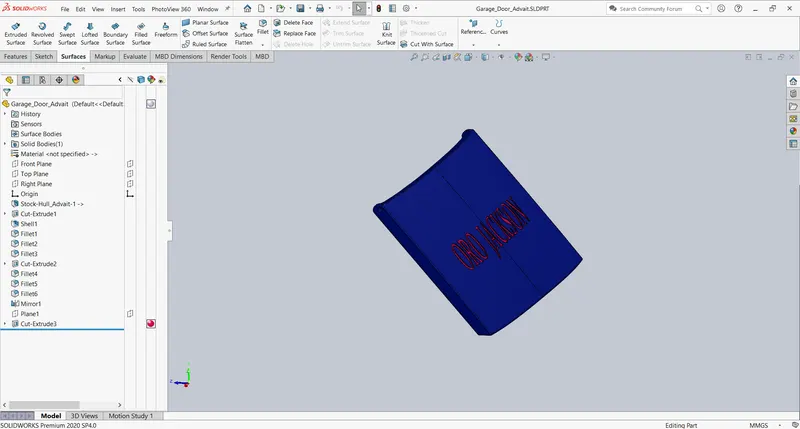
iv) Garage Door
The hull of the yacht contains a garage in which a car can be parked. The garage door is a rotating door which opens and closes the entrance to the garage.
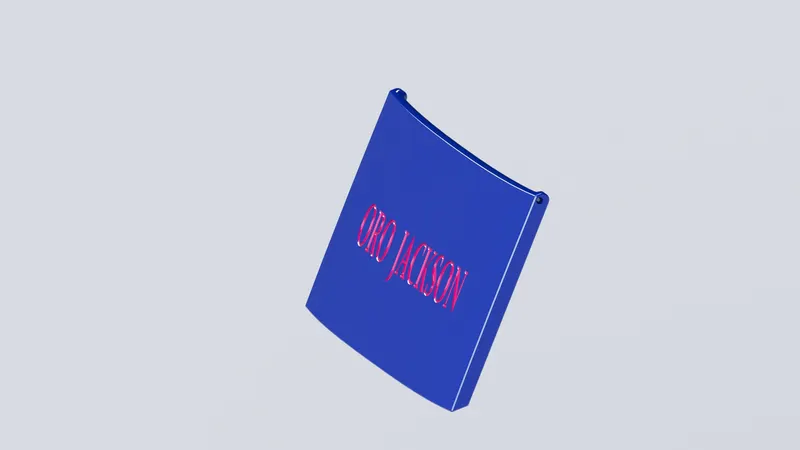
v) Front Seat
These include the front row seats on the yacht deck and the beds accompanying the jacuzzi.
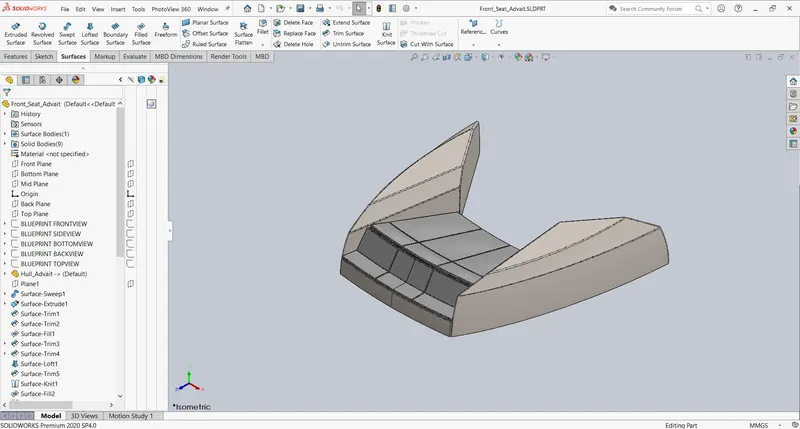
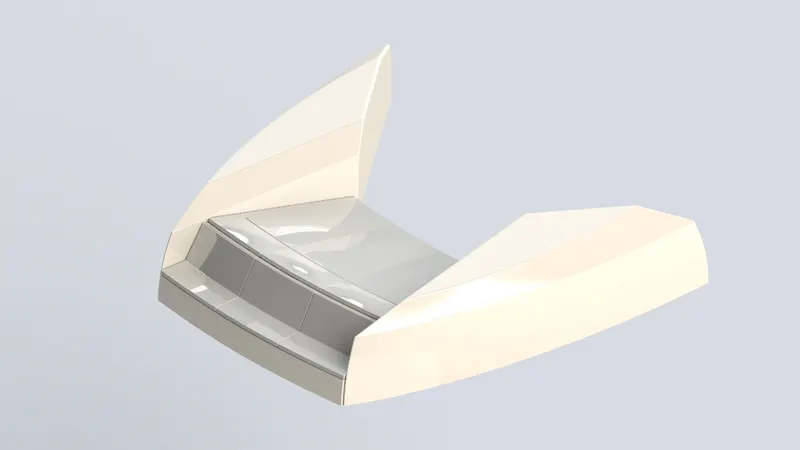
vi) Middle Seat
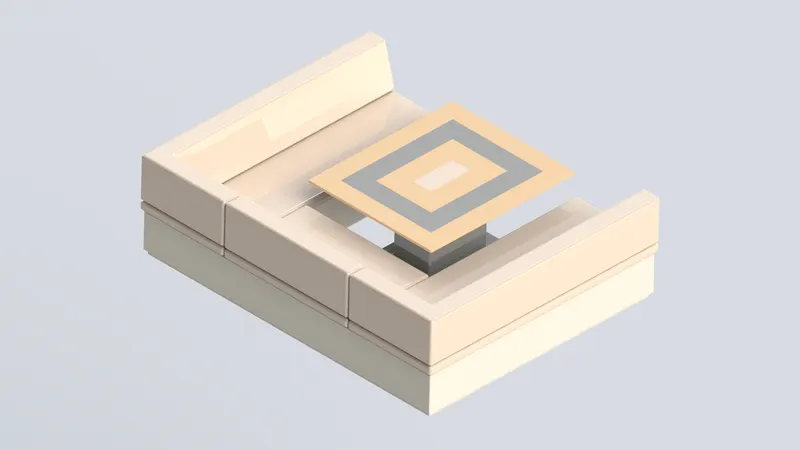
The middle seat is the second row of seats on deck outside the superstructure. A table is also provided in the middle to conducts meetings on the yacht.
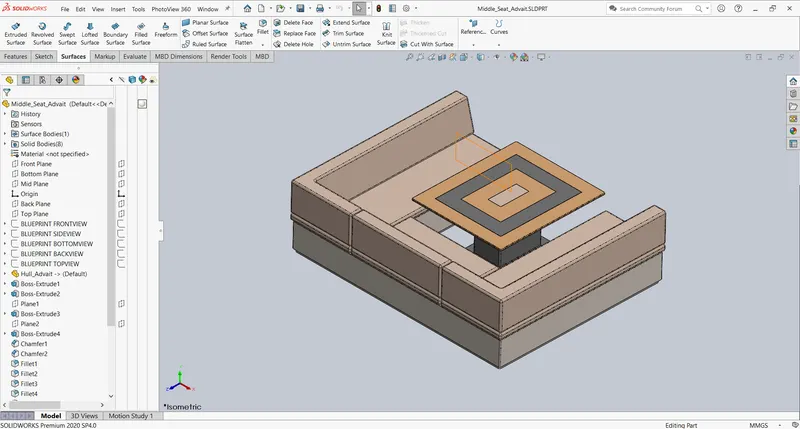
vii) Rear Seat
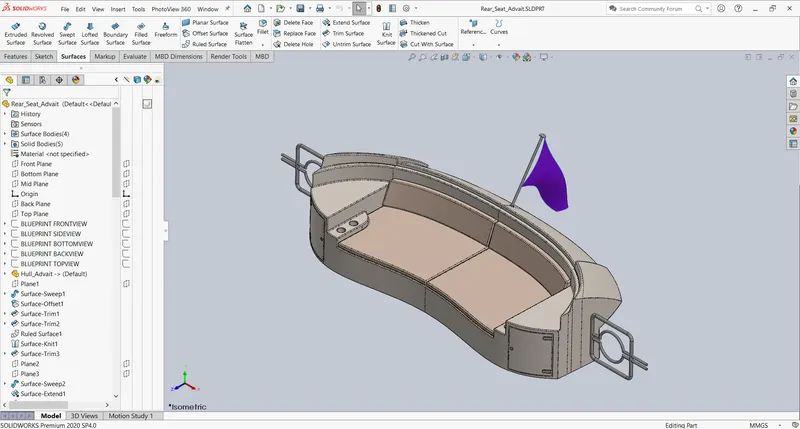
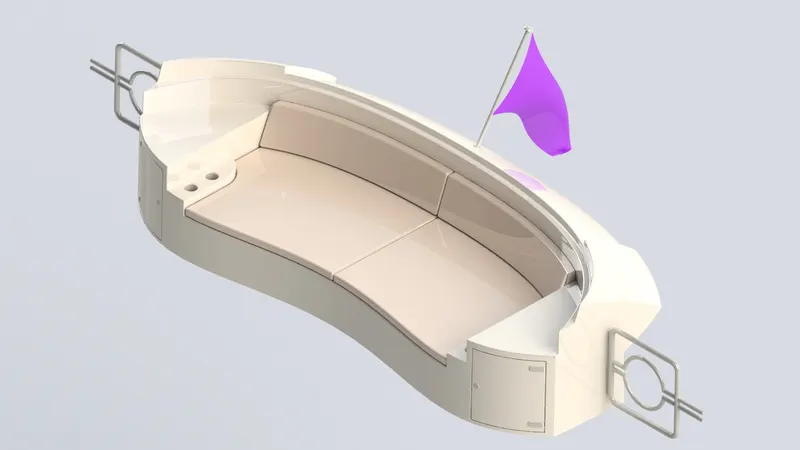
The rear seat comprises of the last row of seats on the deck. On the sides of the rear seats are the gate separating the upper deck and the stair case from below. Lights to the rear side and a flag pole are also fixed on the rear side.
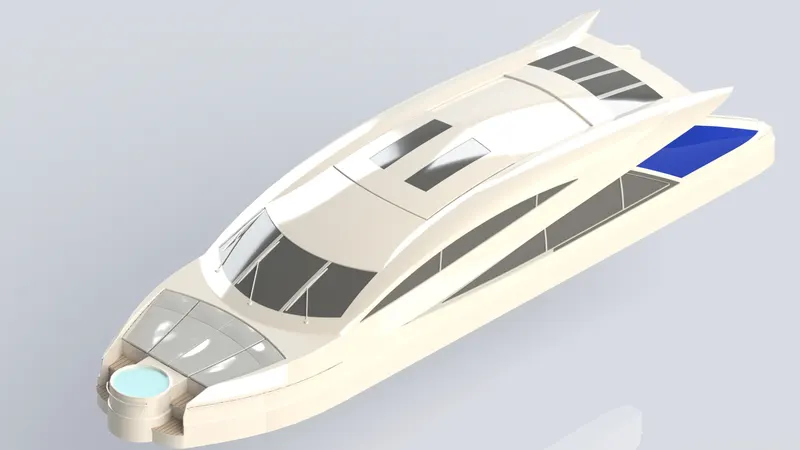
viii) Superstructure
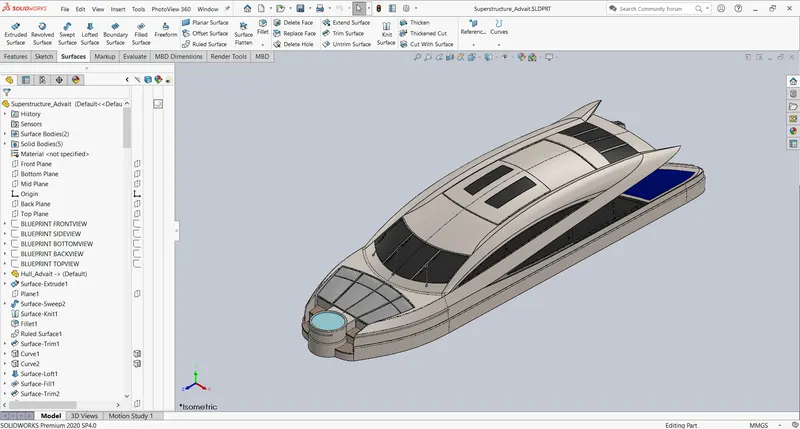
Superstructure refers to the upward section of the yacht above the deck. It is an enclosed space in which people can be accommodated. It is the most visible part of the yacht.
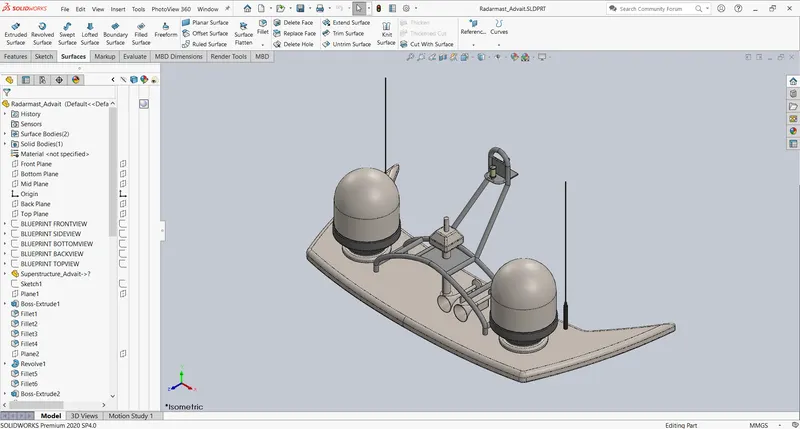
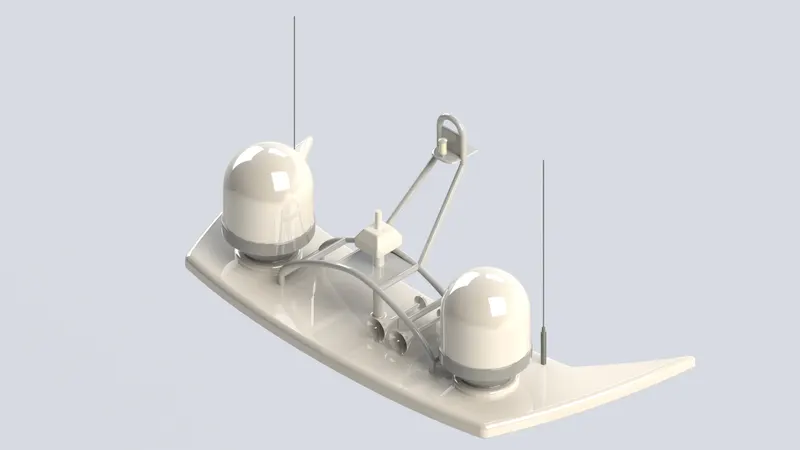
ix) Radar Mast
Radar Mast includes various electronic equipments associated with the radar. It includes antennae to receive signals and provides the support on which the radar is equipped. Lights and horns are also fixed on to the radar mast.
ASSEMBLY
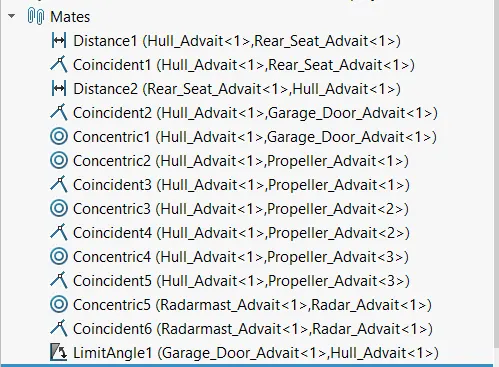
Parts modeled are assembled with respect to each other and fixed. Hull is the first part to be added. Every other part is fixed with respect to hull.
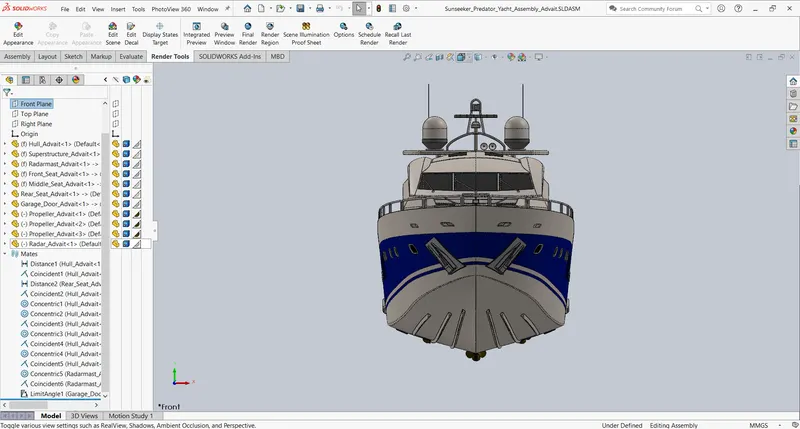
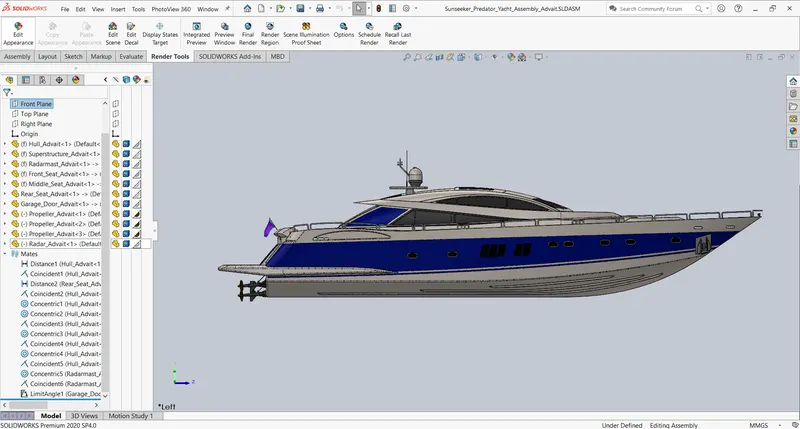
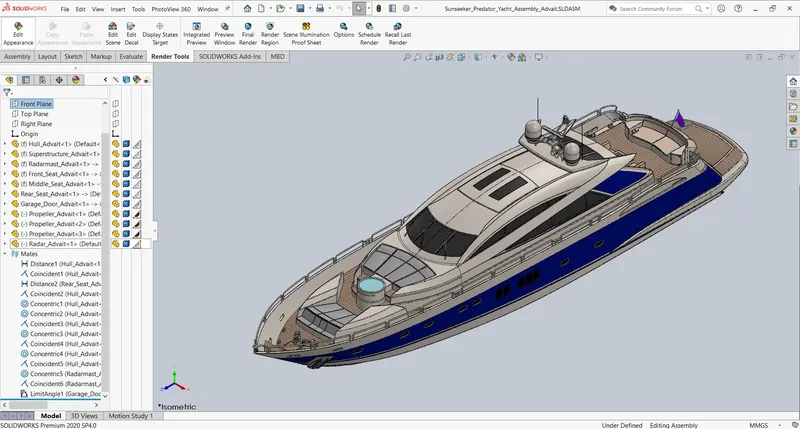
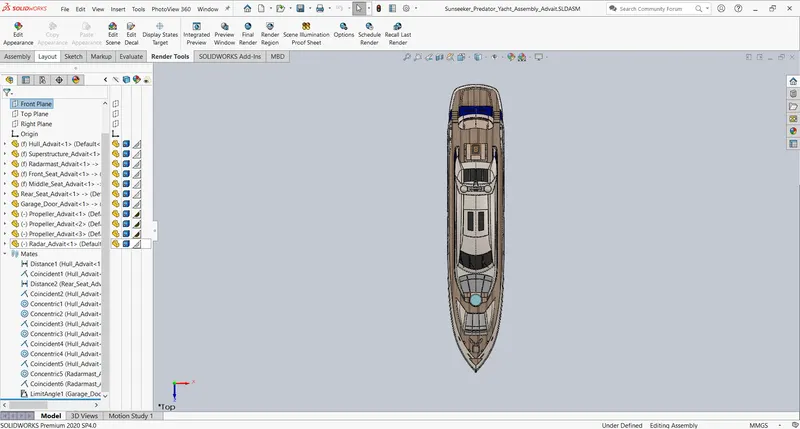
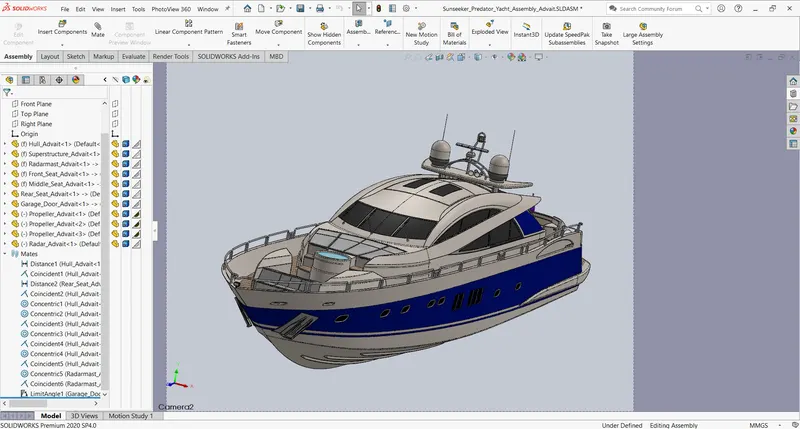
Mates: Mates feature is used to create geometric relationship between parts to fix their position and motion with respect to each other.
RENDERING
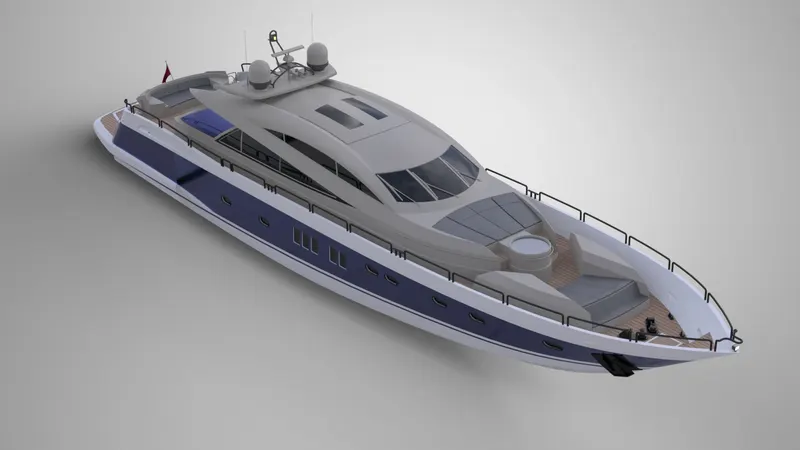
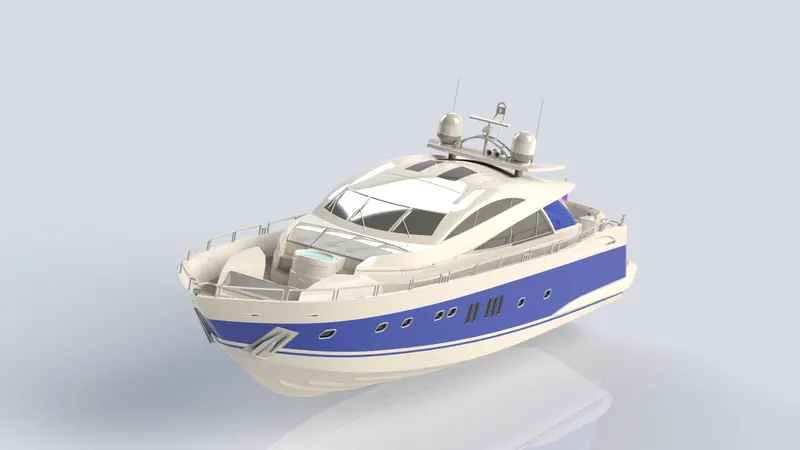
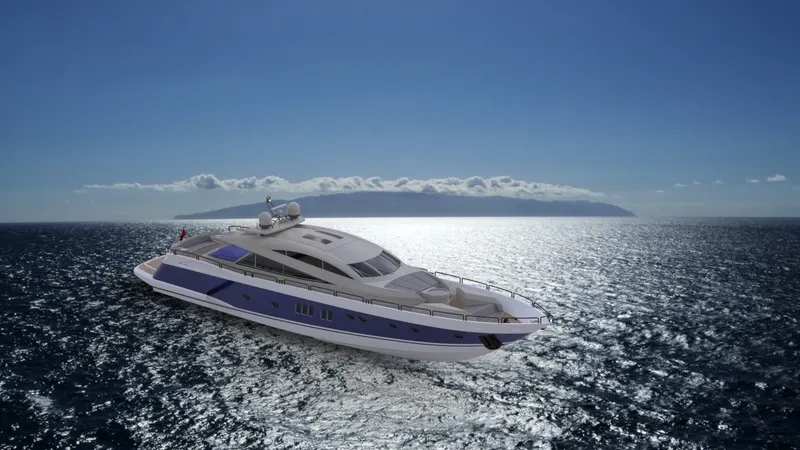
Rendering is the process in which photo-realistic images are created for the model designed. The environment can be set up according to the needs. Background images, camera directions, environment settings, lighting and shadows etc can be tweaked to create the best images possible.
In Solidworks, rendering can be done using Photoview 360 and Solidworks Visualize.
CONCLUSION
- Parts of a Sunseeker Predator Yacht are designed and modeled using Solidworks.
- Assembled the parts modeled using Solidworks.
- Photo-realistic rendering created using Solidworks Photoview 360 and Solidworks Visualize.