Week 9 - Attachment Feature Creation - Challenge 2
Title- Week 9 - Attachment Feature Creation - Challenge 2
Objectives-
1. To understand requirement & function of the Screw boss & Dog house
2. To understand design guidelines for the Screw boss & Dog house
3. To create Screw boss & Dog house for the given Coin holder part
Screw Boss-
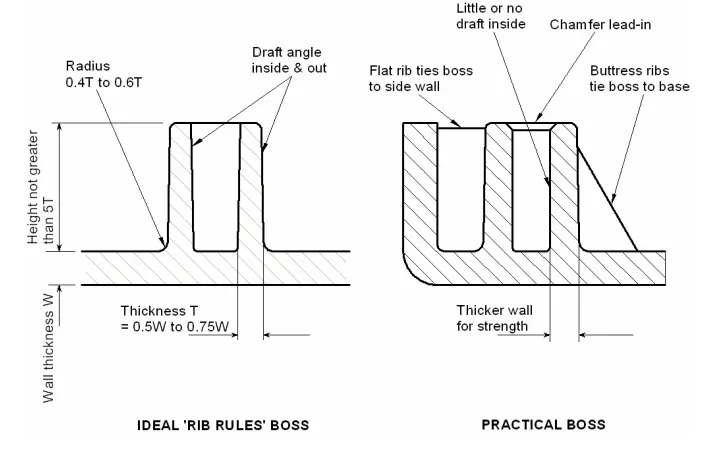
The boss is one of the basic design elements of a plastics molding. Bosses are usually cylindrical because that is the easiest form to machine in the mold and it is also the strongest shape to have in the molded part. The boss is used whenever we need a mounting point, a location point, a reinforcement around a hole, or a spacer. The boss may receive an insert, a screw, or a plain shaft either as a slide or a press fit. In other words, the boss is not as simple as it looks. Depending on its use, it may have to stand up to a whole combination of forces – tension, compression, torsion, flexing, shear and bursting - so it must be designed accordingly.
We can start with some general design rules, using the principles we have already developed for ribs and walls. The boss can be thought of as a special case of a rib; one that is wrapped round in the form of a tube. An 'ideal' boss, designed according to rib rules, would not produce sink marks or stick in the mold but unfortunately the tubular form of the boss would not be strong enough in most cases. In real life, most bosses break some rib design rules by necessity. This means that boss design is a compromise between sink marks and functionality.
Rigidity is the simplest aspect of boss design. This can be achieved by supporting the boss with buttress ribs, and often by linking the boss to a side wall. The support ribs can be designed to normal rib rules so that sink marks and stress points are avoided.
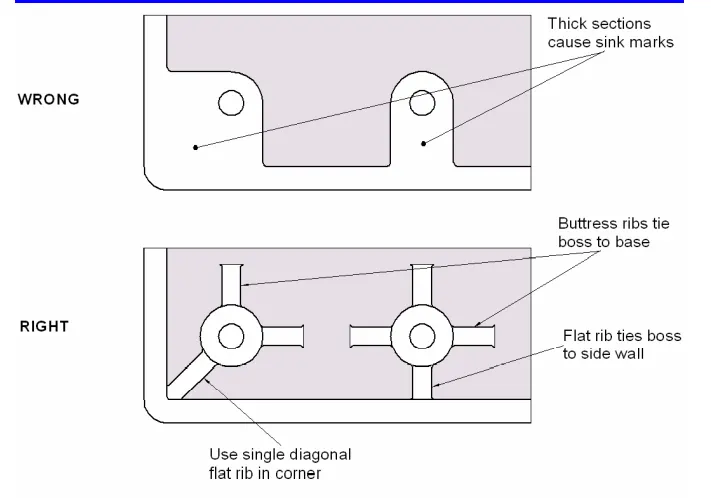
When the boss is linked to a side wall, either at an edge or the corner of a component, there is a right and a wrong way to do it. The wrong way is simply to extend the boss outside diameter to meet the wall. This inevitably produces a thick section that will result in sink marks, voids, and long cooling cycles. The right way is to link or tie the boss to the side wall with a flat rib, preferably recessed a little below the boss or edge height so that it cannot interfere with any assembly conditions. The other ribs that tie the boss to the base wall remain as buttress ribs. For economical machining of the mold, the ribs should be aligned on the X-Y axes of the component except for the flat corner rib which is placed at 45 degrees. The single diagonal rib is better than two XY ribs because it avoids a small mold core between the ribs. Such small cores are prone to damage and are difficult to cool; this may result in slower molding cycles and more down time.
Creation of Screw Boss-
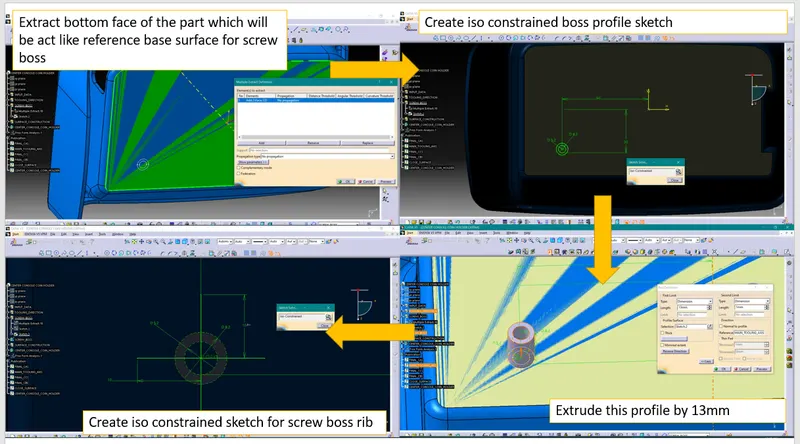
Screw boss calculations
Let us create screw boss for screw of M6
- ID = 5.2mm
- Wall thickness of screw boss, W = 0.6*T = 0.6*2.5 = 1.5mm
- OD = 5.2+1.5*2 = 8.2mm
- Height of screw boss, H = 5*T = 5*2.5 = 12.5 or 13mm
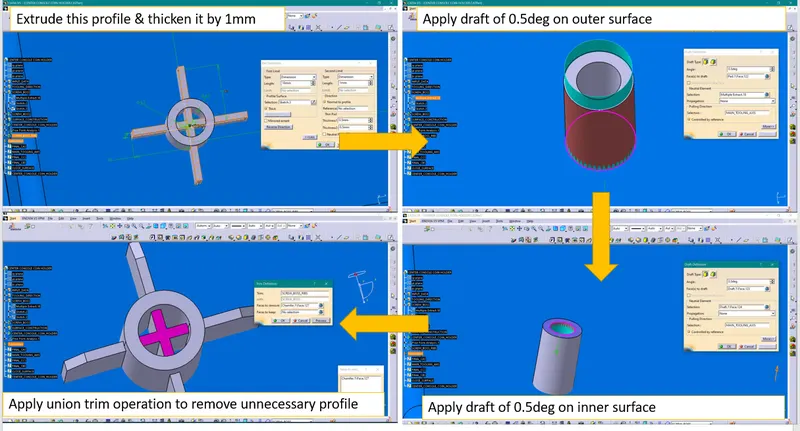
- Boss rib thickness, t = 0.4*T = 0.4*2.5 = 1mm
- Height of boss rib, h = 10mm
- Edge fillet radius, r = 0.25mm
Where, T = Wall thickness of part
Process to create screw boss is explained below-
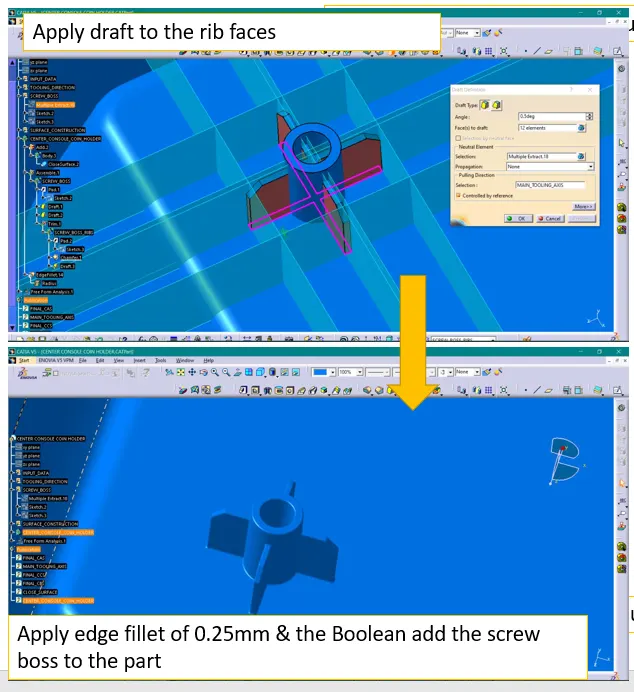
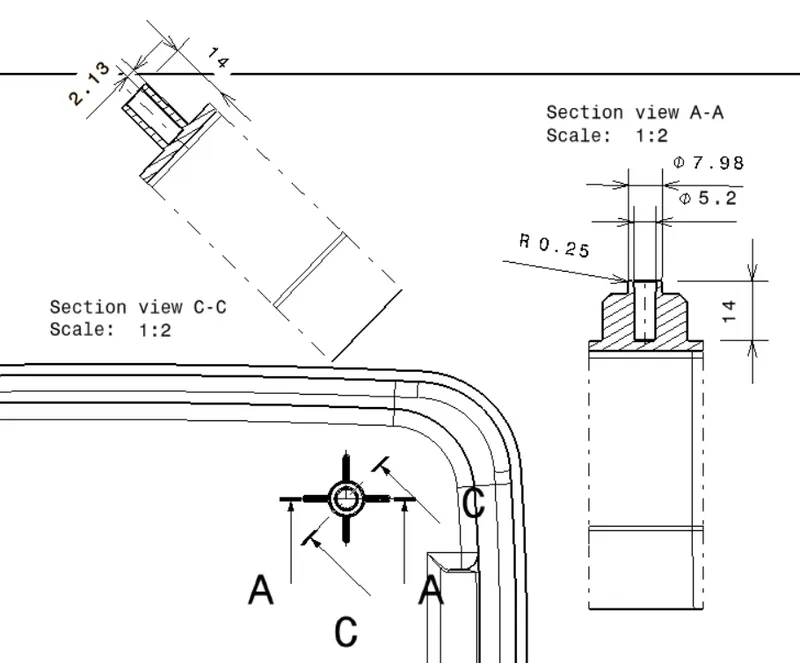
Dog House-
Dog house is an engineering feature used in plastic trim design. Dog houses are used as supporting feature. Sometimes other engineering features like snaps; locators etc. are mounded on them to increase their strength.
Dog houses are subjected to draft analysis to prevent breakage of the component during ejection from mould cavity. Dog house and other engineering components are built on B-surface.
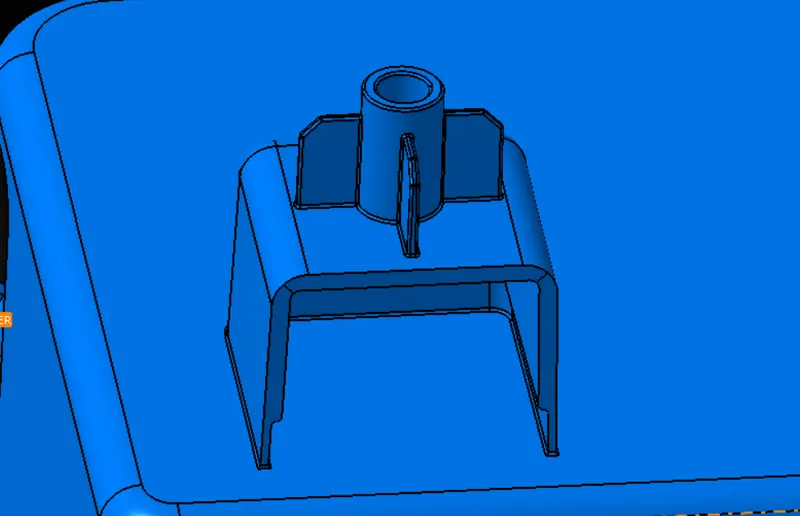
Creation of Dog house-
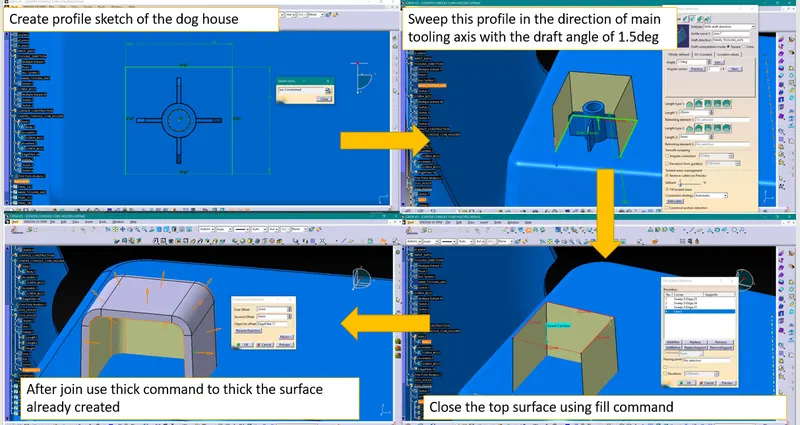
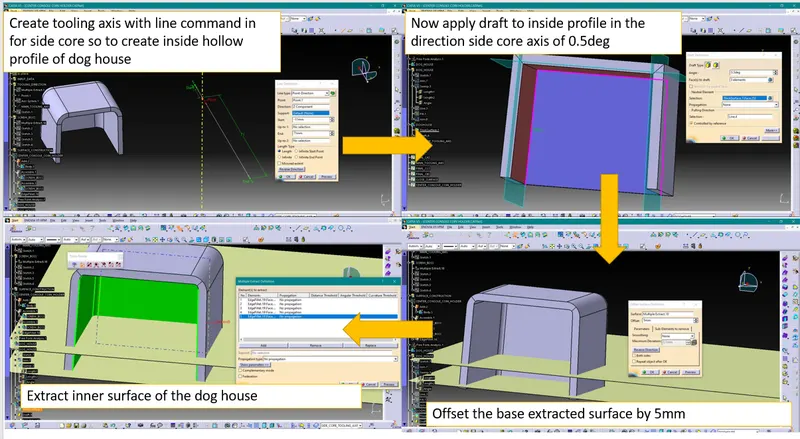
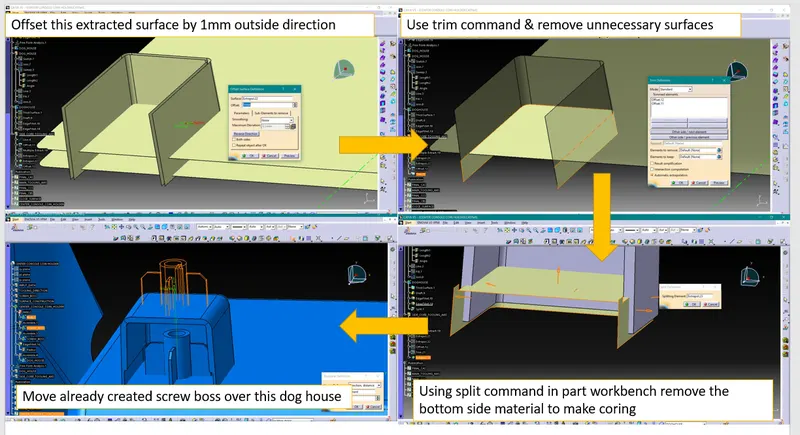
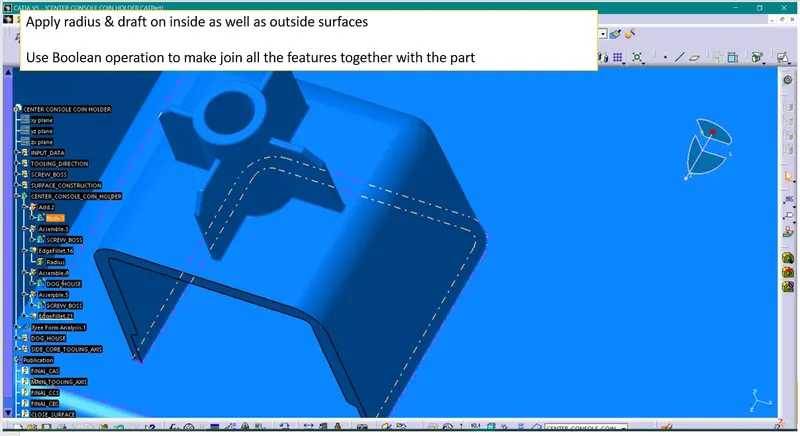
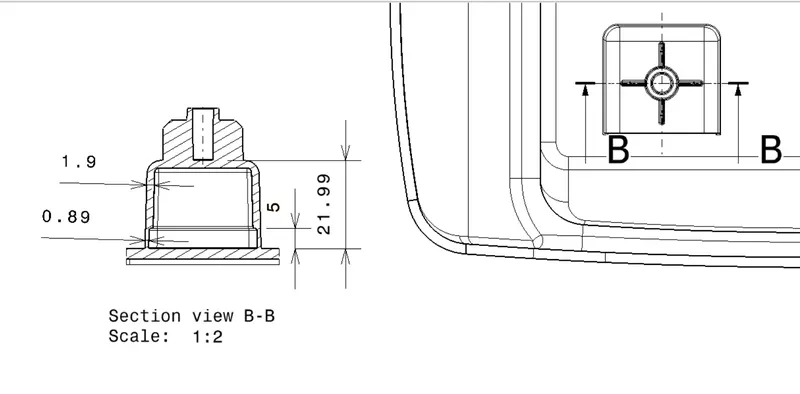
Draft analysis of the coin holder along with all engineering features-
1. Draft analysis of screw bosses with 0.5deg draft angle along main tooling direction
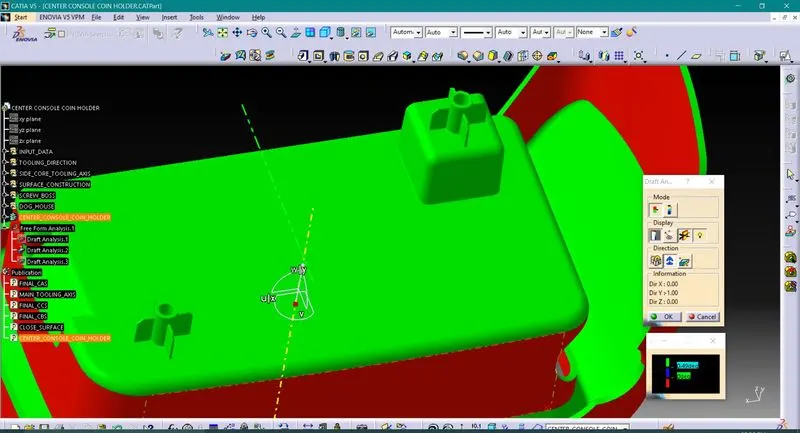
2. Draft analysis of dog house (outer surface) with 1.5deg draft angle along main tooling direction
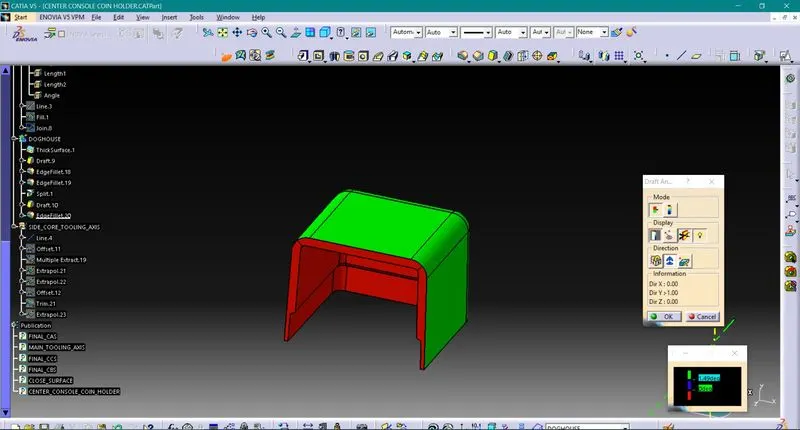
3. Draft analysis of dog house (inner surface) with 0.5deg draft angle along side core axis direction
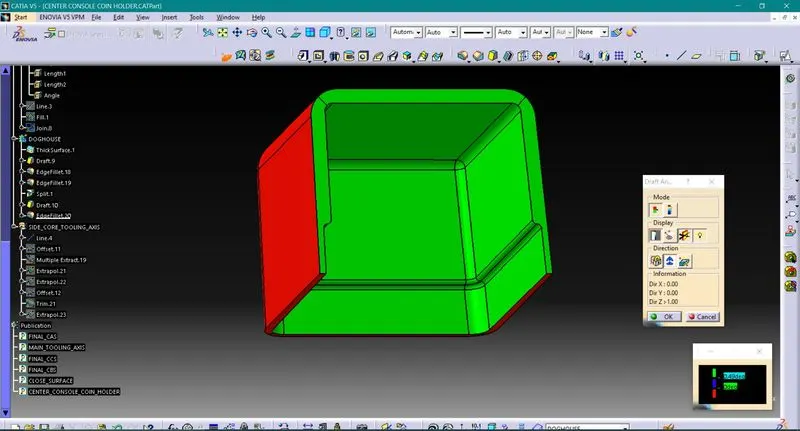
4. Draft analysis of complete part with the engineering features
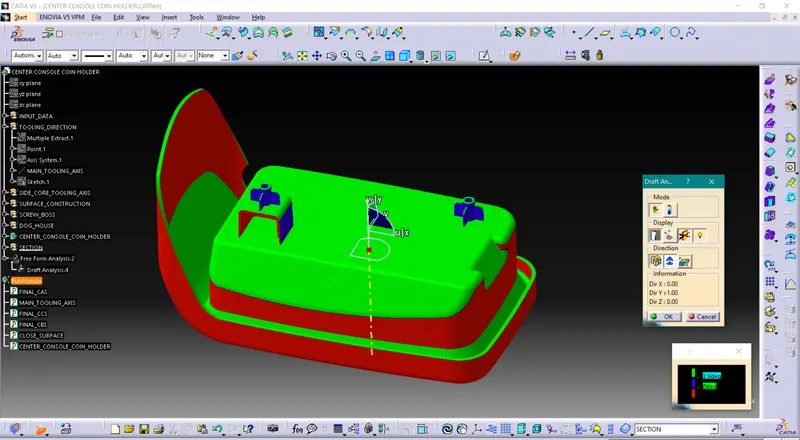
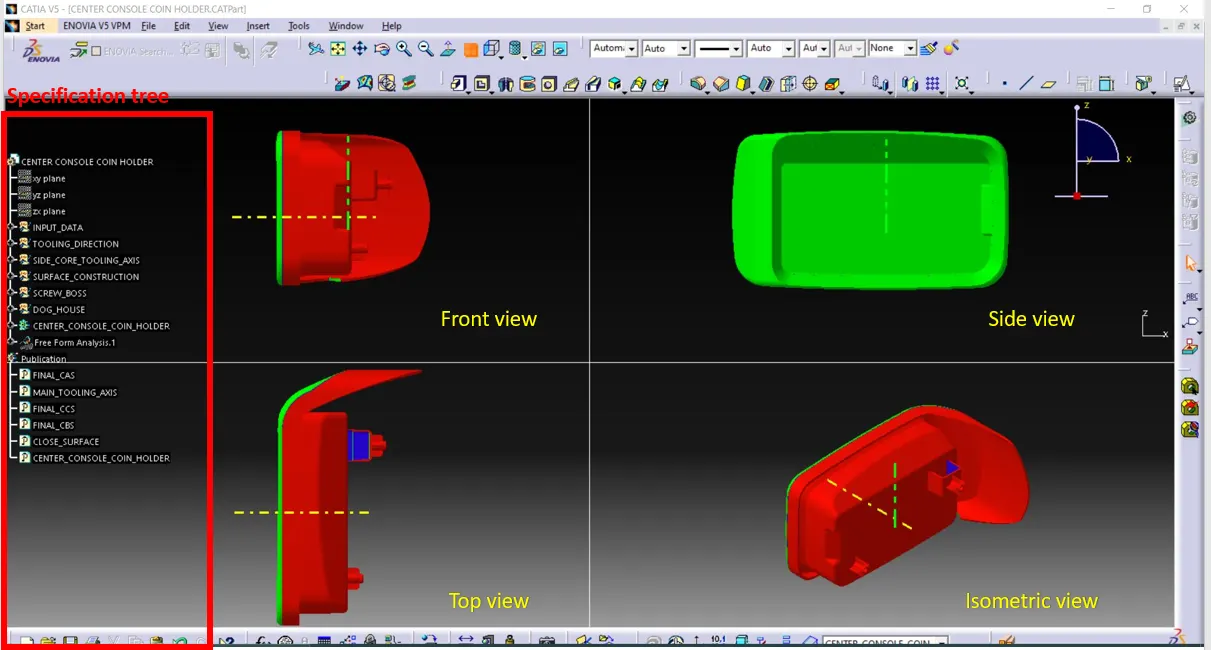
The completed design in various orientations-
Conclusion-
1. We have understood requirement & function of the Screw boss & Dog house
2. We have understood design guidelines for the Screw boss & Dog house
3. We have created Screw boss & Dog house for the given Coin holder part