Week 8 - Universal Joint
Aim of the project:
To perform the Transient analysis simulation of Universal Joint mechanism and capture directional deformation, Equivalent stress, and elastic strain.
Analyze and compare the results obtained in the varied material condition for joint with springs with Stainless steel and Titanium alloy.
Set Up
- In the Ansys workbench we chose Transient analysis and in engineering data we kept the material structural steel as it is, along with that we have added stainless steel and Titanium alloy.
- After Importing the Universal Joint mechanism model in the Geometry, We opened Mechanical module by clicking Edit to the model tab.
- Renamed the models accordingly and kept material Structural steel as it is for Case 1.
- Now under connections we deleted all the contact and added Fixed body to ground joint to the Joint with Spring. Added 2 more Body to ground revolute joints one for Geared joint and other for joint with Springs.
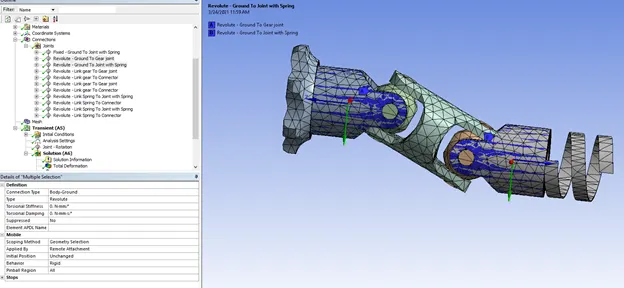
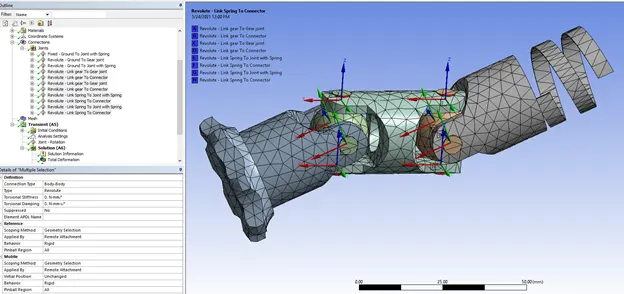
- Later we have Added different revolution joints in 8 different joint positions by keeping hole as mobile scope and pin as reference scope with respect to proper directions as shown below. shown below.
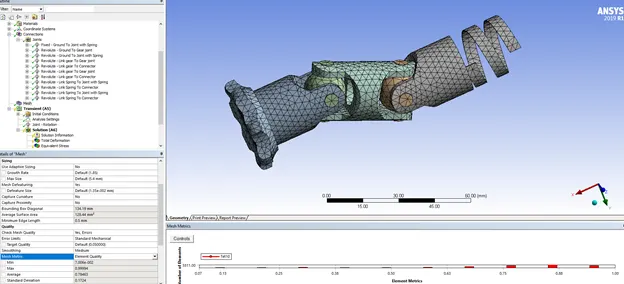
- Refined Meshing was done with respect to academic version of Ansys and kept element size 2.7mm. Kept No for adaptive sizing and smoothing was medium.
7. Under analysis Settings we set the step controls to 5 number of steps and put Auto time stepping Off, time step defined to all 5 steps as 0.1s. kept weak springs as program controlled, Large deflection on and all output controls as yes.
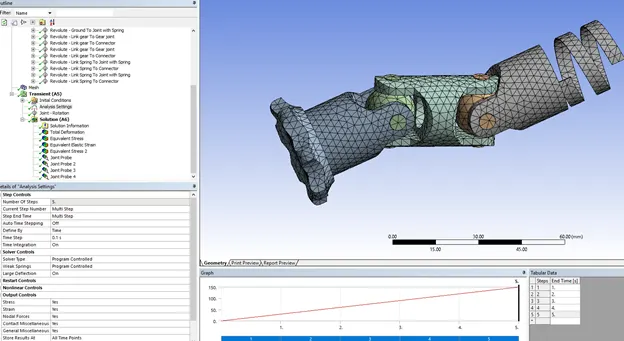
8. Now we added revolute Joint Load to the Gear joint part in type of rotation through incremental angles as shown below. 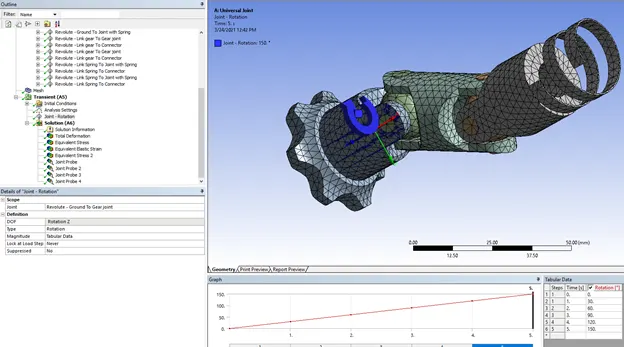
9. Finally, we requested all desired solutions and got the results as shown below.
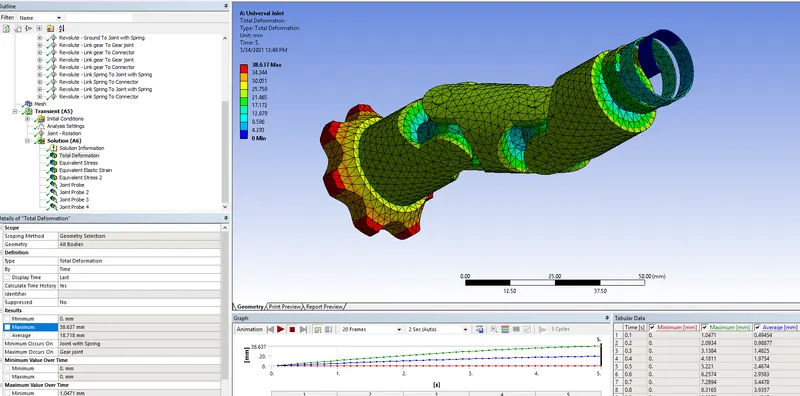
Total Deformation
Maximum: 38.637 mm
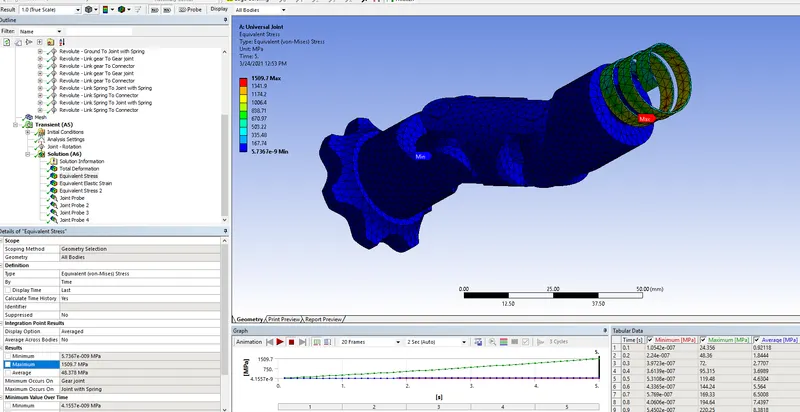
Equivalent Stress,
Maximum : 1509.7 MPa
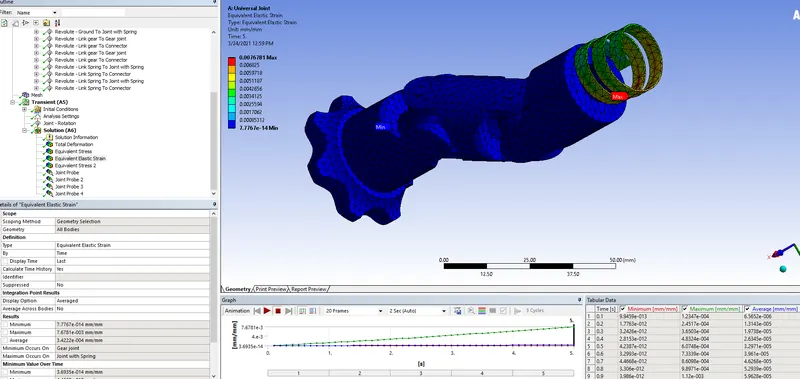
Equivalent Strain
Maximum: 7.6781e-003 mm/mm
All Joint probe result videos attached.
Case 2
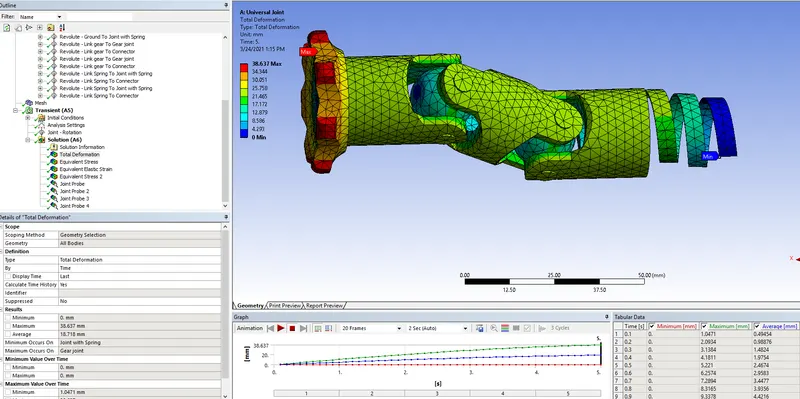
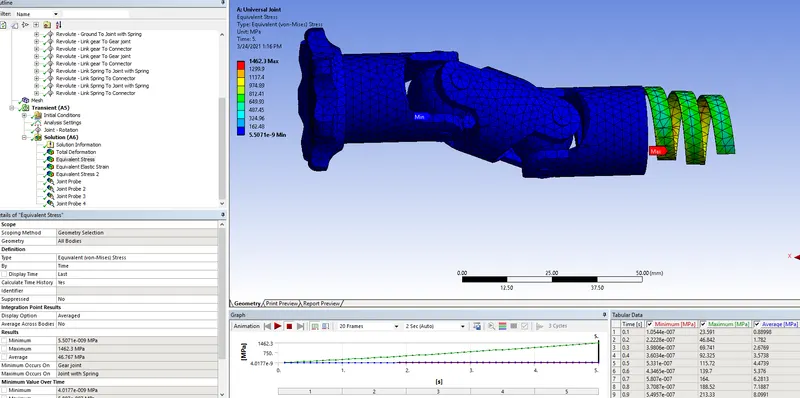
We have changed the material of Joint with springs to Stainless Steel, ran the simulation once again and found the results as shown below.
Total Deformation
Maximum: 38.637 mm
Equivalent Stress,
Maximum : 1462.3 MPa
Case 3
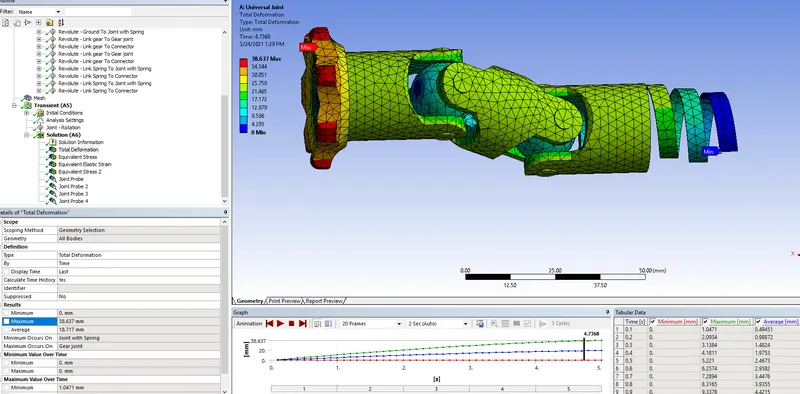
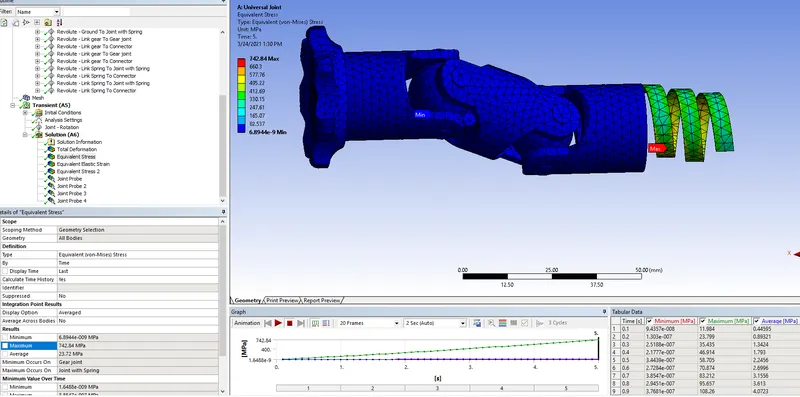
We have changed the material of Joint with springs to Titanium Alloy, ran the simulation once again and found the results as shown below.
Total Deformation
Maximum: 38.637 mm
Equivalent Stress,
Maximum : 742.84 MPa
Conclusion
|
Material of Joint with Spring |
Directional Deformation (Max.) |
Max. Von-mises Stress (Mpa) |
|
Structural Steel |
38.637 mm |
1509.7 MPa |
|
Stainless Steel |
38.637 mm |
1462.3 MPa |
|
Titanium Alloy |
38.637 mm |
742.84 MPa |
We have observed that even though there is change in material for the joint of spring Total deformation was not varied it was constant among all 3 cases. But Von-mises Stress was more in case Structural steel and it reduced when we changed it to Stainless steel and it was far better in case of Titanium material for joint of spring.
So we can conclude that Titanium alloy will be best suited material for joint of Spring in case of Universal joints.