Week 8 - Universal Joint
Case Study of Stress, Strain And Deformation for the Universal Joint.
Objective:
For this challenge, you will have to perform a transient structural analysis on a double universal joint with a spring using three different materials: Structural Steel, Stainless Steel and Titanium alloy(They can all be found in the General Materials section) The three materials must be used on the joint with the springs alone. Use a refined mesh if possible for the academic license. You need to obtain the Equivalent stress and total deformation for all the three cases and compare them. Submit a report regarding the same
Procedure:
Case1:
For Case 1, Static Structural Analysis is carried out on Universal Joint. The material is Structural Steel & the Mesh Size is 4mm and the analysis is carried out on Ansys Workbench. The geometry of the model is imported on the Ansys Workbench for analysis. The Gear is first modified in the space claim and internal dia of the gear is increased.
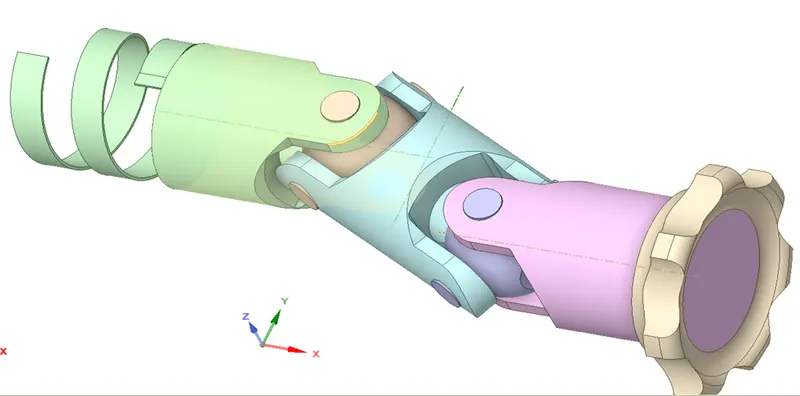
2D Geometry is extruded in the Space Claim to get the model to be imported to the ANSYS. The Extruded model is as shown in the image below:
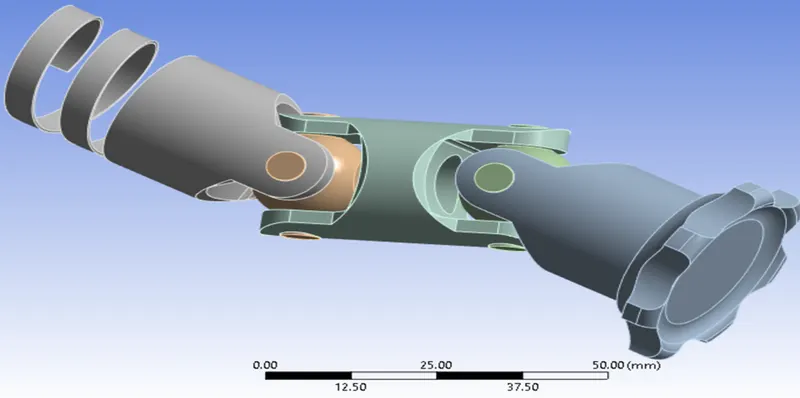
The properties of the material is stated below:
Density: 7850 kg/m3
Tensile Yield Strength: 2.5E+08 Pa
Tensile Ultimate Strength: 4.6E+08 Pa
Young’s Modulus: 1.2E+05
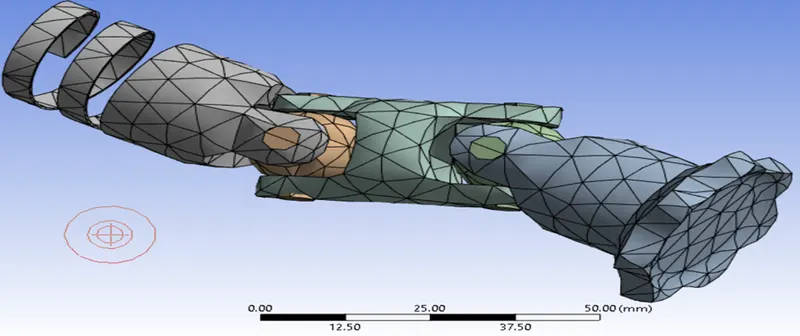
The model is meshed using Ansys Mesher with an element size of 1 mm, and a patch conforming method using tetrahedrons was employed. This is done to get the best refinement within the limitation of Ansys Academic License.
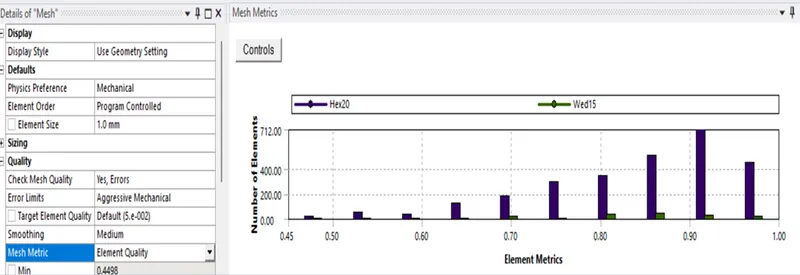
A mesh metric that identifies the elements according to their quality was employed and it can be seen that element of lowest quality are minimal. Most of the elements have very high quality in the range of 0.7-1. Hence, the mesh is of acceptable quality. The meshed model is shown in image below:
The simulation is then run with the setting and the results are then obtained.
Case 2:
For Case 2, Static Structural Analysis is carried out on Bevel Gear. The material is Stainless Steel & the Mesh Size is 4mm and the analysis is carried out on Ansys Workbench.
The Material properties are as follows:
|
Density |
|
||
|
Young's Modulus |
|
||
|
Poisson's Ratio |
|
||
|
Bulk Modulus |
|
||
|
Shear Modulus |
|
Case 3:
For Case 3, Static Structural Analysis is carried out on Bevel Gear. The material is Titanium Alloy & the Mesh Size is 4mm and the analysis is carried out on Ansys Workbench.
The Material properties are as follows:
|
Density |
|
||
|
Young's Modulus |
|
||
|
Poisson's Ratio |
|
||
|
Bulk Modulus |
|
||
|
Shear Modulus |
|
Results:
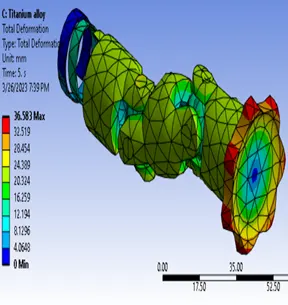
Total deformation of the 3 cases are compared.
Time [s] Minimum [mm] Maximum [mm] Average [mm]
- 0. 36.565 17.714
- 0. 36.546 17.709
- 0. 36.583 17.718
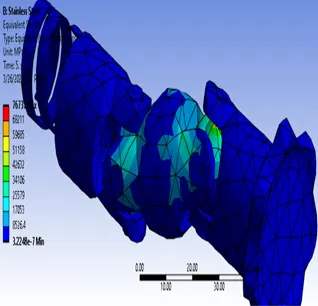
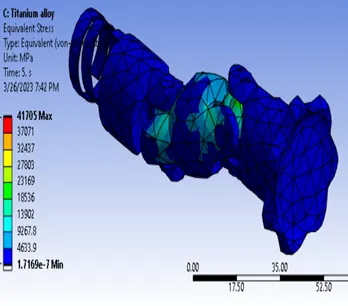
Equivalent Stress of the 3 cases are compared.
Time [s] Minimum [Mpa] Maximum [Mpa] Average [Mpa]
- 3.1391e-007 77140 3064.8
- 3.2248e-007 76737 3020.6
- 1.7169e-007 41705 1687.6
The total deformation on the gear is as plotted and is shown on the plate below.
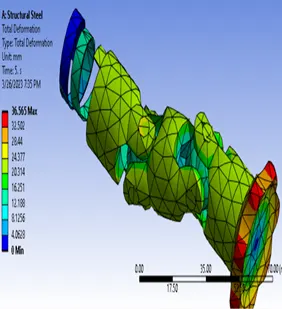
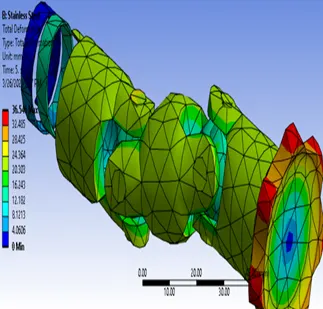
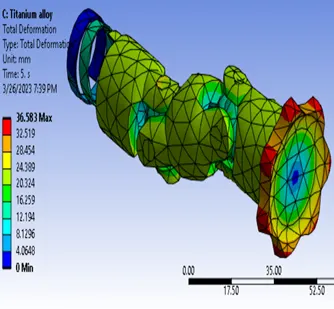
The Equivalent stress is plotted on the plate and is as shown below.
Conclusion:
The Analysis was run succesfully, within the limits of the academic license, the simulation for the 3 cases were examined, the average deformation of the 3rd case is more (i.e 17.717) than the 1st case (17.714). The average equivalent stress for the 3rd case (i.e1687.6) is less than the 1st case (i.e3064.8). Therefere the 3rd (Titanium alloy) case is considered to be most preferable case than 2nd and 3rd case.