Week 8 - Universal Joint
Performing Transient analysis on a Double Universal Joint with three different materials.
OBJECTIVE
To perform a transient structural analysis on a double universal joint with a spring using three different materials Structural Steel, Stainless Steel, and Titanium alloy.
Importing the CAD model
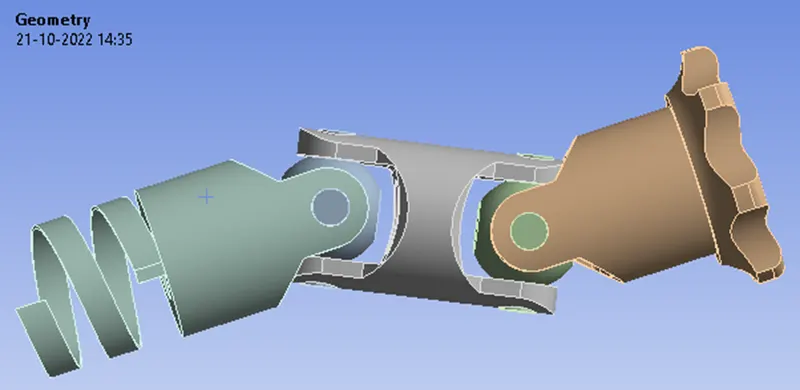
The CAD model is imported and checked for any geometry errors.
Simulation setup
Material Assignment
Case (1) - The entire model is assigned with structural steel material
Case (2) - The joint with spring is alone changed to stainless steel from structural steel
Case (3) - The joint with spring is alone assigned with Titanium alloy as material
Contact definition
In this transient analysis, there is no significance of contacts between the parts, hence no contacts are defined in the model
Joints creation
The spring end is given a fixed joint
2 Body-Ground revolute joint is created for the two end joints
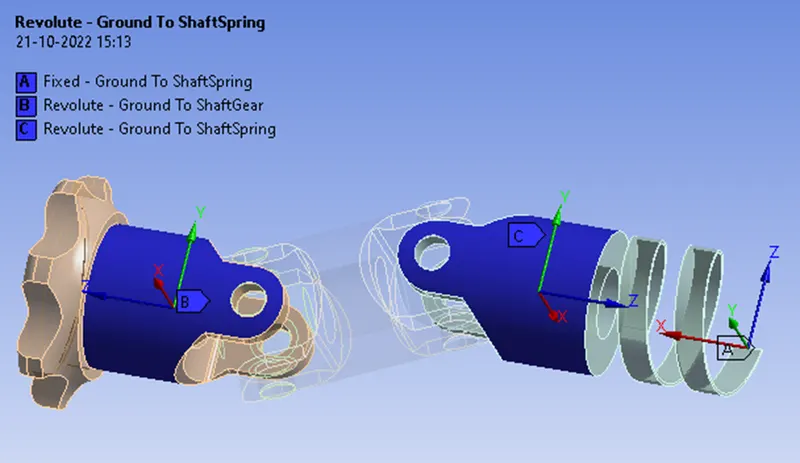
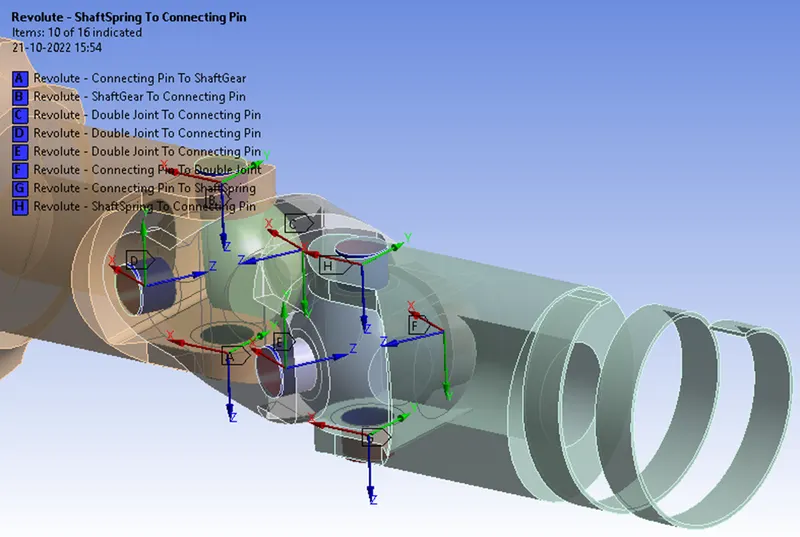
Each pin has 4 revolute joints and thus a total of 8 Body-Body revolute joints interlocked at two pins with gear shaft and spring shaft are created
Mesh Generation
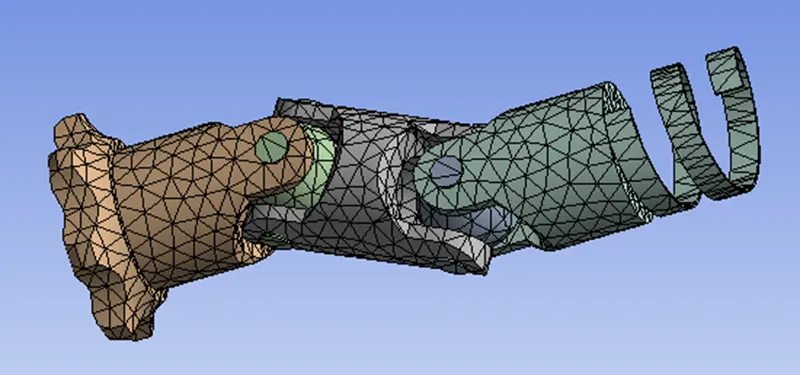
The whole model has meshed with an element size of 4mm.
Analysis settings
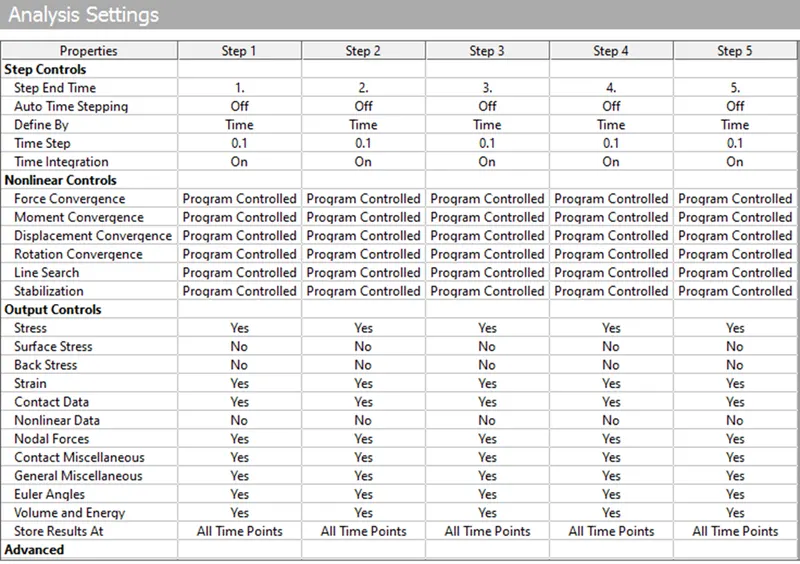
The input motion to the universal joint is given in 5 steps with the following transient analysis settings.
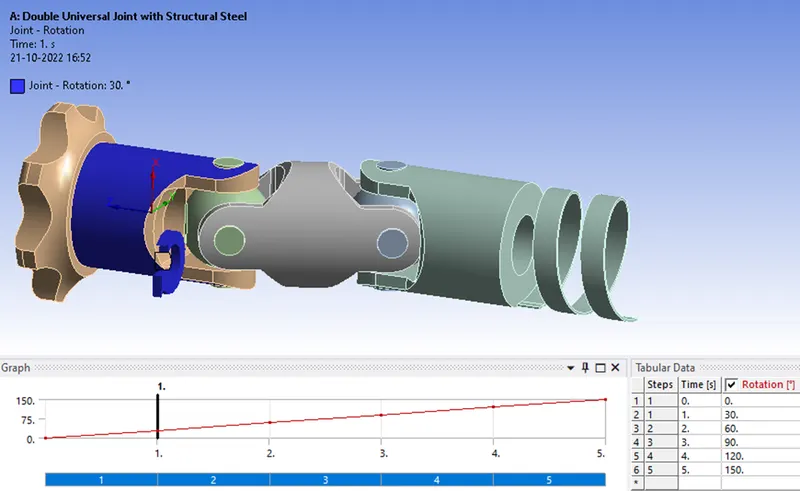
The one end of the double universal joint is given a 150-degree rotation in 5 steps. Each step has a 30-degree value.
Results
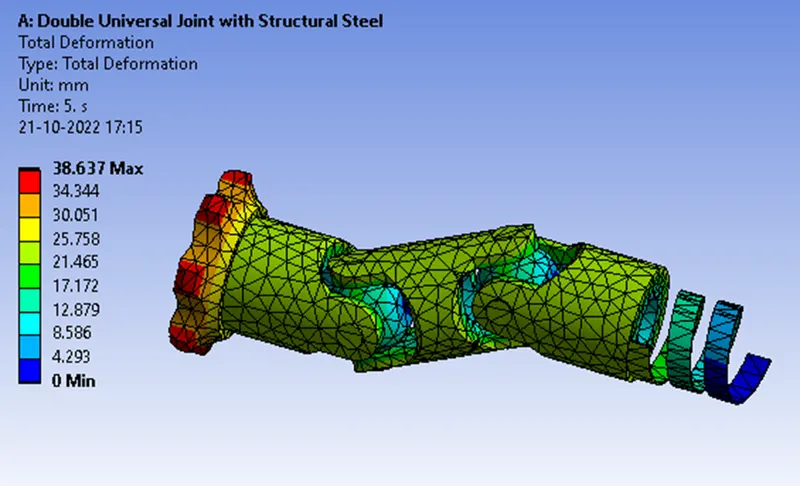
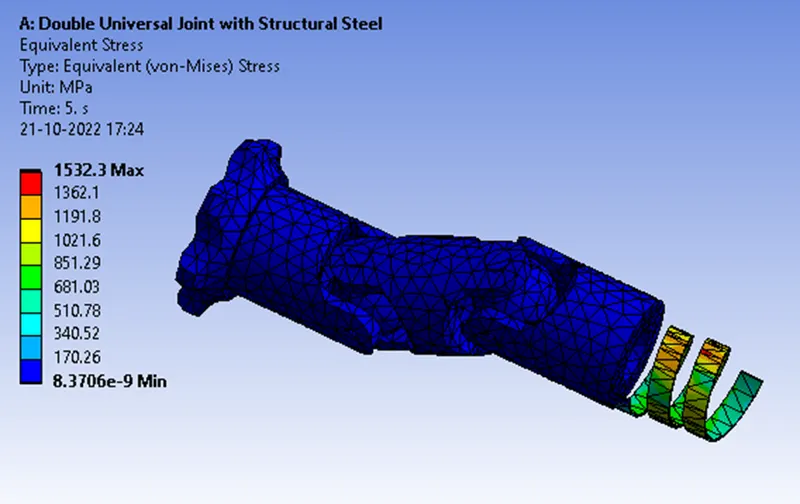
Case (1) - Structural steel
Total Deformation
Equivalent Stress
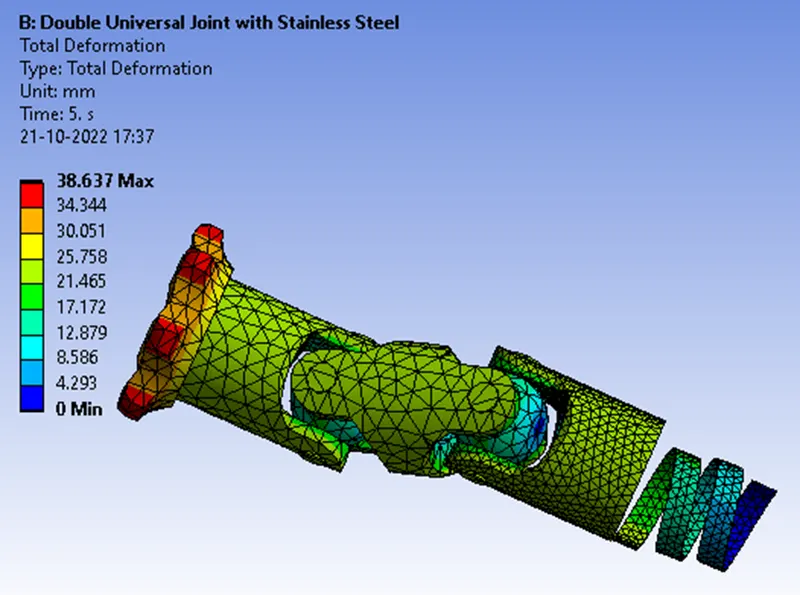
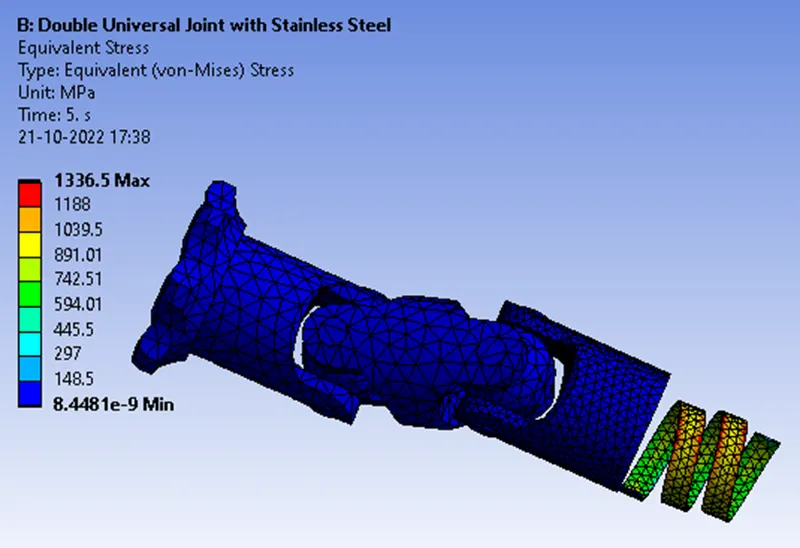
Case (2) - Stainless steel
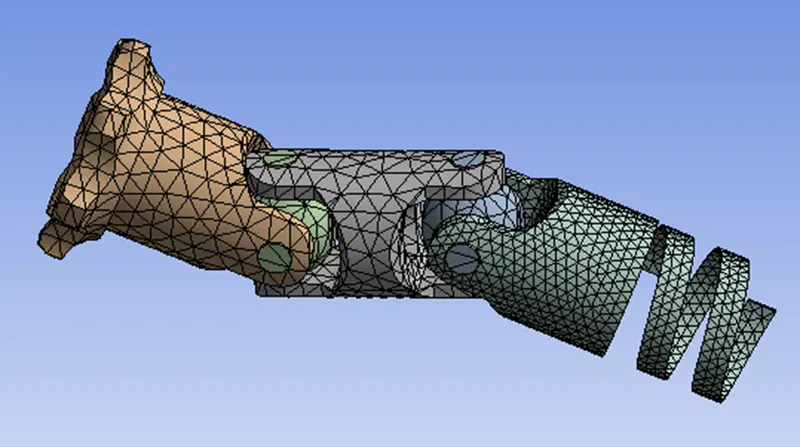
For this case, the meshing for the spring shaft has reduced to 2mm and the rest of the parts have meshed with 4mm as Element size and further analysis has been carried out similarly for case 3 also.
Total Deformation
Equivalent Stress
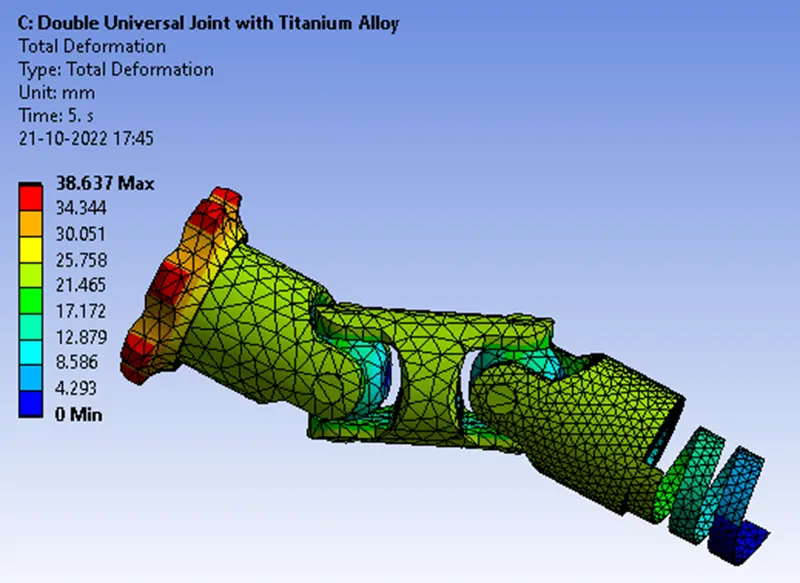
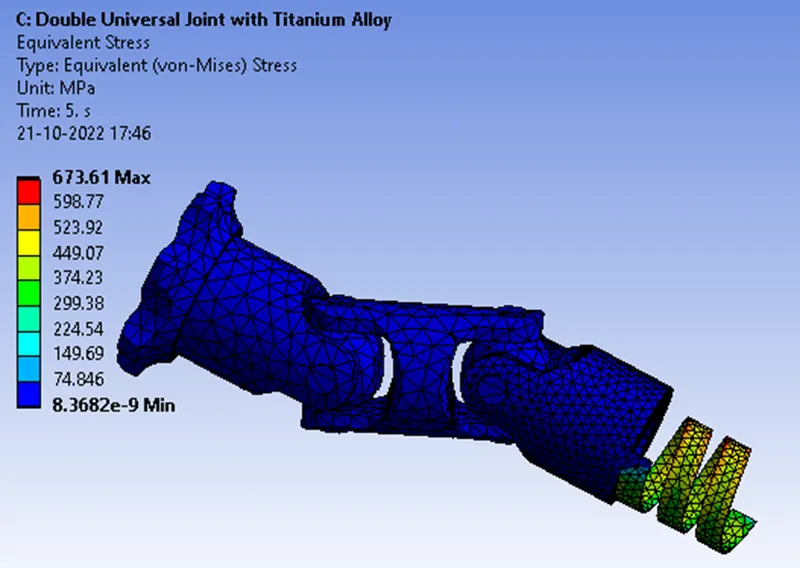
Case (3) - Titanium alloy
Total Deformation
Equivalent Stress
Comparison of results from three cases
|
Analysis of the cases |
Maximum Total Deformation |
Maximum Equivalent Elastic Stress |
Young's Modulus |
|
Case 1: Structural Steel |
38.637 mm |
1532.3 MPa |
2e+05 MPa |
|
Case 2: Stainless Steel |
38.637 mm |
1336.5 MPa |
1.93e+05 MPa |
|
Case 3: Titanium Alloy |
38.637 mm |
673.61 MPa |
96000 MPa |
It is clearly seen that Titanium Alloy has the highest induced stress value. It is due to the fact that it has a low value of Young's modulus compared to structural steel and stainless steel.
Hence terms of stress-induced, stainless steel have the lowest value. On the other hand, Titanium Alloy has the highest strength in terms of ultimate strength value. Thus, depending upon the cost and use case scenario either Stainless steel or Titanium Alloy can be chosen.