Week 8 - Universal Joint
Objective:
The aim of this challenge is to simulate the working of a universal joint and find out the equivalent stress and total deformation in the model. Also the aim was to analyze the effect of 3 different materials on the results, namely, structural steel, stainless steel and titanium alloy.
Case setup and execution:
First the transient structural module was opened and the geometry was imported. Then in the engineering data, in addition to structural steel, 2 new materials - stainless steel and titanium alloy - were added to the material library.
Then the model was opened using Ansys Mechanical. The respective parts were renamed as joint with gear, joint with spring, ball on gear side, ball on spring side and middle joint.
All the above parts were initially assigned structural steel as material, which was parameterised.
Then all the existing contacts were deleted and only the joints were provided.
A body-to-ground revolute joint each was provided to the joint with gear and the joint with spring. A fixed joint was provided to the face at the end of the spring.
Then 4 body-to-body revolute joints each were provided to the ball on gear side and the ball on spring side. In these joints the joint with spring, joint with gear and the middle joint were the mobile parts and the balls were the reference bodies.
A default mesh size of 4 mm was provided to the model. Adaptive sizing was turned off.
In the analysis settings, 5 steps were selected. Auto time stepping was off and time step size of 0.1 sec was selected. The weak springs was program controlled and large deflection was turned on. In the output control all the options were changed to Yes.
Then the joint load was applied to the joint with gear in 5 steps of 30 degrees rotation each.
In the output, total deformation and equivalent stress were requested. Their maximum values were parameterised.
The simulation ran smoothly. But the animation showed that, instead od getting wound up, the spring was getting unwound. Hence the direction of rotation of joint-load was reversed. This time the model showed correct animation.
Results:
Animation
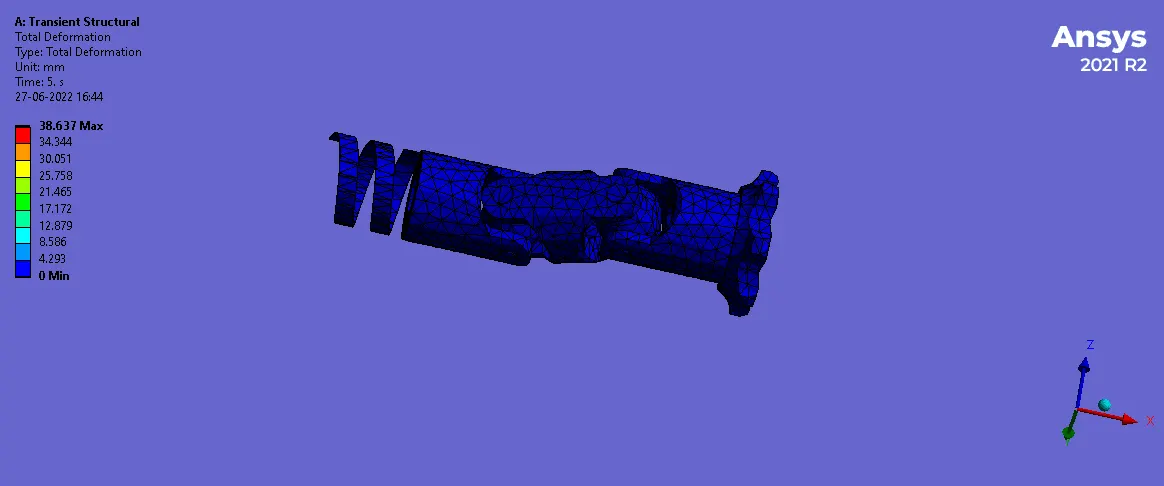
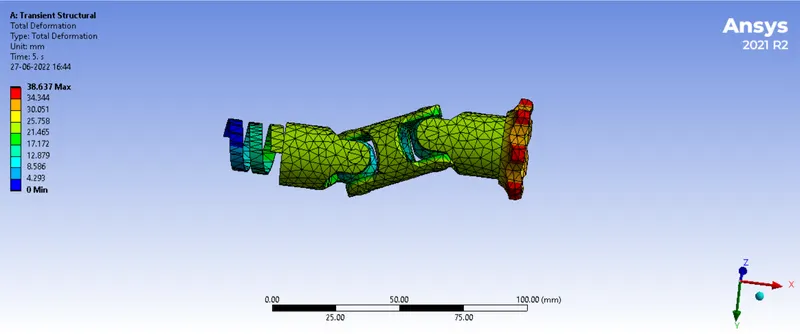
Total deformation
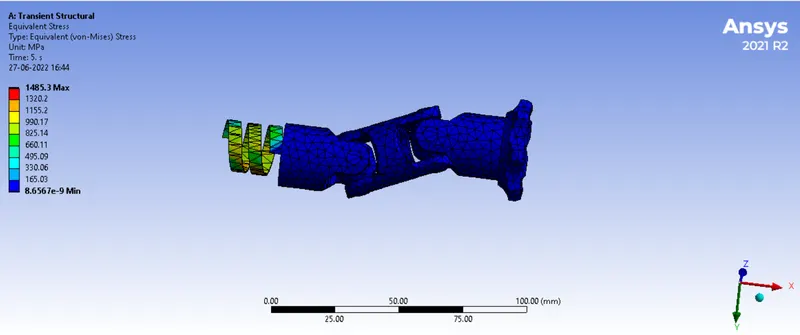
Equivalent stress
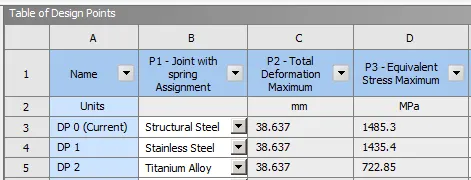
The parametric study was done for the materials stainless steel and titanium alloy. The results for the same are shown below:
Conclusion:
It is clear, that despite undergoing the same total deformation, the maximum equivalent stress is different in 3 cases. This is due to the different material properties. The structural steel with highest Young's modulus (200 GPa) has highest stress, while titanium alloy has the lowest stress due to lowest Young's modulus (96 GPa). The stainless steel has the value in between due to the Young's modulus of 193 GPa. The simulation files are attached in zip format.