Week 8 - Simulation of a backward facing step in OpenFOAM
AIM: To simulate incompressible laminar viscous flow through the backward-facing step geometry
Introduction: In this challenge, the flow-through backward-facing step has been simulated using icoFOAM solver which is performed in OpenFOAM software. As a result, if the simulation, velocity, pressure profile for different mesh grading factors can be achieved. The dimensions of a given backward-facing step are below. And simulate the flow with different garding factors.
Nature of flow: Incompressible flow
Block Mesh specification:
Number of blocks = 5
The arrangement of blocks is as follow:

Mesh Specification:
- Number of cells along the X-direction(longer dimension) = 200
- Number of cells along with the y-direction = 10
Desired Output:
- Run the first simulation without grading factor
- Run the second simulation with a mesh grading factor of 0.2, 0.5, 0.8. Compare the effect of grading factor with necessary contour & plots.
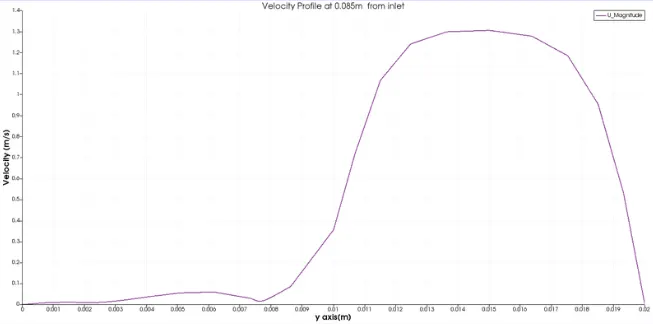
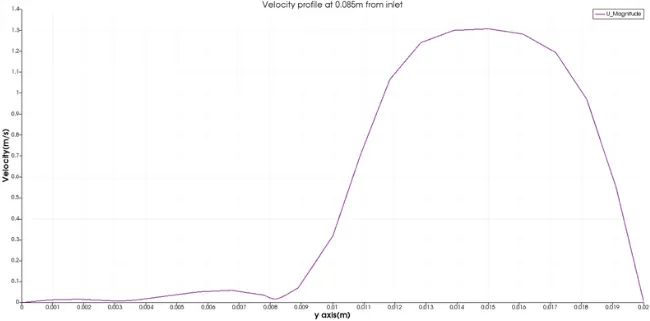
- Measure the velocity profile at 0.085m from the inlet of the geometry with a line plot.
- Compare velocity magnitude contour near the step region for the above-mentioned grading factors.
OpenFoam Code for creating given geometry using BlockMesh


/*--------------------------------*- C++ -*----------------------------------*
  =========                 |
        /  F ield         | OpenFOAM: The Open Source CFD Toolbox
       /   O peration     | Website:  https://openfoam.org
      /    A nd           | Version:  8
     /     M anipulation  |
*---------------------------------------------------------------------------*/
FoamFile
{
    version     2.0;
    format      ascii;
    class       dictionary;
    object      blockMeshDict;
}
// * * * * * * * * * * * * * * * * * * * * * * * * * * * * * * * * * * * * * //

convertToMeters 1;

vertices
(
    (0 0 0) //0
    (0.08 0 0) //1
    (0.08 0.005 0) //2
    (0 0.005 0)  //3
    (0.08 0.01 0)  //4
    (0 0.01 0)  //5
    (0.2 0.01 0)  //6
    (0.2 0.005 0)  //7
    (0.2 0 0) //8
    (0.2 -0.01 0) //9
    (0.08 -0.01 0) //10

    (0 0 0.001)  //11
    (0.08 0 0.001)  //12
    (0.08 0.005 0.001)  //13
    (0 0.005 0.001)  //14
    (0.08 0.01 0.001)  //15
    (0 0.01 0.001)  //16
    (0.2 0.01 0.001)  //17
    (0.2 0.005 0.001)  //18
    (0.2 0 0.001)  //19
    (0.2 -0.01 0.001)  //20
    (0.08 -0.01 0.001) // 21
);
blocks
(
    hex (0 1 2 3 11 12 13 14) (80 5 1) simpleGrading (0.2 5 1)
    hex (3 2 4 5 14 13 15 16) (80 5 1) simpleGrading (0.2 0.2 1)
    hex (2 7 6 4 13 18 17 15) (120 5 1) simpleGrading (5 0.2 1)
    hex (1 8 7 2 12 19 18 13) (120 5 1) simpleGrading (5 5 1)
    hex (10 9 8 1 21 20 19 12) (120 10 1) simpleGrading (5 5 1)
);

edges
(
);

boundary
(
    inlet
    {
        type patch;
        faces
        (
            (0 11 14 3)
            (3 14 16 5)
        );
    }
    outlet
    {
    	type patch;
    	faces
    	(
    		(9 8 19 20)
    		(8 7 18 19)
    		(7 6 17 18)
    	);

    }
    upperwalls
    {
    	type wall;
    	faces
    	(

    		(5 16 15 4)
    		(4 15 17 6)

    	);

    }
    lowerwalls
    {
    	type wall;
    	faces
    	(
    		(0 1 12 11)
    		(10 9 20 21)
    		(10 21 12 1)

    	);

    }
    frontAndBack
    {
        type empty;
        faces
        (
            (3 2 1 0)
            (5 4 2 3)
            (4 6 7 2)
            (2 7 8 1)
            (1 8 9 10)
            (11 12 13 14)
            (14 13 15 16)
            (13 18 17 15)
            (12 19 18 13)
            (21 20 19 12)

        );
    }
 );
mergePatchPairs
(
);


// ************************************************************************
Inlet, outlet, upper wall, lower wall, front, and back are user-defined faces for creating boundary conditions in the above code.
Run time t= 50 s

Time-step size dt = 0.0005 s

/*--------------------------------*- C++ -*----------------------------------*
  =========                 |
        /  F ield         | OpenFOAM: The Open Source CFD Toolbox
       /   O peration     | Website:  https://openfoam.org
      /    A nd           | Version:  8
     /     M anipulation  |
*---------------------------------------------------------------------------*/
FoamFile
{
    version     2.0;
    format      ascii;
    class       dictionary;
    location    "system";
    object      controlDict;
}
// * * * * * * * * * * * * * * * * * * * * * * * * * * * * * * * * * * * * * //

application     icoFoam;

startFrom       startTime;

startTime       0;

stopAt          endTime;

endTime         0.5;

deltaT          0.0005;

writeControl    timeStep;

writeInterval   20;

purgeWrite      0;

writeFormat     ascii;

writePrecision  6;

writeCompression off;

timeFormat      general;

timePrecision   6;

runTimeModifiable true;


// ************************************************************************* //
Boundary Conditions
Velocity for user-defined faces.
/*--------------------------------*- C++ -*----------------------------------*
  =========                 |
        /  F ield         | OpenFOAM: The Open Source CFD Toolbox
       /   O peration     | Website:  https://openfoam.org
      /    A nd           | Version:  8
     /     M anipulation  |
*---------------------------------------------------------------------------*/
FoamFile
{
    version     2.0;
    format      ascii;
    class       volVectorField;
    object      U;
}
// * * * * * * * * * * * * * * * * * * * * * * * * * * * * * * * * * * * * * //

dimensions      [0 1 -1 0 0 0 0];

internalField   uniform (0 0 0);

boundaryField
{
    inlet
    {
        type            fixedValue;
        value           uniform (1 0 0);
    }

    outlet
    {
        type            zeroGradient;
    }
    upperwalls
    {
    	type		noSlip;
    }

    lowerwalls
    {
    	type		noSlip;
    }

    frontAndBack
    {
        type            empty;
    }

}

// ************************************************************************
Pressure for user-defined faces.
/*--------------------------------*- C++ -*----------------------------------*
========= |
/ F ield | OpenFOAM: The Open Source CFD Toolbox
/ O peration | Website: https://openfoam.org
/ A nd | Version: 8
/ M anipulation |
*---------------------------------------------------------------------------*/
FoamFile
{
version 2.0;
format ascii;
class volScalarField;
object p;
}
// * * * * * * * * * * * * * * * * * * * * * * * * * * * * * * * * * * * * * //
dimensions [0 2 -2 0 0 0 0];
internalField uniform 0;
boundaryField
{
inlet
{
type zeroGradient;
}
outlet
{
type fixedValue;
value uniform 0;
}
upperwalls
{
type zeroGradient;
}
lowerwalls
{
type zeroGradient;
}
frontAndBack
{
type empty;
}
}
// *************************************************************************Kinematic viscosity of working fluid(Air) = 1.48e-5 m^2/s
/*--------------------------------*- C++ -*----------------------------------*
========= |
/ F ield | OpenFOAM: The Open Source CFD Toolbox
/ O peration | Website: https://openfoam.org
/ A nd | Version: 8
/ M anipulation |
*---------------------------------------------------------------------------*/
FoamFile
{
version 2.0;
format ascii;
class dictionary;
location "constant";
object transportProperties;
}
// * * * * * * * * * * * * * * * * * * * * * * * * * * * * * * * * * * * * * //
nu [0 2 -1 0 0 0 0] 1.48e-5;
// ************************************************************************Mesh Grading Factor(MGF)
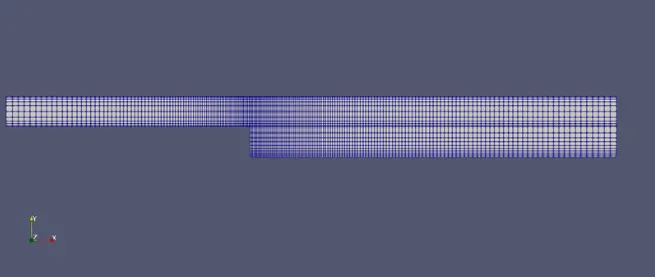
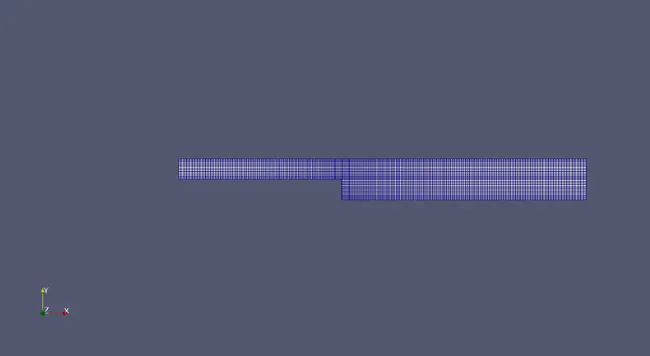
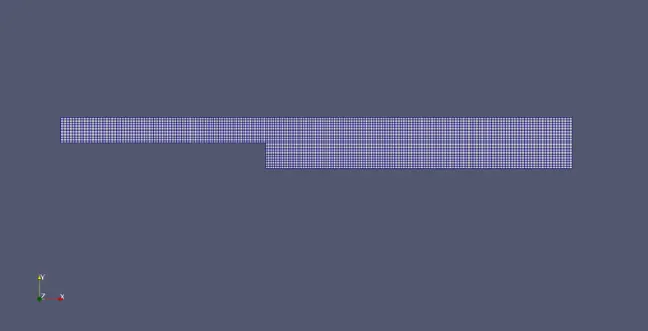
It is used to stretch the mesh in a particular axis. For our challenge, we are using 0.2, 0.5, and 0.8 as our grading factors.
OpenFoam Code for creating the mesh with MGF =0.2
blocks
(
    hex (0 1 2 3 11 12 13 14) (80 5 1) simpleGrading (0.2 5 1)
    hex (3 2 4 5 14 13 15 16) (80 5 1) simpleGrading (0.2 0.2 1)
    hex (2 7 6 4 13 18 17 15) (120 5 1) simpleGrading (5 0.2 1)
    hex (1 8 7 2 12 19 18 13) (120 5 1) simpleGrading (5 5 1)
    hex (10 9 8 1 21 20 19 12) (120 10 1) simpleGrading (5 5 1)
);
OpenFoam code for creating mesh with MGF = 0.5
blocks
(
    hex (0 1 2 3 11 12 13 14) (80 5 1) simpleGrading (0.5 2 1)
    hex (3 2 4 5 14 13 15 16) (80 5 1) simpleGrading (0.5 0.5 1)
    hex (2 7 6 4 13 18 17 15) (120 5 1) simpleGrading (2 0.5 1)
    hex (1 8 7 2 12 19 18 13) (120 5 1) simpleGrading (2 2 1)
    hex (10 9 8 1 21 20 19 12) (120 10 1) simpleGrading (2 2 1)
);
OpenFoam code for creating mesh with MGF= 0.8
blocks
(
    hex (0 1 2 3 11 12 13 14) (80 5 1) simpleGrading (0.8 1.25 1)
    hex (3 2 4 5 14 13 15 16) (80 5 1) simpleGrading (0.8 0.8 1)
    hex (2 7 6 4 13 18 17 15) (120 5 1) simpleGrading (1.25 0.8 1)
    hex (1 8 7 2 12 19 18 13) (120 5 1) simpleGrading (1.25 1.25 1)
    hex (10 9 8 1 21 20 19 12) (120 10 1) simpleGrading (1.25 1.25 1)
);
Results:
Velocity profile for MGF =0.2
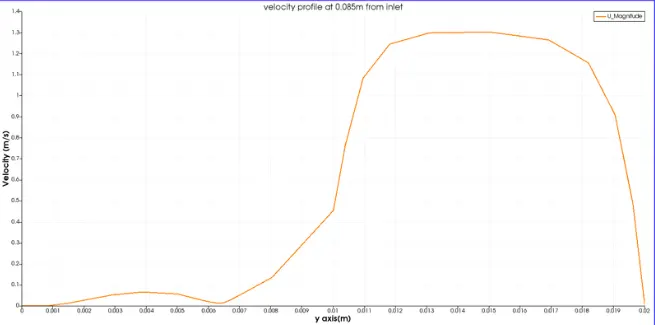
Velocity profile for MGF =0.5
Velocity profile for MGF =0.8
Conclusion:
By calculating the Mesh Grading factor, flow quantities can be calculated at the desired location. In our simulation flow quantities are calculated in more numbers of grid near to all walls.
From the above graph, it was noted that the velocity profile gets smoother near the walls. In MGF = 0.2 velocity profile is smoother near the wall as compared to other MGF.
But in MGF = 0.2 velocity profile has some sharp edges in the region other than the wall. Because of the coarse mesh in this region, MGF = 0.5 & 0.8 have smooth curves.