Week 4.1 - Genetic Algorithm
Introduction to Genetic Algorithms:-
A genetic algorithm is a search heuristic that is inspired by Charles Darwin’s theory of natural evolution. This algorithm reflects the process of natural selection where the fittest individuals are selected for reproduction in order to produce offspring of the next generation.
A genetic algorithm (GA) is a method for solving both constrained and unconstrained optimization problems based on a natural selection process that mimics biological evolution. The algorithm repeatedly modifies a population of individual solutions. At each step, the genetic algorithm randomly selects individuals from the current population and uses them as parents to produce the children for the next generation. Over successive generations, the population "evolves" toward an optimal solution.
You can apply the genetic algorithm to solve problems that are not well suited for standard optimization algorithms, including problems in which the objective function is discontinuous, nondifferentiable, stochastic, or highly nonlinear.
Notion of Natural Selection:-
The process of natural selection starts with the selection of fittest individuals from a population. They produce offspring which inherit the characteristics of the parents and will be added to the next generation. If parents have better fitness, their offspring will be better than parents and have a better chance at surviving. This process keeps on iterating and at the end, a generation with the fittest individuals will be found.
This notion can be applied for a search problem. We consider a set of solutions for a problem and select the set of best ones out of them.
Five phases are considered in a genetic algorithm.
- Initial population
- Fitness function
- Selection
- Crossover
- Mutation
1. Initial population:-
The process begins with a set of individuals which is called a Population. Each individual is a solution to the problem you want to solve.
An individual is characterized by a set of parameters (variables) known as Genes. Genes are joined into a string to form a Chromosome (solution).
In a genetic algorithm, the set of genes of an individual is represented using a string, in terms of an alphabet. Usually, binary values are used (string of 1s and 0s). We say that we encode the genes in a chromosome.
2. Fitness Function:-
The fitness function determines how fit an individual is (the ability of an individual to compete with other individuals). It gives a fitness score to each individual. The probability that an individual will be selected for reproduction is based on its fitness score.
3. selection:-
The idea of selection phase is to select the fittest individuals and let them pass their genes to the next generation.
Two pairs of individuals (parents) are selected based on their fitness scores. Individuals with high fitness have more chance to be selected for reproduction.
4. Crossover:-
Crossover is the most significant phase in a genetic algorithm. For each pair of parents to be mated, a crossover point is chosen at random from within the genes.
5. Mutation:-
In certain new offspring formed, some of their genes can be subjected to a mutation with a low random probability. This implies that some of the bits in the bit string can be flipped.
Syntax for ga :-
clear all
close all
clc

% Input

x = linspace(0,0.6,150);
y = linspace(0,0.6,150);
num_spaces = 50;

% Forming 2d array

[xx yy] = meshgrid(x,y);
for i = 1:length(xx)
    for j = 1:length(yy)
        input_vector(1) = xx(i,j);
        input_vector(2) = yy(i,j);
        input_vector = [input_vector(1),input_vector(2)];
        f(i,j) = stalagmite(input_vector);
    end
end

% Study 1 - unbounded
tic
for i = 1:num_spaces
    [results, fopt(i)] = ga(@stalagmite,2)
    xopt(i) = results(1);
    yopt(i) = results(2);
end

study_time1 = toc

% Plotting

figure(1)
subplot(2,1,1)
surf(x,y,-f)
shading interp
hold on
plot3(xopt,yopt,-fopt,'Marker','o')
subplot(2,1,2)
plot(-fopt)
xlabel('Iteration')
ylabel('Function Maximum')

% Study2 - bounded

tic
for i = 1:num_spaces
    [results,fopt(i)] = ga(@stalagmite,2,[],[],[],[],[0;0],[0.6;0.6]);
    xopt(i) = results(1);
    yopt(i) = results(2);
end

study_time2 = toc

% Plotting

figure(2)
subplot(2,1,1)
surf(x,y,-f)
shading interp
hold on
plot3(xopt,yopt,-fopt,'Marker','o')
subplot(2,1,2)
plot(-fopt)
xlabel('Iteration')
ylabel('Function Maximum')

% Study3 - Increased initial population
tic
options = optimoptions('ga')
options = optimoptions(options,'populationsize',250)
for i = 1:num_spaces
    [results,fopt(i)] = ga(@stalagmite,2,[],[],[],[],[0;0],[0.6;0.6],[],[],options);
    xopt(i) = results(1);
    yopt(i) = results(2);
end

study_time3 = toc

% Plotting

figure(3)
subplot(2,1,1)
surf(x,y,-f)
shading interp
hold on
plot3(xopt,yopt,-fopt,'Marker','o')
subplot(2,1,2)
plot(-fopt)
xlabel('Iteration')
ylabel('Function Maximum')
Function calling code:-
function A = stagalmite(input_vector)
x = input_vector(1);
y = input_vector(2);
f1 = (sin(5.1*pi*x+0.5)).^6;
f2 = exp((-4*log(2)*((x-0.0667).^2))/0.64);
f3 = (sin(5.1*pi*y+0.5)).^6;
f4 = exp((-4*log(2))*((y-0.667).^2)/0.64);
A = -(f1*f2*f3*f4);
end
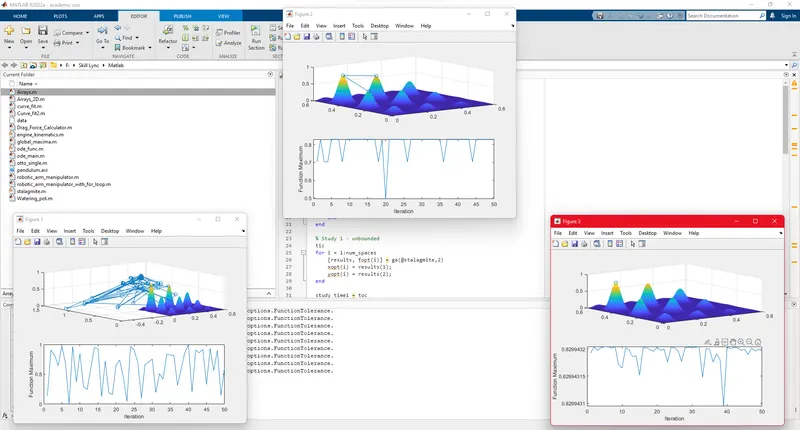
Explanation:-
Initialize the values of x & y taking 150 values between the interval 0 & 0.6
No. of iterations - 50
We take the 2d array of x & y using meshgrid command & store it in input_vector array.
ga only minimises a function , if -f is taken it gives us the maxima.
we use genetic algorithm function to find maxima.
The output is store into results which contains maxima & fopt which contains the value at which maxima is obtained.
Plot the surface of x,y & -f to get 3D plot.
Tic Toc command is used to record the time.
Similarly we do it with bounded values.
But it could not give the maxima value.
So next we do the study with initial population & bounded values.
Finally we get the maxima value.