Week 8 - Simulating Cyclone separator with Discrete Phase Modelling
Aim :
To perform analysis on the cyclone seperator and calculate the seperation efficiency and the pressure drop.
Theory :
Emprical models used to calculate the cyclone efficiency:
Cyclone seperator is the device which is used to seperate particle from the carrier gas .
For example , it is able to seperate dust particle from the gas .
This cyclone seperator is simple in construction , economy and flexibility and its maintenance cost is highly low when compared with other form of seperation.
There are many types of cyclone seperators used depends upon the application.Their efficiency is the main role in imparting the application.Most commonly used cyclone seperator is the reverse folw seperator with tangential inlet mostly used in the industrial gas cleaning.
The flow with swirl is get simulated not only by k-E model, because this becomes inadequate which can cause excessive turbulence velocities and un realistic tangential velocities ,
Reynolds stress model can improve the accuracy of the numerical solution.For gas solid flow there are two models , Like RSM and STOCHASTIC LAGRANGIAN MODEL in commercial.
The conventional method of predicting the flow field and the collection efficiency of a cyclone is emprical.
Here some emprical model which is used to calculate the efficiency,
1)IOZIA AND LEITH MODEL
2)LI AND WANG MODEL
3)KOCH AND LICHT MODEL
4)LAPPLE MODEL
1) IOZIA AND LEITH MODEL :
The modified version of Brath model, is iozia and leith model which is developed based on the force balance. there are two forces which creates during the cyclone former is centrifugal force and latter is the flow resistance .
These two forces are carried by the vortex endurance.
2)LI AND WANG MODEL:
The LI AND WANG MODEL includes the particle bounce aand rebounce in to the entertainment and turbulent diffusuion at the cyclone wall . a two dimensional and analytical expression of the particle is obtained .
there are few assumption in which the LI AND WANG model is carried out.
1) the radial velocity particle and radial concentration particle are not constant for the uncollected particles within the cyclone.
2) boundary condition with the consideration of the turbulent diffusion co efficient and particle rebounce
radius of the cyclone is equal to the tangential velocity.
3)KOCH AND LICHT MODEL :
Inherently turbulnt nature of the cyclones and the disribution of gas residence times within the cyclone Koch and Lich describes the paricle motion in the entry and collection regions.
Tangential velocity of a particle is equal to the tangential velocity of a gas flow.
there is no slip in the tangential direction between the particle and the gas.
the radius of the cyclone seperator is related to the tangential velocity.
4) LAPPLE MODEL :
This consist of force balance without considering the flow resistence .The entering particle in the cyclone is evenly distributed across the inlet opening width to the wall in the cyclone is collected with 50% efficiency.
CASE STUDIES :
Two case studies are there
1) varying the particle diameter with constant velocity .
2)varying the velocity with constant particle diameter .
GENERAL PROCEDURE AND BOUNDARY SETUP FOR THE CYCLONE ANALYSIS
step 1:
Open the space claim and import the geometry.
extract the volume by prepare volume icon and select the edges .
Suppress the body for physics.
Step2:
Next is setup which is used to setup the initial boundary condition.
Steady state , Gravity is applied
Model is K-Epsilon model with RNG exactly at swirl dominated flow.
Moving to the discrete phase model . This discrete phase model is combined with two module one is coupled flow and other is uncoulpled flow.
In coupled flow the discrete phase will not have interaction with continous phase , where as the uncoupled flow will have interaction between two discrete and continous phase.
Another factor which deals the particle trajectory is step length factor. the smaller the time step the larger the step length factor.
Both the specify the length scale and steplength factor will affect the time step size.
Boundary conditions:
Inlet velocity has to edited for the various velocity but for base model is performed at 3m/s.
Discrete phase model type.
Scheme as simple and changing the turbulent kinetic energy and turbulent dissipiation rate as second order.
Solution instead of hybrid , go for standard .
Initiallization of the simulation and run the simulation .
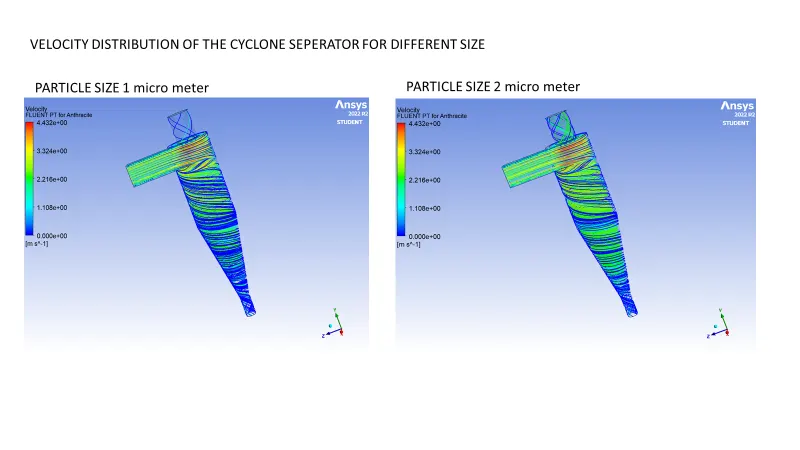
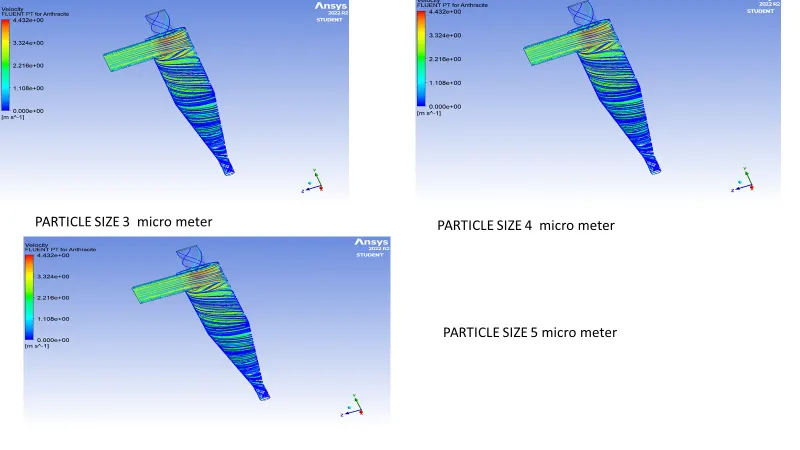
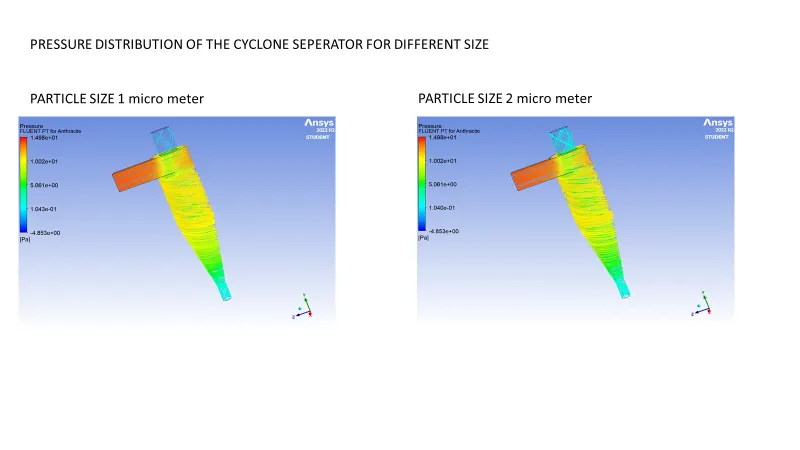
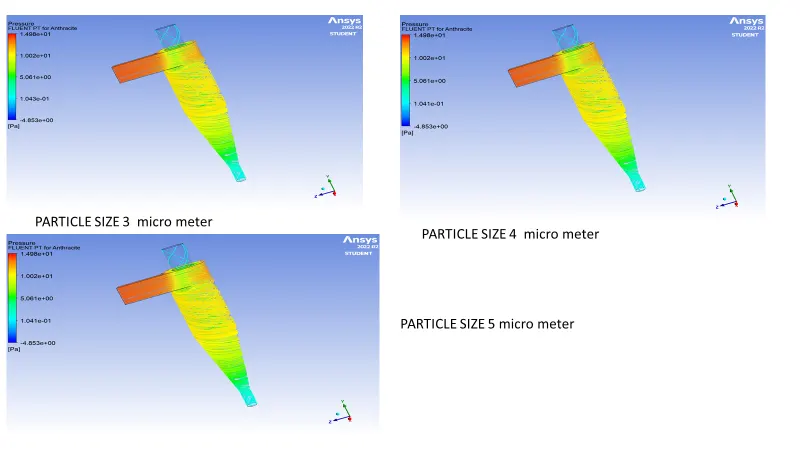
Two different scenarios are discussed, One is varying the size of the particle and another one is varying the velocity of the particle.
Velocity distribution of the cyclone seperator by varying the particle size of the matter.
The pressure distribution of the cyclone distributor by varying the particle size of the matter.
The velocity distribution of the cyclone seperator by changing the particle velocity speed.
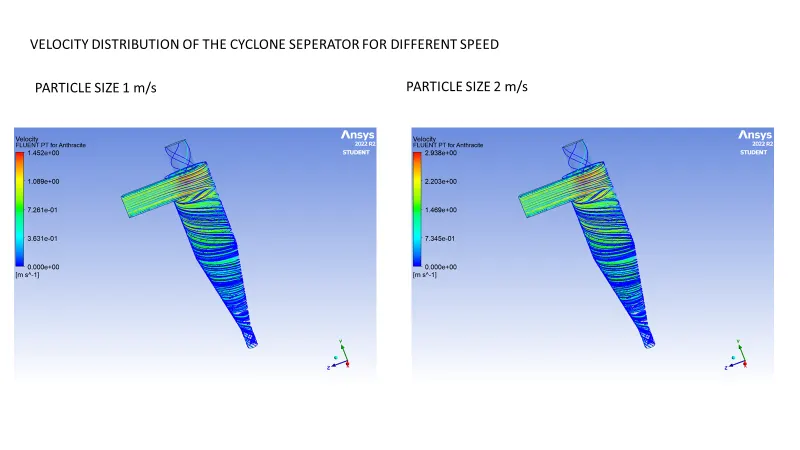
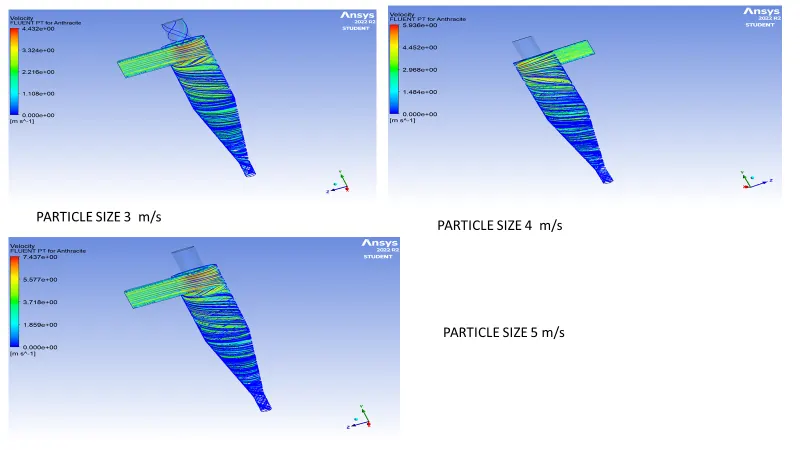
Pressure distibution of the cyclone seperator by varying the velocity of the particle matter.
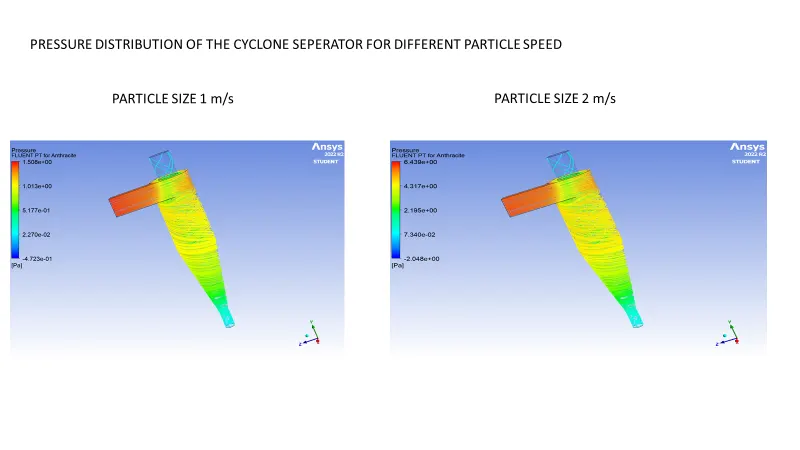
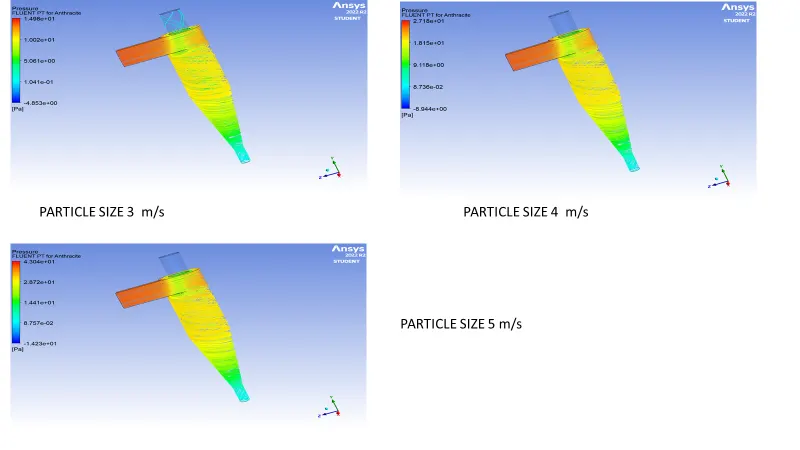
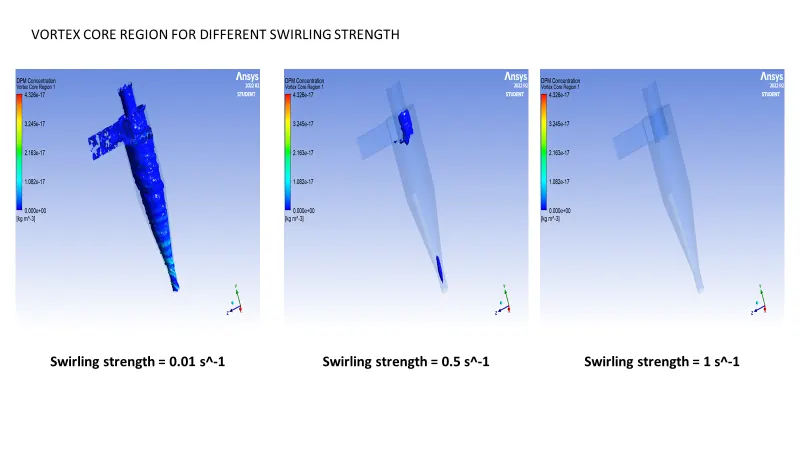
Vortex region of the cyclone seperator based on the swirl strength is intrepreted.
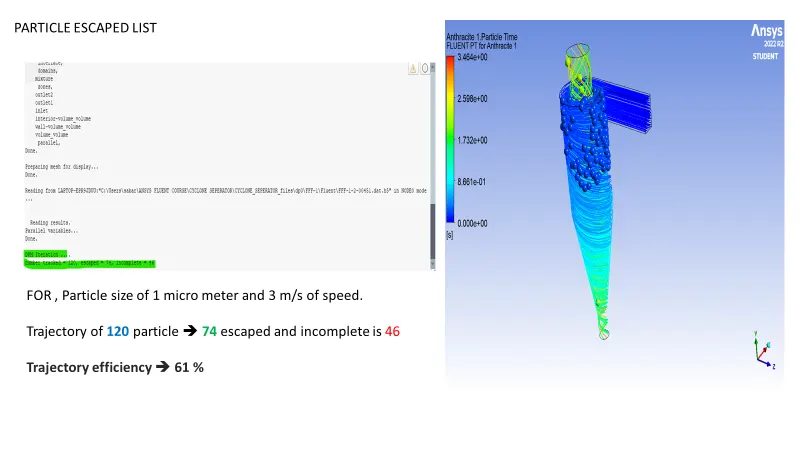
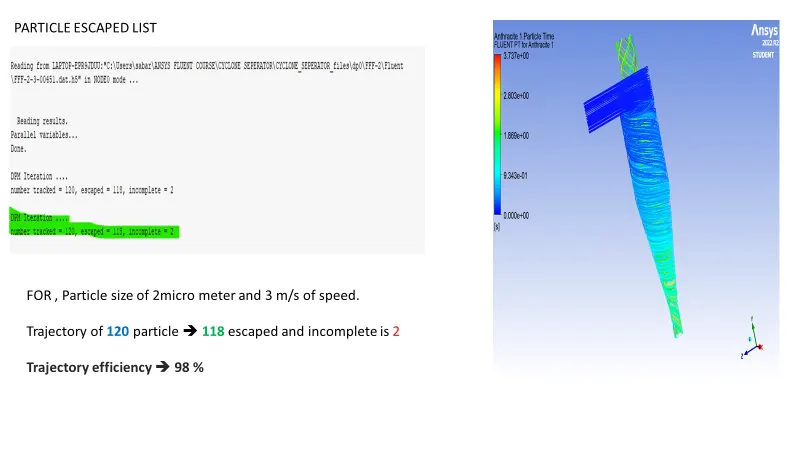
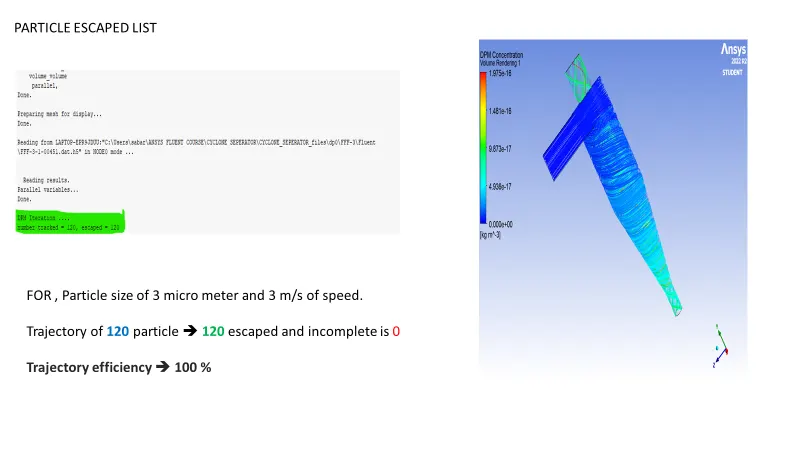
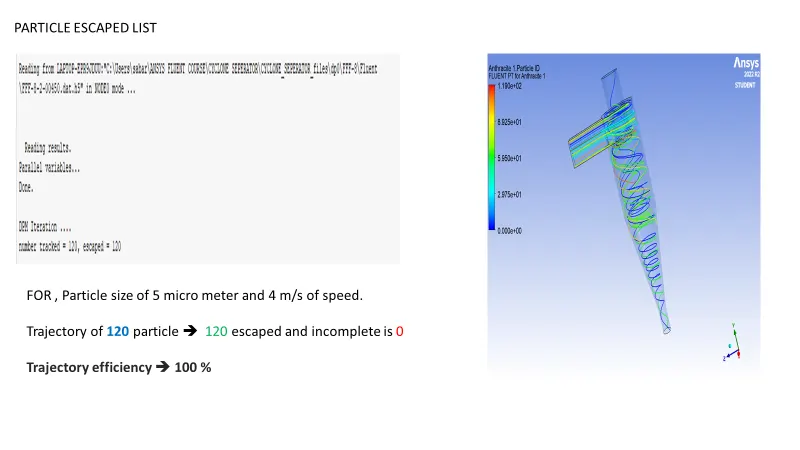
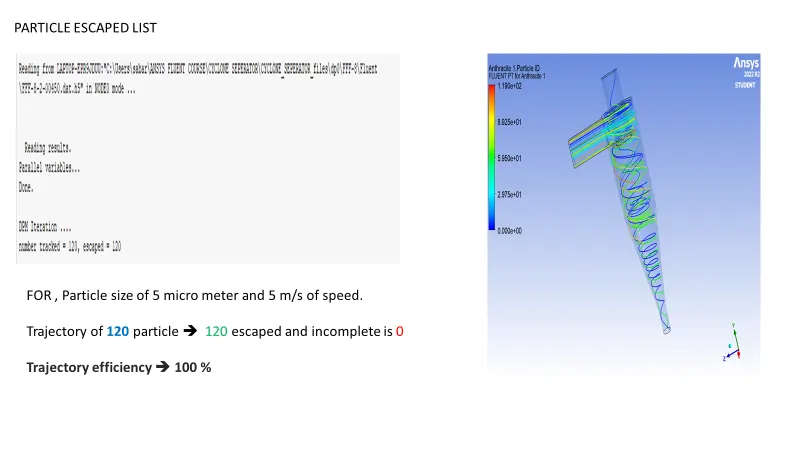
Trajectory efficiency is also calculated by the particle data history.
Based on the escaped and incomplete data fine particle this efficiency is calculated which is also directly proportional to the cyclone seperator efficiency.
For the different particle size :
1)
2)
3)
4)
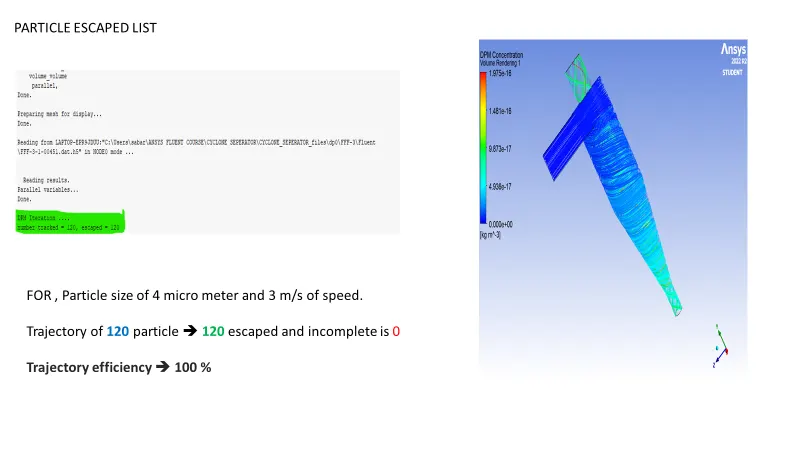
5)
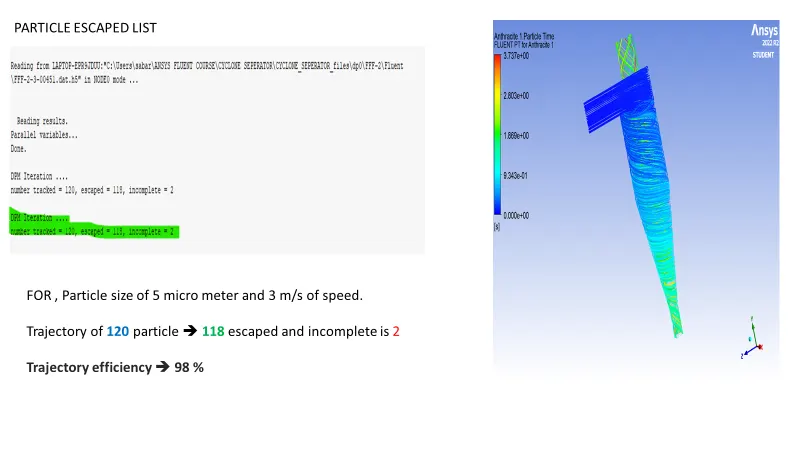
For the different velocity:
1)
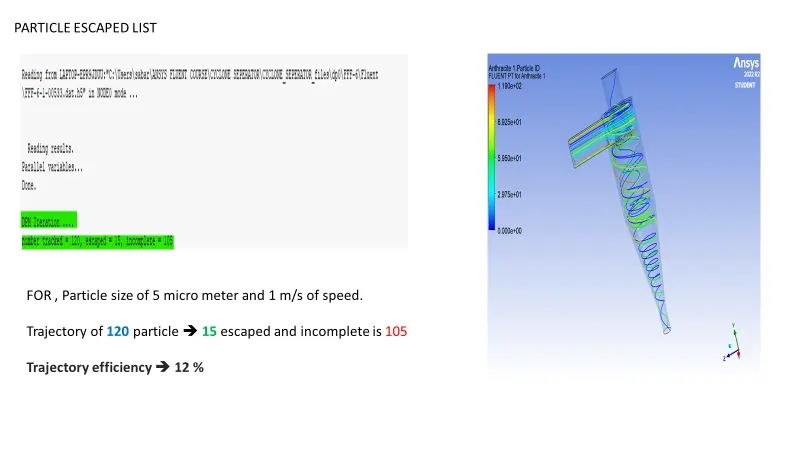
2)
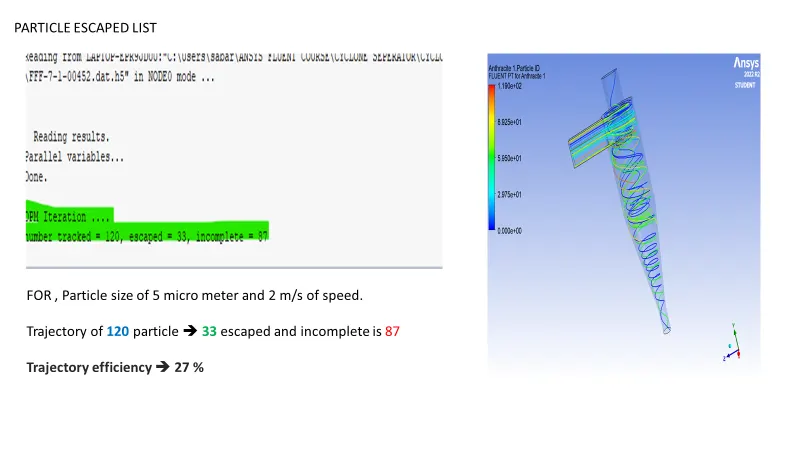
3)
4)
Conclusion:
Here the trajectory efficiency clearly states the performace of the cyclone seperator.
the paticle size and the velocity and the design of the cyclone seperator is all cumulatively decides the performance efficiency of the cyclone seperator.