Week 8 - Simulating Cyclone separator with Discrete Phase Modelling
Aim : To perform analysis on cyclone separator and calculate the separation efficincy and pressure drop.
Objectives :
- Discussion on four empirical models used to calculate the cyclone efficiency.
- To perform an analysis on cyclone separator by varying the particle diameter from 1 um to 5 um. Calculate separation efficiency in each case.
- To perform analysis on a cyclone separator by varying particle velocity from 1m/s to 5m/s and calculate the sep-aration efficiency and pressure dropin eacgh case.
INTRODUCTION
Cyclone separator is device that employ a centrifugal force generated by a spinning gas stream to separate particles from the flue gases. It's simple design, low cost, and maintenance-free operation make it ideal for use as pre-cleaners for more expensive final control devices such as bag-houses or electrostatic precipitators. Cyclone collection efficiencies can reach 99% for particles bigger than 5 μm and can be operated at very high dust loading.
Two parameters that define the design of a Cyclone separator are the collection efficiency of particle and pressure drop through the cyclone. An accurate prediction of cyclone efficiency is very important because an inaccuracy in the efficiency prediction may result in an inefficient design of the cyclone separator. CFD has a great potential to predict the flow field characteristics and particle trajectories inside the cyclone as well as the pressure drop. Complicated swirling turbulent flow in a cyclone places great demands on the numerical techniques and the turbulence models employed in the CFD codes when modeling the cyclone pressure drop.
The cyclone efficiency can be determine by four dufferent models. They are discuss as follows;
1. Lapple Model:
Lapple model was developed based on force balance without considering the flow resistance. Lapple assumed that a particle entering the cyclone is evenly distributed across the inlet opening. The particle that travels from inlet half-width to the wall in the cyclone is collected with 50% efficiency. The efficiency of collection of any size of the particle is given by
ηi = 1/ [1+(dpc/dpi)2]
2. Koch & Licht Model:
Koch and Licht collection theory recognized the inherently turbulent nature of cyclones and the distribution of gas residence times within the cyclone. Koch and Licht described particle motion in the entry and collection regions by the following assumptions:
- The tangential velocity of a particle is equal to the tangential velocity of the gas flow, i.e. there is no slip in the tangential direction between the particle and the gas.
- The tangential velocity is related to the radius of cyclone by uRn = constant.
A force balance and an equation on the particles collection yields the grade efficiency
ηi = 1- exp {-2[(G τi Q)(n+1)/ D3)]0.5/(n+1)}
3. Iozia & Leith Model:
Iozia and Leith logistic model are based on force balance. The model assumes that a particle carried by the vortex endures the influence of two forces: a centrifugal force and flow resistance. The collection efficiency ηi of particle diameter dpi can be calculated from
ηi = 1/[1+(dpc/dpi)β
β is an expression for slope parameter derived based on the statistical analysis of experimental data of a cyclone.
4. Li & Wang Model: The Li and Wang model include particle bounce or re-entrainment and turbulent diffusion at the cyclone wall. A two-dimensional analytical expression of particle distribution in the cyclone is obtained.
The resultant expression of the collection efficiency for a particle of any size is given as
ηi = 1- exp{-λθ1}
Effectiveness:
Cyclone separators are generally able to remove somewhere between 50-99% of all particulate matter in flue gas. How well the cyclone separators are actually able to remove this matter depends largely on particle size. If there is a large amount of lighter particulate matter, less of these par0ticles are able to be separated out. Because of this, cyclone separators work best on flue gases that contain large amounts of big particulate matter.
There are several advantages and disadvantages in using cyclone separators. First, cyclone separators are beneficial because they are not expensive to install or maintain, and they have no moving parts. This keeps maintenance and operating costs low. Second, the removed particulate matter is collected when dry, which makes it easier to dispose of. Finally, these units take up very little space. Although effective, there are also disadvantages in using cyclone separators. Mainly because the standard models are not able to collect particulate matter that is smaller than 10 micrometres effectively and the machines are unable to handle sticky or tacky materials well.
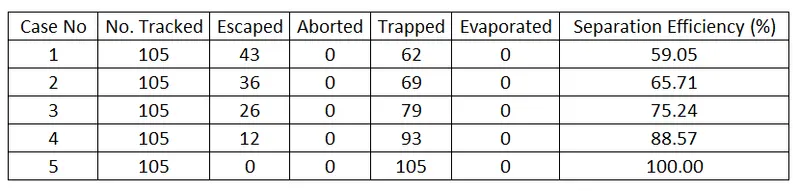
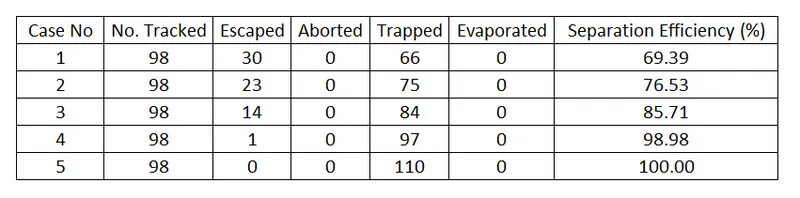
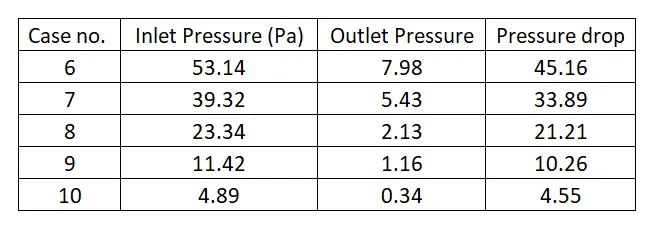
Seperation efficiency is ratio of trapped particles to the total number of particles tracked. Pressure drop is defined as the difference in total pressure between two points of fluid carrying network.
Pressure drop = Total inlet pressure - Total outlet pressure(top).
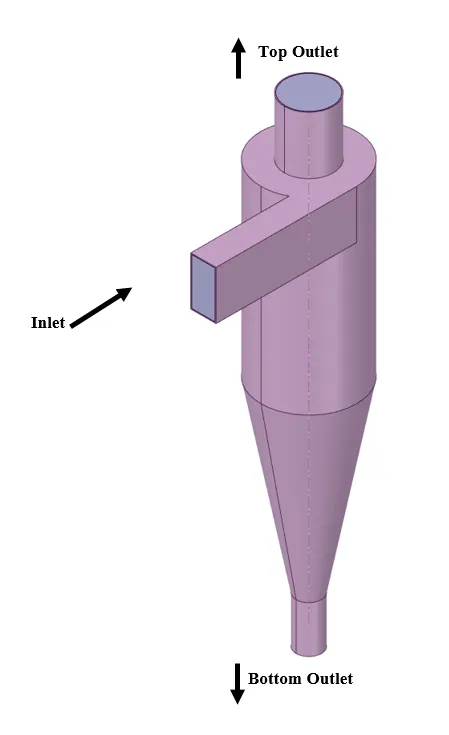
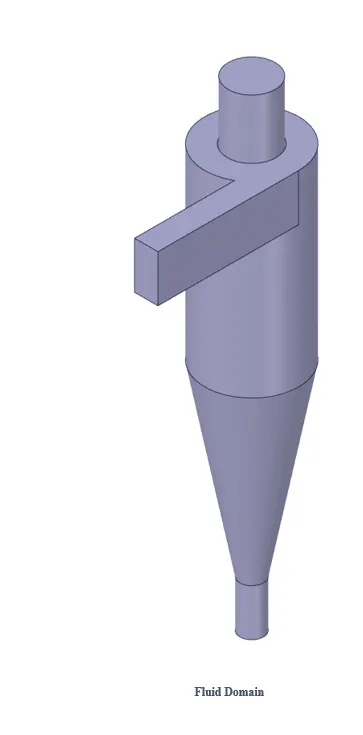
Geometry :
MESHING :
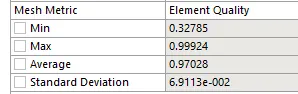
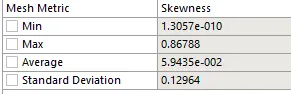
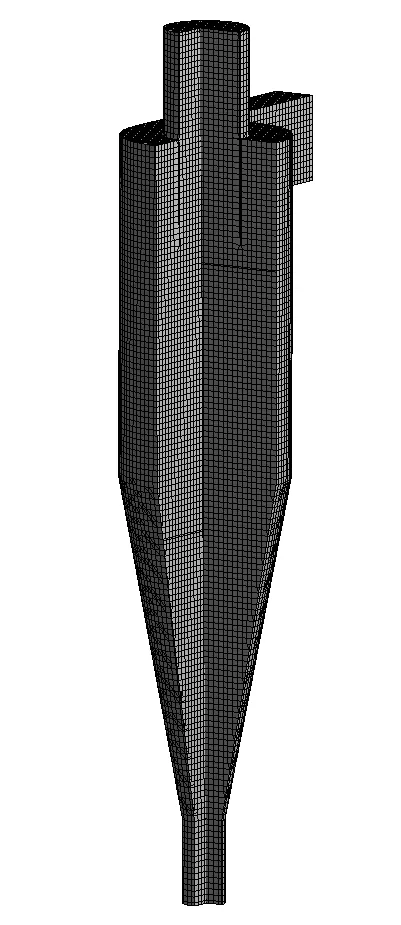
Assembly meshing is used. The element counts is 74667.
Element quality :
Skewness :
Boundary condition :
In order to provide boundary conditions, the name selection are created as shown in above CAD model.
FLUENT SETUP :
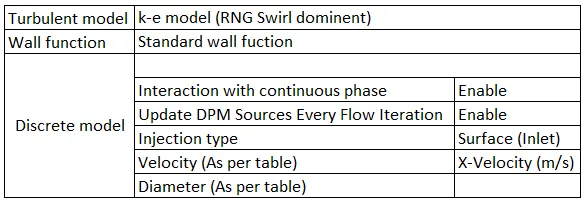
In order to analyse cyclone separator, discrete phase modeling to be done. The discrete phase modeling can be used with several turbulent model. The coupled between turbulent model and discrete phase model can be done by single click. In this project, several cases are created such as varying particcle size by keeping velocity consatnt where as by varying velocity keeping partcle size constant as shown in table.
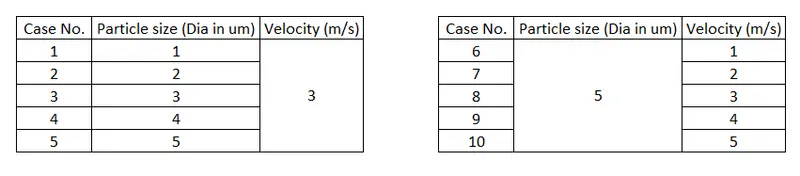
Note : The magnitude of velocity of particle as well air flow from inlet are same in each case.
Turbuence modeling :
Discrete Phase results:
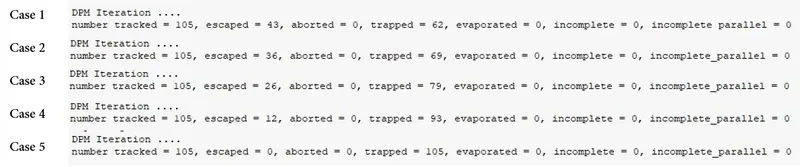
This condition include constant air f,low velocity of 3 m/sec and varying diameter of particle. The particle velocity is same as air flow velocity. Results shows the variation of separation by varying diameter of particles.
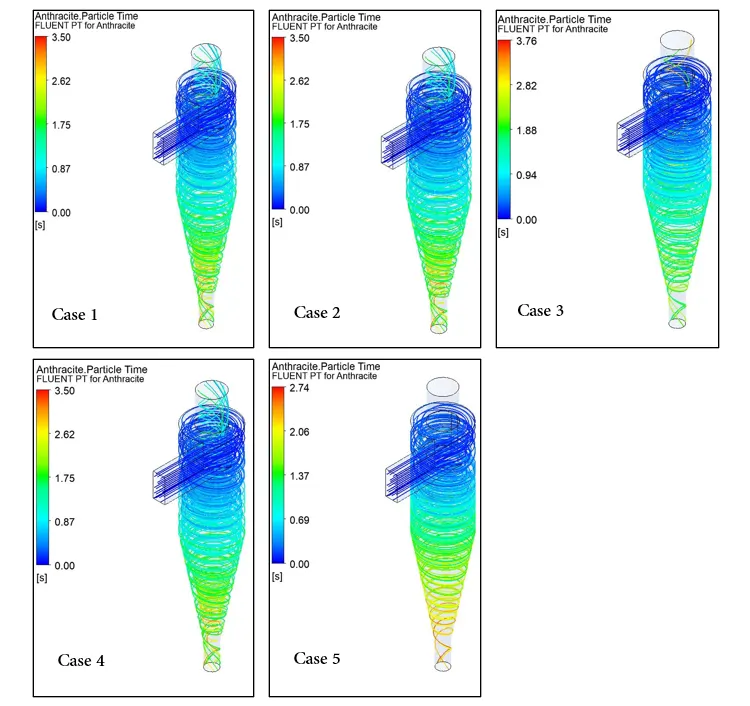
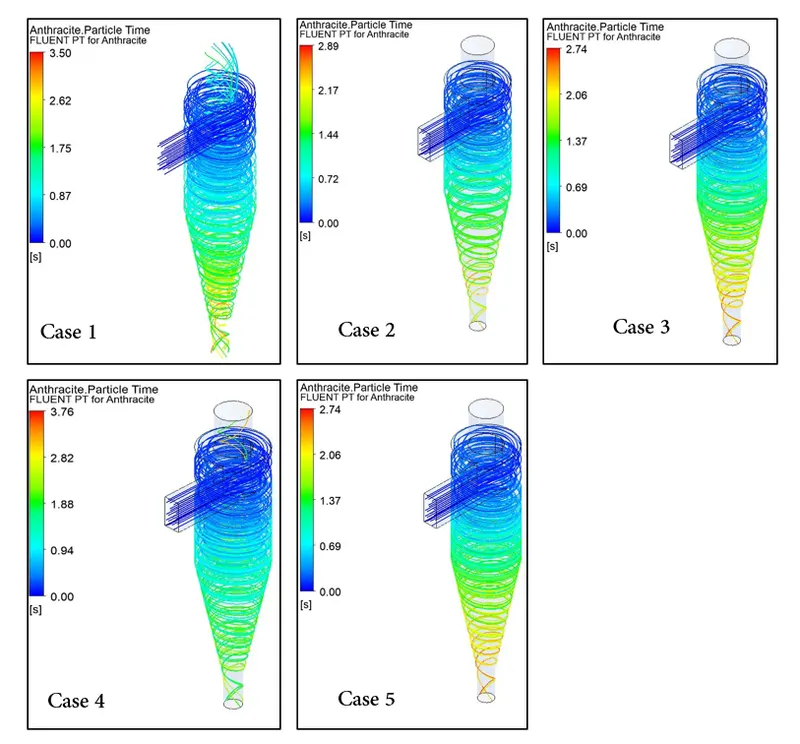
The following images shows residence time of particle inside the cyclone.
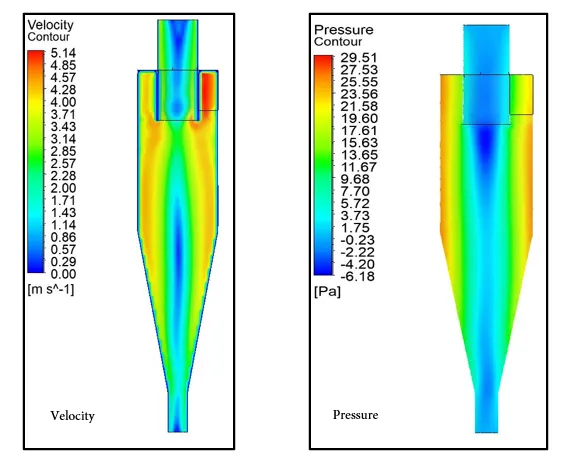
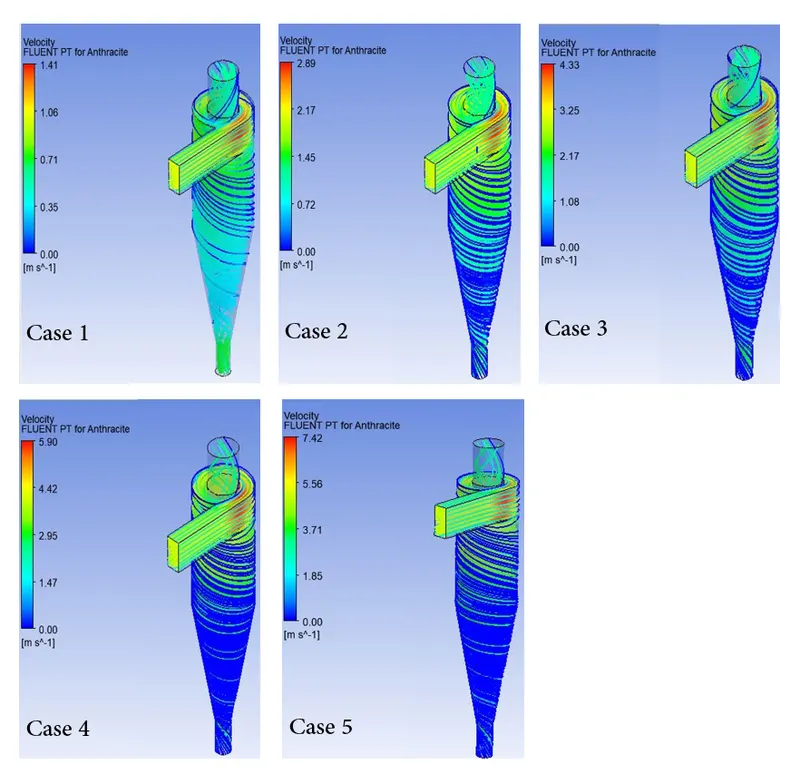
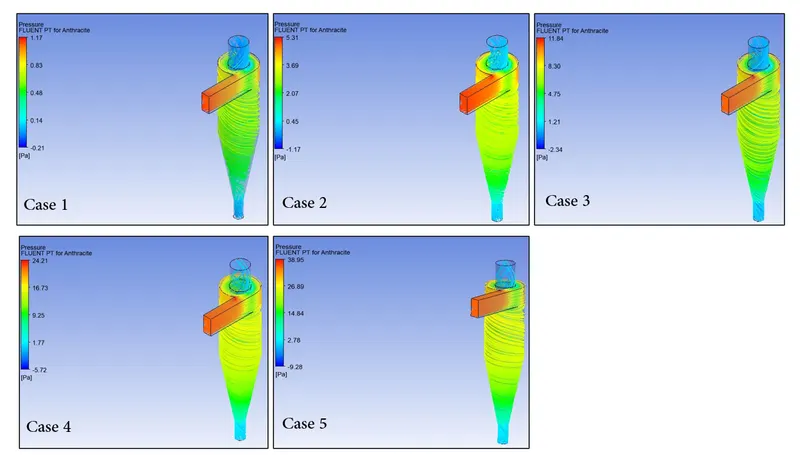
Velocity and Pressure Contour :
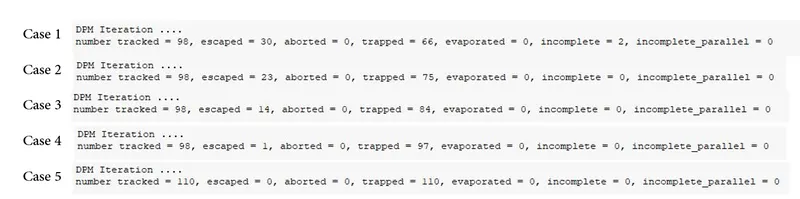
Pressure at inlet and top outlet are given in following table,
Conclusion:
1.Seperation Efficiency depends on both diameter and velocity of particles.
2.Increase in diameter and velocity increases seperation efficiency.
3.Velocity has greater impact as compared to diameter of particle.
4.Pressure drop is dependant on velocity. for constant velocity with varying diameter size the pressure drop remains almost constant.
5.Increase in velocity causes the pressure drop to rise exponentially.