Week 8 - Simulating Cyclone separator with Discrete Phase Modelling
Simulating Cyclone separator with Discrete Phase Modelling
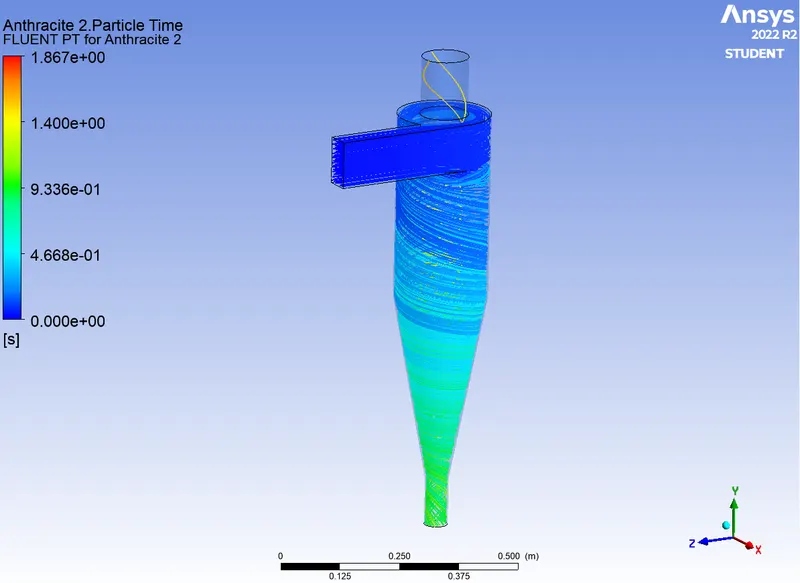
Aim : To perform analysis on cyclone separator and calculate the separation efficiency and pressure drop.
Objective:-
- To write a few words about any four empirical models used to calculate the cyclone separator efficiency.
- To perform an analysis on a given cyclone separator model by varying the particle diameter from 1 μm to 5 μm and calculate the separation efficiency in each case. Discuss the results. [Use both the velocity's as 3m/sec.]
- To perform an analysis on a given cyclone separator model by varying the particle velocity from 1 m/sec to 5 m/sec and calculate the separation efficiency and pressure drop in each case
Theory :
Cyclone separators provide a method of removing particulate matter from air or other gas streams at low cost and low maintenance. Cyclones are somewhat more complicated in design than simple gravity settling systems, and their removal efficiency is much better than that of settling chamber.
CYCLONE EFFICIENCY EMPIRICAL MODELS:
Iozia and Leith Model:
Iozia and Leith logistic model is a modified version of Barth Model, which is developed based on force balance.The model assumes that a particle carried by the vortex endures165the influence of two forces centrifugal force and a flow resistance.
Li and Wang Model:
The Li and Wang model includes particle bounce or re-entrainment and turbulent diffusion at the cyclone wall. A two-dimensional analytical expression of particle distribution in the cyclone is obtained.
Koch and Licht Model:
Koch and Licht collection theory recognized the inher-ently turbulent nature of cyclones and the distribution of gasresidence times within the cyclone.
Lapple Model:
Lapple model was developed based on force balance with-out considering the flow resistance. Lapple assumed that a par-ticle entering the cyclone is evenly distributed across the inlet opening. The particle that travels from inlet half width to the wall in the cyclone is collected with 50% efficiency.
Procedure:
Geometry:
Import the geometry in Space claim
Extract the fluid volume:
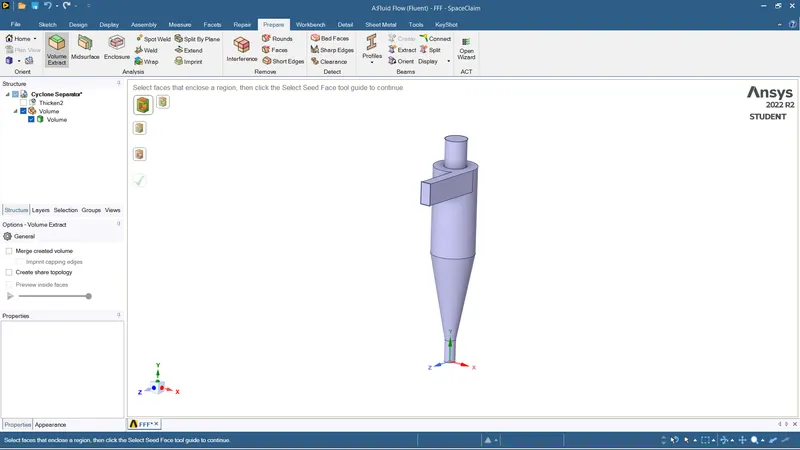
Meshing:
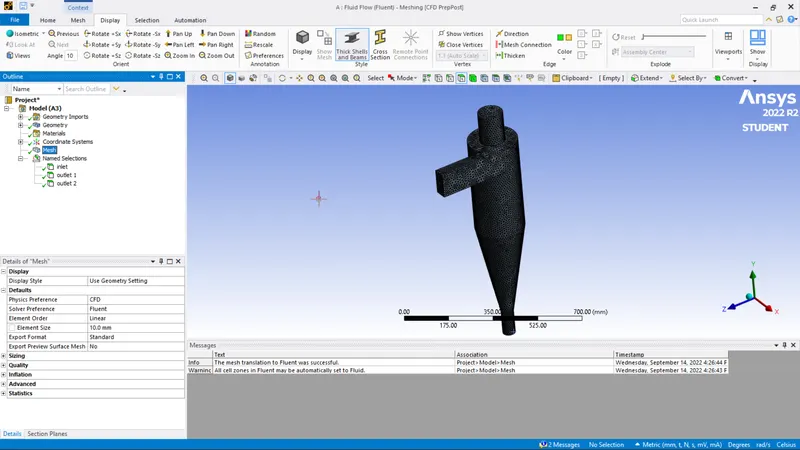
Assign the names accordingly and mesh with 10mm
Setup:
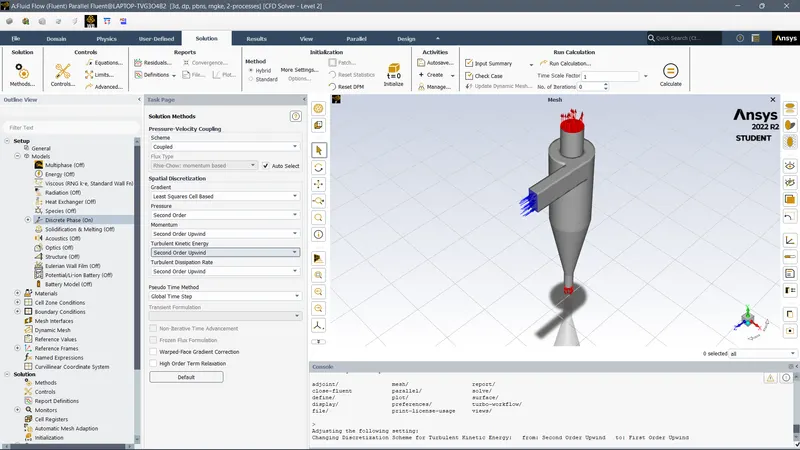
Steady state solver
Gravity - 9.81
Method:
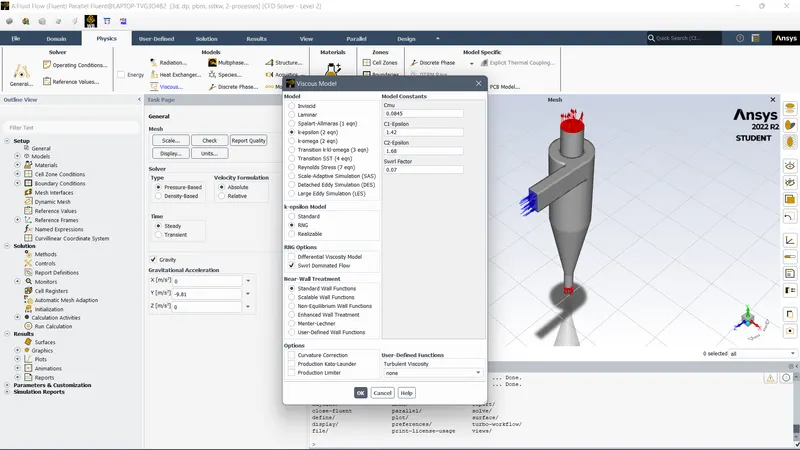
Viscous - RNG K-epsilon model
Discrete Phase:
Diameter - 5 μm , velocity - 3 m/s.
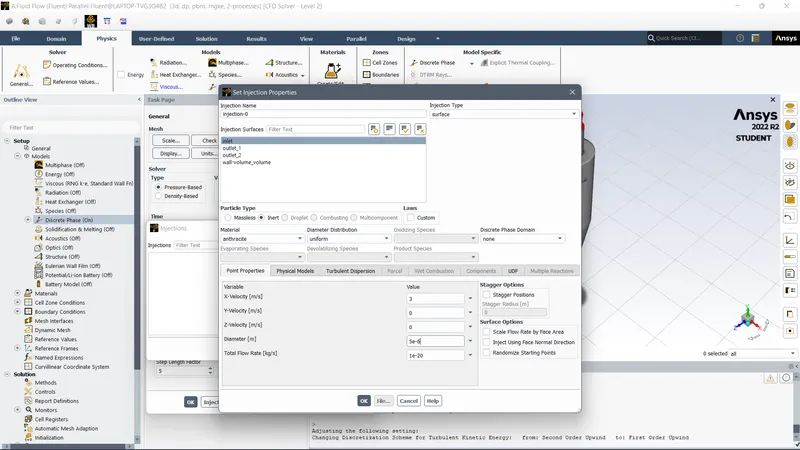
Initialize and calculate the solution.
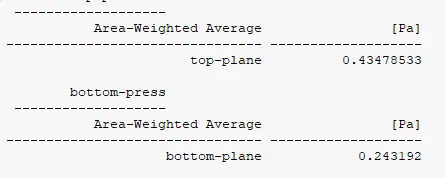
Pressure drop:
Create the top and bottom plane near the outlets.
top-plane =0.43478533 Pa
bottom-plane= 0.243192 Pa
Pressure drop = 0.19 Pa
DPM Iteration ....
number tracked = 124, escaped = 3, trapped = 121
Seperation effeciency = No. of particle trapped / No. of particles
Separation Efficiency in % = (121 / 124) * 100 = 97.5%
Export the particle data.
Open solution and import the data.
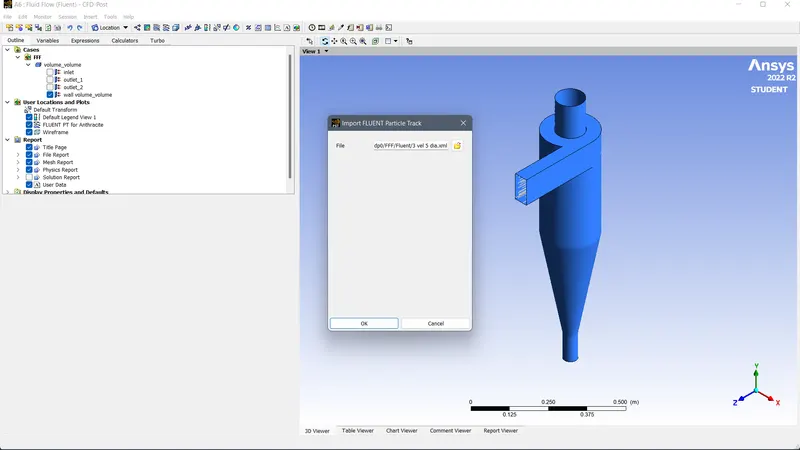
Flow data:
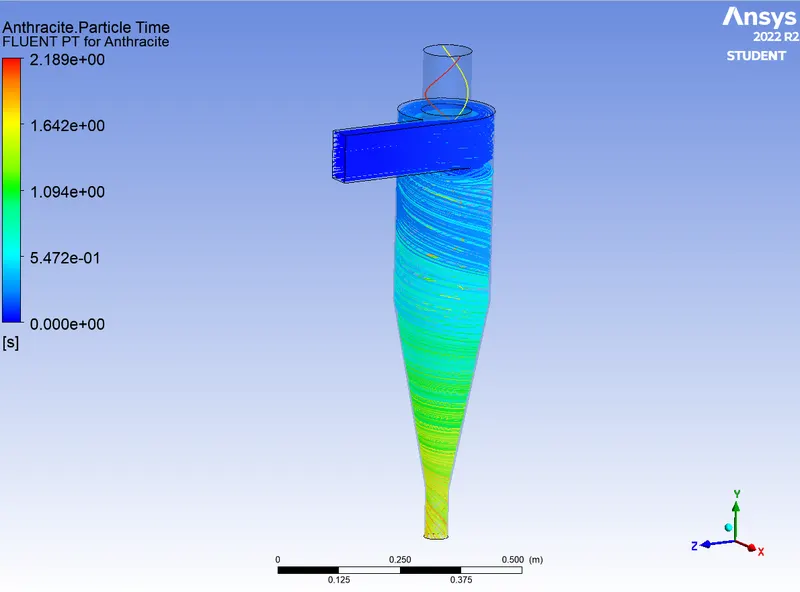
For:
Diameter - 1 μm , velocity - 3 m/s.
Pressure drop= 0.19
Particle data:
DPM Iteration ....
number tracked = 124, escaped = 1, trapped = 123
Seperation effeciency = 123/ 124 * 100 = 99.1%
Import the particle data file.
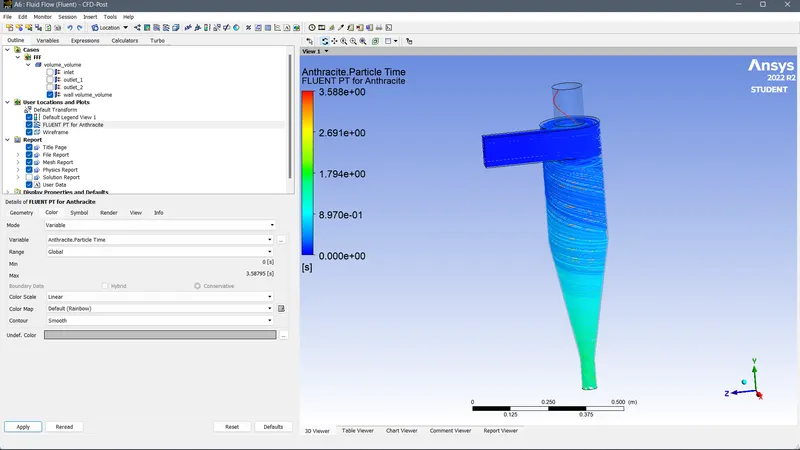
For
Diameter - 5 μm , velocity - 1 m/s
Pressure drop = 0.19
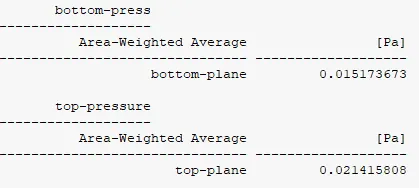
Particle data:
DPM Iteration ....
number tracked = 124, escaped = 4, trapped = 120
Seperation effeciency = 120/124 *100= 96.77 %
Import the data file:
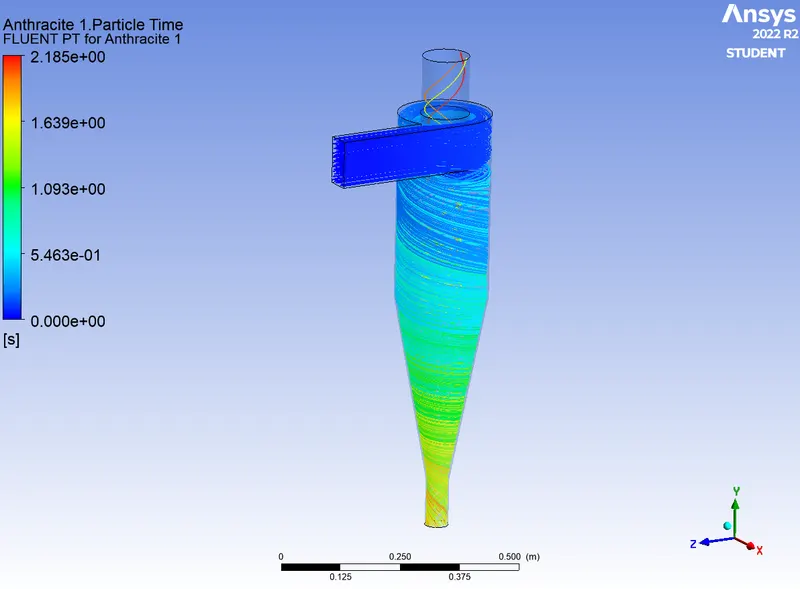
For
Diameter - 5 μm , velocity - 5 m/s
Pressure drop = 0.5
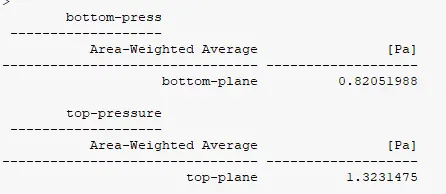
Particle data:
DPM Iteration ....
number tracked = 124, escaped = 4, trapped = 120
Seperation effeciency = 120 / 124 *100 = 96.77 %
Conclusion:
Obtained the particle data for all the cases.
For the increase in particle size, seperation effeciency decreases.
Seperation effeciency increase with increase in velocity.
Pressure drop occurs due to loss in rotational energy.