Multi cell Battery Pack
How weakest cell limits the usable capacity of the battery pack? What is the solution?
Li‐ion batteries are influenced by numerous features such as over‐voltage, under-voltage, overcharge and discharge current, thermal runaway, and cell voltage imbalance. One of the most significant factors is cell imbalance which varies each cell voltage in the battery pack over time and hence decreases battery capacity rapidly. To increase the lifetime of the battery pack, the battery cells should be frequently equalized to keeps up the difference between the cells as small as possible.
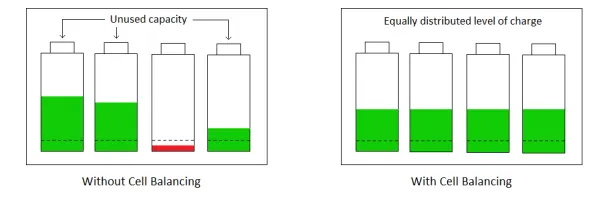
Cell Balancing
Cell balancing is the process of equalizing the voltages and state of charge among the cells when they are at a full charge. No two cells are identical. There are always slight differences in the state of charge, self-discharge rate, capacity, impedance, and temperature characteristics. This is true even if the cells are the same model, same manufacturer, and same production lot. Manufacturers will sort cells by a similar voltage to match as close as possible, but there are still slight variations in the individual cells' impedance, capacity, and self-discharge rate that can eventually lead to a divergence in voltage over time.
The use of cell balancing can improve the performance of series-connected Li-Ion Cells by addressing both State-of-Charge and Capacity/Energy issues. SOC mismatch can be remedied by balancing the cell during an initial conditioning period and subsequently only during the charge phase. C/E mismatch can be remedied by balancing during both charge and discharge periods. Even though the defect level for a given cell manufacturer may be very low, the extra confidence that a pack will not be returned, because of an early end of life, maybe well worth the extra effort. It provides another level of quality assurance.
Passive Cell Balancing
This method uses resistors in a balancing circuit which equalizes the voltage of each cell by the dissipation of energy from higher cell voltage and formulate the entire cell voltages equivalent to the lowest cell voltage. This technique can be classified as a fixed shunt resistor and switching shunt resistor methods. Also, this method should be used when charging mode only. Because discharge mode does not have reverse direction switching which results in a higher aggregated imbalance in each cycle.
Fixed shunt resistor method
The fixed shunt resistor cell balancing circuit is as shown in Figure 2. Where, V1, V2, V3, V4, …Vn is each cell voltage which is connected in series, and R1, R2, R3, R4, …Rn are fixed shunt resistors of each battery cell.
This technique balances each cell voltage by connecting the fixed resistor in parallel with each series-connected cell based on the required cell balance current. The balancing current is dissipated through the resistor which limits the voltage of each cell. This method is suitable for nickel and lead‐acid battery balancing circuits since these batteries are brought into overcharge conditions without any damage. This circuit is very simple, hence it requires fewer components and low cost. But the disadvantage of this technique is to provide the energy losses due to the energy are dissipated as heat in all the cells during balancing operation.
Switching shunt resistor method
The switching shunt resistor cell balancing circuit is as shown in Figure 3. Where, V1, V2, V3, V4, …Vn is each cell voltage which is connected in series, Q1, Q2, Q3, Q4, …Qn are semiconductor switches of each cell andR1, R2, R3, R4, …Rn are fixed shunt resistors of each battery cell.
This technique balances each cell voltage by connecting the resistor in parallel with each series-connected cell through controlled on/off semiconductor switches or relays. In this method, the resistor value is properly chooses based on the required balancing current. This method requires a controller for controlling the circuit in two different two modes. In continuous mode, the switches on/off are controlled at the same time, in sensing mode, the voltage of each cell is detected by a voltage sensor, which detects the cell imbalance situation and decides which resistor should be shunted.
Active Cell Balancing
This method is known as a non‐dissipative balancing technique that uses storage elements such as capacitors or inductors which transfer the energy from higher charge cell to lower charge cell until all the cells are balanced. This method can be classified based on capacitors, inductors, and power electronic converters. Also, this method can be used in both charging and discharging operations. This balancing circuit balances the cells in a shorter time and high efficiency than the passive balancing technique. But this circuit is a very complex system which increases the system cost high.
Capacitor based active balancing method
This technique is known as the charge shuttling method in which charge from the higher energy cell is released, that charge must be stored in a capacitor, and then transfer into a lower energy cell. There are different topologies of capacitor‐based cell balancing schemes are available. This technique can be classified based on a single capacitor and several capacitors used equalization methods.
Single capacitor cell equalizing circuit
Several capacitors based cell equalizing circuit, A, switched capacitor and B, double‐tiered switched capacitor
CONCLUSION
A difference in cell voltages is a most typical manifestation of unbalance, which is attempted to be corrected either instantaneously or gradually through by-passing cells with higher voltage. However, the underlying reasons for voltage differences in the level of battery chemistry and discharge kinetics are not widely understood. Therefore goals and extent of bypassing charge can not be clearly defined and attempted balancing can often achieve more harm than good. In fact, many common cell balancing schemes based on voltage only result in a pack more unbalanced than without them. Here we discussed the importance of cell balancing and various types of cell balancing techniques