Week 8 Multi cell Battery Pack
Q) How weakest cell limits the usable capacity of the battery pack? What is the solution?
ANS
a battery pack contain no of single cell grouped and connecting all cell a pack is formed a cell is of various chemistry when we charge or discharge by load the battery pack is very imp and is one of cell is weak the pack gets weak
Even if the batteries exhibit the same chemistry with the same physical size, shape, and
weight, they can have different total capacities, different selfdischarge rates, different internal resistances, and different aging which all have an effect on the overall battery life . These differences make batteries to face a major challenge of battery life, which research has shown can be extended by cell balancing. and thus call upon the battery management system (BMS) to perform cell balancing always.
The battery pack is limited in performance by the lowest capacity cell in the pack since once the weakest cell is depleted, the entire pack is effectively depleted.
CELL BALANCING
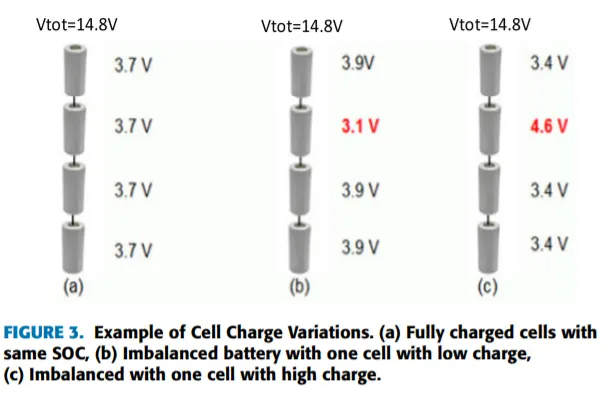
The importance of cell balancing is to equalize the voltage and SOC among the battery cells when they fully charged. As shown in Fig. 3 the two batteries have variations in cell charges, and this calls for cell balancing to bring the cells to the same SOC.
The main cell balancing schemes are active and passive methods . The cell balancing algorithms
are classified into a voltage-based algorithm and chargebased algorithm. The algorithms yield into either active or passive cell balancing methods that are applicable to balancing batteries, the attach file explains in detail.
The Need for Cell Balancing
When you need several cells grouped together to power a device, you need to do some sought of balancing. The reason is that battery cells are fragile things that die or get damaged if they are charged or discharged too much. For your cells that have different SoC and you start using them, their voltage starts dropping until the cell with the least amount of energy stored in it reaches the discharge cut off voltage of the cell.
At that point, if the energy keeps flowing through the cell, it gets damaged beyond repair. Now, if you attempt to charge this group of cells to the correct combined voltage, the healthy cells get overcharged and thus get damaged as they will take the energy that the already dead cell is no longer able to store. Imbalanced lithium-ion cells die the first time you try to use them. This is why balancing is absolutely required.
Other reasons for cell balancing include:
--Thermal Runaway
Battery cells, especially lithium cells are very sensitive to overcharging and over-discharging. This leads to thermal runaway when the rate of internal heat generation exceeds the rate at which the heat can be released. By the use of cell balancing, every non-defective cell in the battery pack should be balanced to the same relative capacity as the other non-defective cells. Other than using cell balancing, you can keep the pack cool since heat is one of the primary factors that lead to thermal runaway. This minimizes the retention of heat in the pack. You should maintain the battery environment at room temperature.
--Cell Degradation
When a lithium cell is overcharged even slightly above its recommended value the energy capacity, efficiency, and life cycle of the cell reduces. Cell degradation is mainly caused by:
1. Mechanical degradation of electrodes or loss of stack pressure in pouch-type cells.
2. Growth of solid electrolyte interface (SEI) on the anode. SEI is seen as a cause for capacity loss in most, if not all, graphite-based Li-ion when keeping the charge voltage below 3.92v/cell.
3. Formation of electrolyte oxidation (EO) at the cathode that may lead to sudden capacity loss.
4. Lithium-plating on the surface of the anode generated by high charging rates.
--Incomplete Charging of a Cell Pack
Batteries are charged at a constant current of between 0.5 and 1.0 rate. The battery voltage rises as the charging progresses to peak when fully charged then subsequently falls. Consider three cells with 77 Ah, 77 Ah, and 76 Ah respectively and 100 percent SoC and all cells are then discharged and their SoC goes down. You can figure out quickly that cell 3 becomes first to run out of energy since it has the lowest capacity.
When power is put on the cell packs and the same current is flowing through the cells, once again, cell 3 lags behind during charging and may be considered fully charged as the other two cells are fully charged. This means that cells 3 have a low Coulometric Efficiency (CE) due to the cell’s self-heating that results in cell imbalance.
--Incomplete Use of Cell Pack Energy
Drawing more current than the battery was designed for or short-circuiting the battery is most likely to cause premature failure of the battery. When discharging the battery pack, the weaker cells discharge faster than the healthy cells whereas they reach the lowest voltage more quickly than other cells. Providing regular rest periods during operation of the battery allows the chemical transformations in the battery to keep track of the demand for current.
solution
Maintenenace Balancing
Both active and passive cell balancing are effective ways to improve system health by monitoring and matching the SoC of each cell.
Active cell balancing redistributes charge during the charging and discharging cycle, unlike passive cell balancing, which simply dissipates charge during the charge cycle. Thus active cell balancing increases system run-time and can increase the charging efficiency.
Active balancing requires a more complex, larger footprint solution; passive balancing is more cost effective. Whichever method works best in your application, Analog Devices Inc. offers solutions for both, integrated into our battery management ICs (such as the LTC6803 and LTC6804) and complementary devices that work in conjunction with these ICs to provide a precise, robust battery management system.
Lithium-Ion Battery Pack With Fault
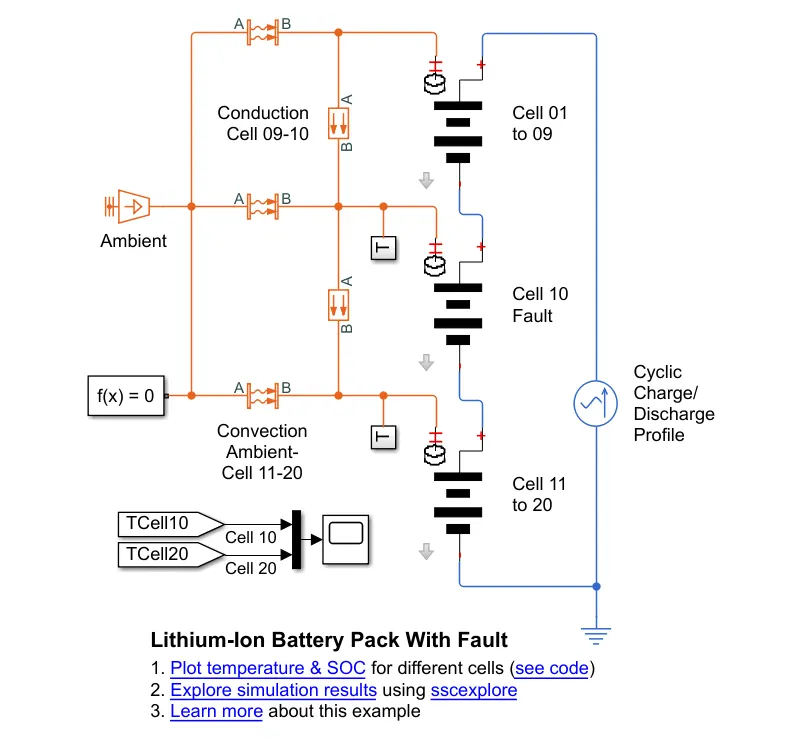
as wee know that from manny cell the battery pack is made and fault in any one of its cell problem may arise there is a simulink model in matlab all the cell 1 to 20 are connected in series and one of the cell is faulty
This example shows how to simulate a battery pack consisting of multiple series-connected cells in an efficient manner. It also shows how a fault can be introduced into one of the cells to see the impact on battery performance and cell temperatures. For efficiency, identical series-connected cells are not just simply modeled by connecting cell models in series. Instead a single cell is used, and the terminal voltage scaled up by the number of cells. The fault is represented by changing the parameters for the Cell 10 Fault subsystem, reducing both capacity and open-circuit voltage, and increasing the resistance values.
results
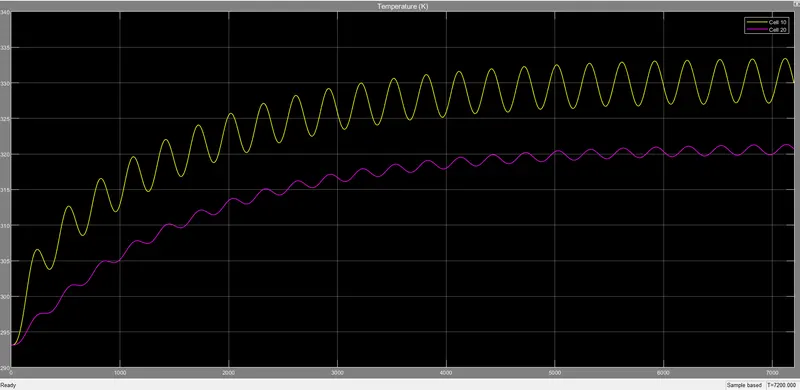
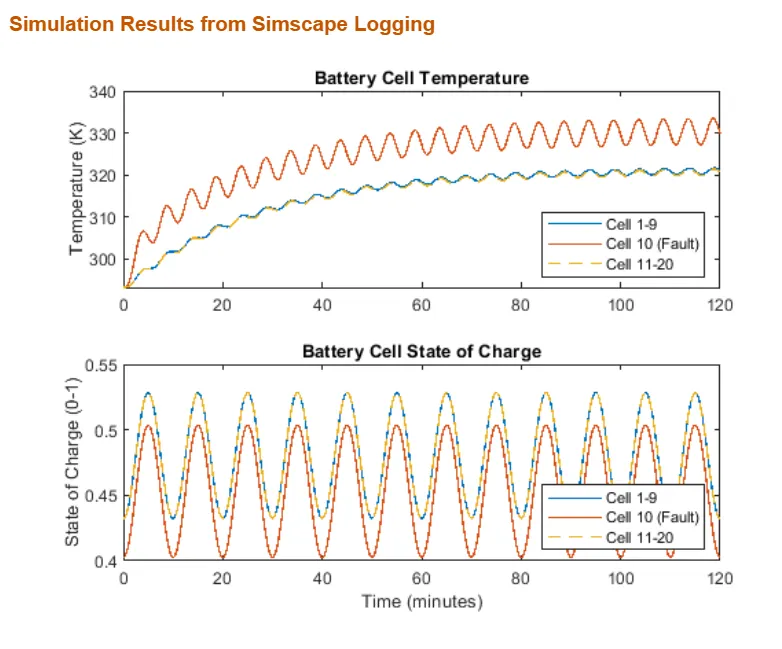
graph above is showing simulation result of 20 cells, the yellow graph is of a fault cell undergoing high temperature causing to overheat, compared to the rest which are at nominal battery temperature.