Week-11 Challenge: Braking
- For a defined driving cycle, calculate the energy required for braking.
- Why electric motor can’t develop braking torque at high speed similar to starting? How electric and mechanical brakes are coordinated?
- Make a MATLAB program which plots contour of given motor speed, torque and efficiency values. Attach the code as a .m file attach a screenshot of all the plot
....................................................................................................................................
Q1) For a defined driving cycle, calculate the energy required for braking.
ans
A brake is a mechanical device that inhibits motion by absorbing energy from a moving system. It is used for slowing or stopping a moving vehicle, wheel, axle, or to prevent its motion, most often accomplished by means of friction. Vehicle reaches from one velocity to another velocity level
When applied brake vehicle don’t stop suddenly vehicle still in motion due to kinetic energy (linear and rotational motion)
When a vehicle accelerates either from rest or while in motion, its kinetic energy will increase and the opposite occurs when a vehicle decelerates.
Taking an example question for better understanding .
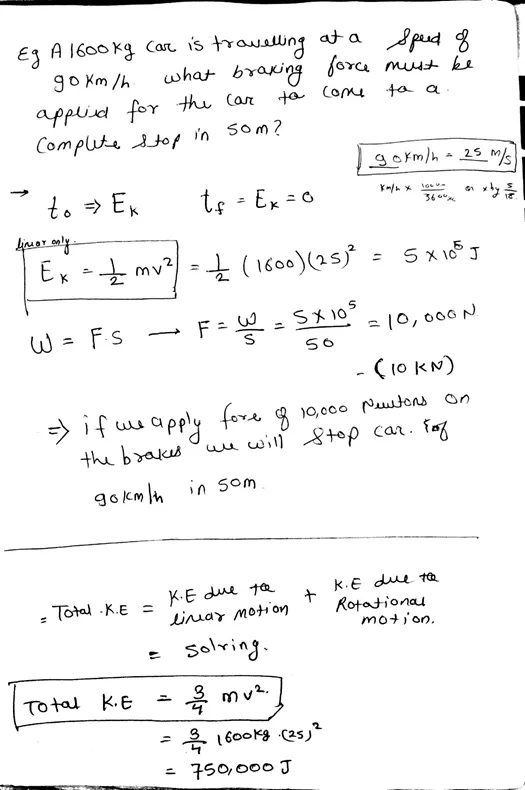
Above example we calculate the energy for braking
now we take a standard drive cycle calculate its braking energy required. And polot the curve
US EPA Urban Dynamometer Driving Schedule (FTP-75)
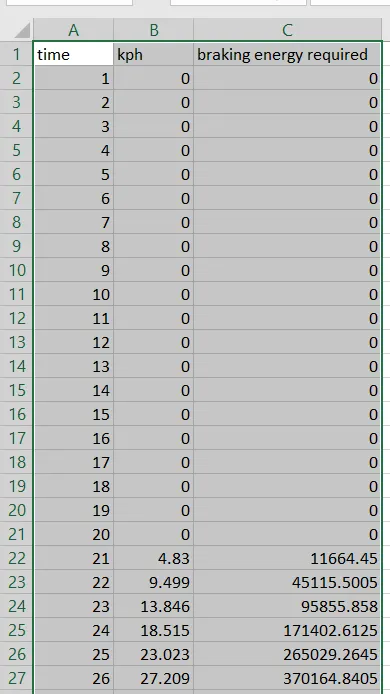
And so on we calculate the further values of energy of braking
E=1/2*M*V^2
M= mass of vehicle
V= velocity
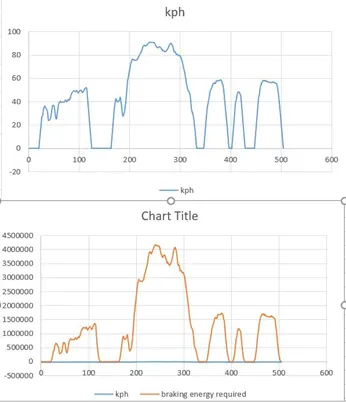
We see that after time 200sec speed increases and so braking energy is also required high.
We calculate the energy required for braking.
...............................................................................................................................
Q2) Why electric motor can’t develop braking torque at high speed similar to starting? How electric and mechanical brakes are coordinated?
ANS
The electric moter can’t develop braking torque at high speed similar to starting lets see what happens
When moter is in starting or moderate speed it require torque to maintain speed
When the ev moter in low speed it has more torque supporting braking operation, less speed ie low inertia so braking energy required is less.
When the speed is high torque required is high moter cannot provide we seen in speed torque curve
'angular speed', Now there is a relation between power consumption, torque and angular speed which is given by : Power = (Torque)*(Angular speed).
So more the torque, less is the angular speed required for the same rate of work consumption.
If the input power is constant, torque and angular speed become inversely proportional. Only then does the angular speed decreases as the torque increases.
It is a kind of a trade off only when constant power input is available
How electric and mechanical brakes are coordinated?
--
Series - The Regenerative Braking or the Mechanical Braking noth are applied one after another.
Parallel - The Regenerative Braking or the Mechnical Braking both are applied Parallely.
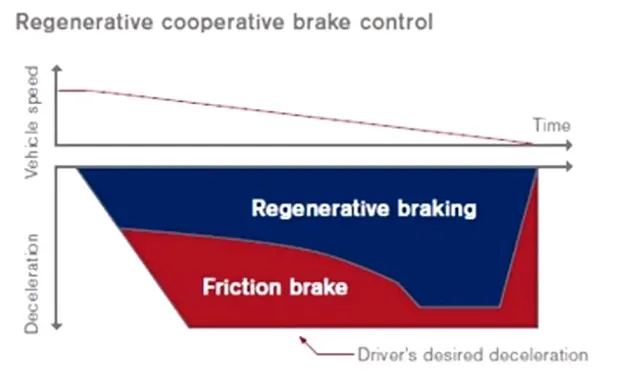
In general, EVs are equipped with the regenerative-hydraulic hybrid braking system. Whenever the regenerative braking torque is insufficient to offer the same deceleration rate as available in conventional vehicles, the hydraulic braking torque is applied. The control of their distribution is depicted in Fig. below which aims to provide the driver with the same braking feel as that experienced in conventional vehicles while maintaining maximum regenerative braking.
During low brake pedal force, only the regenerative braking torque is applied on the driving wheels, and is proportional to the pedal pressing force.
The braking torque on the non-driving wheels is always due to the hydraulic braking which is also proportional to the pedal pressing force.
When the pedal force is beyond a certain limit, the maximum regenerative braking torque is applied on the driving wheels, and the hydraulic braking torque is simultaneously applied on the driving wheels to top up the desired braking torque. Meanwhile, the maximum regenerative braking torque is kept constant to fully recover the kinetic energy.
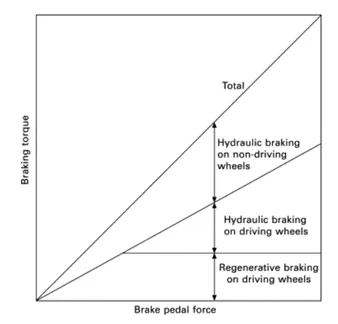
When the brake pedal is pressed the hydraulic fluid reaches the brake piston and created the braking pressure on the wheels and the same kinetic energy is been used by the Regenerative Braking for generating more power using the Bi-directional motor which operates as a generator while braking.
.................................................................................................................................
Q3) Make a MATLAB program which plots contour of given motor speed, torque and efficiency values. Attach the code as a .m file attach a screenshot of all the plot
ans
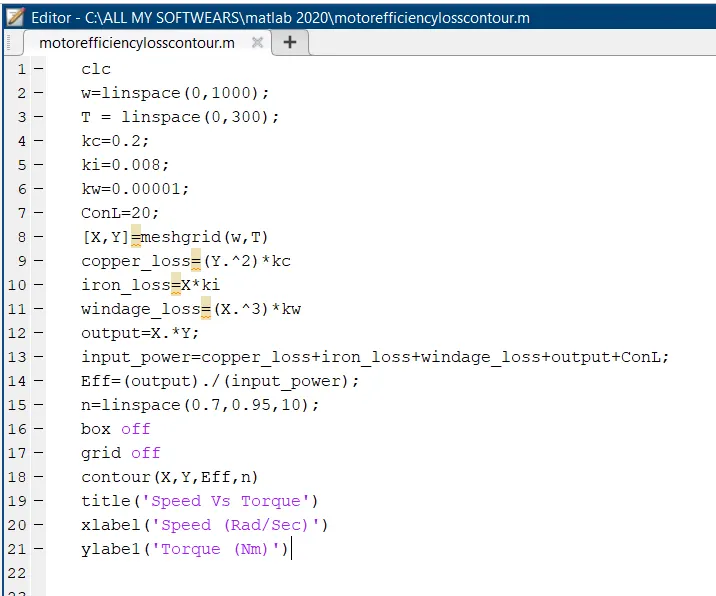
program which plots contour of given motor speed , torque and efficiency values
Loss Coefficients
For Copper Loss (kc)=0.2
For Iron Loss (ki)=0.008
For Windage Loss(kw)=0.0001
and Constant Loss =20.
The Equation of Losses are given below
Coppe'r Loss : kc *T^2
ironLoss : ki * w
Windage Loss : kw * w^3
Total Loss = Copper Loss+Windage Loss + Iron Loss+Constant Loss
Output Power = Torque x Speed
Input Power = Output power +Losses
Efficiency = Output Power/Input Power
The Code used for the plot is given below
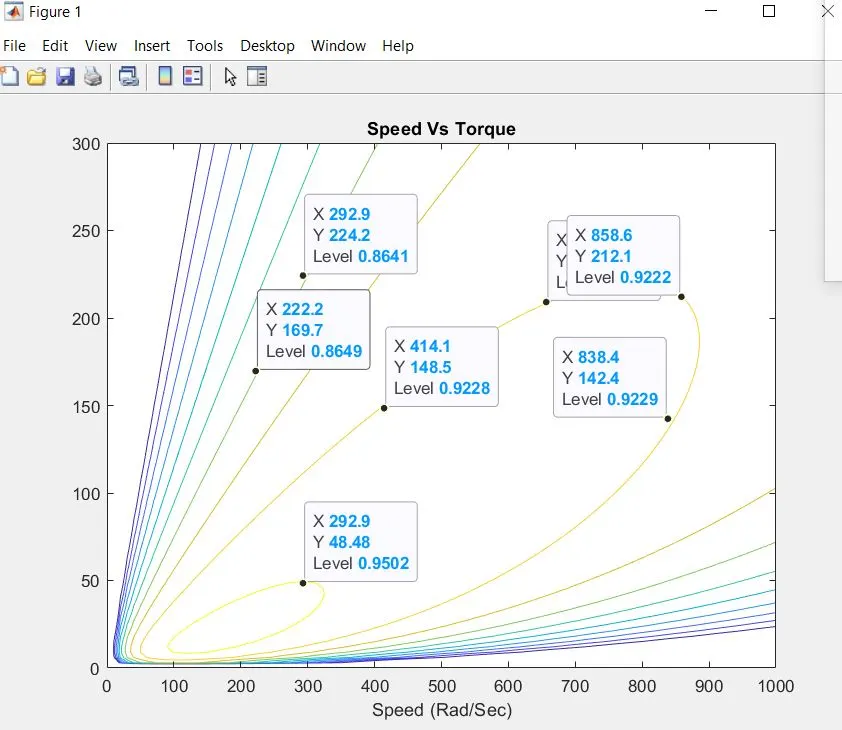
observe Speed(Rad /Sec) in X-axis and Torque(Nm) in Y-axis
contour represents Efficiency at which moter work with respect to speed torque values. Some of the values are displayed with the data cursor in the plot.