Week 8- Moving zones approach in Fluent
AIM:
To understand the concept of the Moving Zones approach in Fluent.
THEORY:
In Fluent there are two types of moving zone approach
- Moving Reference Frame
- Moving Mesh Approach
MOVING REFERENCE FRAME:
Moving reference frame is of two types,
- The single Moving reference frame
- Mixed Moving reference frame
In Moving Reference Frame,
- The frame is moving.
- Mesh topology remains the same.
- There is no change in the control volume.
- It is a steady phenomenon approach.
MOVING MESH APPROACH:
Moving mesh approach is used only for the unsteady phenomenon like,
- Vortex-induced flow.
- Interaction of vortex with bodies.
In Moving Mesh Approach,
- Mesh is moving.
- Topology of mesh changes with time.
- Control volume changes as mesh changes.
- It is an unsteady phenomenon.
PROCEDURE TO SIMULATE THE CASE USING MOVING REFERENCE FRAME:
- First, import the mesh file to fluent.
- Now set the viscous model to k-e, realizable and enhanced wall treatment.
- Set the fluid as air.
- In a cell, zone conditions go to a fluid zone and select the frame motion and enter the rpm as 250rpm.
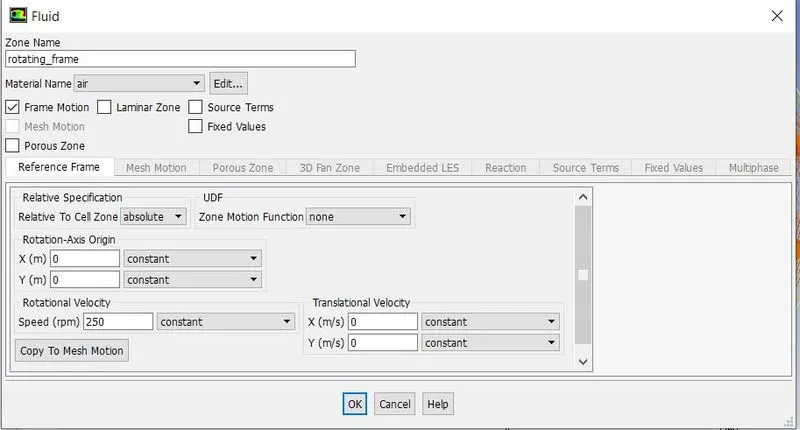
- Now go to initialization and go with hybrid as there is no inlet and outlet.
- Set the convergence absolute criteria as 0.0001 the get accurate convergence and good results.
VELOCITY CONTOUR:
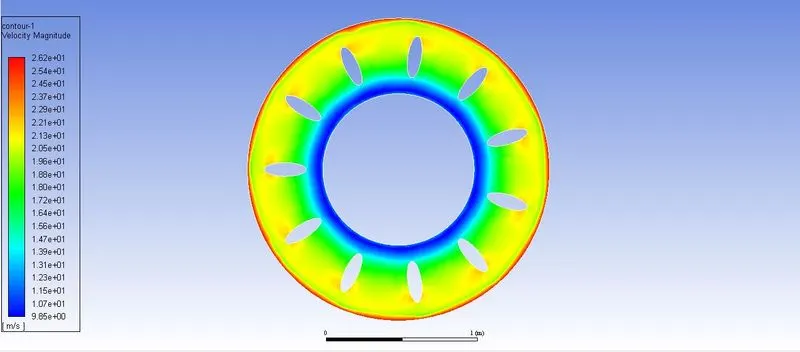
VELOCITY VECTOR PLOT:
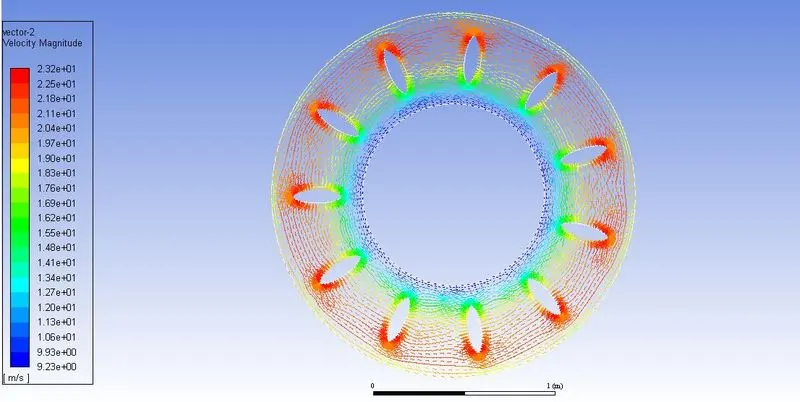
STATIC PRESSURE CONTOUR:
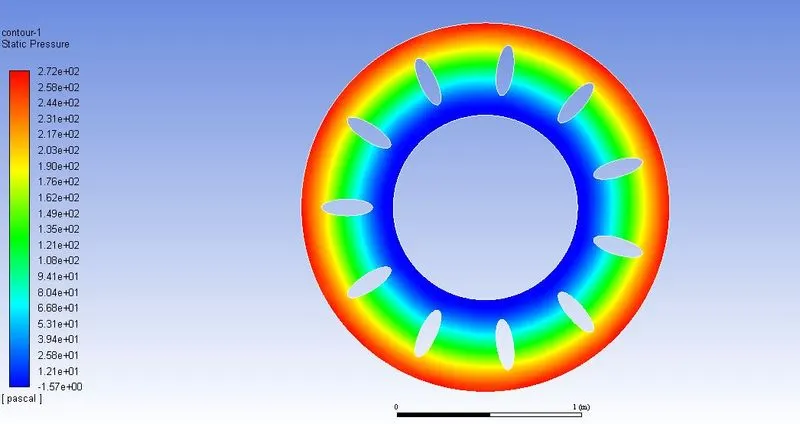
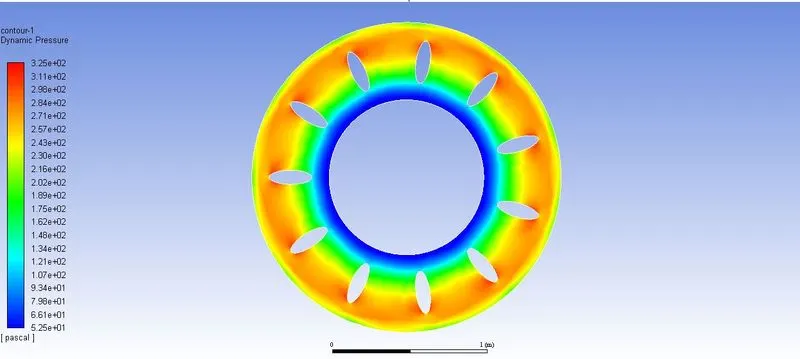
DYNAMIC PRESSURE CONTOUR:
CONCLUSION:
From this simulation, we came to understand the concept of the moving zone approach in fluent.