Week - 8 Mass Scaling
Aim: Perform Mass scaling in LS Dyna to reduce simulation run time
Objectives:
- To reduce runtime required to run the analysis of the given model using mass scaling technique and stability has to be completely intact
- To plot histogram to compare the runtime with mass scaling trails
- Optimize both the DT and TSSFAC parameters
- Run the same simulation model using implicit solver
Procedure:
In this project, the runtime needs to be reduced by using the mass scaling technique by varying the values of DT2MS and TSSFAC with the percentage increase in mass should not be greater than 8% of total mass using both explicit and implicit analysis
Explicit Analysis:
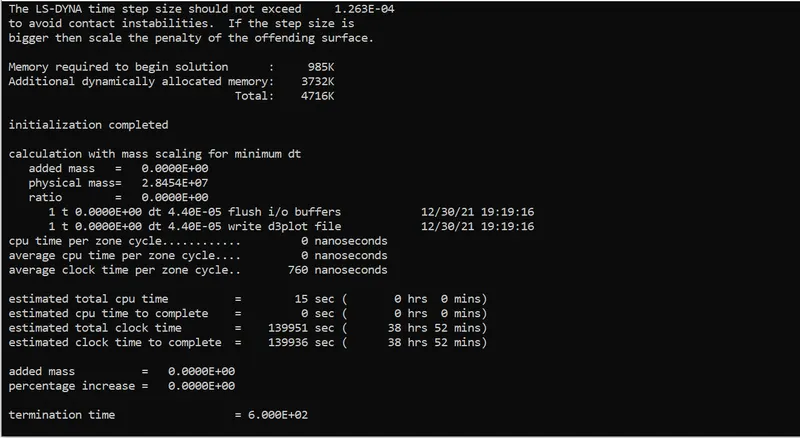
The given simulation file is made to run by keeping the default values DT2MS= -3.5e-5 and TSSFAC= 0.9 to know the computational time
Iteration 1:
| DT2MS | TSSFAC | % mass increase |
| -3.5e-5 | 0.9 | 0 |
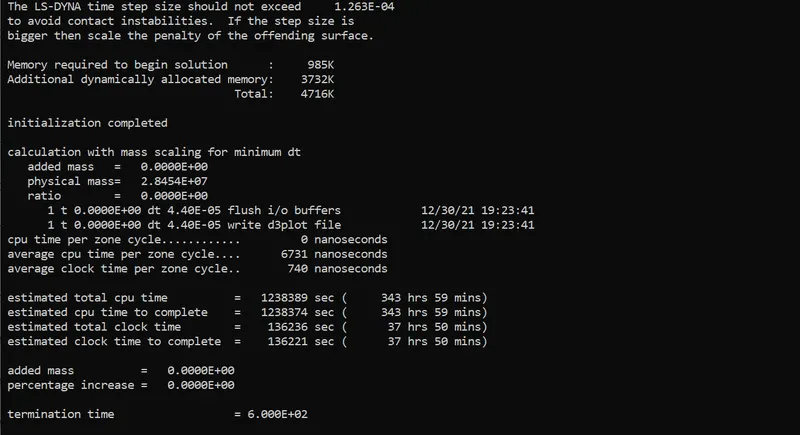
Iteration 2:
| DT2MS | TSSFAC | % mass increase |
| -3.0e-5 | 0.9 | 0 |
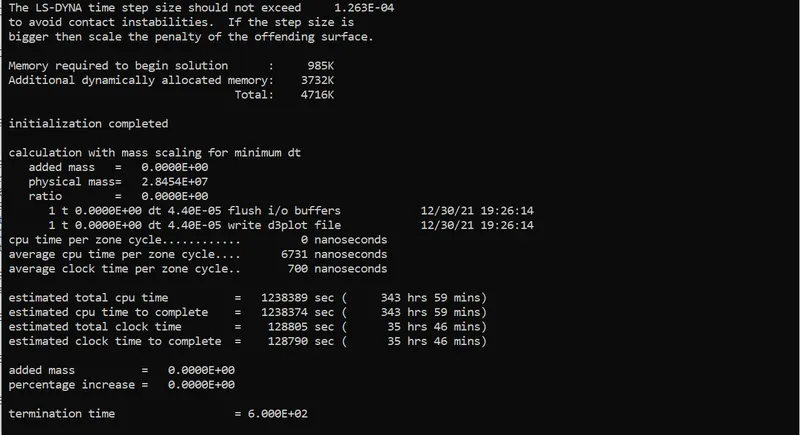
Iteration 3:
| DT2MS | TSSFAC | % mass increase |
| -2.0e-5 | 0.9 | 0 |
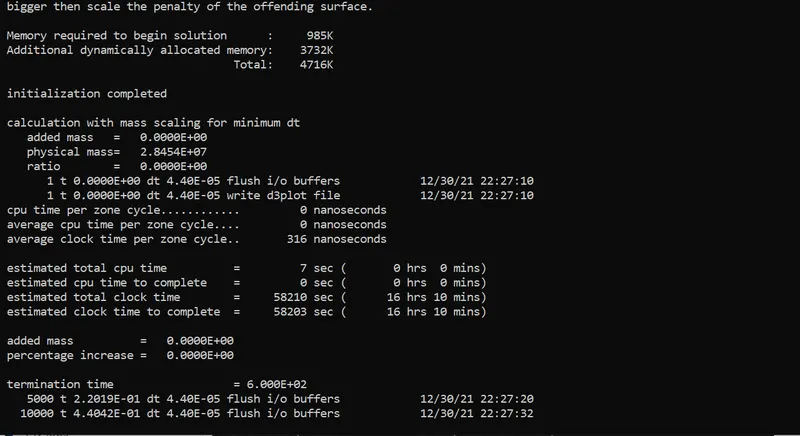
Iteration 4:
| DT2MS | TSSFAC | % mass increase |
| -1e-5 | 0.9 | 0 |
Iteration 5:
| DT2MS | TSSFAC | % mass increase |
| -2.0e-4 | 0.9 | 272(Not acceptable) |
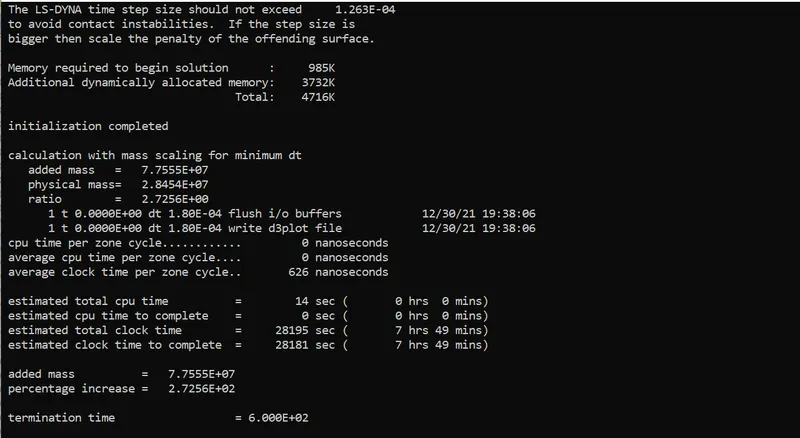
Iteration 6:
| DT2MS | TSSFAC | % mass increase |
| -1.0e-4 | 0.9 | 6.42 |
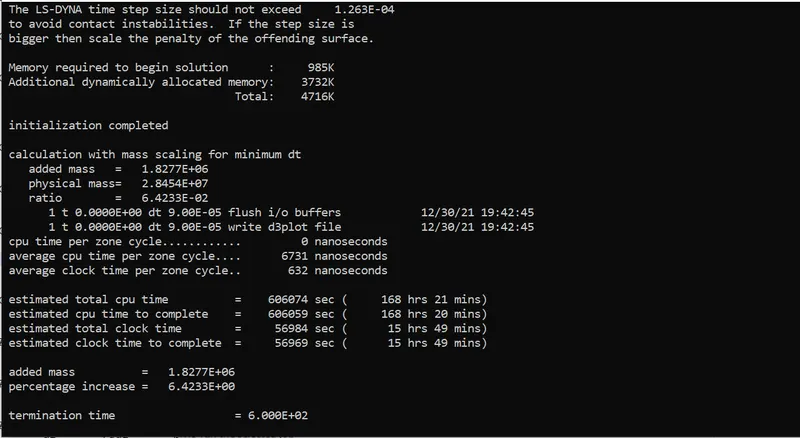
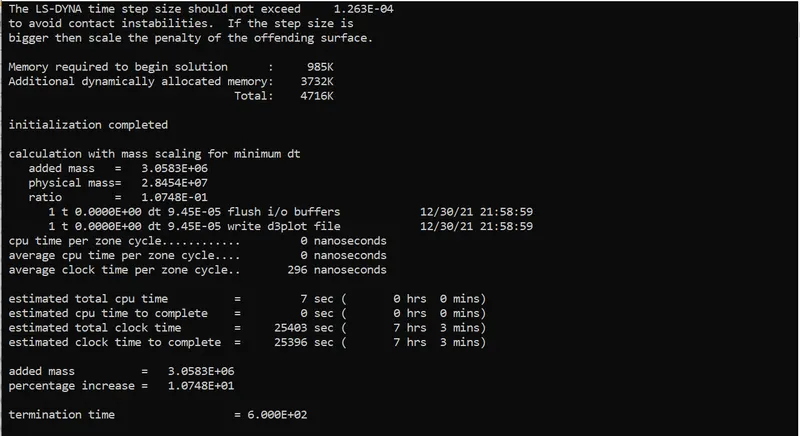
Iteration 7:
| DT2MS | TSSFAC | % mass increase |
| -1.10e-4 | 0.9 | 10.7 |
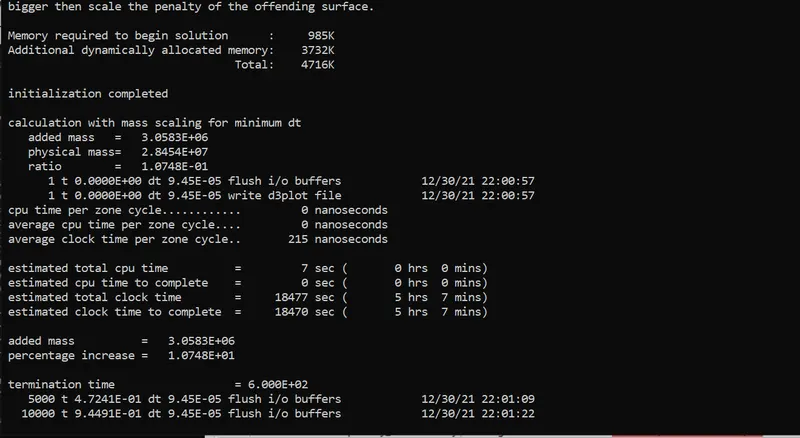
Iteration 8:
| DT2MS | TSSFAC | % mass increase |
| -1.05e-4 | 0.9 | 10.7 |
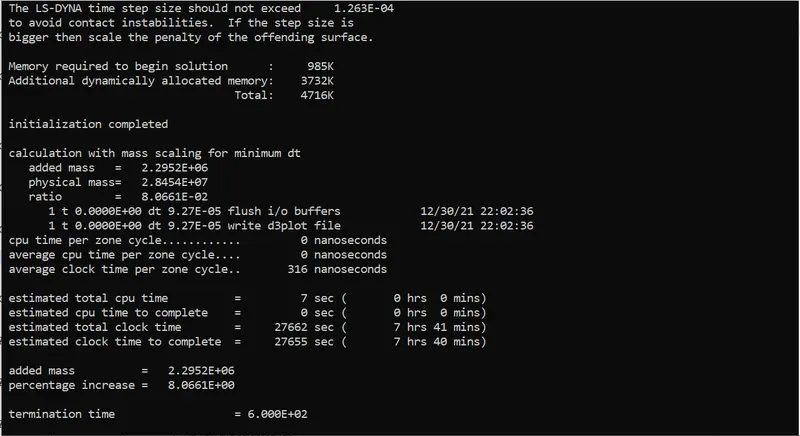
Iteration 9:
| DT2MS | TSSFAC | % mass increase |
| -1.03e-4 | 0.9 | 8.06 |
Iteration 10:
| DT2MS | TSSFAC | % mass increase |
| -1.029e-4 | 0.9 | 8.00 |
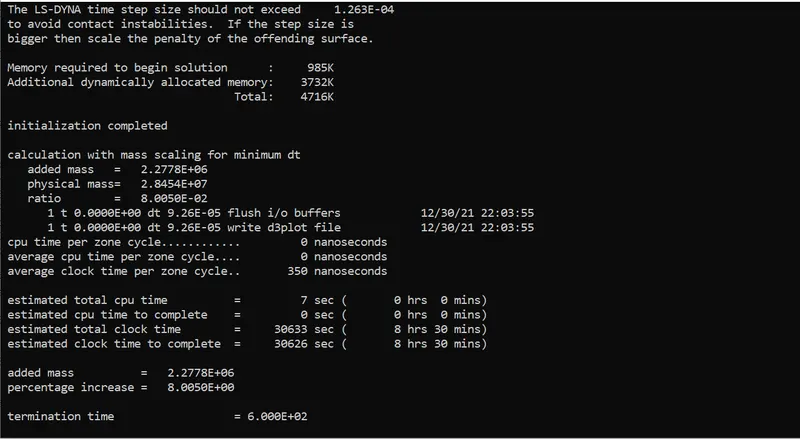
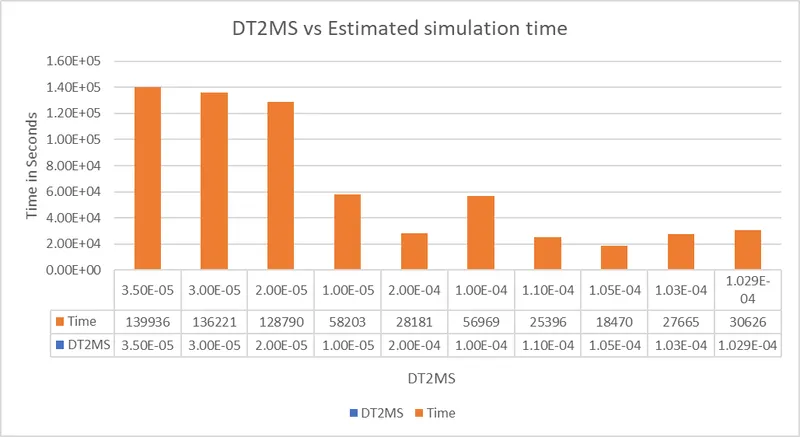
As expected the estimated time has been reduced by increasing the DT2MS value. From the graph, it is observed that the runtime required to complete the simulation for DT2MS= -3.5e-5 is more compared to -2.0e-4 whereas the percentage increase in mass is beyond the given limit of 8%. Hence the optimum value of -1.029e-4 is selected which has an estimated runtime of 8hrs 30 mins with 8% mass addition.
Now Control_Termination card will be implemented with the value of DTMS 0.029e-4 and TSSFAC is decreased further
Iteration 1:
| DT2MS | TSSFAC | % mass increase |
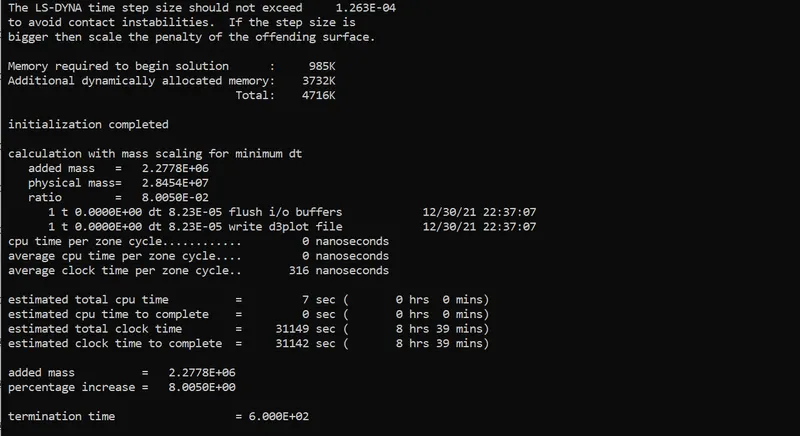
| -1.029e-4 | 0.8 | 8.00 |
Iteration 2:
| DT2MS | TSSFAC | % mass increase |
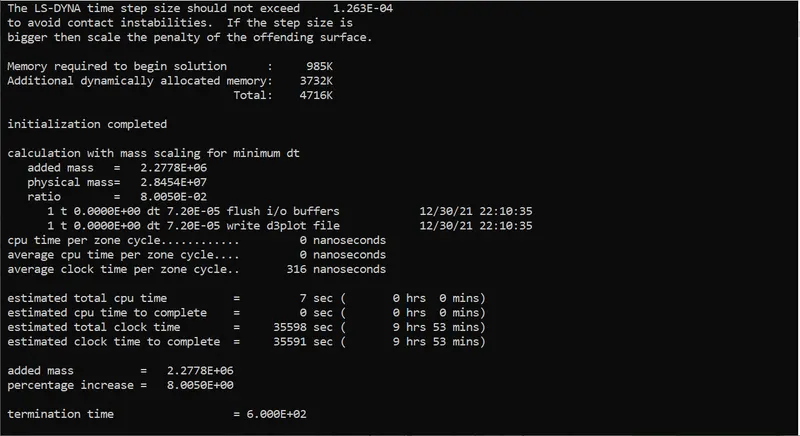
| -1.029e-4 | 0.7 | 8.00 |
Iteration 3:
| DT2MS | TSSFAC | % mass increase |
| -1.029e-4 | 0.6 | 8.00 |
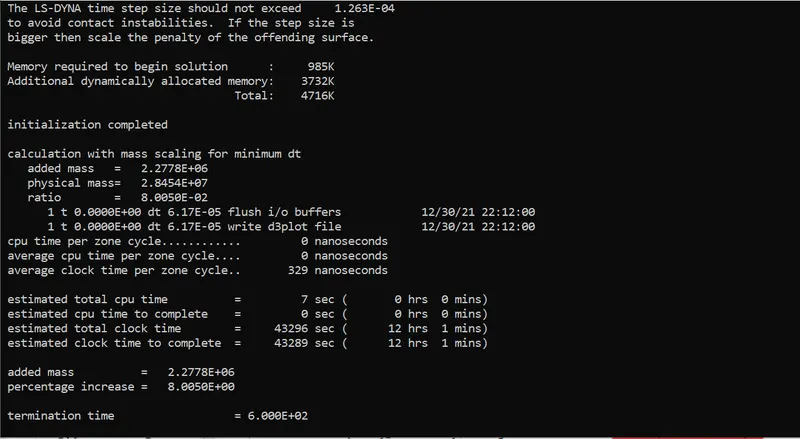
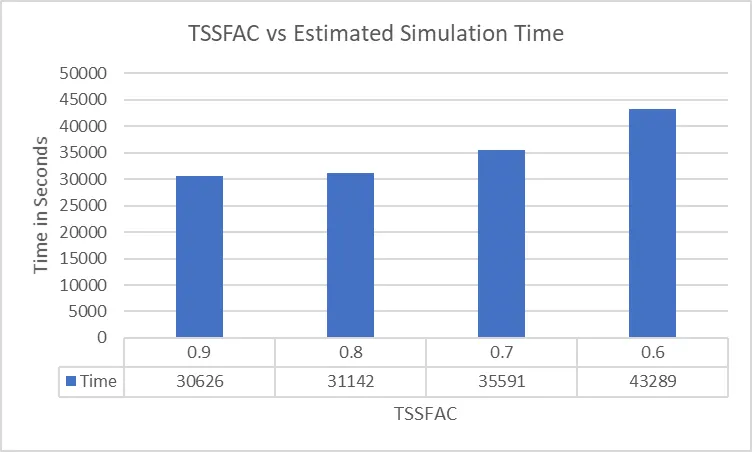
From the results, it can be stated that TSSFAC parameter won't affect the mass addition to the system whereas it affects the estimated time required for simulation, there is an increase in estimated time compared to the previous iteration
Implicit Analysis:
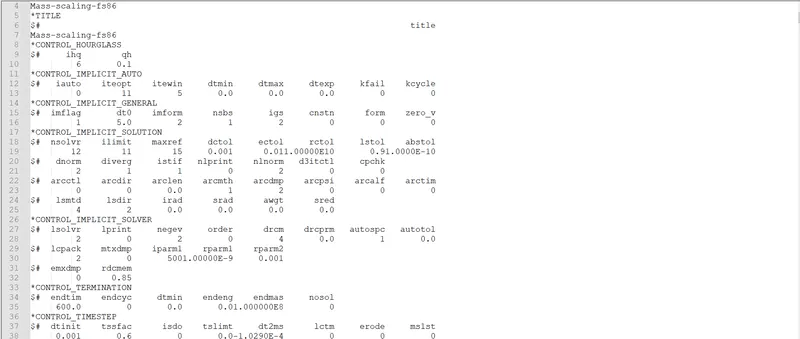
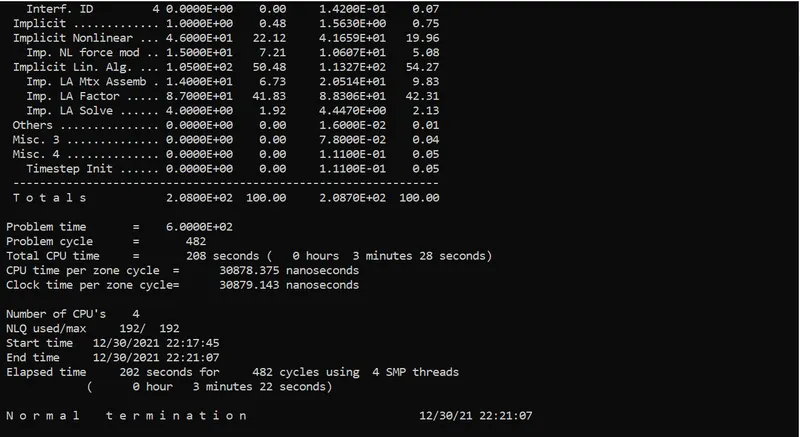
It shows that the implicit method took 3 Minutes 28 seconds to solve the simulation
Conclusion:
- Using the mass scaling technique we reduce the simulation time by adjusting the timestep
- We noticed that DT2MS and TSSFAC parameters affect the simulation time but TSSFAC does not have any impact on mass addition
- The values of DT2MS and TSSFAC does not affect the runtime required to complete the simulation for implicit analysis
Simulation File:
https://drive.google.com/drive/folders/1uqTLpfY6c8t2ou2LjBgGtAJjQP8gBKo9?usp=sharing